Feeling stuck in your career? Do you need specific qualifications for a new job, an apprenticeship, or a university course? Functional skills in English and maths could be your answer.
Unlike traditional academic qualifications, these are designed for the real world. They give you the essential, practical abilities you need for work and daily life. Think calculating a budget, not abstract algebra; or writing a professional email, not analysing classic literature. This makes them a fast and effective way to boost your career prospects and open new doors.
What Exactly Are Functional Skills?

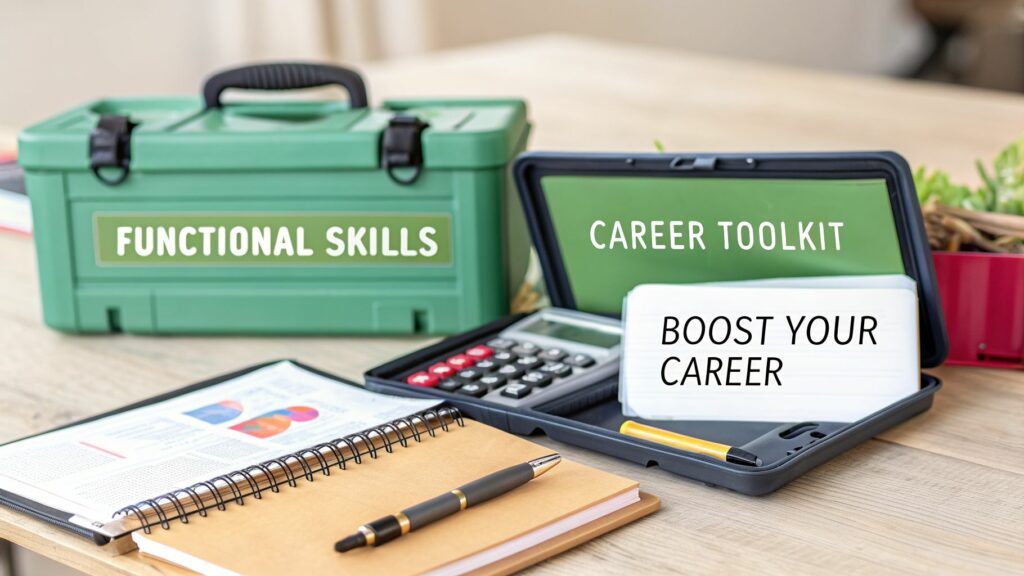
Have you ever felt like you’re trying to build a career without the right tools? That’s what it can feel like trying to get ahead without solid, everyday English and maths skills. Functional Skills are that practical toolkit, arming you with the essential abilities you need to tackle daily challenges at work and at home.
Forget stuffy textbooks and theory you'll never use. These qualifications are more like a hands-on manual for life, created to help you develop the core skills used every single day, whether you're on the shop floor or in the office.
The Practical Toolkit for Your Career
The entire point of functional skills English and maths is to build your confidence and ability in real-world situations. It’s not about memorising complex formulas or analysing centuries-old poetry; it’s all about practical, day-to-day application.
These qualifications are a clear signal to employers that you have the foundational skills to hit the ground running. For instance, with Functional Skills English, you can prove you can:
Write clear, professional emails that get a response.
Understand instructions and reports from your manager without confusion.
Communicate confidently with colleagues and customers.
It’s the same for maths. Functional Skills Maths gives you the confidence to handle numbers with ease. You’ll learn how to tackle tasks like managing project budgets, working out percentages for a sales discount, or just making sure your payslip is correct.
In essence, Functional Skills are the 'Swiss Army knife' for your career. They are versatile, reliable, and immediately useful for the tasks you face every day, making them a huge asset for any adult learner.
Why They Matter for You as an Adult Learner
For many adults, the thought of returning to study can be daunting, especially if school wasn’t a great experience. Functional Skills are different. They offer a direct and accessible path to a recognised qualification, which you can often complete online in just a few months.
The focus is on building skills you can use immediately. This makes them the perfect choice if you need to:
Meet a specific job requirement.
Secure an apprenticeship.
Get into university with an Access to Higher Education Diploma.
They provide the official Level 2 qualification that employers and universities look for, but without the long-term, theory-heavy slog of some other routes. It's a smart and efficient way to make a real change in your career, on your terms.
Making Sense of the Levels and Exams
Trying to figure out different qualifications can feel like a puzzle. Thankfully, the path through functional skills English and maths is refreshingly clear. The system is set up like a ladder, so you can start on the right step for you and climb towards your goals at your own pace.
It all starts with Entry Levels 1, 2, and 3. Think of these as the first steps, building your confidence with the core skills you need every day, from the very basics to more complex tasks.
The Entry Level Foundations
At these early stages, it’s all about mastering the fundamentals for daily life. You'll get to grips with the essentials that help you operate confidently on your own.
Entry Level 1: This is the beginning. You might learn to write a simple shopping list or recognise numbers on a phone.
Entry Level 2: Building on that, you could be learning to write a short note to a friend or add up the cost of a few items in a shop.
Entry Level 3: This level gets you ready for the next big jump. You might fill out a straightforward form or work out a basic budget for your weekly food shop.
Each of these levels is a stepping stone, making sure you have a solid base before you tackle the qualifications that really open up your career options: Level 1 and Level 2.
Level 1 and Level 2: Your Career Boosters
Once you have the basics down, you’re ready for the levels that employers and universities really pay attention to. These are a step up, directly focused on the skills you’ll need in the workplace.
Level 1 is an intermediate qualification, roughly on par with a GCSE Grade 2 or 3. It shows an employer you can handle everyday work tasks confidently.
For most people, though, the main goal is Level 2. This is the real game-changer.
A Functional Skills Level 2 qualification is widely recognised by employers, colleges, and universities as the trusted equivalent to a GCSE Grade 4 (previously a C). It is the key that unlocks doors to higher education, apprenticeships, and better job roles.
As you’d expect, a Level 2 task is more involved. For English, you might be asked to draft a formal report for a manager. In Maths, you could be calculating the area of a room for a redecorating project.
This comparison table gives you a clear picture of how these qualifications are valued and what they can do for your future.
Functional Skills Levels vs GCSE Grades at a Glance
This table clearly shows how Functional Skills levels stack up against GCSE grades, helping you understand their value in the job market and for higher education.
| Functional Skills Level | Equivalent GCSE Grade | What It Means for You |
|---|---|---|
| Level 2 | Grade 4 (previously C) | This is the key qualification. It meets the entry requirements for most university courses, apprenticeships, and a wide range of jobs. |
| Level 1 | Grade 2 or 3 (previously D-F) | A solid intermediate step that demonstrates practical ability for many entry-level roles and further training. |
| Entry Level 3 | Grade 1 (previously G) | A strong foundation that prepares you to move on to Level 1 and build career-ready skills. |
Seeing the direct equivalency, especially for Level 2, shows just how powerful these qualifications are for unlocking new opportunities.
Understanding the Exam Process
The exams for functional skills English and maths are designed to see how you apply your skills, not just test abstract theory. For English, the assessment is split into three parts:
Reading: Show you can understand and pull information from different texts.
Writing: This checks your ability to produce clear documents, like emails or articles.
Speaking, Listening, and Communicating (SLC): This usually involves a presentation and a group discussion to show your verbal communication skills.
For Maths, the exam is usually in two parts: one where a calculator is allowed and one where it isn’t. This ensures you have a solid grasp of both mental arithmetic and using tools to solve more complex problems. By understanding the structure, you can pick the perfect level to start at and walk into your exams feeling confident and prepared.
Choosing Between Functional Skills and GCSEs
If you're looking to get the qualifications you need, you've probably come across two main options: Functional Skills and GCSEs. We get asked about this all the time. While both are valuable Level 2 qualifications, they’re built for different purposes.
Think of it like choosing a vehicle. A GCSE is like a train on a fixed academic track. It’s designed for a longer, more theoretical journey—perfect for someone heading towards a specific academic destination, like a university Maths degree.
In contrast, functional skills English and maths are more like a versatile, all-terrain vehicle. They’re built for the real world, ready to help you navigate the practical challenges you’ll face in your job and daily life, right away.
What's the Real Difference?
The main distinction comes down to purpose. GCSEs are traditionally academic, focusing on a deep, theoretical understanding of a subject. They encourage you to analyse complex ideas and are the standard route for school leavers preparing for A-Levels and university.
Functional Skills, on the other hand, are all about practical application. The entire point is to give you skills you can use at work the very next day.
The core idea is simple: Functional Skills are for doing, while GCSEs are for studying. One isn’t better than the other; it’s about choosing the right tool for your personal and professional journey.
When Are Functional Skills the Right Choice for You?
For many adult learners and working professionals, Functional Skills are simply the smarter, more direct route. They make the most sense if you are:
Securing an Apprenticeship: Most apprenticeships require Level 2 English and Maths. Functional Skills are a fast and widely accepted way to meet this requirement.
Getting into University: A Level 2 Functional Skills qualification is accepted for entry onto most Access to Higher Education Diplomas, the most popular way for adults to get into university.
Meeting Job Requirements: You’ll often see jobs asking for "GCSE C/4 or equivalent." Functional Skills Level 2 provides that exact equivalent, proving your competence to employers without delay.
This hierarchy shows the clear progression, with Level 2 being the certificate that proves your practical ability.

As you can see, Entry Level is the doorway to learning, Level 1 is a key stepping stone, and Level 2 gives you that all-important certificate you need for your career.
Making the Decision That's Best for You
Ultimately, your own goals are your best guide. If you need a qualification to quickly unlock a new job, start an apprenticeship, or get onto an Access course for university, then functional skills English and maths are often the most efficient and relevant path.
They’re designed to give you the practical, real-world abilities that employers truly value, so you can perform your role with confidence from day one.
How These Skills Unlock Your Career Potential

So, how do these qualifications actually help you get ahead? When we move past the theory, Functional Skills English and Maths provide the tangible proof that employers are looking for. Think of them not as just another line on your CV, but as a direct investment in your professional toolkit.
Holding a Level 2 certificate is like having a master key. It proves you can handle the practical, day-to-day demands of a job. That’s why employers in booming sectors like healthcare, social care, and various skilled trades actively seek out candidates with these qualifications.
They need to know you can communicate clearly, follow instructions precisely, and manage numbers accurately. These qualifications are your evidence.
Navigating the Modern Job Market
The world of work is competitive. Employers need reliable ways to gauge a candidate's abilities, and Functional Skills qualifications are exactly that. They show you’re ready to perform essential workplace tasks, making you a far more capable and attractive applicant.
Just consider the difference this can make to your career path:
Better Job Opportunities: Many job descriptions list a Level 2 in English and Maths as a minimum requirement. Getting this qualification opens up a much wider range of roles.
Promotion Prospects: To climb the ladder, you have to show you can handle more responsibility. These skills prove you’re ready for that next step, whether it involves managing budgets or writing reports.
Further Training and Education: They are often the critical first step for apprenticeships, further training, or higher education courses that might have been out of reach before.
Functional Skills are your passport to professional progress. They open doors that might have been closed, giving you the confidence and the credentials to pursue the career you truly want.
Understanding the Apprenticeship Landscape
Functional Skills have always been a key part of UK apprenticeships, but it’s worth knowing about some recent changes. In a major policy shift on 11th February 2025, the government removed the mandatory requirement for apprentices aged 19 and over to achieve these qualifications. This change, which gives employers and apprentices until 1st April 2025 to decide on continuing their studies, was aimed at offering more flexibility. You can discover more insights about this policy change on NQU.co.uk.
But here's the crucial part: while the government rule has changed, the demand from employers for competent, skilled staff has not.
Most employers still view Functional Skills English and Maths as the gold standard for a capable employee. By gaining these qualifications proactively, you make yourself a standout candidate. You’re showing you have the essential skills they value most, regardless of any mandatory rules.
Your Guide to Studying Functional Skills Online

Ready to get started? So far, we’ve looked at the 'what' and 'why' behind functional skills English and maths. Now, let’s explore the 'how'. We’ll focus on the incredible flexibility that online learning provides, especially for you as an adult learner.
The days of rigid college timetables and long commutes are over. Modern online learning providers like Stonebridge Associated Colleges have completely changed the game, putting you firmly in control of your own education. It’s all about making your studies fit around your life, not the other way around.
Learn on Your Terms with a Flexible Subscription
One of the biggest breakthroughs in online education is the shift away from large, upfront course fees. Many providers now offer a flexible, subscription-based model, which is perfect for adult learners juggling work, family, and everything else.
Think of it like a gym membership for your brain. You get full access to all the course materials, dedicated tutor support, and resources you need for one simple monthly fee.
This way of learning has some major advantages:
No Long-Term Debt: You avoid getting locked into a long-term credit agreement, which takes a huge financial weight off your shoulders.
Complete Flexibility: You have the freedom to pause your studies if life gets hectic or cancel your subscription at any time without penalty.
Learn at Your Pace: You can take as much or as little time as you need to really grasp the material, ensuring you feel genuinely confident before moving on.
This approach puts you in the driver’s seat. It gives you the power to move as quickly or as steadily as your schedule allows.
The modern subscription model for functional skills English and maths is designed for real life. It understands that circumstances change, offering a low-risk, high-flexibility path to gaining your qualifications.
The Power of an All-in-One Solution
One of the biggest headaches for learners used to be organising everything separately. You’d find a course provider, but then have to track down an approved exam centre on your own, adding extra stress and hassle.
Today, providers like Stonebridge offer an all-in-one solution. When you enrol on a package like our Functional Skills English & Maths Level 2 Including Exams course, both your training and your final exams are included from the start.
This integrated approach makes the whole process completely seamless. Your exam is taken online from the comfort of your own home, with a remote invigilator ensuring it meets all official standards. You also get tutor support throughout your studies, guiding you right up to exam day.
Recent data shows just how effective supportive learning environments are, especially for flexible and online learners. You can read the full research about these pass rates on Pearson.com.
By choosing a provider that handles everything from enrolment to your final certificate, you can focus on what really matters: learning the skills you need to succeed, without putting your life on hold.
Your Functional Skills Questions Answered
You’ve likely got a few questions about functional skills English and maths, so we’ve put together some straightforward answers to the most common queries we hear. This section will give you the direct, practical information you need to feel confident about taking your next step.
How Long Does It Take to Get a Level 2 Qualification?
This is one of the most common questions we get, and the answer is simple: it’s entirely up to you. Unlike a rigid college timetable, the biggest benefit of learning online with a provider like Stonebridge is that you are in complete control.
Some learners are on a mission to meet a job deadline and power through the material in just a few weeks. Others prefer to take their time over several months, fitting studies around a full-time job and family life. Our subscription model means you set the pace, making your education work for you.
You're not on your own, either. A dedicated personal tutor will be there to support you, helping you figure out when you’re genuinely ready for the exam. This way, you go in feeling confident and fully prepared, not rushed.
Is the Functional Skills Level 2 Exam Really Hard?
It’s completely normal to feel a bit of exam-day nervousness, but these tests are designed to be challenging yet achievable. Where traditional academic exams might test you on abstract theories, Functional Skills assessments are all about solving practical, real-world problems.
The key to passing isn’t just about memorising facts—it’s about practice.
Our online course is packed with mock questions and practice materials that look and feel just like the real exam. Getting familiar with the format is crucial for building your confidence. With a tutor to guide you through any tricky spots, you’ll develop the hands-on skills you need to succeed.
The Functional Skills exam is a test of what you can do, not just what you know. With the right preparation and support, it is a goal well within your reach.
Can I Get into University with Functional Skills?
Yes, you absolutely can. A Functional Skills Level 2 qualification in both English and Maths is widely recognised by UK universities as an equivalent to a GCSE Grade 4 (what used to be called a Grade C).
This makes it a standard entry ticket for many Access to Higher Education Diplomas—the most popular route to university for adult learners. So, if you dream of a degree in a field like Nursing, Social Work, or Business, getting your Level 2 qualifications is often the perfect first step. It’s always wise to double-check the specific entry requirements for your dream course, but you'll find these qualifications open far more doors than you might think.
The UK government also continues to emphasise how crucial these core skills are. The 16-19 funding framework highlights functional skills English and maths as vital for progression, with rules for 2025/26 and beyond ensuring students get the right support. You can learn more about these government funding findings. This official backing proves their value as a solid foundation for both higher education and your career.
Ready to take control of your future? At Stonebridge Associated Colleges, we make gaining your qualifications straightforward and stress-free.