At 8:12 on a Monday morning, a small business can't open its files. Staff members are locked out, a ransom note is on screen, and every minute matters. The person called in next isn't just a tech expert. They're a cyber crime investigator, part detective, part analyst, and part evidence specialist.
For many adult learners, that mix is exactly what makes the career so appealing. It's practical, purposeful, and built around solving real problems.
A Day in the Life of a Digital Detective
A cyber crime investigator's day often starts with urgency. One case might involve a phishing email that led to account compromise. Another could centre on a laptop that needs to be secured before key evidence disappears.
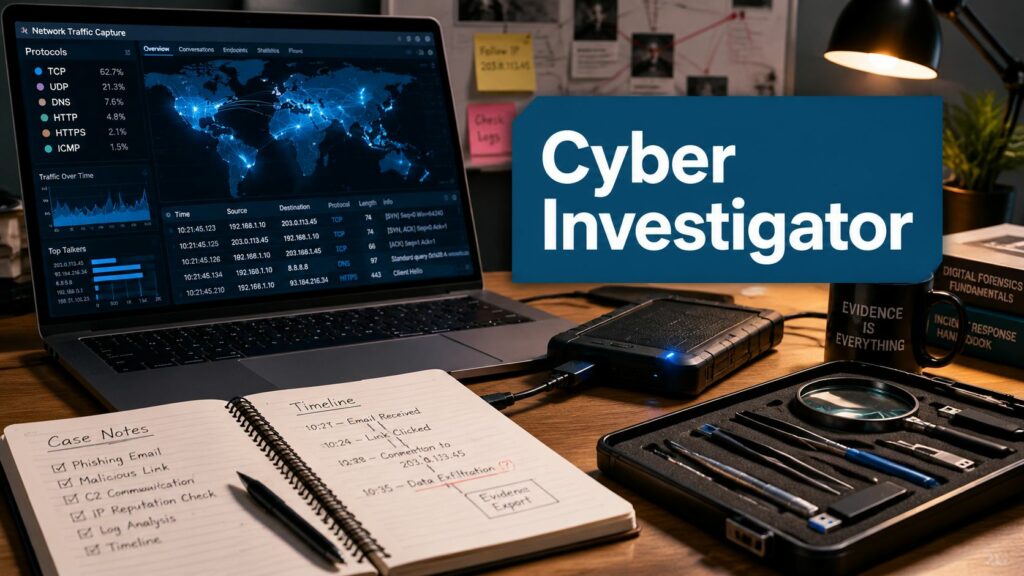
The first task is rarely “hack back” or write code. It's usually to preserve evidence, understand what happened, and work out who needs to be interviewed. That can mean checking devices, reviewing logs, speaking to staff, and building a clear timeline of events.

By lunchtime, the investigator may be comparing browser history, sign-in records, and cloud activity. Later, they might prepare notes for senior colleagues, legal teams, or police partners.
A good investigator doesn't rush to the clever answer. They protect the evidence first.
That's what surprises many people about the role. It isn't only about technology. It's about staying calm, thinking clearly, and turning digital traces into a story that makes sense.
What a Cyber Crime Investigator Really Does
At its core, a cyber crime investigator finds out what happened, how it happened, and whether it meets the threshold of a criminal offence. In the UK, that work matters because cyber incidents are common and often complex.
The 2024 Cyber Security Breaches Survey summary discussed here found that 50% of businesses and 32% of charities experienced a cyber security breach or attack in the previous 12 months, with phishing the most common threat for businesses. The same source states that 72% of medium businesses and 74% of large businesses identified attacks in the period.

Core duties
A cyber crime investigator may spend time on:
Evidence collection. Securing computers, phones, storage media, and cloud data properly.
Incident reconstruction. Building a timeline from logs, messages, file activity, and user actions.
Interviews. Speaking with victims, witnesses, colleagues, or managers to fill in the gaps.
Case documentation. Writing reports that other people can follow.
Legal support. Presenting findings in a way that supports prosecution or regulatory action.
Where they work
Some investigators work in public law enforcement. Others work in corporate security, digital forensics, fraud teams, or incident response.
That's one reason the field suits different kinds of learners. You don't have to picture only one job title or one employer. You're building a skill set that can travel across sectors.
Essential Skills and Tools for the Job
The role can sound intimidating at first, but it becomes much clearer when you break it into skills. You don't need to know everything on day one. You do need to start building the right habits.

Technical strengths
Device handling. Investigators often need to secure encrypted or cloud-synced devices early, acquire data through the correct legal process, and maintain a clear chain of custody, as outlined in this overview of cyber crime investigation workflow.
Log and artefact analysis. You'll learn to look at browser activity, authentication records, and file-system clues.
Digital forensics triage. In busy environments, you need to decide what to preserve first and what can wait.
Tool confidence. Roles may involve forensic software and e-discovery platforms, but the bigger skill is knowing why you're using a tool and how to document your method.
A short video can help make the field feel more real:
Human skills
Clear writing. Your findings must make sense to non-technical readers.
Critical thinking. A strange log entry isn't proof on its own. You need context.
Attention to detail. Small mistakes can damage a case.
Professional communication. You may need to explain evidence to managers, police, solicitors, or court officials.
Practical rule: If you can explain a complex incident in plain English, you're already thinking like an investigator.
Your Pathway to a Career in Cyber Crime
If you're an adult learner, the biggest question usually isn't “Is this interesting?” It's “Can I realistically get there from where I am now?” The answer is yes, if you take it step by step.
The UK has treated cyber crime investigation as a serious specialist area for years. The overview of the profession linked here notes that the National Cyber Crime Unit was established within the National Crime Agency in 2013. The same source cites the UK government's 2023 cyber security skills report, which estimated that 51% of businesses had a basic skills gap and 25% had an advanced skills gap.

Two strong starting points
For many people, an Access to Higher Education Diploma is a practical bridge to university study and future specialist roles.
Here's how the two routes differ:
| Pathway | Best for | What it helps you build |
|---|---|---|
| Access to Higher Education Diploma (Computing) | Learners drawn to systems, data, and technical problem-solving | A foundation in computing concepts that supports later study in cyber security, digital forensics, or IT |
| Access to Higher Education Diploma (Criminology) | Learners interested in crime, justice, behaviour, and investigation | Useful context for understanding offending, evidence, legal process, and criminal justice environments |
How to choose
If you enjoy the technical side and want to work close to systems and evidence, Computing is often the clearest first step.
If you're fascinated by why offences happen, how cases are handled, and how investigators operate within justice systems, Criminology may suit you better.
Some learners start with the subject that feels most natural, then specialise further through higher education and practical experience.
Learn Flexibly Online with Stonebridge
Adult learners need study that fits around work, family, and everyday responsibilities. That's why flexibility matters so much at the start of a career change.
Stonebridge Associated Colleges offers 100% online study, personalised support from qualified tutors, and a subscription-based model that lets you pause or cancel at any time without long-term credit agreements. Its modular structure and affordable monthly fee make it easier to learn at a pace that works for real life, not an ideal timetable.
The college has over twenty years of experience and offers more than a hundred career-focused programmes, including Access to Higher Education Diplomas in Computing and Criminology. It's also accredited by the UK Register of Learning Providers and regulated by the Financial Conduct Authority.
If you've been waiting for a route into higher education that feels manageable, this is the kind of setup that can make the first step feel possible.
Start Your Investigation Today
A career as a cyber crime investigator can combine purpose, problem-solving, and long-term opportunity. You don't need to have it all mapped out today. You just need a credible first step, and an online Access to HE diploma can be that step.
If you're ready to move towards a career in cyber investigation, explore the flexible online options at Stonebridge Associated Colleges. The Access to Higher Education Diploma (Computing) and Access to Higher Education Diploma (Criminology) can help you start building the knowledge, confidence, and qualifications to progress.