You might be doing this already. Listening to English on the way to work, checking your emails twice before sending them, and still feeling that your progress is slower than it should be.
If that sounds familiar, you're not behind. You're busy, and most adults don't need perfect English. They need clear English for work, study, and everyday life. That's why the best way to improve isn't to memorise endless vocabulary lists. It's to build habits that fit your routine and fix the mistakes that keep causing confusion.
Your Practical Roadmap to Better English Skills
A lot of adults feel stuck because they think improvement requires long study sessions and heavy grammar books. In reality, progress often starts with a simpler plan. Learn what matters for your life, practise it often, and check whether your communication is getting clearer.
That matters because the need is widespread. In England, approximately 6.6 million adults, or 18% of the working-age population, have very poor literacy skills, which shows why accessible support matters so much for adults trying to improve their English through work, study, or daily life, according to the National Literacy Trust overview of adult literacy in England.
Practical rule: Don't ask, how can I learn more English. Ask, where do I need better English this week.
Think in real situations. A team meeting. A college assignment. A form at the GP. A message to a customer. When you connect English practice to these moments, learning becomes more manageable and more useful.
Set Clear Goals and Build a Daily Routine
Vague goals slow people down. Better English can mean many things, so name your target clearly. You might want to speak more confidently in meetings, write cleaner emails, or prepare for a qualification.

Pick goals you can see
Try goals like these:
At work: contribute one clear point in every team meeting
In writing: send emails with fewer corrections and less hesitation
For study: prepare for Functional Skills English or another recognised course
In daily life: speak more confidently in appointments, calls, and conversations
Flexible learning matters here. Nearly 20% of UK adults say they'd be more encouraged to join English skills courses if flexible scheduling options were available, which shows how important realistic routines are for working adults, as highlighted in this Learning and Work Institute evidence review.
Keep the routine small
You don't need a perfect timetable. You need a repeatable one.
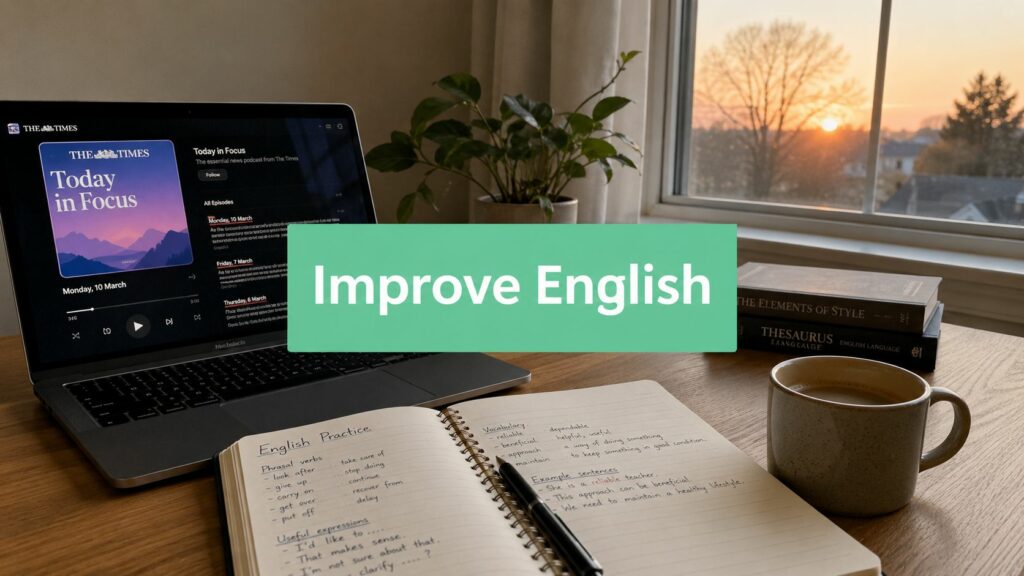
During your commute: listen to a UK news podcast and note two useful phrases
At lunch: read one short article related to your job
In the evening: write five sentences about your day using one grammar point correctly
Small practice done daily beats ambitious plans you can't maintain.
If you're searching for how to improve English skills, begin with these steps. Clear goal. Short routine. Consistency.
Focus on Smart Practice, Not Just More Hours
Many learners assume progress comes from learning more words. Vocabulary helps, but it isn't always the main reason communication breaks down. Often, the underlying issue is a small set of repeated mistakes.

These are functional errors. They include things like using the wrong tense, missing articles, or choosing the wrong preposition. The sentence may be understandable, but it doesn't sound precise or professional.
A stronger method is to track your own common errors and reduce them one by one. A study referenced through adult English learner speaking skills guidance found that learners who focused on reducing recurring functional grammar errors improved communication clarity by 42% in a year, compared with 12% for those who prioritised vocabulary expansion.
What smart practice looks like
Use one weekly focus:
| Weekly target | Example |
|---|---|
| Tense control | I went yesterday, not I go yesterday |
| Articles | I need the report, not I need report |
| Prepositions | At work, in the office, on Monday |
Clear communication improves faster when you correct repeated mistakes than when you just add more words.
This approach also matches real-world needs. Employers, tutors, and exam markers often notice repeated errors before they notice a limited vocabulary range.
Measure Your Progress to Stay Motivated
Motivation grows when you can see evidence of change. If you only study and never check your improvement, it's easy to feel like nothing is working.

Use simple weekly checks
Record yourself speaking for one minute on the same topic each week. It could be your job, your plans, or a recent news story. Listen back and notice whether your target error appears less often.
For reading and writing, keep one notebook for new phrases, corrected sentences, and short summaries. Structured note-taking helps more than many learners realise. UK education diagnostics show that using structured note-taking systems can increase reading comprehension by 25 to 30% for adult English learners, which makes it a strong way to improve retention and monitor progress.
Try Cornell Notes or a simple page split into keywords, examples, and your own summary.
Here's a useful demonstration to support that habit:
Look for these signs of progress
Speaking: fewer pauses caused by grammar uncertainty
Writing: cleaner sentences and fewer repeated corrections
Reading: quicker understanding of work or study materials
You don't need dramatic change every week. You need visible movement.
Accelerate Your Journey with Formal Learning
Self-study works well at the start, but many adults reach a point where feedback matters more than effort alone. If you're preparing for a promotion, applying for a course, or trying to gain a recognised qualification, formal learning can speed things up.

A good course gives you structure, tutor guidance, and a reason to stay consistent. It also helps if you need English for a specific goal, such as Functional Skills English Level 2, professional communication, or entry to higher education.
That support model works. The overall achievement rate for Adult Learning programmes in the UK is 95.7%, which shows how effective structured, supportive programmes can be for adults completing qualifications, according to UK further education and skills statistics.
When formal learning makes sense
Formal study is worth considering if you need:
Regular feedback: someone to spot patterns in your mistakes
A qualification: proof of your English level for work or study
A flexible format: online learning that fits around shifts, childcare, and family life
If your main question is how to improve English skills in a way that leads to real career progress, a structured course often becomes the turning point.
If you want a practical way to improve your English skills, Stonebridge Associated Colleges offers Functional Skills English & Maths Level 2 Including Exams, a flexible online course designed for adult learners. It can help you strengthen the reading, writing, speaking, and communication skills you use in everyday life, at work, and when progressing to further study. With 100% online learning, personalised tutor support, included exams, and the freedom to study around your schedule, it’s a focused and effective next step if you want to build confidence and gain a recognised qualification.