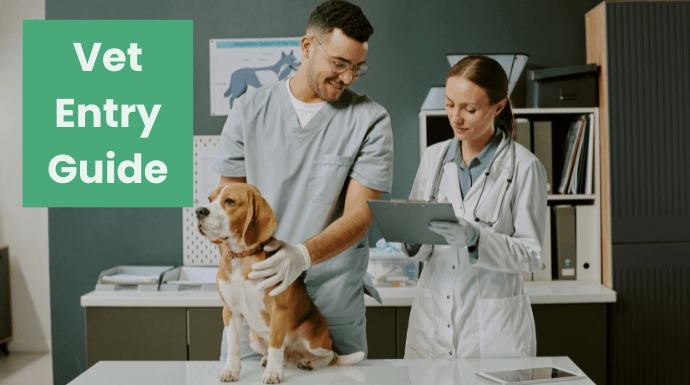
You might be reading this with a mix of excitement and nerves. You love animals. You can see yourself in a clinic, on a farm, in surgery, or supporting worried owners through difficult decisions. But once you start looking up veterinary science entry requirements, the path can feel dense, competitive, and full of rules that seem to change from one university to another.
That feeling is normal.
Becoming a vet in the UK asks a lot from you. You need strong science grades, relevant work experience, a well-organised application, and a realistic understanding of the profession itself. The good news is that there isn’t just one type of applicant who can succeed. Some students take the traditional A-level route. Others come to veterinary science later through an Access to HE Diploma and build their path step by step.
This guide is for both groups. If you’re a school leaver aiming straight for vet school, you’ll see what the academic benchmark really looks like. If you’re an adult learner, career changer, or someone who needs a second chance, you’ll also find a practical route that can move you forward.
Your Dream of Becoming a Vet Starts Here
You are looking at a career that can start in very different places. One student is choosing A-level subjects at 16. Another is returning to study after years away from the classroom and considering an Access to HE Diploma. Both are aiming at the same destination, but the route only works if it matches the person taking it.
That is why veterinary science entry requirements can feel so intense at first. You are not only asking, “Do I like animals enough for this?” You are also asking, “Which route gives me the best chance of applying well?” Vet school admissions work a bit like a multi-part filter. Grades matter. Subject choices matter. Work experience matters. The way those pieces fit together matters just as much.
Competition is high, and places are limited. Offer rates also vary between universities and applicant groups, as noted earlier. That can sound discouraging. Used properly, it is useful information. It tells you to plan early, check details carefully, and choose a pathway that fits your background instead of copying someone else’s.
Practical rule: Treat veterinary science entry requirements as a full application system, not just a grades checklist.
This catches a lot of applicants out. Some students put all their energy into grades and leave experience until the last minute. Others build strong animal handling experience but miss a required science subject. A good application is usually balanced. Admissions teams want evidence that you can manage the academic side of the course and that you understand what veterinary work entails.
Start by asking yourself four simple questions:
-
Academic fit: Do your current or planned qualifications match the entry requirements?
-
Subject fit: Are you studying, or planning to study, the sciences universities ask for?
-
Experience fit: Can you show that you have seen the profession up close and understand its demands?
-
Pathway fit: Does the traditional A-level route suit you best, or would an Access to HE Diploma give you a clearer, more realistic route into higher education?
That last question deserves real attention.
A-levels are often the clearest route for school leavers, but they are not the only serious route. An Access to HE Diploma can be a structured and respected option for adult learners, career changers, and students who need a second start. The key is not choosing the route that sounds most familiar. It is choosing the one that lines up with university policies, your timeline, and the way you learn best.
So begin with an honest stocktake. Look at where you are now, not where you think you should be. If you do that early, the process becomes much easier to handle. What looks overwhelming from a distance usually becomes manageable once you split it into decisions you can make one at a time.
The Core Academic Hurdles You Must Clear
For most applicants, the first gate is academic. Universities want clear evidence that you can handle a science-heavy degree with a fast pace and a lot of technical content. That’s why entry standards are high.
The usual benchmark is three A-levels at AAA, and Chemistry and Biology are typically compulsory, as outlined in The Medic Portal’s guide to veterinary medicine entry requirements. Many universities also expect a solid GCSE profile. Liverpool is one example of a university that requires at least five GCSEs at Grade 6 (B), including Maths, English, and sciences.

What universities are really looking for
This isn’t about making the process difficult for the sake of it. Veterinary degrees rely on a deep understanding of biology, chemistry, physiology, disease processes, and clinical reasoning. If your science foundation is shaky, the course becomes much harder very quickly.
That’s why Biology and Chemistry matter so much. Biology supports areas like anatomy, physiology, microbiology, and animal systems. Chemistry underpins drugs, metabolism, biochemistry, and lab-based understanding.
A-level subject choices
| Essential Subjects | Highly Recommended Subjects |
|---|---|
| Biology | Maths |
| Chemistry | Physics |
| Psychology | |
| A third academic subject you can perform strongly in |
A common point of confusion is the third A-level. In many cases, it doesn’t have to be another science, but it should still be a serious academic subject. The safest choice is usually one you can do well in while keeping your workload realistic.
GCSEs still matter
Students sometimes assume universities only care about A-levels. That’s not true. GCSEs can affect whether you meet the minimum entry threshold, especially in Maths and English, which support data handling, communication, and record keeping.
Strong veterinary applicants usually build their profile from the ground up. GCSEs support A-levels, and A-levels support everything that follows.
If you don’t match this profile yet
Not meeting the classic school-leaver route doesn’t mean the door is closed. It means you need to think carefully about your pathway. If you’re missing the right A-level subjects, if your school qualifications are older, or if you’re returning to study as an adult, an alternative route may make more sense than trying to force a route that doesn’t fit your circumstances.
For now, the key message is simple. Check the academic side early. Don’t guess. Compare your current qualifications against the exact veterinary science entry requirements for each university on your list.
Gaining Hands-On Work Experience
You can picture the moment. You arrive for your first day observing at a vet practice, and within an hour you realise the job is much broader than treating sick animals. There are worried owners to reassure, notes to write accurately, hygiene routines to follow, and difficult decisions happening in the background. That is why work experience matters so much. It shows universities that you have seen the actual shape of the profession, not just the version people talk about from the outside.
For vet school admissions, work experience works like a reality check and a piece of evidence at the same time. It helps admissions tutors judge whether you understand the demands of veterinary medicine. It also helps you test your own fit for the course. That matters whether you are applying through A-levels or building your case through an Access to HE Diploma. Different academic routes can lead to the same application process, and both routes are stronger when they are backed by relevant experience and thoughtful reflection.
Deadlines matter here too. Reporting on the admissions cycle, Vet Times noted that the University of Liverpool may require applicants to submit separate work experience evidence by a late October deadline in the application year, for example 23:59 on 29 October 2026 for that cycle, with incomplete applications rejected automatically. The lesson is simple. Check each university’s process early, and treat work experience records with the same care you give your grades.

What strong experience looks like
Admissions tutors are usually looking for breadth and insight, not just a long total number of hours. A single placement can teach you a lot, but experience across different settings gives you a fuller picture of the profession.
Useful settings often include:
-
Veterinary practices: You might observe consultations, cleaning routines, prep, client communication, and how the team works under time pressure.
-
Farms: These placements can show you herd health, livestock handling, disease prevention, and the business side of animal care.
-
Rescue centres or shelters: You may see welfare issues, rehabilitation, behaviour concerns, and the emotional side of caring for vulnerable animals.
-
Kennels, catteries, or stables: These settings can build your confidence with routine husbandry and day-to-day animal management.
That range matters because veterinary medicine is not one job in one room. It is a profession with several working environments, different species, and different pressures.
What you should record as you go
Start a written log from day one. Do not trust yourself to remember details months later.
Keep track of:
-
Dates and hours
-
Where you were and what you observed or did
-
The name of the supervisor or contact person
-
What you learned, including anything that surprised you or challenged your assumptions
A good log is like lab notes. It gives you accurate raw material to use later in your application and interview.
Reflection is what turns experience into evidence
Students often focus on getting placements and forget the second half of the job, which is thinking about what those placements taught them. Universities are not only asking, “Were you there?” They are also asking, “Did you understand what you saw?”
So go beyond statements like, “I shadowed in a small animal clinic.” Explain what you noticed. How did staff speak to anxious owners? What did you learn about teamwork, infection control, time management, or professionalism? What looked rewarding, and what looked difficult?
That kind of reflection shows maturity. It also makes your motivation more believable, because it is based on direct experience rather than a general love of animals.
One more point often gets missed. Work experience is not only there to prove yourself to admissions tutors. It is also there to help you decide whether this path still feels right after you have seen the routine, pressure, and emotional weight involved. If the answer is yes, you move into the application process with much stronger foundations.
Alternative Pathways to Veterinary Science
You might be looking at veterinary medicine and wondering whether you have missed your chance. Perhaps you did not take the usual A-level subjects at school, or perhaps you are coming back to study after years in work or raising a family. That does not automatically close the door. It means you need to choose the route that fits your starting point and still gets you to the same destination.
For many applicants, that route is the Access to Higher Education Diploma in Veterinary Science. It gives adult learners and career changers a structured way back into science study, with a clear focus on progression to higher education. In the same way that A-levels are the standard route for many school leavers, an Access course can be the organised alternative for students whose path has been less linear.

Who this route is for
According to the Stonebridge course information for the Access to HE Diploma in Veterinary Science, applicants need Level 2 qualifications in English and Maths, equivalent to GCSE grade C/4 or equivalent, must be UK residents, and must be at least 19 years old.
That makes this pathway a realistic option if you:
-
Left school without the usual vet school subject profile
-
Need to rebuild your science background before applying
-
Are returning to education after time away
-
Need study to fit around work, family, or other responsibilities
The key point is simple. Veterinary admissions are competitive, but they are not designed only for one type of student.
What an Access course actually asks of you
An Access diploma works like a bridge between where you are now and the pace of higher education. You are not expected to arrive fully polished, but you are expected to work consistently. Courses are structured, timed, and built to help you recover study habits that may feel rusty at first.
As noted earlier in the article, some providers describe this as a steady weekly commitment over several months, often with regular online participation and independent study. That rhythm matters. It helps you practise the same habits vet schools will expect later, such as meeting deadlines, managing workload, and keeping up with science-based content.
If you are comparing routes, this is often the key question to ask yourself. Do you need the sixth form model of A-levels, or do you need a planned return-to-study route designed for adults?
Access diploma or A-levels?
Neither route is automatically better. The stronger choice is the one that matches your academic history, your current responsibilities, and the entry requirements of the universities you want to apply to.
| Route | Often suits students who | Main strength |
|---|---|---|
| A-levels | Are school leavers or recent students with a strong science base | Familiar and widely accepted by vet schools |
| Access to HE Diploma | Are adult learners, career changers, or students returning after a gap | Structured re-entry to education with progression in mind |
That comparison can take some pressure off. You are not choosing between a “proper” route and a lesser one. You are choosing between two recognised ways of proving academic readiness.
Why this route can still make you a strong applicant
Some students worry that an alternative route will make admissions tutors question their ability. In many cases, the opposite can happen if the course is completed well. An applicant who has returned to study, handled a demanding schedule, and produced strong results may show discipline, maturity, and clear motivation.
What matters most is evidence. If your Access course gives you the required academic preparation, and your chosen universities accept it, then it can serve the same purpose as A-levels. The strategic part is checking university policies early, rather than assuming all vet schools treat qualifications in exactly the same way.
That is why this pathway deserves serious consideration. For the right student, it is not a backup plan. It is a deliberate, structured route into a very competitive field.
Mastering the Application and Interview Process
Once your qualifications and experience are taking shape, your focus shifts to presentation. A veterinary application works best when every part supports the same message. Your grades show academic readiness. Your experience shows realistic commitment. Your application writing and interview show whether you can explain that journey clearly.
Use this timeline graphic as a simple planning tool.

Build a coherent application
A common mistake is treating each part of the application separately. Admissions tutors don’t read your profile that way. They’re looking for alignment.
Your application becomes stronger when it answers questions like these:
-
Do your subject choices match your intended course?
-
Does your work experience support what you say about wanting this career?
-
Can you explain what you learned, not just what you did?
-
Do your written and spoken answers sound thoughtful and realistic?
Writing your personal statement well
Keep it grounded. The best statements usually avoid grand claims and focus on clear evidence.
Try to include:
-
A believable motivation: Why veterinary medicine, specifically?
-
Academic readiness: Show that you understand the scientific demands.
-
Practical insight: Refer to what you’ve seen and learned through placements.
-
Reflection: Explain how your experiences shaped your thinking.
A strong personal statement doesn’t try to sound impressive in every line. It sounds informed, sincere, and specific.
Many applicants also need to prepare for interviews and, in some cases, admissions testing. Some universities ask for more than grades and written materials because they want to assess communication, judgement, and readiness under pressure.
Interviews and tests
Some universities may ask for an admissions test or interview as part of selection. For example, Cambridge is noted in earlier guidance as a university that can require the ESAT alongside high academic standards. Even where tests differ, the broader principle is the same. Universities want evidence that you can think clearly, communicate well, and understand the profession beyond the textbook.
For interviews, prepare by revisiting your own application. If you wrote about a placement, be ready to discuss it properly. If you said you value animal welfare, be ready to explain what that means in practice. Good preparation isn’t memorising perfect answers. It’s knowing your own story well enough to talk about it calmly and authentically.
University Variations and What to Expect
You shortlist two vet schools that both lead to the same profession, then realise they do not judge applications in quite the same way. One puts heavier weight on top grades and admissions testing. Another looks closely at how you present your experience and how competitive the course is overall. That can feel frustrating at first, but it is useful. It means you can apply strategically, not blindly.
Veterinary admissions work a bit like comparing different maps to the same destination. The destination is the same, becoming a vet. The routes are different, and the details on each map matter.
Same career goal, different admissions style
This is why there is no single template for a strong application. As noted in the Veterinary Schools Council guide mentioned earlier, universities can differ not just in grade offers, but in how they assess suitability across the whole application.
Cambridge is often discussed because of its very high academic expectations and the possibility of an admissions test such as the ESAT. Other universities may be just as selective in practice, but with a different emphasis. Some place more attention on the full pattern of your application, including context, work experience expectations, and interview performance.
That distinction matters for both main routes into vet school.
If you are taking A-levels, you need to check more than the headline grades. Look closely at required subjects, any GCSE conditions, and whether a university expects a particular type of science preparation.
If you are considering an Access to HE Diploma, check acceptance policies line by line. Some universities are more open to Access applicants than others. Some may ask for specific science units, a distinction profile, or extra evidence that your academic background matches the demands of the course. Access is a structured alternative route, but it only works well if the universities on your list clearly accept it.
How to compare universities properly
A spreadsheet helps because it turns a confusing pile of course pages into something you can use. Give each university its own row, then compare the points that affect your chances most.
Include:
-
Required grades and science subjects
-
GCSE expectations
-
Whether Access to HE applicants are accepted, and on what terms
-
Work experience expectations
-
Admissions tests
-
Interview format
-
Anything unusual in the selection process or course structure
This part is less about finding the “best” vet school and more about finding the best fit for your current profile.
A student with excellent predicted A-level grades may sensibly apply to highly academic courses. An adult learner with a strong Access profile and well-chosen experience may build a better shortlist by focusing on universities that clearly welcome non-traditional applicants. Both approaches are valid. The key is matching your application to universities that are set up to recognise your strengths.
Don’t assume every vet school is looking for the same version of a future vet.
The strongest shortlist is usually a focused one. When you understand how each university assesses applicants, you can make choices with more confidence, present your background more clearly, and avoid wasting applications on courses that do not fit your route.
Your Next Steps to Becoming a Vet
You might be at your desk with three tabs open, one university page in front of you, your current qualifications in another, and a growing sense that everyone else understands this process better than you do.
That feeling is common. Vet school applications can look like a maze until you break them into the next few decisions you control.
Your job now is to choose the route that fits your starting point and then build from there. For some students, that means the traditional school-leaver path with GCSEs, A-levels, and planned experience. For others, especially adult learners or students whose earlier qualifications do not match the usual pattern, an Access to HE Diploma can be a structured and credible route back into science study. Both paths can lead to the same goal. The difference is choosing the one that gives you the strongest application, not the one that feels most familiar.
A practical action plan
Start with the question, “What is true for me right now?”
-
Match your current qualifications to real course requirements. Do not guess. Check what universities ask for in your route.
-
Check whether your science foundation is strong enough. If you are on the A-level route, Biology and Chemistry usually matter most. If you are considering Access, look closely at which universities accept it and what conditions they set.
-
Set up your experience record now. Keep dates, duties, reflections, and what you learned from each placement. This makes application writing much easier later.
-
Build a shortlist that fits your profile. A good shortlist works like a well-fitted shoe. It should suit where you are now and where you are aiming to go.
-
Choose a timeline you can sustain. A rushed plan often leads to weak preparation. A realistic plan gives you time to improve grades, gain experience, and prepare for interviews properly.
If the Access route is on your radar, treat it as a serious academic commitment. As noted earlier, these courses usually require steady weekly study over several months. That structure is often exactly what makes them useful. It gives adult learners and career changers a clear framework for rebuilding study habits, covering the right science content, and preparing for university expectations in an organised way.
Keep your focus on evidence, not panic.
A strong veterinary application is rarely built in one burst of effort. It usually comes together piece by piece: the right subjects, relevant experience, thoughtful reflection, and a shortlist that matches your route. If you are comparing the A-level path with Access to HE, ask a simple question at each stage. Which option gives me the clearest way to meet university requirements and show that I am ready?
If you’re exploring a flexible route into higher education, Stonebridge Associated Colleges offers online distance learning options, including the Access to Higher Education Diploma in Veterinary Science. It can be a practical next step if you’re an adult learner who needs a structured alternative to A-levels and wants to study around work or other responsibilities.