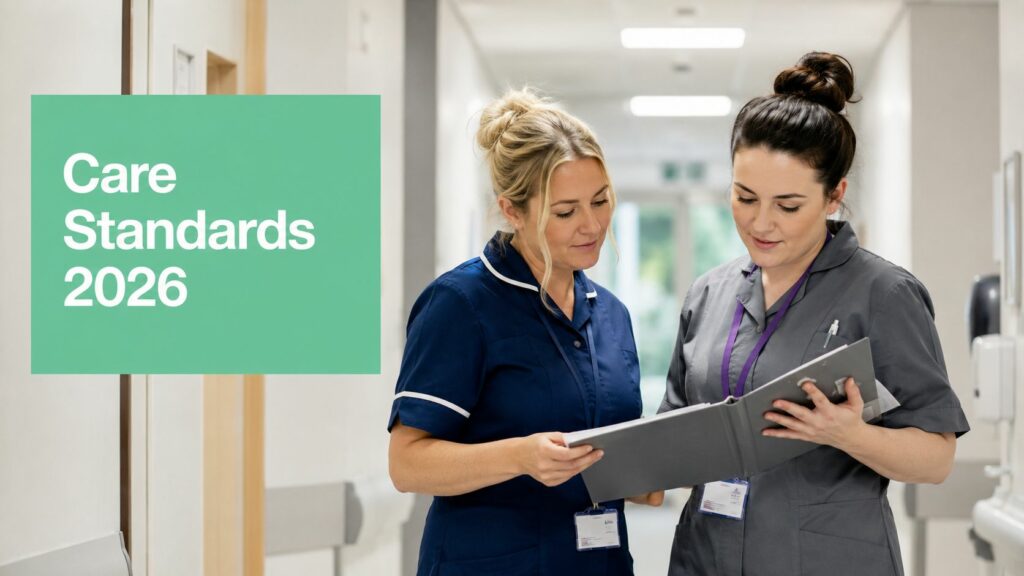
You might already be working in care, or you could be planning your next step into the sector and wondering what employers really mean when they talk about health and social care standards. The answer is simpler than the jargon makes it sound. Standards are the practical rules that help you keep people safe, treat them with dignity, and show that your work is consistent and accountable.
They matter because the UK care system is under pressure. In England, the adult social care workforce had around 1.59 million filled posts in 2022/23, while the Care Quality Commission said the sector still faced major recruitment and retention pressures, with access to services remaining a fundamental problem in its national review (CQC state of health care and adult social care in England, 2022 to 2023). That’s why understanding standards is career knowledge, not just policy knowledge.
Why Health and Social Care Standards Matter Now
The pressure on care is real
When services are stretched, standards become the safeguard that keeps quality from slipping. They help providers stay focused on safe practice, but they also give staff a clear benchmark for what good care looks like day-to-day. Without that shared reference point, care can become inconsistent very quickly.
For you as a learner or practitioner, that means standards are part of your professional toolkit. They shape how you document care, how you communicate with colleagues, and how you respond when something isn’t right. They also help you explain your own competence with confidence in interviews and reviews.
Practical rule: if you can show how your work supports safety, dignity, and consistency, you’re already thinking in standards language.
Why this matters for your career
Employers don’t just want good intentions. They want evidence that you understand the expectations behind care work and can apply them under pressure. That’s where formal learning becomes useful, because it gives structure to experience and helps you turn everyday tasks into recognised practice.
Defining the Fundamental Standards of Care

Think of the fundamental standards as a safety net. They are the basic requirements that every provider must meet so care is not only available, but safe, respectful, and properly managed. The UK government’s fundamental standards list 11 key requirements, including that care must be appropriate, person-centred, safe, and open through a duty of candour (UK government fundamental standards).
What the standards look like in practice
A standard becomes real when you can see it in daily work. Appropriate care means the person’s needs and preferences shape what happens next. Good nutrition and hydration are not side issues. They’re part of keeping someone well and supporting recovery.
Protection from abuse is another clear example. It means staff notice risks, report concerns promptly, and follow safeguarding procedures instead of hoping a problem goes away. Clean premises, suitable equipment, and safe staffing all sit in the same system of care, because one weak area can affect the rest.
The legal framework behind this is specific. The Health and Social Care Act 2008 regulations say care and treatment must be appropriate, meet needs, and reflect preferences (legislation.gov.uk). That’s the core message, good care is not generic, it is personal.
Navigating the UK Regulatory Framework

The main regulator you need to know is the Care Quality Commission, or CQC. In practice, UK standards are often organised around five inspection domains, safe, effective, caring, responsive, and well-led (five health and social care standards framework). That structure matters because it turns broad expectations into a workable checklist.
What each domain means for you
Safe covers safeguarding, infection control, and medicine management. If records are poor or medication checks are missed, safety can slip fast.
Effective is about evidence-based practice and staff competence. If training is weak, the service may look organised on paper but still fail people in practice.
Caring means people are treated with compassion and respect. Responsive means care fits individual needs, not a one-size-fits-all routine. Well-led looks at governance, learning culture, and how leaders handle risk.
A service can have a good policy and still fail an inspection if staff can’t demonstrate it in records, audits, training logs, and improvement actions.
The useful habit is to read your own work through the same lens. Ask whether the care you provide could be explained clearly to a manager, an inspector, or a family member. If not, the process probably needs tightening.
How to Meet and Exceed Care Standards

Professional development is how you prove standards, not just understand them. The Care Certificate in England is built around 16 distinct standards, and the first is Understand your role (Skills for Care Care Certificate standards, March 2025). That tells you something important. Good practice starts with clarity about responsibilities.
What employers look for
They want staff who can show their learning in real settings. That often means keeping evidence of training, taking part in audits, joining supervision properly, and acting on feedback. It also means knowing when to escalate concerns instead of handling everything alone.
A useful approach is simple.
- Keep your evidence tidy: file certificates, reflection notes, and feedback so you can show progress easily.
- Use audits constructively: they’re not about blame, they show where practice needs improvement.
- Link learning to action: if you’ve completed training, apply it in a shift, record it, and discuss it in supervision.
If you want formal learning that supports this kind of progress, a qualification can turn experience into a stronger career profile. An online course can help you build the knowledge needed for compliance, confidence, and progression. One option is Stonebridge Associated Colleges, which offers flexible online study in adult care and related pathways.
Advance Your Career with Flexible Learning

If you want to work well in care, you need more than goodwill. You need recognised knowledge, and you need a way to study that fits around real life. Stonebridge offers Level 3 Diploma in Adult Care (RQF), Access to Higher Education Diploma (Health and Social Care), and TQUK Level 5 Diploma in Leadership and Management for Adult Care (RQF), all through 100% online study with tutor support and a flexible subscription model.
That model matters for busy adults. You can study around work and family, and the subscription can be paused or cancelled without long-term credit agreements. The wider learning offer also includes over a hundred career-focused programmes, with the college accredited by the UK Register of Learning Providers and regulated by the Financial Conduct Authority.
Quality standards from NICE also matter here, because they translate research into measurable benchmarks and keep decisions grounded in UK-relevant evidence on effectiveness and cost-effectiveness (NICE quality standards). If you’re ready to build a career that stands up to inspection and supports better care, explore a course that matches your goals and start moving forward today.
Ready to take the next step in care? Explore Stonebridge’s health and social care courses in more detail and find a flexible online programme that fits your goals.