You've got a job to hold down, family to juggle, and a qualification gap that keeps showing up in applications. Maybe you need English for a better role, maths for an apprenticeship, or a way back into study without sitting in a classroom every week. Distance learning Functional Skills can fit that life, but only if you understand what the course asks of you, especially if online learning feels a bit shaky already.
The honest question is not just whether you can study from home. It's whether you can do it with enough support, enough structure, and enough confidence to keep going when work, care, tiredness, or technology get in the way. Adult learners usually do best when they know the path in advance, so let's make that path clear and practical.
Why Adult Learners Choose Functional Skills
A lot of adults return to education for a very ordinary reason. A job application asks for English or maths, a college course needs an entry qualification, or an apprenticeship wants proof that you can handle practical numeracy and communication. Functional Skills exists for exactly that kind of need, because it is built around everyday life and work, not abstract academic theory.
That is why it often feels more accessible than a GCSE route. The qualifications are used as an alternative pathway for adults who need something recognised, relevant, and achievable around existing commitments. For learners who have been out of study for years, that practical focus matters more than a glossy promise of convenience.
What learners usually want from the qualification
People come to Functional Skills for different reasons, but the pattern is familiar.
-
Work progression: Some need a qualification for a promotion, a new role, or a licence to apply for training they already want.
-
Further study: Others need an entry route into apprenticeships, vocational courses, or college programmes that accept Functional Skills as a gateway qualification.
-
Confidence rebuilding: Many want to prove to themselves that they can still pass English or maths after a long break from education.
A good way to think about it is this. Functional Skills is not about becoming a mathematician or literary critic. It is about showing that you can read, write, calculate, and respond in situations that come up in real life.
Practical rule: if the qualification helps you solve a real problem, whether that is work entry, course entry, or confidence, you are probably looking at the right kind of study.
That practical value is why adult learners keep choosing it. They want the shortest sensible route to a recognised result, not a return to full-time schooling.
Understanding Functional Skills Levels and Structure
Functional Skills is organised so learners can start at the right point, rather than being pushed straight into the hardest content. The usual pathway runs from Entry Level through to Level 2, and each stage asks for a little more independence and accuracy. In the UK, Level 2 Functional Skills is commonly treated as an alternative to GCSE-style study for adults who need a practical qualification route.
The content stays close to everyday tasks. In maths, that means data handling, averages, percentages, and graph interpretation, so the work often feels familiar to adult life rather than detached from it. In English, the focus is on reading, writing, and practical communication that works in real situations, not just in a purely academic essay room.

How the levels usually feel in practice
Entry levels usually support basic literacy and numeracy. As you move up, the tasks become more complex, but they stay grounded in practical use. That structure helps learners who do not want to begin with theory and only later discover why they need it.
A simple example helps here. At a lower level, you may be asked to read a short notice, complete a basic form, or work out a straightforward calculation. At Level 2, the same kind of skill appears in a more demanding form, such as reading a workplace email carefully, comparing information from a chart, or using percentages to check a bill or budget. The skill is familiar, but the judgment expected from you is sharper.
Level 2 is the level most adults ask about because it often appears in course and job requirements. Some providers state that a Level 2 Functional Skills Maths course can be completed within 16 weeks and is available to learners aged 19+, which gives a realistic sense of pace and eligibility. The same practical role is reflected in the wider UK treatment of Functional Skills as an alternative route to GCSEs and as a pathway into further education, apprenticeships, and vocational training.
What to expect from assessment
Assessment in online Functional Skills is not just about knowledge. The process can involve secure digital handling, controlled timing, and exam-centre procedures that protect the integrity of the qualification. Pearson's digital Functional Skills sample materials show that exam centres may receive a ZIP file with a data folder up to 24 hours before the assessment, which means the system depends on careful file handling and digital readiness, not just subject knowledge.
That matters because some learners assume online means informal. It doesn't. It is still a regulated qualification, with real assessment conditions and clear expectations. For adult learners who have been out of education for a while, the hard part is often not the maths or English itself, but getting comfortable with the platform, the file uploads, the login steps, and the sense that the screen is part of the exam process. A learner who is confident at work can still feel unsure the first time they have to submit work through a portal, and that is normal. The answer is usually support, practice, and enough time to get used to the digital side before assessment day.
How Distance Learning Delivery Works
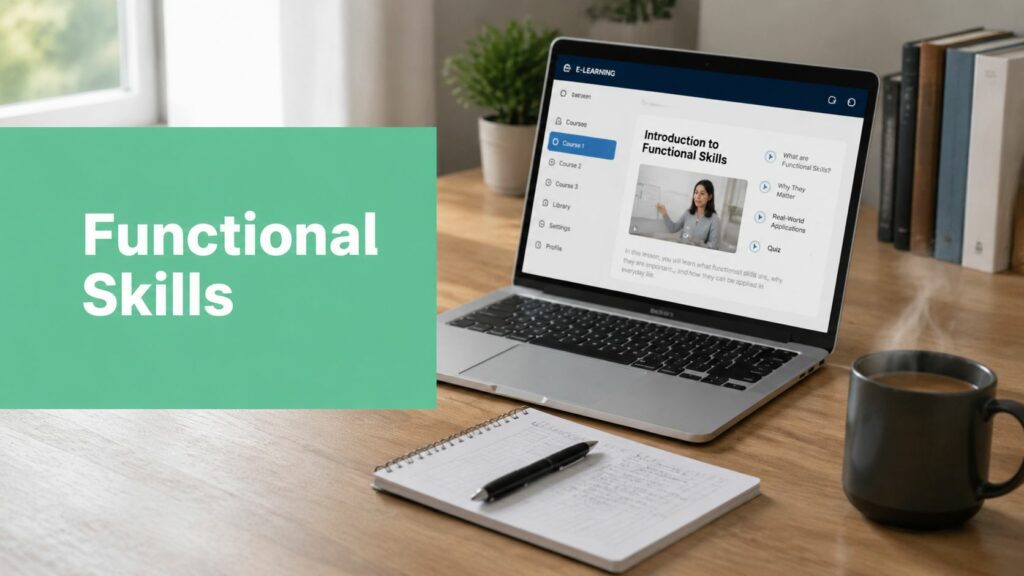
Distance learning functional skills usually starts with a portal, not a timetable. You log in, read the materials, complete tasks, and send work to a tutor for feedback. The basic model is simple, but the day-to-day experience depends on whether the course is self-paced, tutor-led, or somewhere between the two.
At its best, the platform becomes a steady routine rather than a one-off event. You might read a lesson on your phone during a lunch break, finish practice questions on a laptop in the evening, then upload work when you've got a quiet moment. That flexibility is one of the main reasons adult learners choose online study in the first place.

The digital side matters more than people expect
A successful online learner needs more than subject knowledge. They need enough comfort with devices, downloads, uploads, login screens, and learning platforms to keep the course moving. Pearson's digital assessment materials make that clear, because even the exam process depends on secure file handling and software navigation.
Clear advice: if logging into a portal, opening a file, or finding the submit button already feels stressful, don't ignore that. You may need a provider with more active support, not just more content.
That point lines up with wider research on distance learning barriers. Work on distance education has found that low digital literacy, language barriers, limited support, and reduced motivation can hold back marginalised learners, while OECD guidance for low-skilled adults recommends personalised advice, additional support, and blended options rather than online-only delivery. A useful overview of those access barriers is discussed in this study on distance learning and learner support, which highlights why technology confidence is part of the learning problem, not a separate issue (distance learning barriers and learner support).
The assessment workflow is part of the course
Many learners think of the exam as a final checkpoint. In practice, it is part of the whole experience from day one. That is why a provider should explain how exam booking works, what technology you'll need, and what support you'll get if a file won't open or a platform behaves badly on the day.
The UK government's Digital Functional Skills conditions also matter here. The approved subject content is organised around five areas, using devices and handling information, creating and editing, communicating, transacting, and being safe and responsible online, and assessments must be controlled by regulation. That means the online route is not casual self-study, it is a structured qualification with specific digital expectations (Digital Functional Skills conditions and requirements).
Benefits and Realistic Limitations
A learner who has just finished a shift, dealt with childcare, and still wants to make progress on Maths or English often sees the appeal of online study straight away. The course fits around real life. You can work in shorter blocks, return to a topic after a break, and keep going without having to travel to a classroom at a fixed time.
Functional Skills also has a practical purpose for adults. UK English and Maths Level 2 qualifications are designed as work-ready, everyday credentials, and they can meet entry requirements for some degree and apprenticeship pathways. That makes them useful when you need a qualification that has a clear purpose rather than one that only sits on a CV (Distance Learning Centre overview).
What the flexibility really buys you
Flexibility is more than a convenience. For someone balancing shifts, caring duties, or irregular hours, it can be the factor that makes study possible at all. Removing the daily journey to a classroom and the pressure of a fixed timetable can take away two of the most common barriers adult learners face.
It also changes how revision feels. If one lesson needs to be repeated, you can return to it without embarrassment. If a question type keeps causing trouble, you can spend longer on it, much as you would replay a tricky section of a recipe until the steps make sense. That kind of control is one reason many adults prefer distance learning to a room-based schedule.
Where the problems usually begin
The first difficulty is often digital confidence. A course can be flexible and still feel heavy if the learner is unsure how to use the platform, afraid of clicking the wrong thing, or already stretched by work and family pressure. A study by T. K. Kim, C. C. M. Lee, and S. T. Kim on distance learning barriers and learner support, published in ERIC, shows that support needs are part of the learning process itself, because too much independence too early can make online study harder than it needs to be (distance learning barriers and learner support).
The wider digital divide creates another problem. Digital Promise's piece on bridging the digital divide explains that access to devices, reliable internet, and confident use of technology still shapes who can take part well in online learning, especially for learners from low-income backgrounds, English language learners, and learners with disabilities (bridging the digital divide). In practical terms, a learner can be motivated and capable, yet still struggle if the course assumes equipment, internet access, or tech confidence that is not really there.
A better question to ask yourself
A more useful question is not whether online study is good or bad. It is what support you will need for it to work well. If you need regular tutor contact, help with devices, or a mix of online study and guided sessions, that is a sensible starting point. It means the course should fit your life, not the other way round.
Choosing a Quality Distance Learning Provider
A good provider makes the route feel clear from the first email. A weak one hides the important details behind marketing language and leaves you to figure out the rest. The difference shows up in support, assessment handling, and how the provider explains the course before you pay.
What to check before you enrol
Start with the basics. Ask whether the qualification is regulated, how the course is delivered, and whether the cost includes exam entry or whether that is separate. Then ask how you'll get tutor help, how fast feedback usually comes back, and what happens if you need to pause your study.
-
Accreditation and recognition: Check that the qualification is properly recognised and that the provider can explain its awarding route clearly.
-
Fee transparency: Look for a clear breakdown of tuition, exam fees, and any extra charges.
-
Tutor support: Find out whether support is email-only, scheduled, or available in a more guided format.
-
Assessment arrangement: Ask where and how the exam is booked, and what you need to do before the day.
-
Platform usability: Make sure the learning portal is simple enough for you to use without stress.
-
Pause and resumption rules: Confirm what happens if work or family life interrupts your study.
Useful habit: if a provider cannot answer your practical questions in plain English, they probably won't feel easy to deal with later either.
One example of a provider model is Stonebridge Associated Colleges, which offers online Functional Skills Level 2 study with subscription-based flexibility and tutor support.

Questions that expose weak providers fast
Ask what happens if you miss a week. Ask whether feedback is personalised or generic. Ask who handles exam booking and whether you'll get help with the technical side before assessment day.
If the answers feel vague, keep looking. Quality online learning is never just a set of PDFs and a login. It is a support system.
Study Strategies and Exam Preparation Tips
Adults who return to study usually don't need lectures on motivation. They need a plan that survives real life. The best approach is short, regular sessions rather than long bursts that collapse after a busy week.
For English, use everyday reading practice. Short articles, emails, workplace notices, and application forms all help you spot the kind of language Functional Skills uses. For writing, practise structuring short responses clearly, because examiners need to see that your message is organised and relevant, not padded out.
A simple revision rhythm that works
Try this pattern.
-
Read one lesson section: Keep it small enough that you can finish it without rushing.
-
Do a few practice questions: Focus on the question type, not just the topic.
-
Review tutor feedback: Look for repeated mistakes, especially the ones you keep making under pressure.
-
Redo weak areas: Repetition builds confidence faster than moving on too soon.
For maths, work on the question types that show up again and again, such as percentages, averages, and interpreting data. Don't only practise the answer, practise the method, because the process is what helps you stay calm when the wording changes.
Preparing for the controlled exam environment
The exam day is easier when the format feels familiar. Make sure you know how much time you have, what tools are allowed, and how the questions are presented. If your course includes practice assessments, treat them seriously, because they show you where you hesitate, rush, or misread instructions.
Exam habit that helps: read the command word first, then the information, then the question. Many mistakes happen because learners answer the topic instead of the task.
If online study has made you nervous about technology, practise the platform itself before the exam. Opening files, moving between screens, and submitting work should feel routine by then. Confidence often comes from familiarity, not talent.
Your Next Steps to Getting Started
If you want to return to study, start by being honest about your support needs. Ask yourself whether you need a quiet self-paced course, regular tutor contact, help with the platform, or a structure that keeps you moving when motivation dips.
Stonebridge Associated Colleges offers online Functional Skills English and Maths Level 2 as a distance learning option, with subscription-based study, tutor support, and exam-inclusive pricing. That kind of setup suits adults who need a recognised qualification without committing to a traditional classroom timetable.
Before you enrol anywhere, check three things. First, whether you're ready to study in short regular sessions. Second, whether you can handle the basic tech with or without support. Third, whether the provider explains the exam route clearly enough that you know what happens next.
If that sounds like the kind of structure you need, take the next step with a provider that matches your pace and your circumstances. Visit Stonebridge Associated Colleges to review our online Functional Skills option and decide whether it fits the support, flexibility, and exam arrangements you want.