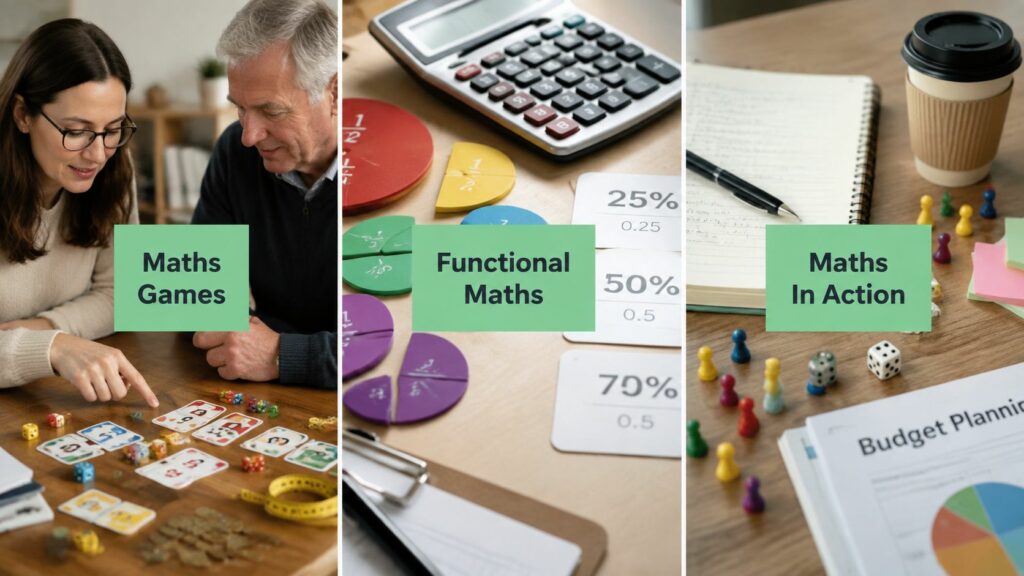
How can adult learners practise essential maths without falling back on the same detached worksheet drill? If you teach Functional Skills, or you're studying it yourself, the answer is often a short game with a clear purpose. The best functional skills maths games do more than entertain, they help you rehearse number, fractions, decimals, percentages, ratio, money, measure, data, and problem-solving in a form that feels usable.
This roundup is written for tutors and adult learners who need practical choices for Functional Skills Maths Level 1 and Level 2. Level 2 sits within the regulated UK qualification family for adults and includes work with problem solving, underpinning skills, and mixed question types, so the games below need to do more than test quick recall. A simple pattern works well for each activity, summary, learning focus, materials, play steps, assessment, and adaptations. When a game lands well, connect it to a real-life or workplace context, explain the maths in plain English, then use the outcome to plan the next step.
A simple visual check can help you choose quickly. Think of a checklist with four boxes, skill match, adult context, clear feedback, and easy access. If a game misses two of those, it probably needs tutor support or a different format.
If you already use a favourite activity, share it with your learners and compare what keeps them focused. Adult numeracy improves fastest when the task feels relevant, brief, and easy to revisit.
1. Transum Maths

Transum works well when you want a fast warm-up that still feels like maths, not a test. The site gives you browser-based interactives such as Digital Darts, FizzBuzz, and estimation golf, so learners can begin straight away without installs. That makes it useful for blended lessons, small-group teaching, and short revision bursts.
Why tutors like it
The strongest point is variety. You can move from topic to topic, which helps when a learner needs a quick confidence boost in number, FDP, ratio, or measure. The timed and score-based modes add mild pressure without making the task feel heavy.
Practical rule: Use Transum first for fluency, then ask one follow-up question that links the game to a real Functional Skills task.
For adult learners, that follow-up matters. A game on estimation can become a discussion about shopping, travel time, or checking a bill. In a class, one learner can play individually while the rest work in pairs, which keeps the room active without turning the lesson into free play.
Transum's weakness is that some games do not explain the method. That means tutors should model the thinking before launch, then debrief after the round. It is a strong starter, but it works best when you add your own explanation and a short written check.
2. MaffsGames

MaffsGames is a good fit when you need sharply focused practice. The tasks are labelled by skill, so you can pick ratios, percentages, fractions, or units without digging through a large library. That clarity makes it easy to align with a session plan or a learner's weak spot.
Best use in adult settings
The site's short modes suit learners who prefer low-friction repetition. A tutor can project one game on a screen and use it as a shared warm-up, or assign it for quiet independent practice. Because the questions are tightly defined, it works well for building automaticity before a more complex task.
The design is plain, but that can be a strength in Functional Skills delivery. Learners see the maths quickly, and the keyboard-friendly format helps with speed and focus. Since there are no learner accounts or formal dashboards, the tutor needs to track progress by listening, observing, and noting errors.
Adult learners often need repetition that feels purposeful, not childish. MaffsGames gives you that if you frame each round around one clear target.
A useful approach is to start with one mode, then ask learners to explain where they hesitated. That turns a quick game into assessment evidence. It also helps you decide whether the next lesson should revisit place value, unit conversions, or ratio language.
3. NRICH Interactive Activities
NRICH is the best choice here if you want learners to think, not just click. The interactive activities encourage reasoning, strategy, and discussion, which suits adult learners who need more than speed. Matching Fractions, Decimals and Percentages is a good example because it can work online or as a printable task.
Why it supports Functional Skills thinking
Functional Skills Maths at Level 2 expects learners to handle fractions, decimals, percentages, and ratios with confidence. NRICH helps by slowing the pace and asking learners to justify decisions. That is valuable for adults who can do isolated calculations but struggle when the problem is unfamiliar.
The activities work well in pairs or small groups. One learner can describe a method, another can challenge it, and the tutor can listen for misconceptions. That makes NRICH useful for class discussion, coaching sessions, and supported independent study.
If a learner can explain why an answer works, they're more likely to cope with a new exam-style question later.
NRICH is less game-like than arcade-style sites, so some learners may need encouragement at first. It is also not built around progress tracking, which means tutors should record what learners say and do during the activity. Used this way, it becomes a strong bridge between play and assessment.
4. Topmarks Maths Games
Topmarks is a good shortcut when you need something free, quick, and easy to filter by topic. It collects many maths games in one place, including options for percentages, measure, and money. That breadth makes it useful when a learner's gap is narrow and you want repeated practice.
How to use it well
For Functional Skills learners, the best use is targeted drilling. If someone keeps mixing up money or measure, you can pick a short activity and revisit it several times across a week. That repetition helps adults who need short sessions around work or family commitments.
Many of the older Flash-based activities have been replaced with HTML5 versions, so the site works better in modern browsers. The games are not all identical in quality, because Topmarks curates third-party resources. That means tutors should preview each one and keep the better matches.
A simple class routine can work well:
Choose one topic: Pick a single weak area, such as percentages or data.
Set a short goal: Ask the learner to complete one round without rushing.
Discuss the method: Ask what clue they used to decide.
Log the error: Write down the most common mistake.
Repeat later: Return to the same skill in a different context.
For home practice, that structure keeps the activity from becoming random browsing. It also gives adults a sense of progress, even when the site itself offers no formal analytics.
5. BBC Bitesize Functional Skills Maths
BBC Bitesize is less game-heavy than some other sites, but it's one of the most helpful resources for adult learners who need explanation before practice. Its Functional Skills materials use real-life examples and interactive quizzes, which fits the applied nature of the qualification. The mix is especially useful for learners returning to study after a long break.
Where it fits best
Use Bitesize when a learner needs a concept explained in simple language before they try an activity. Percentages, ratio, fractions, decimals, measure, and data are all covered in a way that links to everyday use. That makes the site a strong reference point for both Level 1 and Level 2 learners.
The quizzes are not as playful as dedicated game platforms, but they do support active recall. A tutor can pause after each question and ask the learner to explain the reasoning, which turns a quiz into a mini assessment. That is especially useful for apprentices and adult returners who want relevance, not just revision.
The main limitation is the lack of personal dashboards. Learners won't get the same tracking feel as they might on a game platform, so tutors need to build that structure themselves. Still, the combination of explanation and practice makes Bitesize a reliable core resource.
6. Wordwall
Wordwall is the most flexible option when you want to build your own Functional Skills Maths game. Tutors can create or adapt quizzes, match-ups, spinning wheels, and other templates, then tailor them to care, retail, construction, or any other workplace setting. That flexibility makes it especially useful for adult classes with mixed experience.
A tutor-led option for real contexts
This is the site to use when generic practice isn't enough. You can turn a lesson on percentages into a shop discount activity, or make ratios feel relevant to ingredients, doses, or mixing instructions. The result is closer to the kind of decision-making adults face in work and daily life.
Wordwall also has many community sets tagged Functional Skills Maths, which saves planning time. The quality of those shared resources varies, so tutors should curate carefully. The best sets are usually the ones that mirror a lesson objective and give immediate feedback.
Because it's so adaptable, Wordwall works well for formative checks. You can start with a quick game, identify misunderstanding, then re-run the same content in a different template. That keeps the learning active without changing the maths target.
7. Fraction Rush
Fraction Rush is useful when you want short, focused practice with immediate feedback. It offers timed Rush modes for fractions, percentages, multiplication, division, and UK money, which makes it well matched to key Functional Skills content. The site also includes concise tutorials, so learners can move between explanation and practice.
Why it suits adult learners
The adult-friendly angle is the pace. Some learners want a short burst of challenge rather than a long lesson, and Fraction Rush supports that. The optional Versus mode adds motivation, but the practice mode is the safer place to start for nervous learners.
The UK money content is particularly relevant. Learners can practise mixed coins, giving change, and £/p notation in a setting that feels close to everyday use. That is useful in retail, hospitality, care, and many other work contexts.
Use it carefully with low-confidence learners, though. The timed format can motivate some people and unsettle others. A tutor can reduce pressure by giving a warm-up round first, then moving to a timed attempt only after the learner understands the method.
Keep the competition secondary. The maths should stay in the foreground.
If you want an activity that feels brisk, clear, and closely linked to money and FDP, Fraction Rush earns a place in an adult Functional Skills toolkit.
Functional Skills Maths Games, 7-Tool Comparison
| Tool | Implementation complexity 🔄 | Resource requirements ⚡ | Expected outcomes ⭐ | Ideal use cases 💡 | Key advantages 📊 |
|---|---|---|---|---|---|
| Transum Maths | Low, one‑click browser games 🔄 | Minimal, device + browser ⚡ | ⭐⭐⭐, improves speed & accuracy; short practice 📊 | Warm-ups, blended lessons, whole‑class starters 💡 | Fast setup; wide variety; team play |
| MaffsGames | Low, focused single‑skill games 🔄 | Minimal, keyboard + browser ⚡ | ⭐⭐⭐, builds automaticity for specific skills 📊 | Short, targeted drills; independent practice 💡 | Skill‑labelled games; free and UK‑aligned |
| NRICH Interactive Activities | Medium, may need tutor facilitation 🔄 | Low–medium, browser; printable resources ⚡ | ⭐⭐⭐⭐, strengthens reasoning & problem solving 📊 | Group problem solving; deeper conceptual work 💡 | University‑backed pedagogy; high‑quality tasks |
| Topmarks Maths Games | Low, curated third‑party games 🔄 | Minimal, browser; varied compatibility ⚡ | ⭐⭐⭐, broad reinforcement across topics 📊 | Home practice; topic‑filtered quick drills 💡 | Extensive curated library; easy access |
| BBC Bitesize (Functional Skills Maths) | Low, guided pages and quizzes 🔄 | Minimal, browser; no install ⚡ | ⭐⭐⭐⭐, clear explanations + applied practice 📊 | Adult returners; vocational contexts; revision 💡 | Trusted brand; context‑rich worked examples |
| Wordwall | Medium, authoring and remixing templates 🔄 | Low–medium, browser; some paid features ⚡ | ⭐⭐⭐⭐, highly aligned formative checks & revision 📊 | Custom resources, centre‑specific scenarios 💡 | Flexible templates; community sets to remix |
| Fraction Rush | Low–Medium, timed modes; optional versus 🔄 | Minimal, browser; optional accounts ⚡ | ⭐⭐⭐, focused FDP & money practice with feedback 📊 | Short bursts, focused FDP practice, competitive drills 💡 | Immediate feedback; adult‑appropriate pace |
Turn Game Time into Steady Progress
The best choice depends on the learning goal. Use fluency drills like MaffsGames or Fraction Rush when a learner needs repetition. Use reasoning puzzles like NRICH when you want deeper thinking. Use applied quizzes and explainers like BBC Bitesize when the learner needs context before practice. Use tutor-created activities in Wordwall when the maths has to match a job, a sector, or a specific assessment target.
A simple follow-up routine keeps the learning honest. Identify one target skill. Run a short game. Ask the learner to explain their method. Record accuracy and misconceptions. Then repeat the same skill or increase the challenge. That pattern helps tutors turn play into evidence, which is what Functional Skills study really needs.
Adaptation matters just as much as the game itself. Remote learners often need shorter tasks and clearer instructions. One-to-one learners may need more pause time and verbal explanation. Large groups usually benefit from projected activities, team play, and quick debriefs. Competition, reading demand, and question difficulty should all shift to fit the learner in front of you.
If you want a structured route beyond free practice, Stonebridge Associated Colleges offers a Functional Skills English and Maths Level 2 Including Exams course with 100% online study and personalised tutor support. Its flexible subscription model uses an affordable monthly fee and lets learners pause or cancel without long-term credit agreements, which helps adults study around work and family life. Stonebridge learners and alumni can also access the learndirect: Community Hub app, available only to learners and alumni of the learndirect Digital Group, where discussion groups, topic-specific communities, and interactive forums can support connection along the way.
If you're ready to move from casual practice to steady progress, explore online study with Stonebridge and keep the conversation going. Tell your tutor, or the learners you support, which maths game helps most and what skill you want to tackle next.
Stonebridge Associated Colleges offers flexible online study that fits around adult life, including Functional Skills Maths support with tutor guidance and exam preparation. If you want a structured way to turn functional skills maths games into measurable progress, visit Stonebridge Associated Colleges and see how online learning can support your next step.