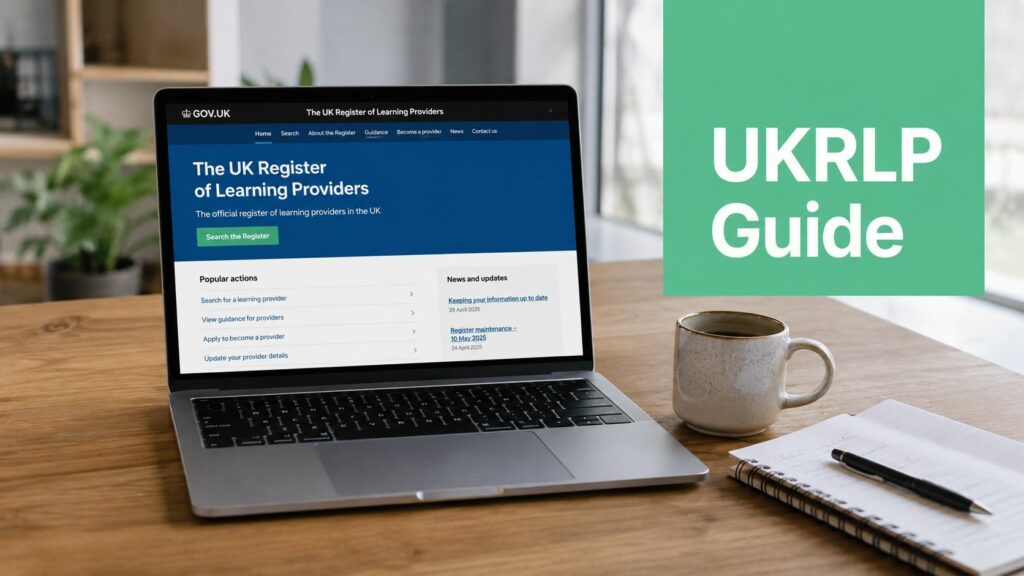
Can a college be trustworthy because its name appears on a register? Not necessarily. The UK Register of Learning Providers can help you confirm that an education or training organisation exists and has a recognised identity, but it isn't a quality rating. That distinction matters when you're comparing online courses, checking funding arrangements or deciding whether a provider deserves further research.
This guide is for adult learners, employers and anyone checking a UK education provider. You'll learn what the UK Register of Learning Providers, or UKRLP, does, how the UK Provider Reference Number, or UKPRN, works, how to search the register, and what registration can and can't tell you. You'll also see how the register fits into a practical decision about online study.
What the UK Register of Learning Providers Actually Does
The UK Register of Learning Providers is an online government register covering learning providers across England, Northern Ireland, Scotland and Wales. It stores core identity information about organisations that deliver learning and assigns each verified provider a UK Provider Reference Number, or UKPRN. The register is run through the Learning Records Service and is designed to share consistent provider data with government and partner agencies, rather than act as a quality mark. Official UK guidance on EduBase and the UKPRN explains that registration doesn't represent quality assurance or accreditation.
That means the register answers a basic but important question: does this provider have a verified identity in the national learning-provider system? It doesn't, by itself, tell you whether tutors are excellent, whether a course suits your career plans or whether a qualification is accepted for a particular job.

Why a shared register helps
Before the UKPRN created a common reference point, different agencies could hold provider information in different formats. A single identifier helps connect records held by separate systems across the UK nations. This is a form of data interoperability, meaning that systems can exchange and match information more reliably.
The UKRLP can support information sharing involving:
Government agencies, which need consistent provider identity data.
Learner-record systems, where provider details must match submitted records.
Employers, which may need to check a training organisation before working with it.
Learners, who can use the register as an initial verification step.
The UKRLP registration service says applying for a UKPRN is free and usually takes around 10 minutes. Providers are checked against a recognised external source before being listed, which shows that the service is intended as a low-friction identity process, not a lengthy academic inspection.
Practical rule: Treat UKRLP registration as the first check, then investigate the course, qualification, awarding organisation, learner support and complaints process separately.
Understanding the UKPRN Number
Think of a UKPRN as an identity number for a learning provider. Just as a British driving licence has a unique number that connects a person with their driving record, a UK Provider Reference Number connects an organisation with its provider record.
The UKPRN is an 8-digit identifier issued through the UKRLP. For UK learner-record submissions, it must be in the numeric range 10000000 to 99999999 and must match the value held in the register. The official ILR guidance for the UKPRN field explains that a mismatch can prevent connected services from working properly, including access to learner-record processes.
For learners, the number is useful because it gives you a precise reference rather than relying only on a trading name. A provider may use a public brand that differs from its legal entity name, so checking the UKPRN can help you connect the two records.
UKPRN at a glance vs other reference numbers
| Reference number | Who it identifies | Typical length | Where learners see it |
|---|---|---|---|
| UKPRN | A learning provider | 8 digits | Provider websites, course information and learning records |
| URN | A school or education establishment in systems that use a unique reference number | Varies by system | School information and inspection records |
| UKCP | A college reference used in relevant college administration | Varies by system | College documentation where applicable |
These identifiers aren't interchangeable. A UKPRN identifies the learning provider, while a URN or another education reference may identify a different type of organisation or record. If an employer, funding body or provider asks for a UKPRN, use the exact number shown in the UKRLP record.
The UKRLP homepage confirms that providers are verified against a recognised external source and assigned a UKPRN for sharing identity data with partner agencies. Registration still isn't accreditation, so the number confirms identity and system compatibility, not teaching quality.
How to Search the Register as a Learner
Searching the UK Register of Learning Providers is straightforward, but you should use the result carefully. The public register is a starting point for checking identity, not a substitute for reading course terms or asking an adviser detailed questions.
Follow these steps
Open the official UKRLP search service. Use the government register rather than an advert, directory or lookalike website.
Enter the provider name or UKPRN. Searching by the exact UKPRN is usually more precise because names can be similar.
Select Search. Review the returned record instead of assuming that a name match proves the organisation is the one you're considering.
Compare the details. Check the legal entity name, trading name, address and contact information against the provider's own materials.
If you can't find a result, check the spelling and try the legal name as well as the trading name. A merger, name change or recently updated record may also explain why your first search doesn't work. Don't follow a search-engine advert to a portal that imitates the official service. Start from the government register.

What the result can tell you
Cross-reference the UKPRN shown on the register with the number published by the provider. If you're considering an apprenticeship, compare it with the details used in the relevant apprenticeship service arrangements. For company information, you can also compare the legal entity with the organisation's Companies House record.
A listing can support confidence that you've found a real provider. It can't confirm that the course is suitable, current or well taught.
An absence from the register deserves careful investigation, particularly if a provider claims to deliver learning that depends on formal government or partner-agency recognition. Ask the organisation for an explanation before sharing money or personal information.
How Providers Register and Keep Records Up to Date
How does a college become identifiable in the UK Register of Learning Providers before you decide whether to enrol? Registration starts with the organisation's identity and eligibility, rather than an inspection of its teaching. For example, when Stonebridge Associated Colleges registered, we needed to show that our legal identity and learning activity met the UKRLP process requirements, and then prepare accurate information for submission.
The application normally includes the legal name, trading names, addresses, contact details, company number and company type. The provider submits these details online. The registration service checks the organisation against a recognised external source before assigning its UKPRN. That number then acts as the provider's consistent reference across funding, data and verification systems, often without a learner seeing the process behind it.

Keeping the record dependable
Registration does not end the provider's responsibility. The organisation must keep its record accurate when contact details, legal status or other core information changes. The UKRLP FAQ describes the register as a database of legal-entity details, giving learners, employers and government bodies access to consistent information.
A provider's maintenance work may include:
Reviewing core details, including names, addresses and contact routes.
Updating legal information, such as a change to the organisation's status.
Checking learner information, where this relates to provider records and returns.
Using the self-service process, so amendments can be submitted efficiently.
Responding to validation requests, if the UKRLP team needs confirmation.
The review timetable depends on the relevant process and the provider's responsibilities. For learners, the practical lesson is clear: an outdated record can cause confusion if a college changes its name, moves office or reorganises its legal structure.
Accurate records help employers, councils, learners and partner agencies identify the correct organisation. They also reduce rejected data, administrative delays and uncertainty about which legal entity delivers a course.
Why Registration Matters for Learners and Employers
Could a college's name be different from the organisation that legally delivers your course? That distinction matters when you are choosing a credible online college. Learners want to know who they're enrolling with. Employers want to know who will train their staff. Providers need their identity to work across connected systems.
Behind the scenes, the UKPRN helps funding, learner-record and verification systems match the right organisation. For a learner, it provides a firm reference when you ask about funding, enrolment or your records. Comparing it with the provider's legal name can reveal whether a marketing name belongs to the organisation delivering the course.
That check should lead to better questions about awarding organisations, qualification recognition, tutor support and assessment. Registration supports your initial checks, while the course details and provider's wider evidence help you decide whether the college suits your goals.
Employers can check a potential training partner before agreeing arrangements. Matching the legal name and UKPRN with contracts, invoices and other documents reduces administrative mistakes. It is especially useful where organisations have similar names or a provider works through partners.
Providers also use a consistent identity when working with partner systems. This can make onboarding and data exchange more orderly, although separate approvals and quality checks still apply.
What the UK Register Does and Does Not Confirm
| Confirmed by UKRLP | Not confirmed by UKRLP |
|---|---|
| The provider has a record in the national learning-provider register | The quality of teaching |
| The provider has a UKPRN linked to its identity | An Ofsted grade |
| Core legal-entity information can be shared with partner agencies | Awarding-organisation accreditation |
| Verification against a recognised external source has taken place | Guaranteed employment or progression |
| The organisation can be identified across connected systems | That every course meets your personal needs |
The official UKRLP guidance from the Department for Education explains that registration is not quality assurance or accreditation. Use it as a trustworthy first filter, then examine the course, support and recognition before enrolling.
Common Questions and Next Steps with Stonebridge
What is the UKRLP in one sentence? It's a shared UK database of learning-provider identity details, with a UKPRN assigned to each verified provider.
Why does it matter? The UKPRN helps government and partner systems match the correct provider record. For you, it provides a practical identity check before you enrol.
How do I find a provider's UKPRN? Search the official UKRLP service using the organisation's name, or ask the provider for its number and compare it with the register. Stonebridge Associated Colleges publishes its UKPRN through its provider information, and staff can confirm it during enrolment.
Does registration cost learners anything? The UKRLP application is free for providers, as stated by the official registration overview. Learners don't pay a separate UKRLP search fee through the register.
How often must providers update their records? Providers should keep their information accurate and amend it when relevant details change. The register is an identity database, so current legal and contact information matters more than treating registration as a one-off badge.
Is there a UKRLP app for learners? The UKRLP has tools intended mainly for providers managing their records. It isn't the main route for learners searching the register, so use the official web service when checking a college.
Stonebridge offers subscription-based online courses across vocational and academic subjects, including Access to Higher Education Diplomas, health and social care, nursing and midwifery, business management, education and veterinary science. Our courses are studied 100% online, with personalised support from qualified tutors and the option to pause or cancel a subscription without a long-term credit agreement. The modular structure and monthly payment model can help adult learners fit study around work and family commitments.
Learners and alumni of Stonebridge Associated Colleges also get access to the learndirect: Community Hub app, which is available to learners and alumni of the learndirect Digital Group only. The app provides discussion groups, topic-based communities and interactive forums where people can share ideas, ask questions and gain support during online study.
Registration adds reassurance, but your final choice should also reflect the qualification, assessment method, tutor support, payment terms and progression route. If you're unsure, speak with an adviser and ask for the information in writing before you enrol.
If you're ready to study online, explore the flexible subscription courses at Stonebridge Associated Colleges, from English and Maths to healthcare, education, business and Access to Higher Education. Check your course options, speak with an adviser and start an application that fits around your life.