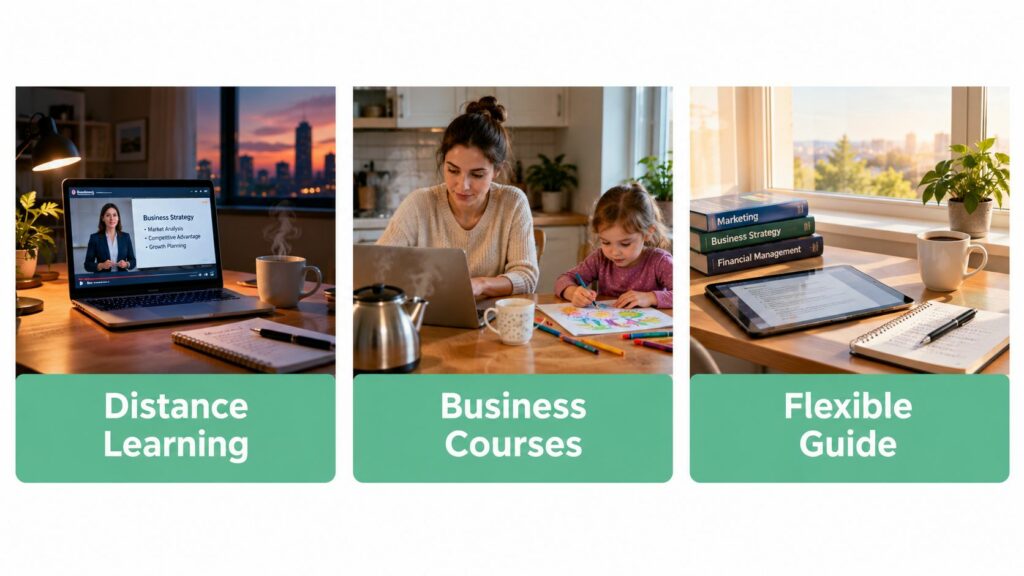
You've finished a late shift, settled the children, or found a quiet hour between caring responsibilities. The laptop is open, the kettle is boiling, and you're wondering whether a business qualification can fit into a life that already feels full.
Distance learning business courses are designed for people in that position. They let you study business online, work with tutor support, and build towards a certificate, diploma or higher education pathway without attending a classroom every day. This guide explains how the main options work, what to check before enrolling, and how Stonebridge's flexible subscription model can help you study around work and family life.
What distance learning business courses actually are
Distance learning business courses are qualifications or training programmes delivered online. Depending on the course, you may study management, marketing, finance, accounting, human resources, business planning or entrepreneurship through a digital learning platform.
You don't usually need to travel to a college. Course materials, recorded lessons, reading, activities, assignments and tutor communication are provided online. Support may be available through email, online portals and digital community spaces, so you can study during the hours that suit you.
That could mean completing a reading task before work, watching a lesson during a lunch break, or writing an assignment after the children are asleep. The useful difference is that your learning doesn't have to compete with a fixed classroom timetable.
How the main formats differ
Fully online study takes place remotely. You access the course content and submit work online, with tutor support provided digitally.
Blended learning combines online study with some scheduled workshops, campus sessions or live classes. It can offer more direct interaction, but those fixed elements may be harder to manage around shifts or caring responsibilities.
Self-paced correspondence study gives you materials to work through independently, often with assignments sent to a tutor for marking. It can be flexible, although the level of online interaction varies between providers.
Distance learning describes how a course is delivered, not whether the learning is less demanding. A well-designed course still has learning outcomes, assessment requirements and progression expectations. The qualification, awarding organisation and regulatory status matter more than whether you study at home or in a classroom.
Business courses are often vocational. That means they focus on knowledge and skills that can be applied in workplaces, such as organising processes, communicating with customers, supporting teams or understanding business performance. A course may still include theory, but it should help you connect that theory with practical decisions.
Levels and types of distance learning business courses
Choosing a level becomes easier when you start with your destination. Are you testing a new interest, preparing for a promotion, changing career, or working towards university?
A short introductory course can be a sensible first step if you're building confidence. Subjects such as bookkeeping, customer service and introductory marketing can help you understand whether business study feels right before committing to a larger qualification.
Level 2 and Level 3 diplomas usually provide more structured vocational learning. Business Administration, Team Leading and Principles of Management are examples of areas that can support progression into administrative, supervisory or junior management work. Some Level 3 qualifications can also carry UCAS points, so check the individual course and university requirements before enrolling.
A route towards higher education
The Access to Higher Education Diploma (Business) is designed for adults who want to progress to university but may not have A-Levels or recent academic experience. It can help you rebuild study skills, practise academic writing and develop a foundation in business and management.
Stonebridge's Access to Higher Education Diploma in Business is delivered online. It can suit learners who need a structured route into higher education while continuing with employment or family responsibilities.
At higher levels, learners may consider Level 4 or Level 5 diplomas, foundation degrees and undergraduate pathways. Professional qualifications can provide a more specialised direction, such as AAT for accounting or CIM for marketing, although entry requirements and assessment arrangements vary.
| Level | Example qualification | Typical learner goal | Progression route |
|---|---|---|---|
| Introductory | Short certificate or taster course | Explore a business topic | Further certificate or diploma |
| Level 2 | Business Administration or Team Leading | Build workplace confidence | Level 3 study or employment |
| Level 3 | Principles of Management or business diploma | Develop supervisory skills | Employment or higher education |
| Access to HE | Access to Higher Education Diploma (Business) | Prepare for a business degree | University application |
| Level 4 and Level 5 | Higher-level business diploma | Strengthen professional knowledge | Higher education or career progression |
| Degree level | Foundation degree or undergraduate pathway | Gain a full higher education qualification | Graduate-level progression |
The right rung depends on your previous study, career aim and available time. You don't need to begin at the highest level. A staged route can make a long-term goal feel more manageable.
Accreditation and how assessment works
Accreditation can look confusing, particularly if you're comparing course pages that use different terms. Start by checking who awards the qualification, whether it's regulated, and how the assessment is completed.
In England, Ofqual oversees regulated qualifications and maintains the framework used to compare qualification levels. The Regulated Qualifications Framework, or RQF, helps show the level and size of a qualification. Equivalent oversight is provided by SQA in Scotland, Qualifications Wales in Wales and CCEA in Northern Ireland.
Regulated status indicates that a qualification meets defined national standards. It doesn't guarantee a particular job or university place, so you should still check the entry requirements for your intended employer or university.

What assessment can involve
Distance learning business courses commonly assess learning through a mixture of:
Tutor-marked assignments, where you apply course knowledge to a question or business situation.
Multiple-choice tests, useful for checking understanding of key terms and concepts.
Short written responses, which help you explain ideas clearly.
Portfolio evidence, where you collect work showing practical understanding.
Academic writing, particularly on Access to HE courses, where you practise the skills needed for degree-level essays.
A course should explain its assessment method before you enrol. Look for information about marking criteria, submission deadlines, feedback and resits.
Practical rule: Don't choose a course based on the qualification title alone. Check the awarding organisation, assessment method and progression requirements together.
Stonebridge courses include personalised support from qualified tutors. Learners can also use structured materials and online support to organise their work.
Costs and funding for distance learning business courses
The cost of distance learning business courses depends on the qualification, awarding organisation, assessment arrangements and support included. A short course may have a different price structure from a regulated diploma or an Access to HE qualification.
Some providers charge one upfront fee. Others offer instalments. A subscription model spreads payment over time and can be useful when a single large payment isn't realistic.
Stonebridge Associated Colleges offers 100% online, subscription-based study across vocational and academic subjects. Learners pay an affordable monthly fee and can pause or cancel their subscription at any time, without a long-term credit agreement. That arrangement can help an adult learner avoid committing to payments during a period when work, health or caring responsibilities may change.
Compare the full cost, not just the headline fee
Before enrolling, check whether the price includes:
Tutor support, including assignment marking and feedback.
Assessment or examination fees, where applicable.
Certification, including any separate certificate charge.
Learning materials, such as printed resources or required software.
Resubmission costs, if an assessment needs to be completed again.
Funding may be available for some eligible Level 3 qualifications through an Advanced Learner Loan. Employer sponsorship, workplace development budgets and subject-specific bursaries may also help, but eligibility varies. Always confirm the current rules with the provider or funding body.
| Course type | Typical price range | Subscription equivalent | Funding options |
|---|---|---|---|
| Short business course | Varies by provider | Monthly access may be available | Employer support or self-funded study |
| Vocational certificate | Varies by qualification | Instalment or subscription route | Employer support and possible finance |
| Access to HE Diploma | Varies by provider and awarding body | Monthly subscription where offered | Advanced Learner Loan may apply to eligible courses |
| Higher-level diploma | Varies by qualification | Payment plan or subscription | Employer sponsorship or self-funding |
The best comparison is the total expected investment. Ask how long access lasts, what happens if you pause, whether support continues, and whether you can restart without losing progress. A lower upfront price isn't automatically better if key services sit outside the advertised fee.
Study formats, timelines and subscription flexibility
Your study format should reflect your actual week, not an ideal week. A parent with nursery runs may have short study windows, while a shift worker may have several uninterrupted hours followed by a demanding run of shifts.
Fully self-paced study gives you the greatest control. You work through modules and submit tutor-marked assignments when ready. A weekly structured course provides clearer deadlines and regular momentum, while blended learning adds live workshops or other scheduled activities.
Some UK online learning options are designed as short, flexible programmes. Current listings include courses that can start at any time and be completed in 6 to 12 weeks, according to the National Careers Service course listings.
Match the pace to your responsibilities
A subscription changes the practical decision. Instead of treating study as one uninterrupted block, you can work through a modular course around the demands of your life. Stonebridge learners can pause or cancel their subscription, then return when circumstances allow.
That matters if your rota changes, childcare breaks down, or a caring responsibility becomes more demanding. You can also plan a shorter study session rather than abandoning the whole qualification because one week was difficult.

A simple weekly plan can help. Choose a realistic study window, identify the next module task, and leave space for reading and assignment writing. Avoid planning every evening if your work pattern or home life rarely allows it.
Learners who prefer external deadlines may benefit from a structured course. Those who need maximum control may prefer self-paced subscription learning. Neither approach is automatically superior. The useful question is which one you can sustain.
Who do distance learning business courses suit?
Distance learning business courses suit adults who need education to fit around existing responsibilities. The strongest option is often the one that removes practical barriers before they interrupt progress.
Shift workers may study early in the morning, after a late shift or during a run of rest days. Online access removes the need to attend at a fixed time, while modular content lets them focus on one manageable task.
Parents and carers often need study to fit around changing routines. A subscription model can reduce pressure by allowing learners to pause during an intense period and resume when there's more space.
Career changers may want to rebuild confidence before applying for a new role or progressing to university. Starting with business administration, management or an Access to HE Diploma can create a structured route rather than relying on unplanned self-study.
Self-employed professionals can use business learning to strengthen planning, finance, marketing or management knowledge between contracts. They may also be able to connect assignments with decisions they're already making in their own work.
Support beyond the course materials
Stonebridge learners and alumni of the learndirect Digital Group can access the learndirect: Community Hub app. The app includes discussion groups, topic-specific communities and interactive forums where learners can ask questions, exchange ideas and connect with others.
That online community can provide a sense of connection that distance learners sometimes miss. It doesn't replace tutor feedback, but it gives learners another place to discuss study routines, share perspectives and feel less isolated.

The wider demand also points towards flexible, practical study. A UK online education survey reported that 21% of British people used some form of online learning, with the 25 to 34 age group at 22% and 18 to 24-year-olds at 46% for online learning materials, as reported by UK online education statistics.
For business learners, that supports a mobile-friendly approach with short learning blocks and self-paced progression. It also explains why a course needs more than downloadable text. Clear navigation, accessible media, tutor contact and a realistic pause policy all affect whether an adult can keep studying.
Frequently asked questions and next steps
What careers can business courses support?
Business qualifications can support applications for roles in business administration, customer service, junior management, retail management and accounting support. They may also help people who are planning self-employment by strengthening knowledge of planning, finance, marketing and operations.
A qualification won't guarantee a job. Employers will also consider experience, communication, digital confidence and the specific duties of the role. Use assignments to build examples of how you've analysed information, organised work or made recommendations.
Will universities and employers recognise the qualification?
Recognition depends on the qualification and awarding organisation. Regulated qualifications sit within national frameworks and have defined standards, but universities set their own entry requirements.
An Access to HE Diploma can be a route into higher education for adults without A-Levels. Before enrolling, check the target university's requirements for the degree, subject content and any required grades.
Does previous study affect entry?
It can. Entry requirements vary by course level, awarding organisation and subject. Some introductory courses may be open to beginners, while higher-level or Access courses may ask for evidence of English and Maths skills or previous qualifications.
Contact the course team before enrolling if your certificates are older, your education took place outside the UK, or you're unsure whether your experience counts. A clear answer at the start can prevent a frustrating application later.
How can study fit around work and family?
Start with your least reliable week. If your timetable only works when everything goes perfectly, it's too demanding. Choose a small, repeatable study block and divide assignments into tasks such as reading, planning, drafting and reviewing.
Stonebridge provides online learning, tutor support and a subscription structure that can be paused or cancelled. The UK flexible learning analysis identifies business studies as a common online subject area and describes flexible learners as including part-time, older and online or distance learners. That makes modular planning particularly relevant for adults combining education with employment.
The next step is practical. Review the course description, qualification, entry requirements, syllabus, assessment method and what's included. If a full diploma feels like too much at first, begin with a shorter business course, establish a study routine, then consider progressing to the Access to Higher Education Diploma (Business) or a higher-level certificate.
Stonebridge Associated Colleges offers flexible, 100% online business and Access to Higher Education courses with qualified tutor support and a subscription you can pause or cancel as your circumstances change. Visit Stonebridge Associated Colleges to explore distance learning business courses and choose a route that fits your work, family commitments and next career goal.