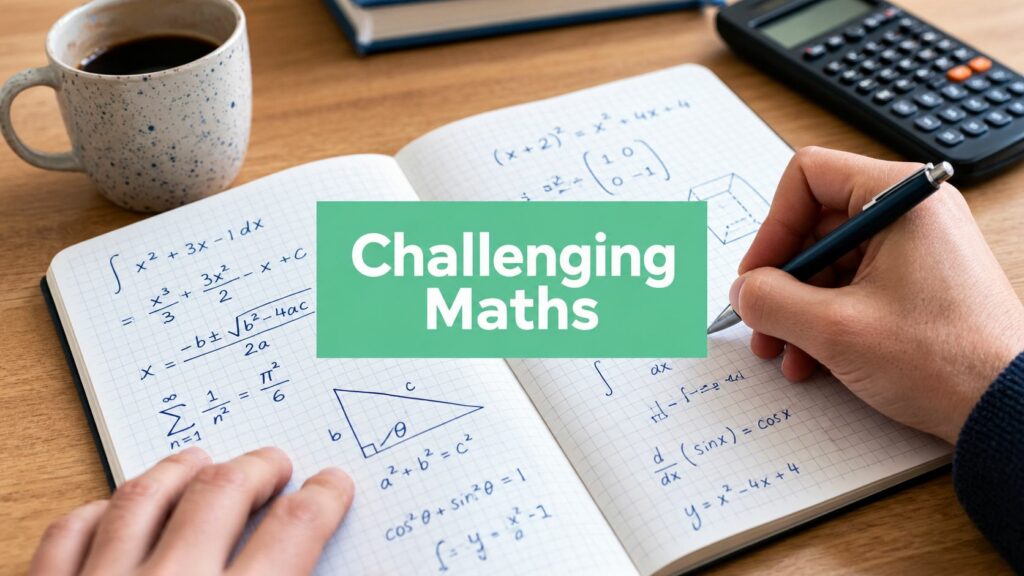
Ready to make difficult maths feel manageable? Many adult learners and resitters freeze when a question looks unfamiliar. The problem often isn't the calculation. It's knowing what the question wants, choosing a suitable method, showing each step and checking whether the answer makes sense.
This guide covers eight useful sources of challenging maths questions, from past papers and interactive platforms to workplace scenarios and peer discussion. Each one can strengthen a different skill, including accuracy, reasoning, interpretation and resilience.
Hard questions also expose confidence gaps. In a UK survey, 35% of adults said they feel anxious doing maths, while 29% actively avoid numbers and data (KPMG and National Numeracy). A calm, repeatable method can help you move forward.
Stonebridge's Functional Skills English and Maths Level 2 Including Exams course offers flexible online learning and personalised tutor support. Clear headings, short paragraphs and practical steps make revision easier to fit around work and everyday life.
1. Past examination papers and mark schemes
Past papers from Pearson Edexcel, City & Guilds and TQUK give you realistic practice. They show how Functional Skills Maths Level 2 questions are worded and how calculations appear in an assessment.
Try this routine:
Work under timed conditions: Practise completing a paper without checking notes.
Mark every step: Use the mark scheme to see where marks are awarded.
Record difficult types: Note whether percentages, ratio, graphs or measures caused trouble.
Retry later: Return to the topic and attempt a similar question.
A wrong answer doesn't mean the whole method failed. You may have chosen the right operation but misread a unit, copied a figure incorrectly or forgotten to round appropriately.
Practical rule: Don't only record the correct answer. Record the step where your reasoning changed direction.
Pearson Edexcel past papers, City & Guilds sample assessment materials and TQUK specimen papers can all support targeted revision. Use them alongside tutor feedback so you understand why an answer works.

2. Online problem-solving platforms
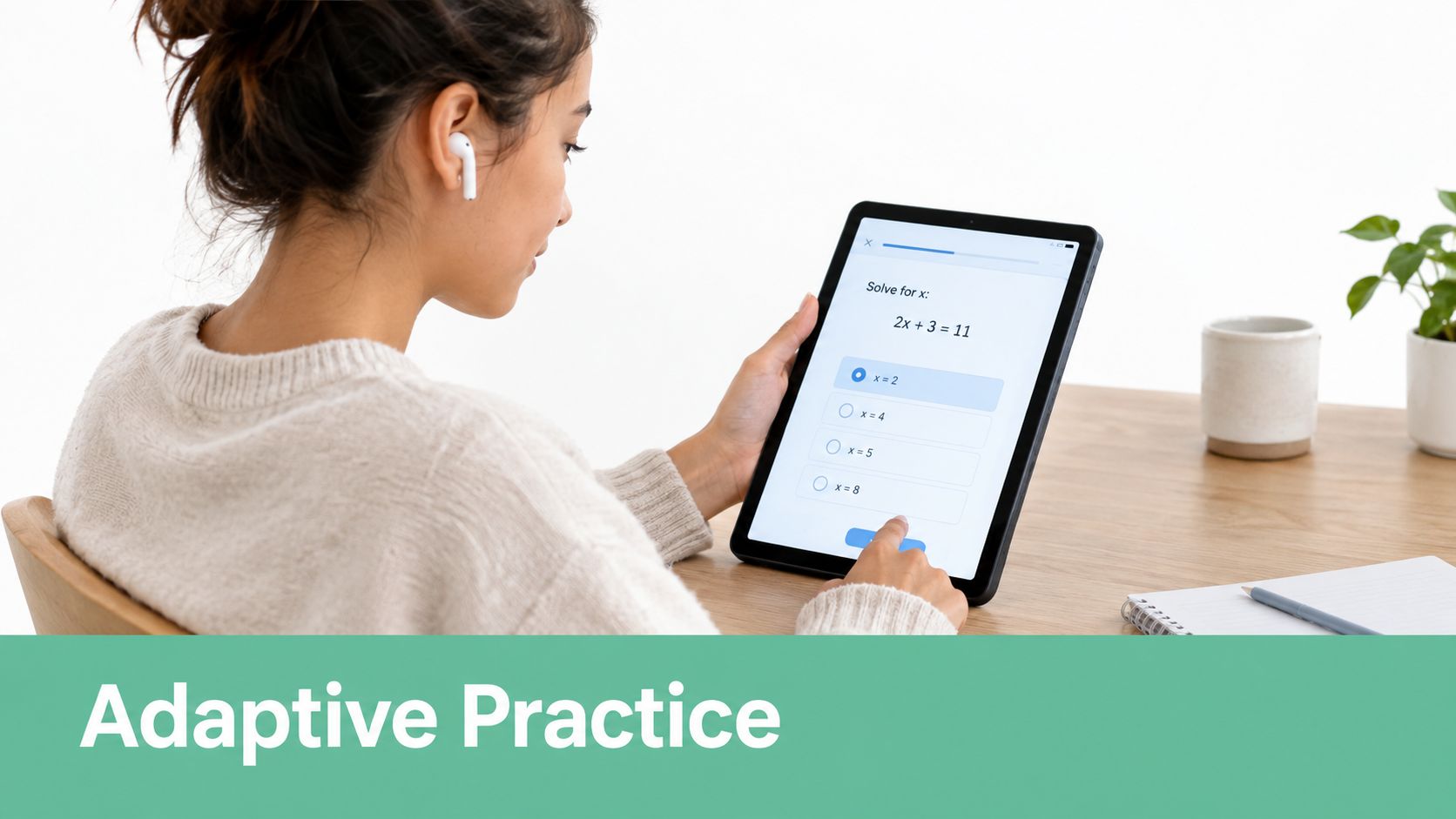
Interactive resources such as Khan Academy, Corbett Maths and MyMaths let you practise topics in manageable steps. Video explanations and immediate feedback can help you spot an error before it becomes a habit.
Start with a level that feels achievable. Build confidence with straightforward percentage or algebra questions, then increase the difficulty once the method feels secure. Guessing repeatedly won't teach you much, so pause and watch an explanation when you're stuck.
A useful weekly habit is to choose one topic, complete a short practice session and write down one method to revisit. Online platforms can then sit alongside past papers, rather than replacing exam-style practice.
3. University entrance and enrichment problems
UKMT challenges, STEP preparation materials, NRICH projects and university entrance problem sets introduce non-routine problems. They may sit beyond the direct requirements of Functional Skills Maths, but they can strengthen persistence and flexible thinking.
These questions often reward pattern spotting rather than immediate formula use. If the answer doesn't appear quickly, write down what you know, test a smaller case or draw a diagram. Give yourself time to explore instead of treating a slow start as failure.
Use enrichment at the right stage
Enrichment works best after you've built confidence with core number, algebra, geometry and data skills. Learners considering an Access to Higher Education Diploma or future degree study may enjoy these problems as an extension.
For exam preparation, prioritise Functional Skills practice first. Enrichment should stretch your thinking without taking attention away from the qualification you're working towards.
4. Textbooks with worked examples
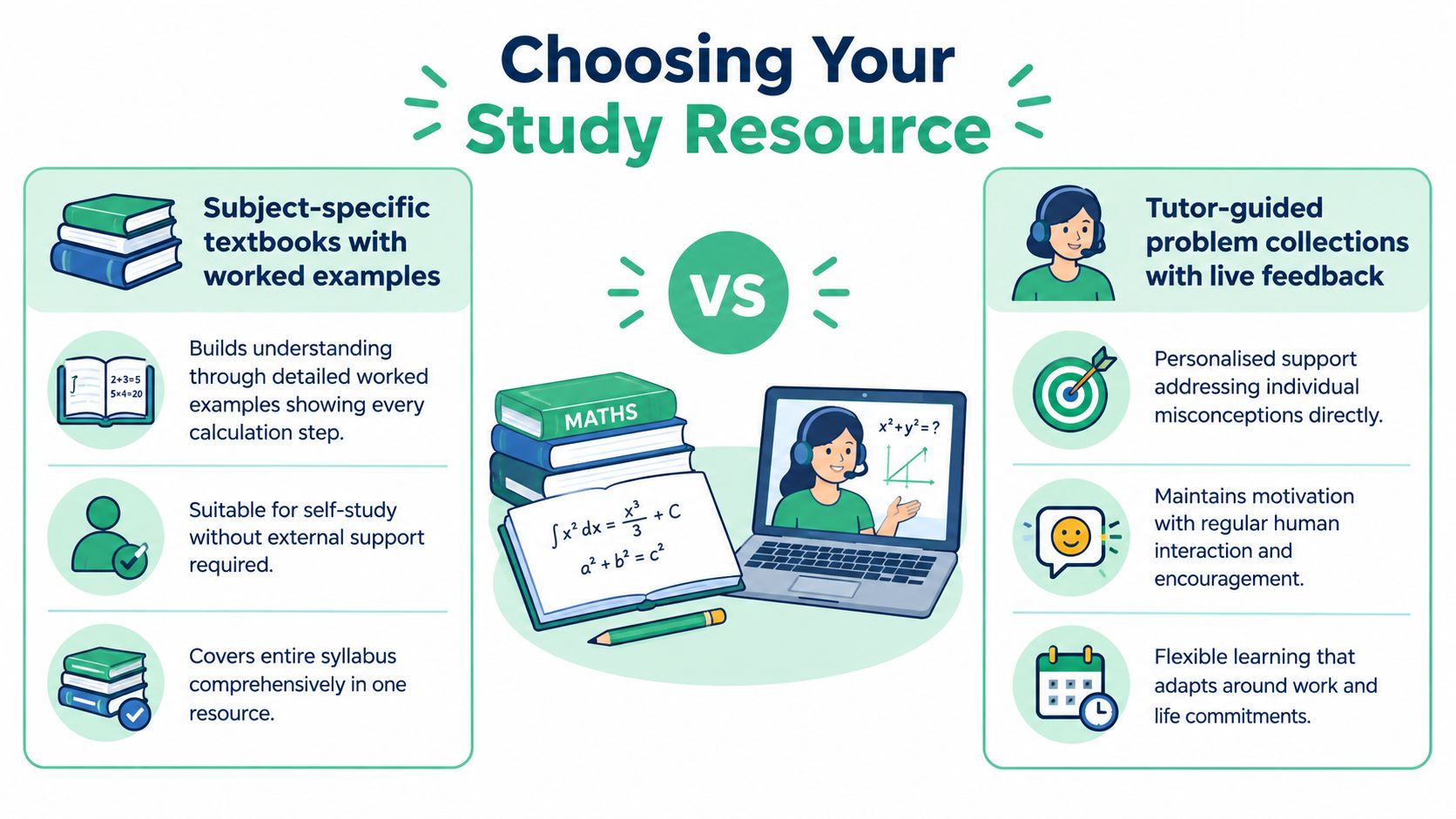
Functional Skills and GCSE workbooks from Collins, CGP, Hodder Education and Pearson organise topics progressively. A good worked example shows how to translate wording into a calculation, not just what the final answer should be.
Cover the solution and complete each example yourself. Then compare your working with the model answer. If your method differs, check whether both approaches reach the same result and use suitable units.
Keep a small revision notebook with:
The question type: For example, compound measures or proportion.
The method: Write the steps in plain language.
The common error: Note what went wrong.
The checking method: Explain how you can test the result.
This creates a personal reference guide for later revision.
5. Tutor-guided problem collections
Some challenging maths questions need more than an answer key. A qualified tutor can explain why your method failed, identify a missing foundation skill and suggest a better route through a similar problem.
Stonebridge's Functional Skills English and Maths Level 2 course combines online study with personalised support from qualified tutors. Prepare specific questions before requesting help. Share your working, including the point where you became unsure, so feedback can focus on your reasoning.
Ask for practice involving the topics you find hardest. Then attempt the new question without copying the earlier solution. That second attempt shows whether the feedback has become a usable skill.
6. Problem-solving competitions
The UK Mathematics Trust has supported school competitions since 1996. Around 650,000 young people take part in its maths challenges each year, according to its public figures (UK Mathematics Trust background).
UKMT Senior Challenge papers, British Mathematics Olympiad questions and NRICH problems can provide demanding practice. Start with earlier papers or easier questions, then work towards more complex problems.
Competition questions often require you to persist when the first approach fails. Set a reasonable time limit, write down attempts, and read the solution afterwards. The aim is not merely to finish. It is to understand the idea that opens the problem.
7. Real-world application problems
Workplace and everyday scenarios make challenging maths more meaningful. A budget, spreadsheet, stock calculation, dosage problem or project plan asks you to interpret information before calculating.
Begin by stripping the scenario down to its mathematical task. Identify the quantities, units and question words. Then calculate and explain what the result means in context.
A correct calculation can still give an unsuitable answer if you ignore the situation around it.
Functional Skills Maths focuses on practical application, so contextual questions deserve regular practice. Link examples to your own work or career interests. This can make revision feel more relevant than solving isolated sums.
8. Peer learning groups and discussion forums
Explaining a method to another learner can reveal whether you understand it. Discussion groups, course forums and the learndirect: Community Hub app can give Stonebridge learners and alumni of the learndirect Digital Group space to ask questions, compare approaches and share encouragement.
Ask focused questions rather than requesting an answer. Include the figures, your working and the step causing difficulty. You can also strengthen your own knowledge by explaining a solution to someone else.
Use peer discussion alongside tutor guidance. A group can suggest an alternative method, while a qualified tutor can help confirm whether it's accurate and suitable for assessment practice.
8-Point Comparison of Challenging Maths Resources
| Resource | 🔄 Implementation complexity | ⚡ Resource requirements | 📊 Expected outcomes | 💡 Ideal use cases | ⭐ Key advantages |
|---|---|---|---|---|---|
| Past examination papers and mark schemes | Low, straightforward self-practice and self-marking | Minimal, papers, mark schemes, time; usually free | Exam-format familiarity; improved timing; gap identification | Final-stage exam prep; timed practice | Authentic exam alignment; low cost; clear marking guidance ⭐⭐ |
| Online problem-solving platforms with adaptive difficulty | Medium, account setup and regular engagement | Moderate, device + internet; some platforms may charge | Personalised skill progression; immediate error correction | Bridging gaps; flexible ongoing practice | Immediate feedback, adaptive pathways, progress analytics ⭐⭐⭐ |
| University entrance and enrichment challenge problems | High, open-ended, non-routine problems needing deep thought | Low–Moderate, problem sets, time, possible tutor/discussion support | Advanced reasoning, creativity, problem-solving resilience | Enrichment; HE preparation; top-performer development | Strengthens deep problem-solving and mathematical thinking ⭐⭐ |
| Subject-specific textbooks with worked examples and exercises | Low–Medium, sequential study and practice | Moderate, purchase or library access; quiet study time | Systematic conceptual understanding; step-by-step methods | Foundational learning; structured self-study | Comprehensive syllabus coverage; worked examples for technique building ⭐⭐ |
| Tutor-guided problem collections with live feedback | Medium, scheduled sessions and active participation | High, tutor time/cost, platform access | Targeted remediation; accelerated improvement; clarified misconceptions | Learners with gaps; those needing accountability or rapid progress | Personalized feedback, tailored plans, maintained motivation ⭐⭐⭐ |
| Problem-solving competitions and challenge questions | Medium–High, timed conditions and competitive format | Low, past papers available; some competitions require entry | Speed, accuracy under pressure; exposure to novel problems | Motivated learners seeking recognition or stretch | Motivating, prestigious, pushes problem-solving limits ⭐⭐ |
| Real-world application and case study problems | Medium, multi-step contextual reasoning required | Moderate, workplace data/examples, domain knowledge | Applied reasoning; math communication; job-relevant skills | Vocational learners; adults returning to work; workplace training | High relevance to employment; contextual motivation; transferable skills ⭐⭐ |
| Peer learning groups and discussion forums | Low, join and contribute; may require moderation | Low, internet access and time; platform/community | Deeper understanding through explanation; varied methods exposure | Collaborative study; debugging solutions; ongoing peer support | Low-cost social learning; alternative approaches; increased motivation ⭐⭐ |
Turn difficult questions into steady progress
Choose one topic-focused problem and read it twice. Underline the information you need, write down what the question asks for and select a method before reaching for a calculator. Show every important step, including conversions and formula substitutions.
When you finish, compare your solution with the mark scheme or worked answer. Record the error in your revision notes, then retry a similar question later. This process turns mistakes into useful evidence about what to practise next.
Competition and university enrichment problems are optional extensions. For Functional Skills Maths Level 2, give priority to past papers, practical scenarios, topic practice and tutor feedback. These activities are more directly connected to assessment preparation and everyday numeracy.
Challenging maths questions remain a genuine barrier for many adults. In England's Survey of Adult Skills 2023, 21% of adults were classed as low performers in adaptive problem solving, compared with 29% across the OECD (Survey of Adult Skills 2023). You don't need to solve everything immediately. You need a steady method and regular opportunities to practise.
Which type of question do you find hardest, exam problems, workplace scenarios, algebra, graphs or something else? Share your experience and use it to choose your next revision task.
Stonebridge offers 100% online study, personalised support from qualified tutors and a modular learning structure. The affordable monthly subscription can fit around work and family commitments, with the option to pause or cancel without a long-term credit agreement. Current course details are available at Stonebridge Associated Colleges.
Stonebridge Associated Colleges offers flexible subscription-based online courses, including Functional Skills English and Maths Level 2 Including Exams, to help learners build practical confidence. Visit Stonebridge Associated Colleges to explore the course, tutor support and study options that can help you approach challenging maths questions with a clearer plan.