Affordable online college courses in the UK can cost as little as a monthly subscription, and eligible learners may have funding that covers the full price. That makes study feel possible again when you're balancing work, family, and everything else that can't wait.
Many adults don't stop wanting to learn. They stop because the usual options look too expensive, too rigid, or too hard to fit around real life. In the UK, that picture has changed a lot. The Learning and Work Institute's Adult Participation in Learning Survey 2024 found that 52% of adults were either currently learning or had done so in the previous three years, and 63% of learners said at least some of their main learning was online, compared with 47% in 2019 (Learning and Work Institute survey 2024).
Why affordable online college courses matter for adult learners
A parent finishes work, cooks dinner, helps with homework, then opens a laptop at 9 pm to explore study options. The course looks useful, yet the price feels like another bill they cannot justify. For that learner, affordable online college courses offer a practical route back into education without requiring life to stop first.

Price is only part of affordability
A low fee has limited value if the course is too difficult to complete. True affordability includes time, flexibility, and the ability to continue when work becomes demanding or family responsibilities change. Online learning gives adults more control over when and where they study, making it easier to fit education around shifts, childcare, caring duties, and changing schedules.
A useful test is simple: if a course looks cheap at checkout but repeatedly clashes with your life, its real cost may be missed deadlines, pauses, or withdrawal.
The UK's adult learning data reflects the lasting place of digital study. The Learning and Work Institute's Adult Participation in Learning Survey 2024 reported that online learning remained well above pre-pandemic levels. Adults increasingly expect education to adapt to their routines rather than forcing every other responsibility aside.
Value beats the lowest headline price
For many adult learners, the strongest option is not the course with the smallest advertised fee. It is the one they can sustain until completion. A subscription model can support that goal by spreading payments over time and avoiding the immediate pressure of one large charge.
The comparison is similar to choosing a monthly travel pass instead of paying for every journey at once. The payment structure matters because it affects whether the journey remains manageable.
Affordability also depends on persistence. A course that fits your budget but not your schedule can lead to repeated pauses. One that fits both gives you a better chance of maintaining momentum and completing a qualification that supports your next career or learning goal.
Understanding the true cost of online college courses
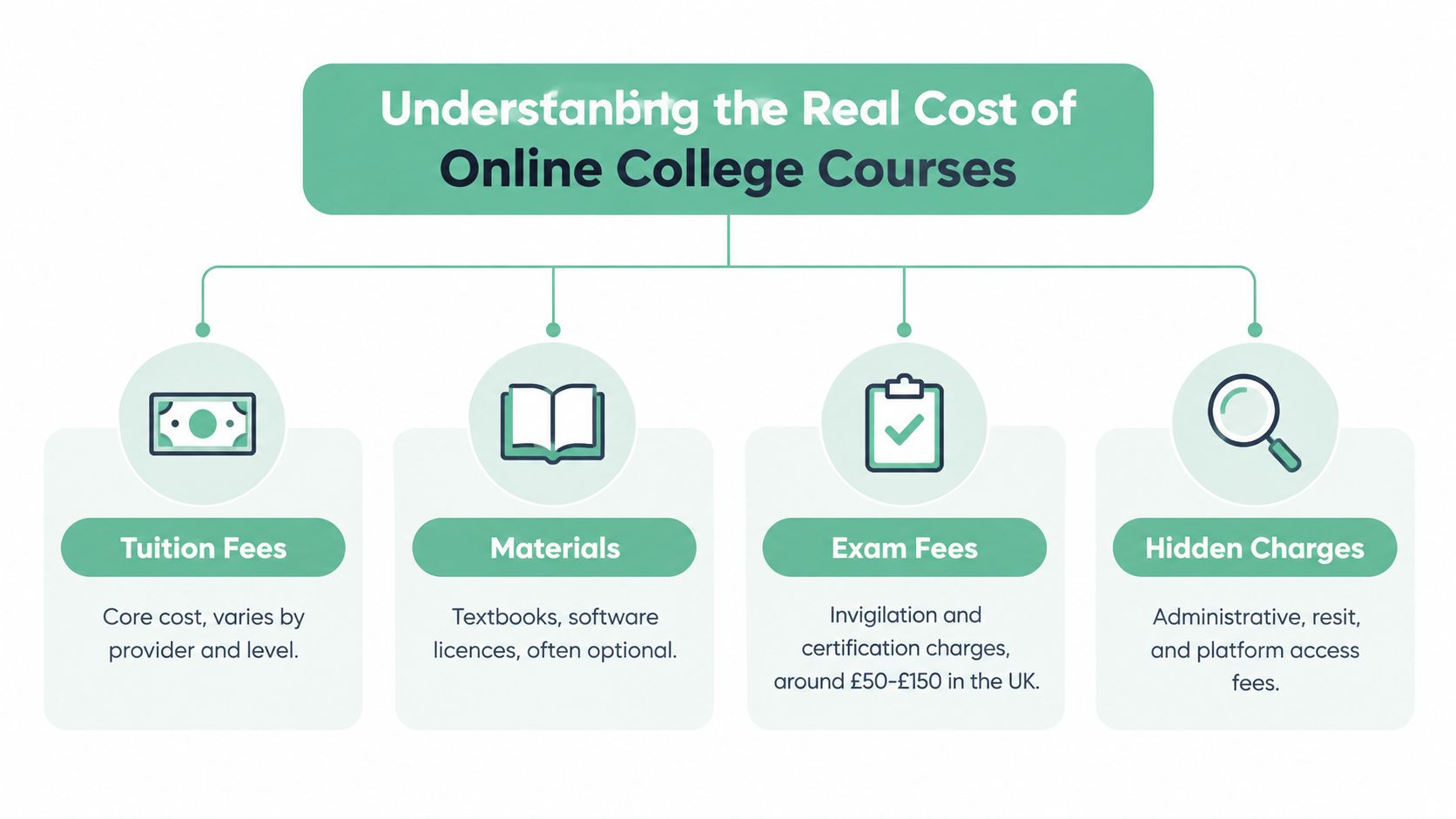
A course may fit your budget on the enrolment page yet become harder to sustain once study materials, assessment charges, and time away from work are included. Tuition is only one part of the calculation. A fair comparison looks at every cost attached to studying and asks whether the payment schedule suits your life.
Use regulated fees as a benchmark
In England, regulated tuition fee caps provide a useful reference point for comparing higher education prices. For 2025/26, the maximum fees for eligible full-time and full-time distance learning courses were £9,535 at providers with both an Access and Participation Plan and a TEF award, or £9,275 at providers with an Access and Participation Plan but no TEF award. Other approved fee-cap providers had lower limits of £6,355 or £6,185. The final year of an eligible full-time or full-time distance learning course remained capped at 50% of the relevant maximum.
These figures indicate the upper end of regulated university pricing, rather than the amount every online course costs. They also do not answer the practical questions that matter to an adult learner. A lower-priced course may still require separate payment for books, software, exam entry, or resits.
Ask what the fee covers
Use a short checklist before comparing advertised prices:
-
Are materials included? Some providers supply course resources, while others expect learners to buy textbooks or software.
-
Are exams included? Assessment and certification may have separate charges.
-
Can you pause without losing money? Flexible terms matter when work, childcare, or caring duties change.
-
Is support included? Tutor guidance and feedback can help you keep progressing instead of paying for a course you cannot complete.
A cost check should include time as well as money. For example, an inexpensive course with rigid deadlines may create pressure if your shifts change, while a slightly higher fee with flexible access may be easier to sustain.
A low price only has value when you can see what sits behind it.
Transparent pricing helps you avoid long-term debt and unexpected additions. It also makes persistence easier to plan, because you can judge whether the course supports your schedule as well as your bank balance.
Subscription vs traditional pricing, which suits you better?
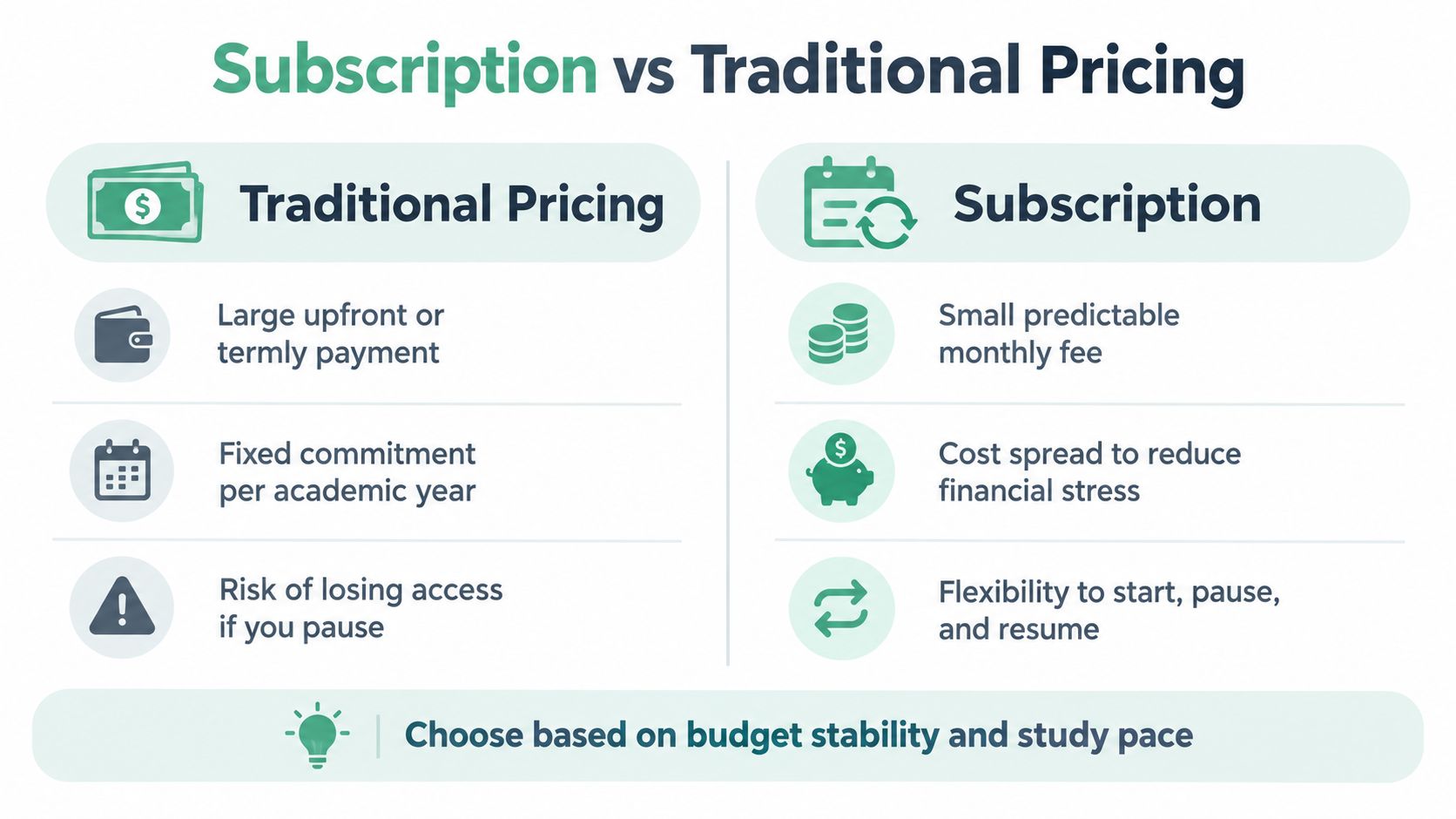
Traditional course pricing asks for a bigger commitment up front. Subscription pricing asks for a smaller, regular payment and gives you more room to adjust. For adult learners, that difference changes the emotional weight of signing up. It's easier to start when you're not locking yourself into a large one-off cost.
Why monthly study often feels easier
Stonebridge Associated Colleges offers flexible, subscription-based courses across a wide range of vocational and academic subjects, with learners benefiting from personalised support and the freedom to pause or cancel their subscription on their course of choice at any time without long-term credit agreements.
That model suits learners who need control. If money is tight one month, a subscription can be easier to manage than a large fixed fee. If work gets busy, pausing study can be less stressful than feeling trapped by a payment you can't use.
When fixed pricing can still work
A traditional payment model can suit learners who know they'll move through the course quickly and want the certainty of paying once. It may also work where a sponsor or employer is covering the fee. But if your schedule is unpredictable, flexibility often matters more than certainty.
The choice isn't really about which system sounds cheapest. It's about which one leaves you less exposed if life changes halfway through. For many adults, monthly access feels safer because it keeps the next step manageable.
How to find and evaluate low-cost accredited courses
Cheap isn't enough. If a course doesn't lead somewhere useful, or if the provider isn't properly recognised, the lower price can turn into wasted time. Start by checking whether the provider is clearly identified, whether the qualification is relevant to your goal, and whether the study format matches how you learn.
Smart saving strategies for online learners
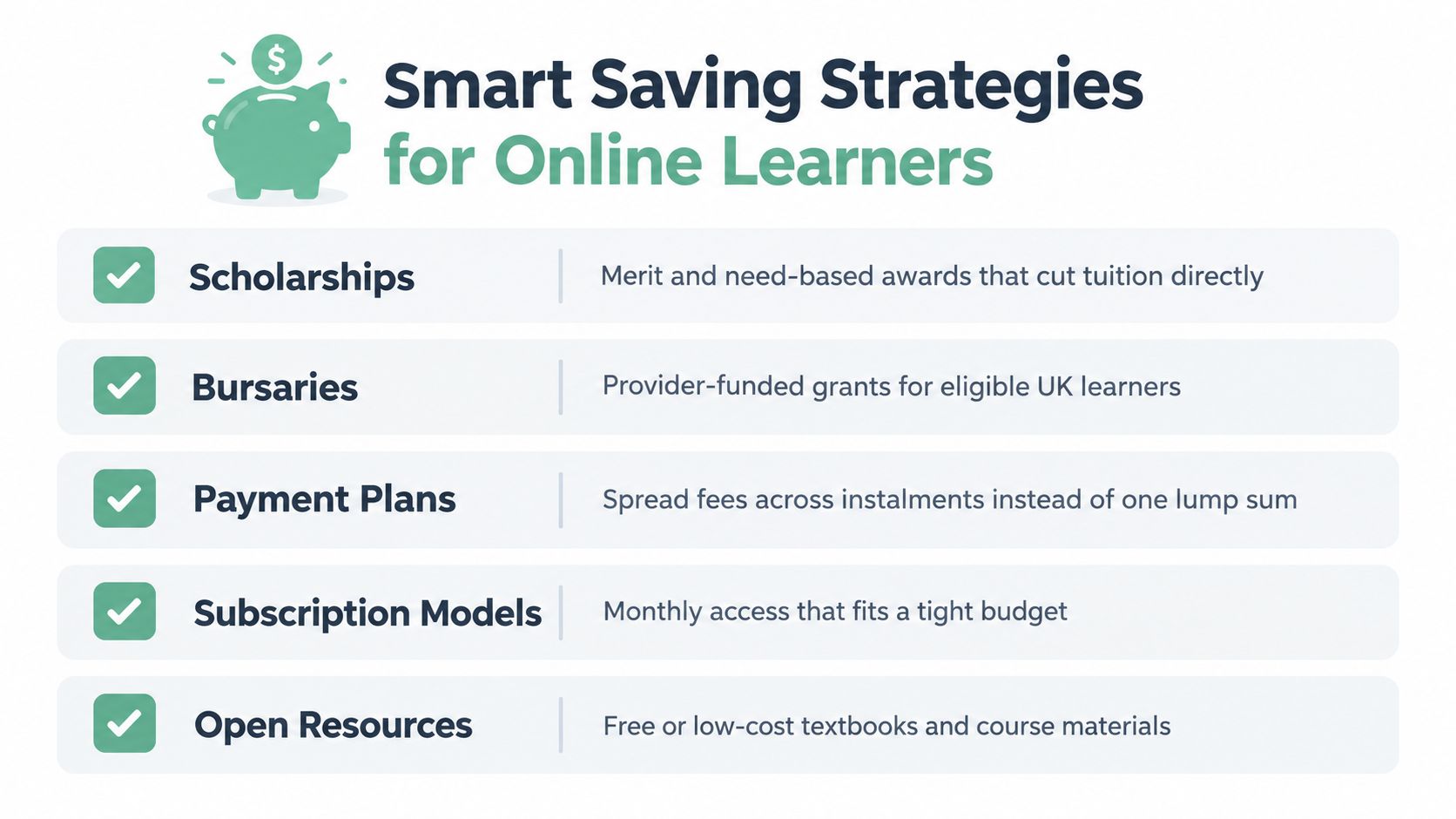
The best savings plan can be different depending on a person's situation. A subscription model can be an excellent way to reduce pressure, but so can funding and bursaries, if they are available to the learner. And when researching more affordable online college courses, the point isn't to find the absolute cheapest route, the point is to keep your costs under control without weakening the value of what you're studying.
Build a budget around your study rhythm
Some learners do better with a fixed monthly amount they can plan around. Others need to line study up with work seasons, family commitments, or funding windows. A subscription helps because it gives you room to pace yourself instead of forcing a rushed completion.
Here are the main savings levers to look for:
-
Scholarships and bursaries reduce the amount you need to pay directly.
-
Payment plans spread the cost instead of asking for one large sum.
-
Subscription models suit learners who want predictable monthly spending.
-
Open resources can cut textbook and materials costs.
-
Funding eligibility may reduce tuition to zero for some learners.
Match the course to the outcome
A course that leads to an Access to Higher Education Diploma, Functional Skills, or another recognised pathway can be a smarter investment than a cheap standalone certificate that doesn't support your next move. If you need progression into higher education or a regulated role, choose the option that helps you get there with the least financial strain.
Affordable study works best when the course, the funding, and your schedule all line up. If one piece is out of place, the savings can disappear quickly.
Why Stonebridge's subscription model makes learning affordable
Stonebridge's approach suits adults who want a realistic way back into study. The subscription model keeps the cost predictable, the online format removes travel and timetable pressure, and the course range gives you options across vocational and academic subjects. That combination is especially helpful if you're trying to study without taking on long-term credit agreements.
A practical fit for adult life
Stonebridge offers 100% online study, personalised support from qualified tutors, and the freedom to pause or cancel a subscription on your chosen course at any time. That matters for learners whose weeks don't look the same from one month to the next. If your budget changes, or work gets busy, you're not stuck forcing a rigid plan.
The course range is broad enough to support different goals, from Access to Higher Education Diplomas to Functional Skills English and Maths, alongside areas such as health and social care, nursing and midwifery, business management, education, and veterinary science. For many adults, that makes Stonebridge a straightforward way to study online with control over cost and pace.
Why this model reduces risk
A subscription doesn't just feel cheaper. It changes the risk profile of study. Instead of committing to a large upfront fee, you can move through the course in a way that suits your life. That's useful if you're returning to education after time away, or if you need to test whether online study fits your routine.
Stonebridge is accredited by the UK Register of Learning Providers and regulated by the Financial Conduct Authority, which gives learners additional reassurance around standards and financial transparency. For anyone comparing affordable online college courses, that combination of flexibility and recognition is hard to ignore.
Your next steps to affordable online learning
Start with the question, not the headline fee. Ask whether the course fits your budget, whether you can keep going when life gets busy, and whether the qualification leads towards the outcome you want. Once you've done that, price becomes easier to judge in context.
A sensible next move is to compare course formats side by side. Look at what's included, check whether funding could apply, and decide whether a monthly subscription would make study feel safer than a one-off payment. If you need a route that lets you begin without overcommitting, that's often the simplest place to start.
For many adult learners, the right course is the one they can realistically finish. That's why flexibility, support, and affordability matter together, not separately.
Stonebridge Associated Colleges offers flexible online courses across vocational and academic subjects, with a monthly subscription model that can make study more manageable for adult learners. If you're looking for affordable online college courses with a low-commitment way to start, visit Stonebridge Associated Colleges and explore the options that fit your budget and your goals.