Some UK universities accept Functional Skills Level 2 in English or maths as a GCSE equivalent for particular courses, but acceptance depends on the institution, subject, course and exact grade requirement. That's the qualified yes behind the question do universities accept Functional Skills Level 2, and it's why a pass certificate alone can't settle an application.
If you're returning to study around work or family, that uncertainty can feel frustrating. You've done the hard part, or you're about to start, and you still need a clear answer for one named course. The guidance below separates general equivalence from real admissions decisions, so you can check your route calmly and with evidence.
What the university answer means
A university can accept your qualification for one course and not for another at the same institution. That isn't a contradiction. It's how admissions works, because each course sets its own entry conditions and some add professional rules on top.
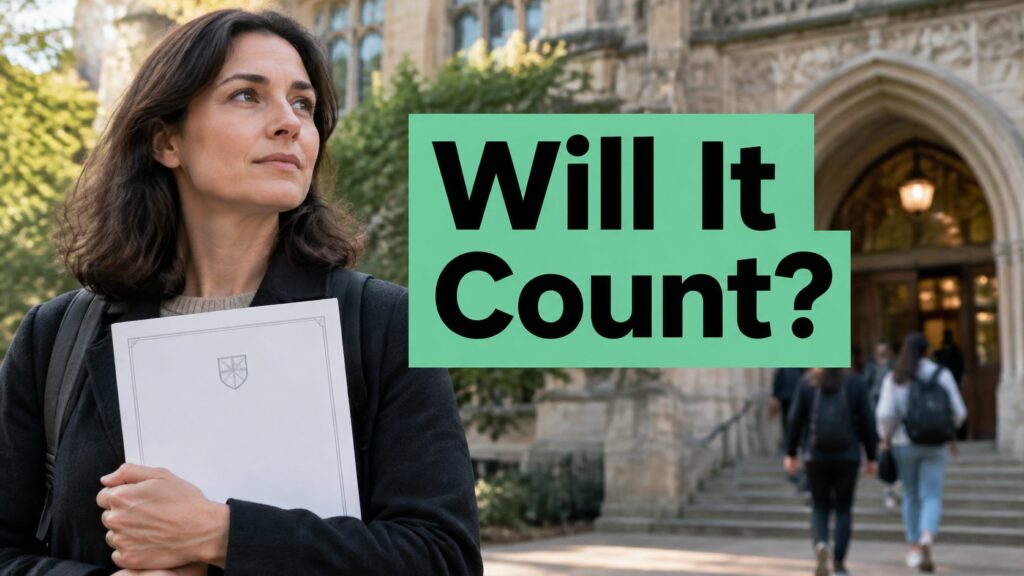
Consider a familiar situation. A learner finishes Functional Skills English Level 2 in the evenings after work, then finds a degree that asks for GCSE English at grade 4/C. The course page doesn't name Functional Skills at all. Does the pass count, or does the application stop at screening?
The difference between a general answer and your answer
The general answer is encouraging. Many universities treat a Level 2 pass as meeting a standard English or maths requirement, especially where they're asking for the usual GCSE threshold. Your answer, though, depends on precise wording. A page might say GCSE, equivalent Level 2 qualification, or a named list of accepted awards, and each phrase leads somewhere different.
You're really checking three separate things, and it helps to keep them apart from the start.
Does the qualification resemble a GCSE? Level 2 is commonly compared with grade 4/C, which explains why universities consider it at all.
Does this university accept it? Institutions publish their own accepted qualifications, and policies differ.
Does this course accept it for the subject and grade needed? This is the deciding question, because course exceptions can override a general policy.
A Level 2 pass can be the right standard and still not match a particular course rule. Checking the exact wording protects you from applying on an assumption.
Once you see the decision in those three parts, the process gets simpler. You're not asking whether Functional Skills is respected in the abstract. You're matching a specific certificate, in English, maths or both, against a specific published requirement, then getting that match confirmed in writing.
How Functional Skills compares with GCSEs
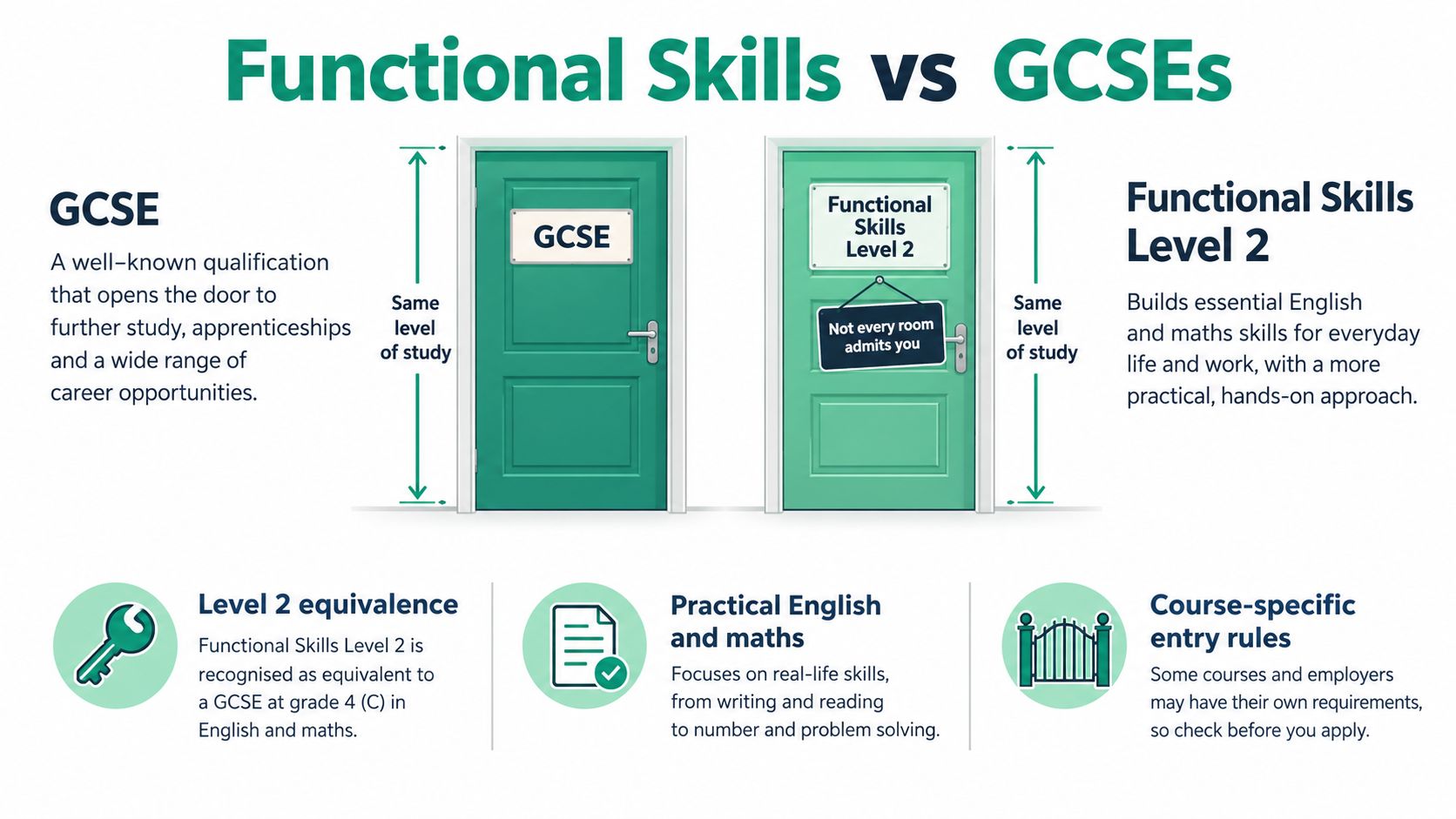
Think of two doorways built to a similar height. One is labelled GCSE and the other Functional Skills Level 2. They're comparable in level, but a sign beside the second door reminds you that not every room admits you through it. That's the distinction learners most often miss.
Functional Skills Level 2 shows practical English or maths competence, the kind you use in work and everyday life. South Essex College describes Level 2 as equivalent to GCSE grade 4 or C and able to support progression to further education and university. That comparison is genuine, but it's a comparison of level, not a promise of identical treatment by every admissions team.
What Leeds shows about the limit
The University of Leeds states that a Pass in Level 2 Functional Skills English or maths is accepted as equivalent to GCSE grade 4/C. Leeds also warns that courses requiring a higher GCSE grade may not accept Functional Skills as a substitute. So a pass that meets the standard threshold can still fall short where a course asks for grade 5, 6 or above.
That warning matters more than it first appears. Functional Skills is graded as a pass, so there's no higher grade on the certificate to point to. If a course wants evidence above grade 4/C, the certificate can't show it, however strong your actual skills are.
Placement adds another practical point. Providers may assess you first and place you at Entry 3, Level 1 or Level 2, as the South Essex course information explains. Enrolling on a Functional Skills course doesn't automatically mean you'll study at Level 2. If a university application depends on it, confirm that your final award will be Level 2 in the required subject, and keep your pass evidence safe.
Practical rule: Equivalence describes the standard you've reached. The admissions page decides how that standard is used.
What determines university acceptance
Four checks decide most applications. Work through them in order and you'll usually know whether your certificate is a plausible match before you contact anyone. Each check comes straight from the course page, so save that page or copy the wording before you start.
The four checks that matter
First, which subject is required? Some courses need English only, some need maths, and many need both, so a pass in one subject won't cover a condition in the other. Second, what's the minimum standard? A requirement at grade 4/C sits at the level Functional Skills can evidence, while a higher grade usually can't be met by a pass. Extended degree and foundation routes need care too, because Leeds notes some of these routes inherit the higher GCSE requirements of the degree that follows.
Third, read the qualification wording carefully. Phrases accepting equivalent Level 2 qualifications leave room for Functional Skills, while a named GCSE requirement needs direct confirmation. Fourth, look for course exceptions, since regulated or competitive programmes can set rules that sit above the university's general position.
Degree apprenticeships show the same logic from another angle. The University of Exeter explains that Functional Skills Level 2 is broadly equivalent to GCSE grades 4 to 9 and that apprentices aged 16 to 18 must evidence Level 2 English and maths before endpoint assessment. Exeter also treats Level 2 English as a standard entry requirement for its programmes. The qualification clearly supports higher level study, but the evidence still has to match the programme's terms.
Check the course wording before you apply
| Course wording | What it may mean | Check before applying |
|---|---|---|
| GCSE grade 4/C or equivalent | Equivalent Level 2 awards may be accepted | Ask whether Functional Skills is named as accepted |
| GCSE grade 5 or 6 | A higher standard than a Level 2 pass can show | Ask whether any alternative evidence is allowed |
| GCSE English and maths | Both subjects are required separately | Confirm you hold, or will hold, each subject |
| Named qualifications only | The list may be closed to other awards | Get written confirmation before applying |
This screening takes minutes and saves real disappointment later. If any row doesn't line up with your certificate, that isn't the end of your route. It tells you which question to put to admissions, or which extra qualification to plan for.
Courses where the rules are stricter
Some subjects apply tighter rules because a professional body, employer expectation or competitive selection process sits behind the degree. These exceptions are where confident general advice breaks down, so they're worth understanding before you choose where to apply.
The image below reflects the kind of guidance conversation that helps at this stage, where requirements are checked against your actual qualifications rather than assumed.

The University of Brighton states that Level 2 Functional Skills passes are accepted as GCSE equivalents for many courses, but not for teaching, pharmacy and medicine. One university, two different answers, depending entirely on the course. A qualification accepted by one department can't be assumed to work across the whole institution.
Teaching shows a related pattern at postgraduate level. Goldsmiths, University of London publishes accepted GCSE equivalencies for its PGCE route, including Level 1/2 Certificates and GCSE grades 4 to 9, while warning that a qualification comparable to grade C may not meet a requirement for grade B. Goldsmiths advises applicants in that position to contact admissions, which is exactly the right response.
The short video below offers further context on weighing up entry routes before committing to an application.
Treat nursing, midwifery, teaching, social work and radiography with the same caution. These courses may specify GCSE equivalence, GCSEs only, or extra science qualifications alongside English and maths. None of that means Functional Skills won't be accepted. It means you shouldn't rely on it until the admissions team confirms your exact certificate against their exact course.
Examples of different applicant outcomes
Two hypothetical applications show how the same certificate can lead to different results. Neither example promises an outcome. They're illustrations of how published wording drives the decision, so you can recognise your own situation in one of them.
Example one where the certificate fits the condition
A learner working full time in retail holds Functional Skills Level 2 in English and maths and wants a business degree. The course asks for GCSE English and maths at grade 4/C or an accepted equivalent. The university's accepted qualifications page names a Level 2 Functional Skills pass at that threshold, like the Leeds position described earlier.
The learner emails admissions with the course name and both certificates, receives written confirmation, and applies knowing that part of the entry requirement is covered. Other conditions still apply, such as Level 3 qualifications, but the English and maths evidence is settled. That written reply is worth keeping with the application documents.
Example two where the same pass isn't enough
Another learner holds the same two passes and applies for a professional health course. This course page asks for a higher GCSE grade in maths and also requires a science qualification. The Functional Skills passes show Level 2 competence, but they can't demonstrate the higher grade, and they don't cover science at all.
Admissions confirms the maths certificate doesn't meet that particular condition. The learner hasn't wasted the qualification, because it still evidences Level 2 skills for other routes. The practical options are a different course, a university whose wording accepts the pass, or further study to meet the named requirement.
The certificate didn't change between these examples. The course wording did, and that's what decided each outcome.
If you take one lesson from both stories, make it this. General comparison charts can guide you, but only the course page plus written confirmation can tell you whether your pass satisfies that requirement. Guessing either way, optimistic or pessimistic, risks a wrong decision.
Check your route with confidence
A short routine turns research into certainty. It works whether you're applying this year or planning study that leads to an application later, and it gives admissions teams everything they need to answer you clearly.
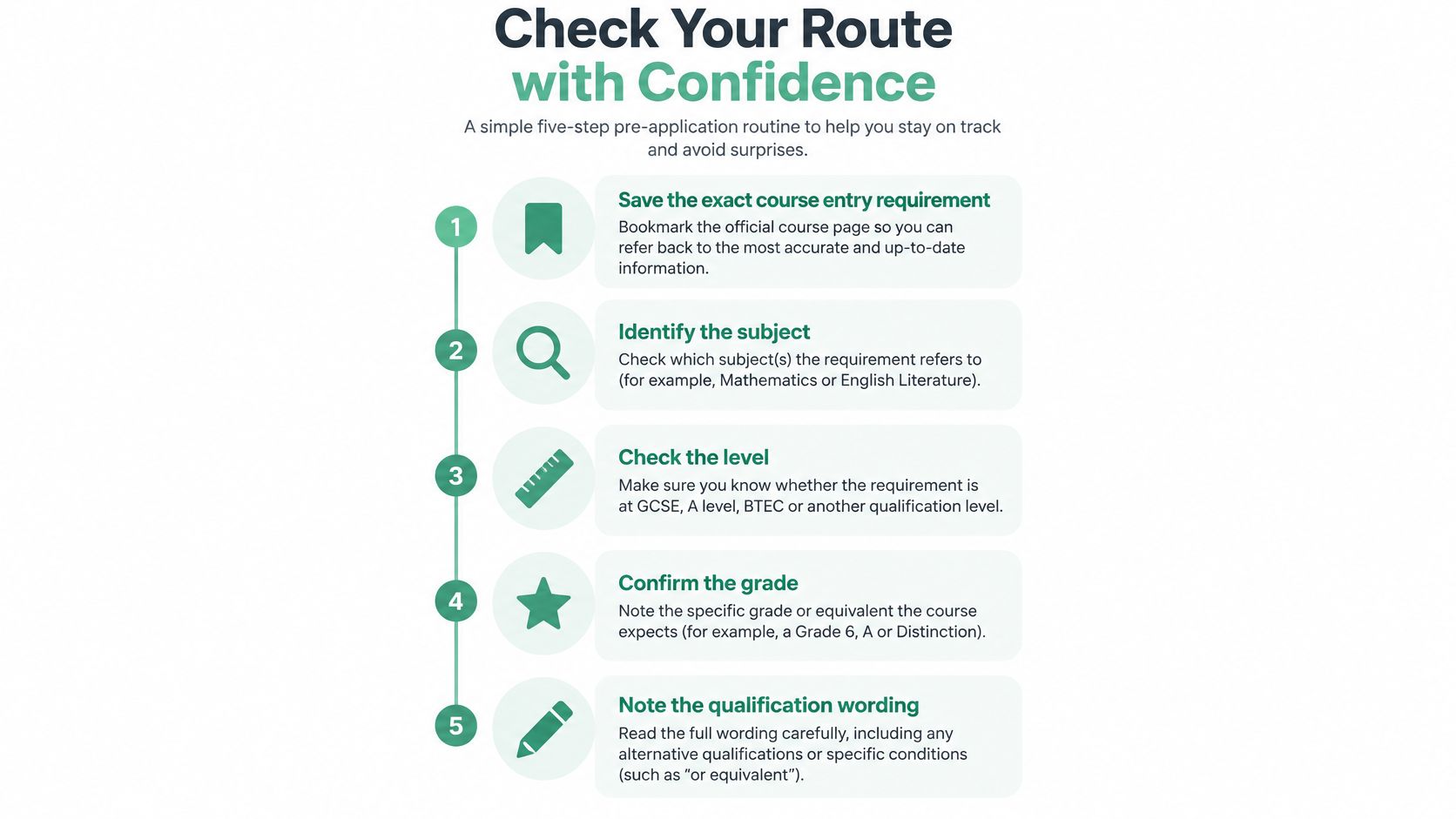
A five step check you can repeat for every course
Save the exact entry requirement: Copy the course wording, including grades and subjects, rather than relying on memory.
Match the subjects: Note whether English, maths or both are required, then compare that with the certificates you hold or plan to gain.
Check the standard: A grade 4/C requirement aligns with Level 2. Anything higher needs a direct question to admissions.
Prepare your evidence: Keep your pass certificate and results details together, since you'll need to reference the subject, level and awarding details.
Ask a precise written question: Name the course, name your qualification, and ask whether it satisfies the stated condition. Keep the reply.
That last step carries the most weight. Ofqual reported 105,690 Level 2 Functional Skills certificates in England in 2024 to 2025, down from 114,435 in 2023 to 2024, in its annual qualifications market report for academic year 2024 to 2025. Admissions teams see this qualification often, so a clear question about your certificate is a normal, welcome enquiry.
If your route runs through preparatory study
Don't assume an Access or foundation place guarantees progression to a particular degree afterwards. The University of Derby offers adults aged 19 or over Level 2 study in Functional Skills English and/or Maths for progression to Access to Higher Education Diplomas or foundation programmes. That's a genuine pathway, but the university you later apply to can still apply its own GCSE equivalence rules.
Map the whole route before you start. Write down your Functional Skills subject and level, your planned Access to Higher Education Diploma or other Level 3 study, and the target university's confirmation for each stage. A pass might satisfy an Access provider's entry requirement while the receiving university later asks for something more.
It's also worth distinguishing English and maths awards from digital qualifications. Ofqual recorded 326,060 Functional Skills certificates across the 2025 to 2026 academic year and notes the move from older ICT awards to Digital Functional Skills in its annual report and accounts 2025 to 2026. Check the awarding organisation, subject, level and certificate date whenever you present evidence, so there's no confusion about which qualification you hold.
Build your next step with Stonebridge
If you're missing the English or maths evidence a course asks for, gaining that qualification is often the most practical first step you can take. It won't guarantee a university place, and no honest guidance should suggest otherwise. It can, though, give you recognised Level 2 evidence to put in front of an admissions team, an Access provider or an employer.
Our Functional Skills English and Maths Level 2 course including exams is built for adult learners who need that evidence in one or both subjects. Study is 100% online, so learning fits around shifts, caring responsibilities and everything else competing for your time. You'll also have personalised support from qualified tutors, which helps when a topic hasn't made sense since school and you need it explained a different way.
Flexible study that fits around real life
Stonebridge courses run on a subscription basis with an affordable monthly fee. You can pause or cancel your subscription at any time, without a long-term credit agreement, so you're not locked in if your circumstances change. The modular structure lets you work through material in manageable sections and set a pace that suits your week, rather than bending your life around fixed term dates.
That flexibility matters when you're studying alongside other preparation. Many learners work on Functional Skills while planning an Access to Higher Education Diploma, building Level 2 English and maths evidence before or during Level 3 study. Used that way, the qualification becomes the first stage of a longer route, with each stage checked against the next provider's requirements as described earlier.
You're not studying alone, either. Learners and alumni of Stonebridge Associated Colleges get access to the learndirect: Community Hub app, available to learners and alumni of the learndirect Digital Group only. The app hosts discussion groups, topic-specific communities and interactive forums where you can ask questions, share progress and hear how other adult learners are managing the same challenges.
Plan the qualification and the checks together
Start with the end in mind. Choose your target courses first, save their entry wording, and confirm whether you need English, maths or both. Then study towards the exact certificates those courses describe, and get written confirmation from admissions once you know which award you'll hold. That order prevents the common problem of finishing a qualification and only then discovering a course wanted something different.
If university isn't your immediate next step, the qualification still stands on its own. Level 2 English and maths evidence supports applications for further study, apprenticeships and roles that ask for GCSE level skills, subject always to each organisation's own wording. Whatever your destination, you'll have a recognised certificate and stronger everyday confidence with reading, writing and numbers.
You're welcome to share your own experience of checking entry requirements, or ask a question about your route, since other learners are often facing the same decision. Calm, careful checking now gives your application the firmest possible footing later.
If you're ready to gain the English or maths evidence your next course asks for, Stonebridge Associated Colleges offers flexible online Functional Skills Level 2 study with tutor support and exams included, on a subscription you can pause or cancel at any time. Visit the course pages to check what's involved, compare it with your target university's entry wording, and start building your route into higher education today.