
When it comes to online learning vs classroom learning, it’s not about which is better overall. It's about figuring out what fits your life, your goals, and the subject you want to study. In the UK in 2026, both options are popular, and many adults now combine flexible online study with essential in-person elements like exams, work placements, or skills observations.
So, how do you choose the right path for you? This guide breaks down the key differences to help you make a confident decision.
Online learning vs classroom learning at a glance

We've been helping learners study online since 1995, so for us, this isn't just a convenient alternative to classroom learning. It’s a core part of how modern adult education works. If you're looking for a simple way to compare the two formats, this table is a great place to start.
| Criterion | Online learning | Classroom learning |
|---|---|---|
| Day-to-day | You study from home, usually at times that suit you. | You attend lessons at set times and places. |
| Flexibility | It's highly flexible, which is great for work and family life. | It's less flexible due to travel and fixed timetables. |
| Cost | It's often simpler to budget for, with no travel costs. | Travel, time off work, and materials can add up. |
| Support | You get tutor guidance and a wealth of digital resources. | You have face-to-face teaching and live group contact. |
| Best fit for | Adults, career changers, and self-paced learners. | Learners who want a fixed routine and in-person teaching. |
In practice, this means online study is perfect if you need to manage other commitments like a job, parenting, or caring for a family member. On the other hand, classroom learning might suit you if you thrive on a fixed routine and immediate, in-person interaction.
A few quick questions can help you decide:
Do you need control over your schedule? Online learning is your best bet.
Do you learn best with live supervision? Classroom learning could be a good fit.
Would commuting make studying difficult? Online learning removes this barrier.
Does your subject require regular, hands-on practice? A blended or classroom approach might be necessary.
The best format is the one you can stick with consistently, not just the one that looks good on paper.
This is where Stonebridge comes in. We offer 100% online study, dedicated support from qualified tutors, and flexible, subscription-based courses that you can pause or cancel without being tied into long-term credit agreements. For adults weighing up online learning vs classroom learning, that blend of freedom and structure often makes the difference between just planning to study and actually finishing your course.
In the next sections, we'll dive deeper into the practical side of things, from flexibility and cost to engagement and the subjects where each route works best.
For many adults, the real debate in online learning vs classroom learning isn't theoretical. It’s about what a normal week actually feels like. One option requires you to travel, sit in a specific place, and keep up with a group. The other lets you log in whenever life allows, which is why it’s a game-changer for learners juggling work, family, and their studies.
What online study feels like
With online learning, your journey typically starts on a dedicated learner platform. From there, you work through modular units, download resources, submit your work, and get feedback from your tutor – all without setting foot on a campus.
This rhythm is ideal for adults who study in the evenings or over the weekend. Research from Harvard Extension School highlights that online courses can be completed in the evenings, over the weekend, or during a lunch hour, which is precisely why they’re so effective for busy learners.
At Stonebridge, we structure our courses in the same way. With 100% online study, modular courses, and personalised support from qualified tutors, you can work through an Access to Higher Education Diploma or a Functional Skills course without trying to force your life to fit around a rigid classroom timetable.
Online learning works best when the course gives you structure, not just freedom.
A typical week might look like this:
Reading a unit after work.
Completing an assignment at the weekend.
Sending a question to your tutor mid-week.
Revisiting a resource before a quiz.
This isn’t a loose, do-it-whenever model. Our online courses have clear deadlines and regular checks to keep you on track and moving forward.
What classroom learning feels like
Classroom learning is built around fixed timetables and on-site attendance. You travel to a location, join a group, and learn through direct teaching, discussions, and live supervision.
This can be reassuring if you like a regular routine. It also offers instant feedback in the room, which some learners prefer when they want to ask a question and get an answer on the spot.
Where each format fits best
| Learning need | Online learning | Classroom learning |
|---|---|---|
| Working around shifts | A strong fit | Often difficult |
| Needing routine | Good, if you self-manage | A strong fit |
| Written study and theory | A strong fit | A strong fit |
| Hands-on demonstration | Sometimes blended | Often stronger |
Classroom learning still holds its own for subjects that require labs, work placements, or practical demonstrations. This includes many health, care, and technical routes where you need to show a skill, not just read about it.
However, the two formats now overlap more than they used to. Many of our learners study theory online and then complete exams, placements, or skills observations in person. This makes the choice less about rigid labels and more about what fits your life.
If you're considering your next step, our flexible subscription model makes online study even more accessible. You can start, pause, or cancel your course without being locked into a long-term credit agreement. Find a course that fits your routine and choose the format that helps you cross the finish line.

When you compare online learning vs classroom learning against the demands of real life, flexibility often seals the deal. If you're working, raising children, or caring for someone, the right course is the one that bends around your commitments, not the other way around.
Studying online eliminates the commute, so the hours you would've spent travelling can be used for reading, revision, or simply being at home. It also allows you to break your study into shorter, more manageable sessions, which is perfect for fitting around shift work, the school run, or other duties that don’t follow a 9-to-5 schedule.
Why pace matters
With a modular online course, progress feels more achievable. You can work through a unit, take a break, and pick it up again once work or home life settles down.
Our subscription-based model makes this a realistic option week after week. With affordable monthly fees and the ability to pause or cancel without long-term credit agreements, you’re not tied to a rigid schedule when things change.
Classroom learning operates differently. Term dates, fixed session times, and travel can squeeze study into narrow windows. If you miss a class because a shift was changed or childcare fell through, catching up can feel like an uphill battle.
Flexibility is only valuable when it’s backed by structure, tutor support, and high-quality materials you can actually work with.
A practical weekly scenario
Imagine you're a Healthcare Assistant on rotating shifts. An evening class could mean a late commute, a rushed meal, and another hour on the road home.
Logging in at home after a late shift is still tiring, but it's far more doable. You can complete a short section, keep your momentum going, and avoid losing half your evening to travel.
What flexibility means for your success
Flexibility alone won't get you to the finish line. Learners who stick to a steady routine are the most likely to complete their course, no matter which format they choose.
That’s why our 100% online courses pair freedom with qualified tutor support and clear learning materials. For many adults, that combination is what turns the idea of studying into an achievable reality.
With Stonebridge, you benefit from:
A better fit for busy weeks when your schedule keeps changing.
Less pressure on travel and childcare arrangements.
More control over your pace when energy is limited.
More realistic study habits that help you see it through to the end.
If the choice between online learning vs classroom learning comes down to everyday practicality, the question is simple: can your provider support your routine, not just your ambition?
When you’re weighing up online learning vs classroom learning, the price is only one part of the equation. What really matters is the total cost in money, time, and flexibility, especially when you’re juggling work, family, and your studies.
Classroom learning often comes with a longer list of costs beyond the headline tuition fee. You need to factor in travel, parking, printed materials, and any time you might need to take away from work or caring duties.
Funding is a crucial factor here too. A House of Lords Library briefing noted that spending on classroom-based adult learning in England fell from around £5.1 billion in the early 2000s to £1.7 billion in 2023/24. In practice, this means many learners are looking much more carefully at what they can afford and what they're getting for their money. You can read the full briefing in the House of Lords Library report on adult learning funding.
The hidden costs of classroom learning
The advertised fee is just the beginning. A weekly course can also mean:
Fuel, bus fares, or train tickets, which add up quickly over a term.
Lost earnings, if you have to leave work early or take unpaid time off.
Printed books and handouts, which aren’t always included.
Childcare or care arrangements, if your study time clashes with home responsibilities.
A lower upfront cost is only useful if the qualification is recognised and the support is genuine.
How online study changes your budget
Online learning usually eliminates the commute, which means no travel costs and no need to budget for accommodation. It also gives you a more predictable monthly outlay, making it easier to plan your finances.
Our subscription-based model is built around this idea. With affordable monthly payments, 100% online study, and the freedom to pause or cancel at any time, you can stay in control of your budget without signing up for long-term credit agreements.
A simple way to measure value
Ask yourself these three questions:
What is the total cost of my studies?
What will this qualification help me earn, access, or achieve?
Can I realistically finish the course without financial strain?
That last point is the most important. A course offers better value when it fits your life, leads to a recognised outcome, and keeps your monthly expenses manageable. For many learners, that’s exactly where we provide a practical path forward.
The truth about online learning vs classroom learning is that motivation comes from good course design, not your location. Someone can sit through a lecture and still lose focus, while another learner can thrive at home because their course is designed to keep them engaged.

How we keep our online learners connected
Studying online can feel isolating if a course is poorly designed, but we build our courses to combat that from day one. As a Stonebridge learner, you’ll receive personalised tutor support, structured assignments, and clear milestones, so every week feels like real progress.
That support is vital when home life gets hectic or distractions pile up. It also helps you build consistent study habits, which is often the hardest part of self-discipline.
What’s more, all our learners and alumni get exclusive access to the learndirect: Community Hub app. With discussion groups, topic-specific communities, and interactive forums, you'll always have a place to ask a question, share a success, or connect with others. You’ll never feel alone on your learning journey!
Engagement comes from structure and support, not just from being in a room.
The benefits of classroom energy
Classroom learning has its strengths. Face-to-face contact, quick questions, and the energy of a group can build confidence, especially at the beginning of a course.
However, that same environment can be a disadvantage for others. A fixed pace and large groups can leave quieter learners waiting for their turn to speak, or never quite getting one.
| Setting | What keeps learners going | Where it can slip |
|---|---|---|
| Online learning | Tutor feedback, clear routines, flexible access | Home distractions, feeling isolated |
| Classroom learning | Group energy, live contact, shared pace | Travel, fixed times, quieter voices |
What this looks like in real life
An Access to Nursing learner might fit their online theory work around practical placement hours. The course still feels active and engaging because deadlines, feedback, and tutor contact keep every stage clear.
A Functional Skills learner building their confidence in English may prefer regular written feedback. Receiving small, steady comments can feel far less daunting than speaking in front of a class, and that helps to keep momentum going.
Staying the course with the right support
Practical support is what makes the difference in real life. For adults juggling work, family, or caring roles, the best format is whichever one removes barriers while keeping you accountable.
At Stonebridge, that means 100% online study, subscription-based access, and tutors who help you stay on track without making your studies feel rigid. It also means having a community around your course, not just a login page.
The lesson is simple: when it comes to online learning vs classroom learning, engagement is a matter of design as much as format. The right support can keep you moving forward long after the initial excitement has worn off.
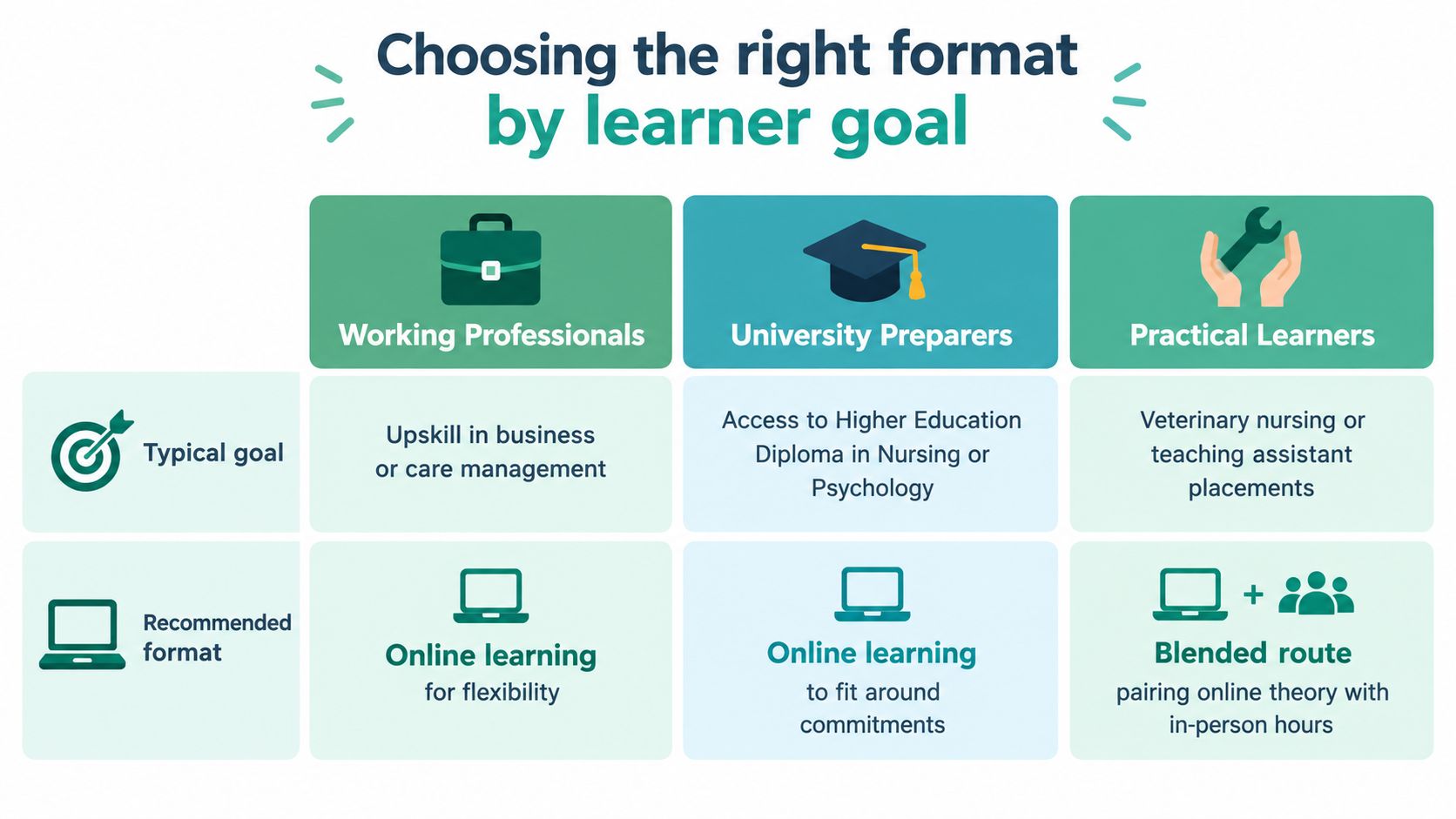
This infographic shows how your learning goals can help you choose the right study format. It compares online and blended routes for working professionals, university preparers, and practical learners.
| Learner profile | Typical goal | Recommended format |
|---|---|---|
| Working Professionals | Upskill in business or care management | Online learning for flexibility |
| University Preparers | An Access to Higher Education Diploma in Nursing or Psychology | Online learning to fit around commitments |
| Practical Learners | Veterinary nursing or teaching assistant placements | Blended route with in-person hours |
For most adults weighing up online learning vs classroom learning, the decision really comes down to what you need to achieve. If your week already revolves around work, shifts, or family commitments, online study usually comes out on top because it puts you in control of your timetable.
Match the format to your goal
Working professionals often need learning that slots around their job, not one that competes with it. Whether you're moving into business, education, or care management, online learning gives you the space to keep earning while you upskill.
Adults aiming for university usually need the same flexibility. An online Access to Higher Education Diploma in Nursing, Midwifery, Social Work, Psychology, or Health Science Professions can be studied alongside the rest of your life, which is exactly why it’s such a popular choice for mature learners.
The best format is the one that helps you keep going until you’ve completed your qualification.
Where classroom or blended routes make sense
Some subjects require more than just reading and writing. If your course depends on supervision, observation, or placement hours, a blended route is often the most sensible choice.
This applies to fields like veterinary nursing, early years practice, and teaching assistant placements, where online theory works best when paired with real-world experience. This mix gives you structure without forcing every part of your course into a classroom.
A quick decision guide
Choose online learning if you need to study around shifts, childcare, or caring duties.
Choose online learning if your goal is a recognised diploma that prepares you for higher education.
Choose a blended route if your subject requires placements or hands-on supervision.
Choose classroom learning only if a fixed attendance schedule genuinely helps you stay consistent.
At Stonebridge, our courses are designed for this kind of choice. With 100% online study, modular courses, qualified tutor support, and a subscription-based model you can pause or cancel at any time, our approach is built around real adult life, not an ideal week.
For anyone still weighing up online learning vs classroom learning, the honest answer is simple. There's no single best format – only the one you can realistically sustain to completion. We're here to make that journey easier for you to follow.
For most adult learners, the real question behind online learning vs classroom learning isn't which is better on paper. It's much simpler: what can you actually keep up with? Classroom study still has its place, especially for hands-on subjects where you need to practise in person. But for adults juggling work, family, and a qualification, online study often offers a far more workable route to success.
We’ve been helping people study online since 1995, so this is a well-established way for you to gain recognised qualifications without turning your life upside down.
What Stonebridge brings to the table
We pair 100% online study with personalised tutor support, which keeps you moving forward without commutes or fixed timetables getting in your way.
You'll also discover a wide range of career-focused programmes, from Access to Higher Education Diplomas to vocational qualifications and Functional Skills in English and Maths.
The real advantage isn't just studying online. It's studying online with structure, proper support, and a qualification that opens doors.
Why our subscription model matters
When you're comparing online learning vs classroom learning, money and flexibility usually settle the argument. Our subscription-based model keeps costs predictable with an affordable monthly fee and the freedom to pause or cancel whenever you need to, without being tied to long-term credit agreements.
This makes starting a course feel far less like a commitment you might regret. It also provides a safety net if your shift patterns change, caring responsibilities increase, or your budget gets tighter.
| What matters most | Our online study | A typical classroom route |
|---|---|---|
| Fit around your life | Strong, modular, and flexible | Fixed sessions and travel required |
| Ongoing cost | Predictable monthly subscription | Fees plus travel and time costs |
| Support | Qualified tutor guidance | Face-to-face contact |
| Progression | Recognised diplomas and Functional Skills | Depends on local availability |
Why you can trust us
Stonebridge is accredited by the UK Register of Learning Providers and regulated by the Financial Conduct Authority. These are important markers that show our commitment to high academic standards and financial transparency.
That reassurance is important whether you're aiming for higher education, hoping to upskill in care, business, or education, or simply want to get your core English and Maths qualifications.
Plus, as one of our learners, you can connect with others through the learndirect: Community Hub app, where discussion groups and communities keep the support going long after your course is finished.
If you’re ready for a study solution that fits around your life, take a look at the courses at Stonebridge Associated Colleges. Choose the path that will move you forward with confidence, on your own terms. Visit Stonebridge Associated Colleges to find your next step.