Could you meet the grades for radiography and still miss out on a place? Yes. Universities also assess your suitability for patient care and clinical placements.
If you're returning to education, your old grades aren't the whole story. There are alternative routes into UK radiography degrees, but choosing the right preparation matters.
Radiography degree entry requirements at a glance
Radiography isn't only for school leavers with A-Levels. NHS Health Careers gives the following typical diagnostic radiography entry routes, including five GCSEs at grades 4–9 or A*–C and two of three A-Levels.
Accepted UK entry routes for radiography degrees
| Route | Typical requirement | What to check |
|---|---|---|
| Five GCSEs (baseline) | Grades 4–9 or A*–C, including English language, maths and science | Each university's exact grades and subjects |
| Two of three A-Levels | At least one normally physics, chemistry, biology or human biology | Accepted science subjects |
| BTEC, HND or HNC | Science-containing qualification | Science content within your units |
| T Level | Relevant health or healthcare science qualification | Whether the subject is accepted |
| NVQ | Relevant qualification | Required level and subject |
| Access to Higher Education Diploma | Science-based Access course | Required science units and grades |
GCSEs provide the baseline, while A-Levels demonstrate further subject study. BTEC, HND and HNC routes need suitable science content. T Levels must cover a relevant health subject. An NVQ needs to match the programme. Access courses offer an alternative academic preparation route.
Practical rule: This is a national guide, not a universal admissions rule. List your qualifications and science subjects, then check the matching route with each university.
Which science subjects matter and how to fill gaps
Check whether your science study was a full qualification or an individual unit, what grade you achieved and when you completed it.
Physics and maths support understanding of radiation, imaging equipment and dose. Biology supports anatomy, physiology and patient care.
An older science GCSE may need recent academic evidence alongside it. If maths feels unfamiliar, a refresher can rebuild confidence. If you haven't studied science, ask admissions which Access units would meet their requirements.
Say you have an older biology A-Level but lack physics and maths. An Access physics unit might address the physics gap, but it won't automatically satisfy a separate maths requirement.
Bring this checklist to admissions:
Subject: Qualification title and unit content.
Grade: Certificate or transcript.
Date: When you completed the study.
Can an Access to Higher Education Diploma get you in?
An Access Diploma can open an application route, but it doesn't guarantee an offer. It prepares adults without A-Levels for higher education rather than qualifying them as Radiographers.

The HCPC education and training standards distinguish academic suitability from wider admissions and professional requirements.
Eligible to apply means meeting entry criteria. Your likelihood of an offer also depends on selection. Eligibility for HCPC registration comes after professional training and meeting registration requirements.
Our guide to what an Access to Higher Education course involves explains the preparation route.
Ask universities for their exact credit, science-unit and Distinction or Merit requirements before enrolling.
For example, a Healthcare Assistant studying around shifts could compare her planned units against university requirements. Scottish applicants should also confirm recognition: RQF qualifications may not be recognised in Scotland in the same way as in England, Wales and Northern Ireland.
Checks and experience universities ask for beyond grades
Strong grades don't establish placement readiness. These checks help universities protect patients and support safe participation.
Checks and experience beyond grades
| Check | What it involves | Who it usually affects |
|---|---|---|
| DBS check | Enhanced criminal-record check | Applicants at the programme's specified stage |
| Occupational health | Questionnaire and vaccination or immunity evidence | Applicants offered a place |
| English language | Evidence of English command | Everyone, with additional evidence potentially needed for overseas qualifications |
| Fitness to study | Assessment of safe placement participation | Learners admitted to the programme |
| Interview | Motivation, communication and suitability | Applicants at universities using interviews |
| Relevant experience | Shadowing, volunteering or patient-facing work | Applicants where required or recommended |
The HCPC radiographer standards specify English equivalent to IELTS 7.0, with no component below 6.5, and detail evidence requirements for overseas-qualified registration applicants. This isn't a universal university IELTS rule for UK applicants.
Disclose relevant health or conviction circumstances early and ask what evidence is needed. Use our university interview preparation guide to practise explaining your suitability.
Allow time to consider your interview answers.
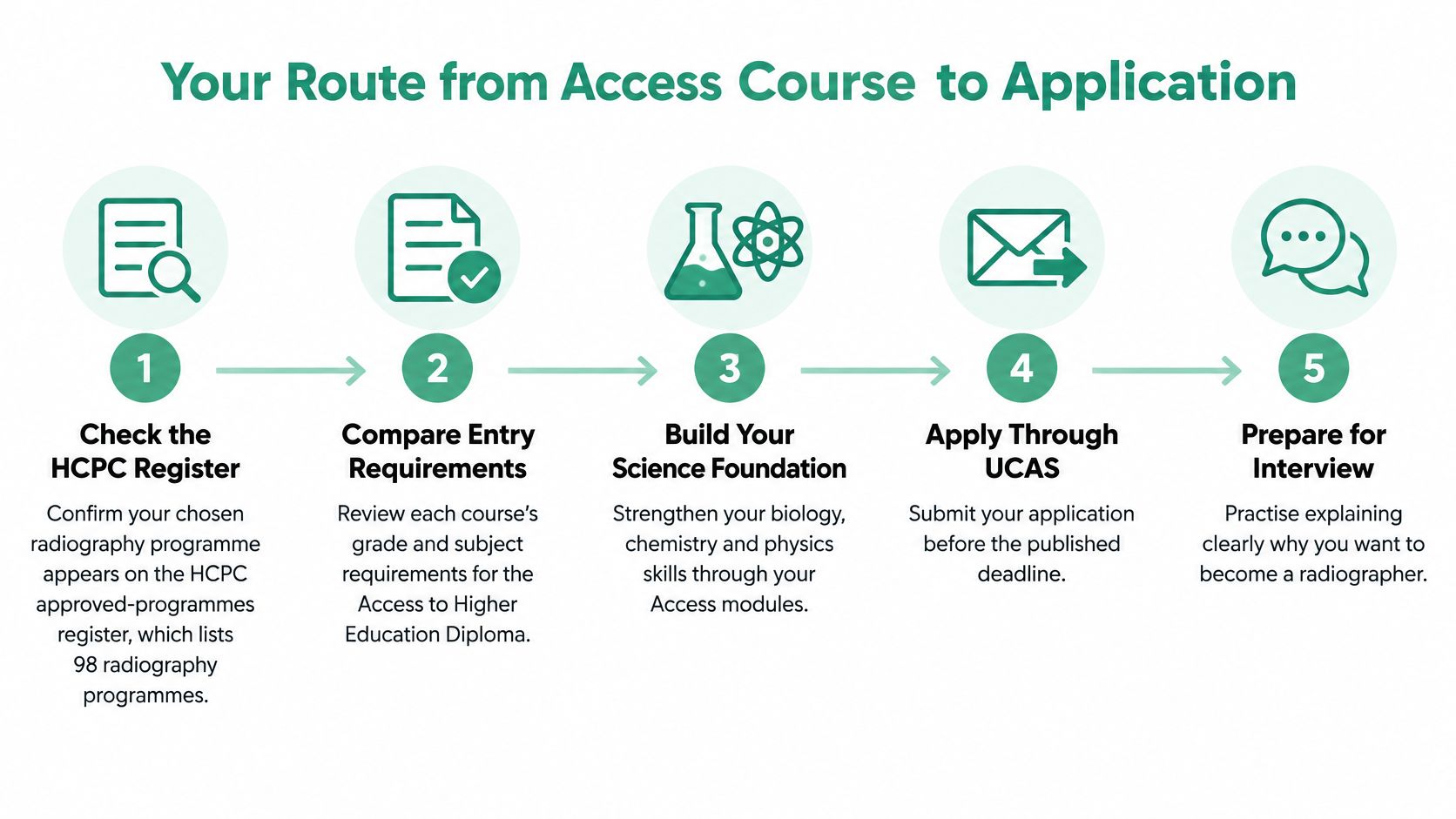
How to plan your route from Access course to application
Check your programme's approval. The HCPC approved-programmes register published results showing 98 radiography programmes at 37 providers, covering diagnostic, therapeutic, apprenticeship and foundation-year routes.
Record university subject and grade requirements so you can compare them accurately.
Match your Access units before enrolling to avoid missing essential science content.
Arrange relevant experience and note what it teaches you about patient care.
Confirm clearance requirements and timing so placement paperwork doesn't delay progress.
Apply through UCAS, explaining your motivation and experience in the required format.
Practise interview questions about teamwork, patient safety and pressure.
If a missing subject prevents admission, ask which additional study would resolve it before planning another application. Confirm course duration against your available study time.
Start your radiography pathway online with Stonebridge
An offer rests on more than grades: universities also weigh health checks, placement suitability and interview performance, so treat the Access route as preparation for each stage rather than a shortcut. Our Access to Higher Education Diploma in Radiography is built for learners without A Levels. Review Course Description, Qualification, Requirements, Syllabus, Assessment and What's Included, then compare the science content with your target degrees.

Study stays 100% online and modular, with personalised support from qualified tutors. A monthly subscription lets you pause or cancel at any time without long-term credit agreements, which helps you fit study around shifts, caring or work.
Stonebridge Associated Colleges has more than twenty years' experience, UK Register of Learning Providers accreditation and Financial Conduct Authority regulation.
Stonebridge Associated Colleges offers flexible online preparation for adults working towards university study. Visit Stonebridge Associated Colleges to explore your radiography pathway and plan study around your commitments.