You're reading job adverts, wondering whether helping people could become your career. A Social Worker job description can sound straightforward, but assessing risk and making difficult decisions takes more than compassion. Here's what to expect, with England's professional requirements as the reference point.
What a social worker does and why the role matters
A Social Worker assesses needs, protects people from harm and coordinates support. In England, it's a protected professional title, not another name for a general support role.
Say a school raises a concern about a child. The worker listens to the family, checks the child's safety, agrees the next action and records their reasoning. Practical help and professional accountability sit together: being supportive doesn't mean avoiding difficult decisions.
Core duties and the legal power behind them
| Duty | What it involves | Typical example |
|---|---|---|
| Assessing needs and risk | Gathering information from people and professionals | Home visit to check a child's safety |
| Safeguarding | Acting on suspected harm, neglect or abuse | Referring concerns to safeguarding colleagues |
| Care planning and review | Agreeing goals and checking progress | Reviewing support at an agreed interval |
| Multi-agency working | Coordinating schools, health, housing and police | Meeting with a school and GP |
| Case recording | Keeping accurate, usable records | Writing notes after a visit |
| Advocacy and practical support | Helping people access services and benefits | Supporting a parent's application |
Authority has limits. Social Work England's professional standards guidance requires workers to balance rights and wishes against risk, using authority lawfully and ethically.
Investigating concerns, sharing confidential information or recommending restrictions requires legal justification. An older man refusing care doesn't automatically justify intervention: the worker must consider his choices, capacity and risks.
Advert check: Look for named statutory duties, clear decision-making authority and an escalation route.
How the role changes across settings
England had 34,300 full-time-equivalent child and family Social Workers in post at September 2024, according to the Department for Education. Children's services are substantial, but they aren't the whole profession.

| Setting | Typical focus | Main decisions | Key records |
|---|---|---|---|
| Children and families | Safety and parenting | Protection or formal support | Assessments and protection reports |
| Adult social care | Independent living | Care eligibility and support | Care Act assessments and plans |
| Mental health | Community support | Need for Mental Health Act assessment | Assessments and reviews |
| Hospitals | Safe discharge | Going home with suitable support | Discharge plans and referrals |
| Youth justice | Young people facing justice processes | Risks to themselves and others | Court reports and plans |
| Fostering and adoption | Carers and placements | Suitability | Assessments and reviews |
Match adverts to these different Social Worker roles. Mental health statutory functions can require additional training and authorisation.
Qualifications, registration and skills employers look for
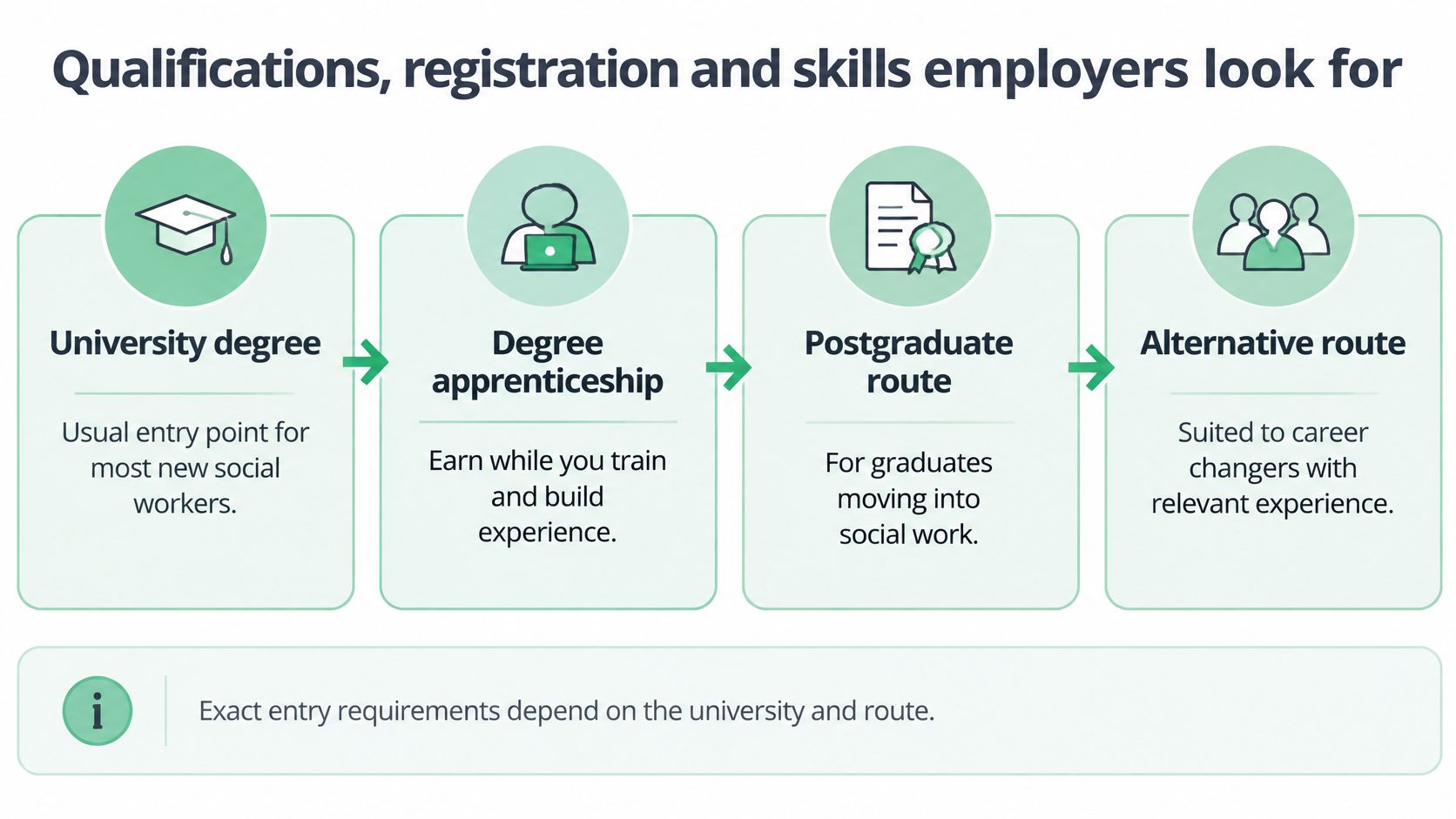
Approved study, supervised placements, qualification, registration and continuing learning make up the route in, whichever starting point you choose.
| Route | Entry point | Time to qualify | Who it suits |
|---|---|---|---|
| Social work degree, BA or BSc | A-Levels or accepted Access Diploma | Typically three years full-time | New entrants |
| Degree apprenticeship | Suitable employment | Around three years, alongside paid work | Employees wanting to qualify while earning |
| Master's in social work | Accepted undergraduate degree | Around two years | Graduates changing career |
| Access Diploma first | Returning to education | One to two years, then a degree follows | Adults without traditional qualifications |
Exact entry requirements are course-specific. Stonebridge offers Access to Higher Education Diploma courses in subjects including Social Work, studied by distance learning. An Access Diploma earns degree entry rather than a licence to practise.
Once qualified, you register before practising. Registration, supervision and development all feature in the government's published early-career standards for child and family social workers.
Employers seek clear writing, legal understanding, empathy, boundaries and sound judgement. Explore the skills needed for social work, including reflection: reviewing why you made a decision after a difficult visit.
The pressures and working conditions to expect
Fewer cases don't automatically mean easier work. BASW's account of Department for Education figures reports average children's caseloads falling from 15.4 to 15.2 in the September 2025 update, while warning that the measure misses complexity.
Paperwork is only part of that pressure.

Emotional demands, urgent risks, meetings and staff absences affect your working day. Pay and contracts are employer-specific, so check the advertised salary rather than assuming a national average is starting pay.
Ask how supervision works, how complex cases are allocated and what happens when colleagues are absent.
Use the video alongside those practical questions.
Career routes and progression after qualifying
Many newly qualified practitioners begin with an assessed and supported year in employment. Later directions include:
Practice development: Practice Educator, Practice Leader or Principal Social Worker.
Management: Team Manager and service leadership.
Specialisation: Adoption, safeguarding, mental health or youth justice.
Wider work: Policy, research, training or teaching, sometimes requiring further study.
A child protection practitioner moving into adoption brings assessment experience but still needs specialist learning. Ask employers about progression support during recruitment, rather than assuming promotion follows a fixed timetable.
Decide if social work suits you and start learning
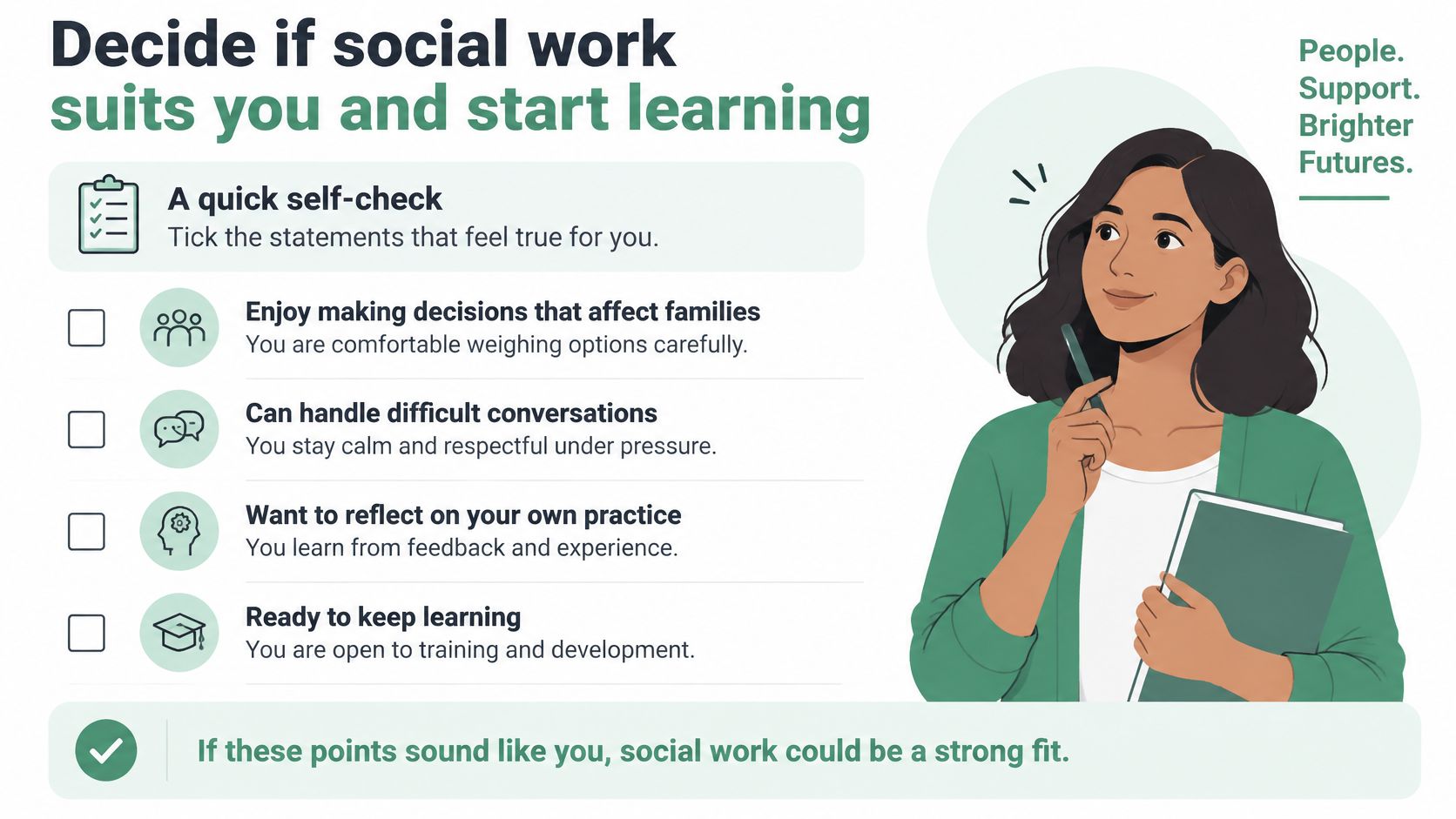
Three questions test the fit. Could you hold a difficult conversation with a distressed family, record it accurately, then take feedback on your judgement the next morning? The role combines statutory power with real caseload pressure, so an honest answer matters more than a confident one. If those demands feel manageable rather than alarming, read why study social work courses before choosing your pathway.
A practical first step is reviewing our Access to Higher Education Social Work course, checking its Course Description, Qualification, Requirements, Syllabus, Assessment and What's Included tabs against your intended university's requirements. Study is 100% online, supported by qualified tutors, and the monthly subscription can be paused or cancelled without long-term credit agreements, so preparation can fit around work or caring commitments.
Stonebridge Associated Colleges offers flexible online Access to Higher Education courses with qualified tutor support. Visit Stonebridge Associated Colleges to explore your study options and request information about preparing for university-level social work training.