
The nursery pick-up starts as a favour. Then a neighbour asks whether you'd take her two year old three afternoons a week and pay you for it. You like the idea, and you're wondering where the line sits between helping out and running a business.
Four questions settle it, and they're the same four whether you're in Bristol, Dundee or Cardiff. Which nation do you live in, how many hours a day will you have the children, whose home will the care happen in, and are you being paid? Answer those and you'll know whether the rules apply to you.
Do you need to register as a childminder?
Run the neighbour's offer through those four questions and the answer is usually clear. Collecting two children each afternoon, feeding them tea and being paid for it is childminding in the eyes of the regulators, and in England that generally means registering with Ofsted or joining a childminder agency.
The exemptions are narrower than you might expect. Unpaid help for family and friends sits outside the rules. So does care in the child's own home, which points towards nannying rather than childminding. Occasional, irregular babysitting is treated differently too, so the line sits between a one-off favour and a settled, regular pattern.
A childcare course doesn't register anyone. Only your nation's regulator can do that, and our guide to preparing for an Ofsted visit shows what inspectors look at once you're in the system.
Childminder registration rules in each UK nation
Registration looks similar on paper across the UK, but the regulator, the checks and the paperwork all change at each border. This table puts the four routes side by side.
| Nation | Regulator | Route | Typical timescale |
|---|---|---|---|
| England | Ofsted or a childminder agency | Early Years Register or General Childcare Register | A few months, set by how quickly Ofsted completes checks and the home visit |
| Scotland | Care Inspectorate | Direct application with references, Disclosure Scotland checks and home inspection | 2 to 3 months |
| Northern Ireland | Local Health and Social Care Trust | Information session, checks and home inspection | 2 to 3 months |
| Wales | Care Inspectorate Wales | Registration for childminding on domestic premises | Plan for several months, from briefing session to home visit |
A couple of things don't fit neatly in a row. Registration fees differ between nations and are revised from time to time, so take the current figure from your own regulator's published fee schedule before you budget. Timelines move too, so treat the table as a planning range rather than a promise.
The checks differ in detail as well. Scotland vets every adult living or working in the home through Protection of Vulnerable Groups and Disclosure Scotland checks before inspecting the property. Northern Ireland asks you to attend an information session first, then clear references, a medical and criminal-disclosure checks ahead of the same kind of home visit. In Wales, Care Inspectorate Wales registers childminding on domestic premises, and its guidance allows only narrow exemptions.
One trap for anyone browsing courses: qualifications certified on the Regulated Qualifications Framework may not be recognised in Scotland the same way as in England, Wales and Northern Ireland. Check before you enrol.
Identify your nation and regulator before you take a single deposit. Applying England's Ofsted assumptions across the UK means taking bookings for a service you cannot legally offer yet, so build the full registration window into your launch date.
How to become a childminder step by step
The apply to register as a childminder guidance sets out the England route. The order matters as much as the paperwork.
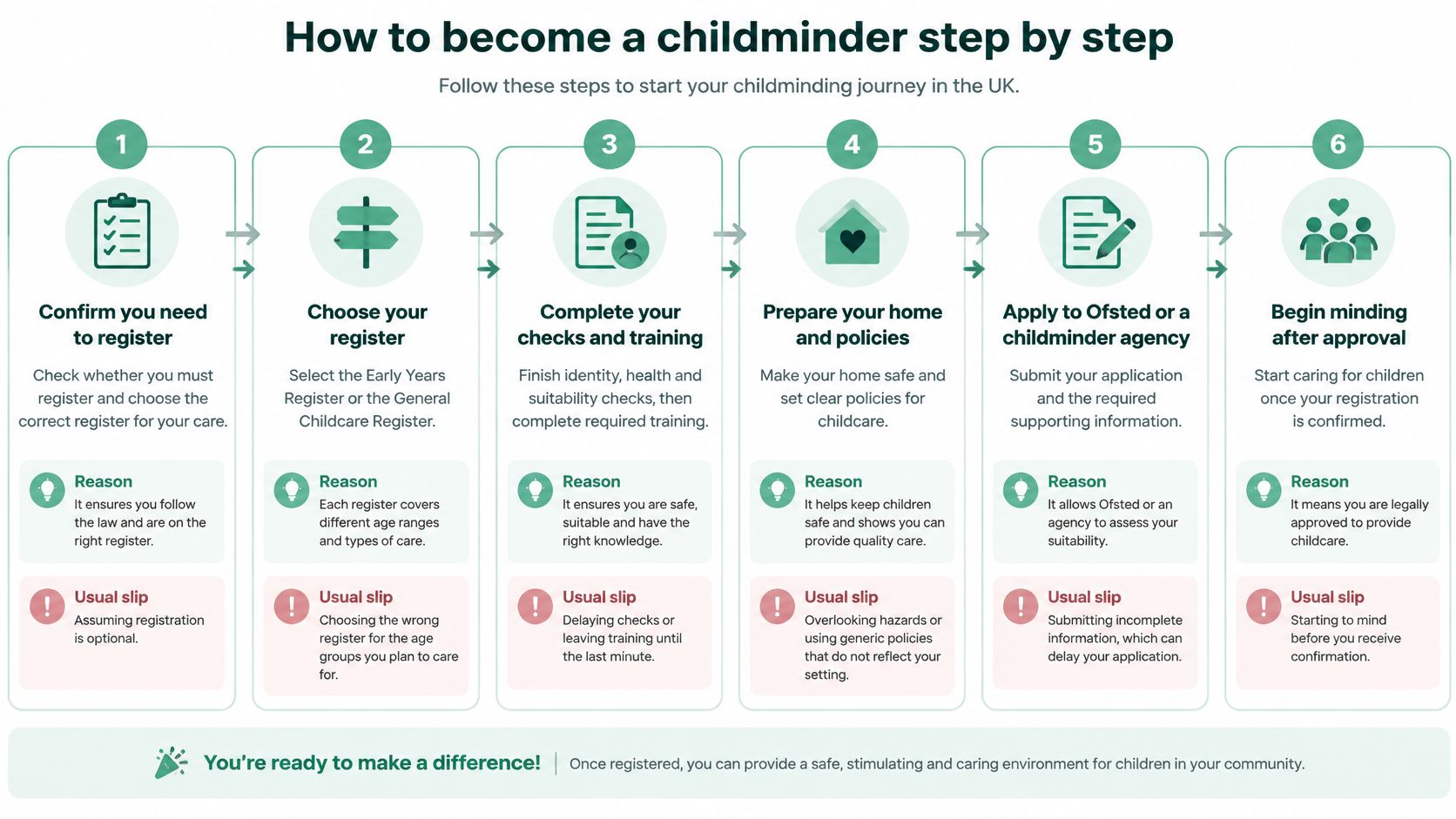
Confirm you need to register and choose your register. Early Years Register if you'll care for young children, because it carries the Early Years Foundation Stage framework. The usual slip is choosing before you know your age range.
Apply for an enhanced DBS check with barred-list information. Anyone aged 16 or over living or working in your home needs one too. Selecting the wrong DBS application category delays the whole application.
Book paediatric first aid and childcare training. The first-aid certificate must be renewed every three years, so diarise the renewal now.
Complete the health declaration booklet and line up two references. Ask referees early, because replies can take weeks.
Prepare the home and build an evidence folder. Safeguarding procedures, risk assessments, emergency contacts, attendance records and a complaints procedure belong in it before you apply, not after.
Apply to Ofsted or a childminder agency. Then plan your EYFS approach if you're on the Early Years Register.
Start your planning and observation records on day one. Registration isn't a substitute for a Level 3 childcare qualification, and a qualification isn't a substitute for registration.
Outside England, keep the same order and swap in your regulator's checks. Here's the walkthrough:
Capacity and age limits to plan around
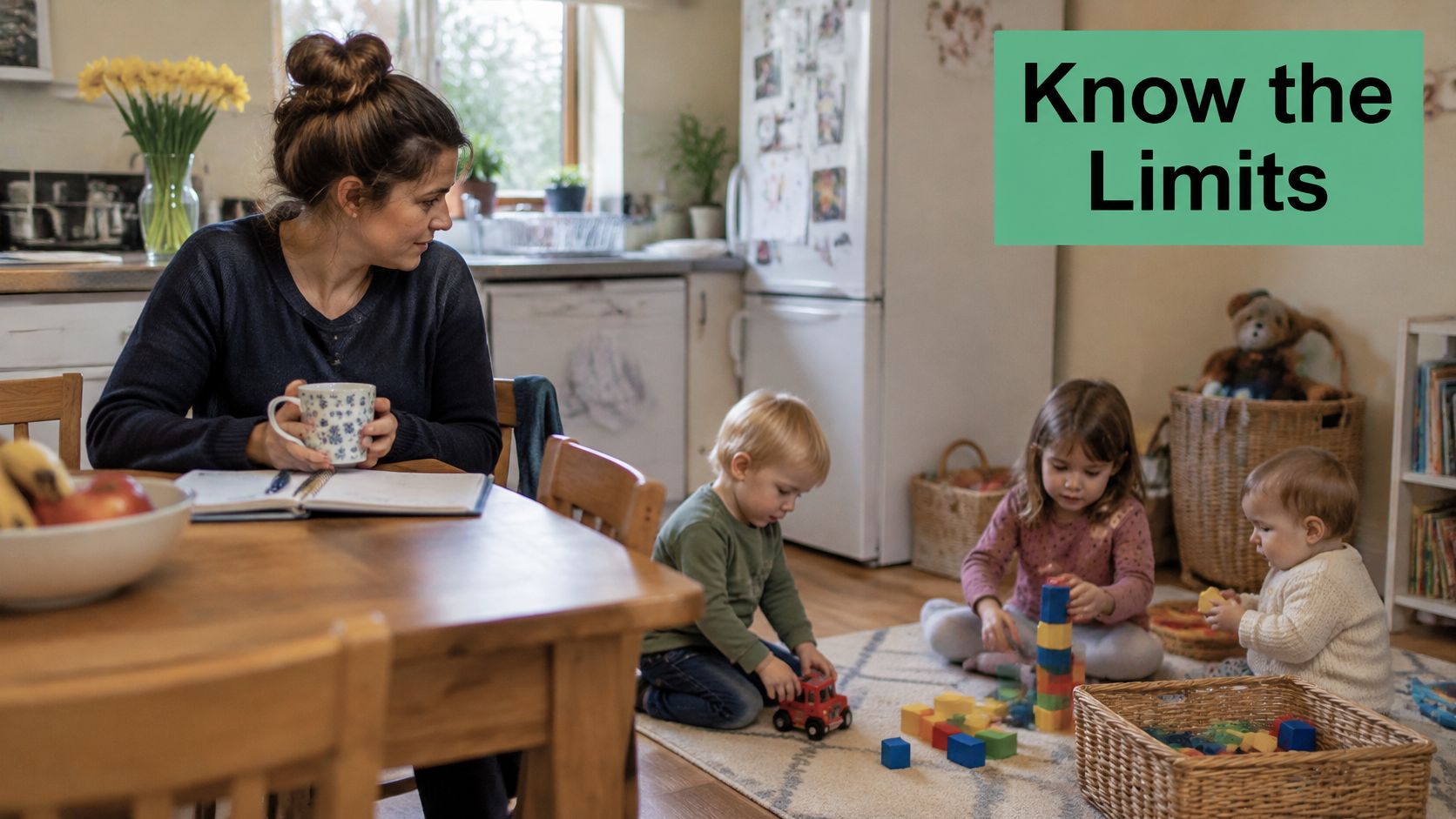
Say you already care for two children under five and three more start in September. That makes five young children, two over the limit of three, so the Early Years Register rules out taking all of them. Six places sounds like room to spare. It isn't.
A childminder on the Early Years Register can look after a maximum of six children, with no more than three classed as young children and normally only one child under one. A young child keeps that label until 31 August after their fifth birthday, according to the Ofsted registration policy for childminders based at home.
The three-young-children limit usually bites before the six. In the September example you could take two of the new starters and turn one away, or wait until an existing child passes the August cut-off and stops counting as young. Check the birthdays on a calendar before you promise places.
An assistant widens your options, and 19 per cent of English childminders employed one in 2025, per the Department for Education provider data. The trade is supervision, payroll and space duties in return for the extra places.
Funded places are the other lever. Between 2024 and 2025, the number of English childminders delivering the working-parent entitlement rose by 7,700, or 73 per cent, according to funded early education statistics, so the admin is worth learning if the hours suit you.
Local demand matters more than headlines. Childminders hold only 7 per cent of registered places in the North West and West Midlands and 11 per cent in the East of England and Yorkshire and Humber, according to the 2025 childcare provider survey. Settle your age mix before you buy a single cot.
What it costs to start childminding
| Cost | Typical starting figure | One-off or recurring |
|---|---|---|
| Ofsted annual fee (Early Years Register) | £35 | Recurring |
| Enhanced DBS check | From £49.50 per check | One-off per person, repeated for household members |
| Health declaration | £0 to over £100 | One-off |
| Paediatric first aid | From £70 | One-off, renewed every 3 years |
| Safeguarding training | From £65 | One-off |
| Insurance | From £50 | Recurring |
| Food hygiene | From £20 | One-off |
Those are Somerset's published estimates, gathered in the government guidance on what childminding costs, and they climb with every adult over 16 in the house. ICO registration for digital records may add another line if you keep everything on a laptop.
To work out your own break-even, add the one-off items, then subtract monthly running costs (insurance, food, equipment, a share of the bills) from expected income. Divide the first number by the second. With £1,800 of start-up costs and £600 spare each month, you recover the outlay in three months. Those figures are illustrative, so run your own.
Then register as self-employed with HMRC, keep income and expense records from the first booking, and check your household can absorb the unpaid months before your first paid place. Our guide to the business start-up plan and budget walks through that maths properly, because registration is the cheap part next to a half-empty setting.
Start your childminding training with Stonebridge
Registering with your nation's regulator proves you can meet the standard. It confirms your safeguarding knowledge, your first aid certificate and the safety of your home. What the paperwork never teaches is how to support a two year old's language, plan a day around mixed ages, or spot a welfare concern early. That gap is where training earns its place.
The TQUK Level 3 Diploma for Working in the Early Years Sector (Early Years Educator) is built around that everyday practice. You study entirely online at your own pace, with personalised support from qualified tutors, so the course fits around work and family life while you move through registration.
Stonebridge Associated Colleges is registered with the UK Register of Learning Providers and regulated by the Financial Conduct Authority. Courses run on a monthly subscription you can pause or cancel at any time, with no long-term credit agreement, so the cost of studying stays as predictable as the start-up budget you just totalled.
One honest limit applies. No online course replaces the registration steps set out for your nation, so match this qualification to the route that applies to you before you enrol.
Ready to turn the nursery run into a proper career? Stonebridge Associated Colleges offers flexible, subscription-based online childcare and early years courses, taught by qualified tutors and built around work and family life, so you can study at your own pace and pause whenever you need to. Visit Stonebridge Associated Colleges to explore the early years courses and take the first step towards registration.