You're reading a Care Home Manager vacancy and wondering whether your experience is enough. Or you're writing one and need clearer duties than “maintain high standards”. A strong Care Home Manager job description names what the manager must do, what evidence inspectors can check and what support the employer provides. This guide focuses on England, where CQC registration applies.
What a care home manager does day to day
Say it's Monday morning. The night shift reports two falls during the week. The manager checks care plans, contacts the GP where appropriate and reviews staffing before other tasks begin.
Core duty areas for a Care Home Manager
| Duty area | Day-to-day tasks | Standard CQC checks |
|---|---|---|
| Care delivery | Review plans, lead handovers, match care to assessed needs | Safe care and treatment |
| Staffing | Plan dependency-led rotas, supervise staff, track training | Enough staff with the right skills |
| Safeguarding | Identify concerns, escalate and follow up investigations | Protection from abuse and improper treatment |
| Medicines and infection control | Audit stock and records, monitor hygiene | Safe medicines handling and infection prevention |
| Incidents and records | Report incidents, maintain care documentation | Accurate, timely records |
| Quality and governance | Audit, track actions, respond to inspections | Well-led service |
| External liaison | Contact families, GPs, local authority and provider | Required CQC notifications |
CQC's regulations guidance connects these responsibilities to safety, safeguarding and governance. CQC inspection evidence also identifies weak documented staffing decisions and oversight.
Application check: Use the table as a duties checklist, then match each row to evidence from your experience.
Registration and the fit-to-manage checks
In England, organisations need a Registered Manager for each regulated activity unless they're health service bodies, under the CQC registration framework originating in the 2009 regulations. This is an operational role with shared legal responsibility. Covering multiple activities or locations requires sufficient capacity and capability.
The registration process includes formal evidence checks.

Providers submit location details, regulated activities and a compliance declaration. Operating without registration can lead to a fine or imprisonment, explains GOV.UK's residential care registration guidance.
The government workforce pathway specifies holding or working towards a Level 5 Diploma in Leadership and Management, or equivalent.
Qualifications, checks and evidence for Registered Managers
| Requirement | What the candidate must show | Evidence asked for |
|---|---|---|
| Good character | Honesty and integrity | Enhanced DBS with barred-list information |
| Qualifications | Relevant leadership diploma, completed or underway | Certificates and qualification records |
| Experience and competence | Skills suited to the home's size, purpose and residents | Full employment history |
| Identity | Proof of identity | Identity documents |
| Health | Fitness to perform the role | Health evidence |
Before applying, gather evidence for every row. The job description should specify location, regulated activity, legal responsibility and reporting line.
How to plan safe staffing around resident needs
A rota can look full on paper and still fail an inspection. CQC inspectors test the reasoning behind the numbers: which residents need two carers to transfer, who needs waking checks at night, and what happens when someone falls. Staffing works like a prescription, where the dose has to match the diagnosis.
A strong job description turns that reasoning into duties the manager must be able to evidence. The planning cycle has five steps.
Assess needs. Identify each resident's support requirements and personal risks.
Set shift coverage. Translate assessments into staff numbers and skills, including nights.
Check competence and record decisions. Confirm training and supervision before allocating responsibilities, then explain why the planned staffing is suitable.
Reassess and escalate. A fall or new diagnosis may require different support, and the provider should hear about gaps before vacancies compromise care.
Learn from incidents. Feed safeguarding concerns and incidents back into staffing reviews.
The visual summarises the planning cycle.
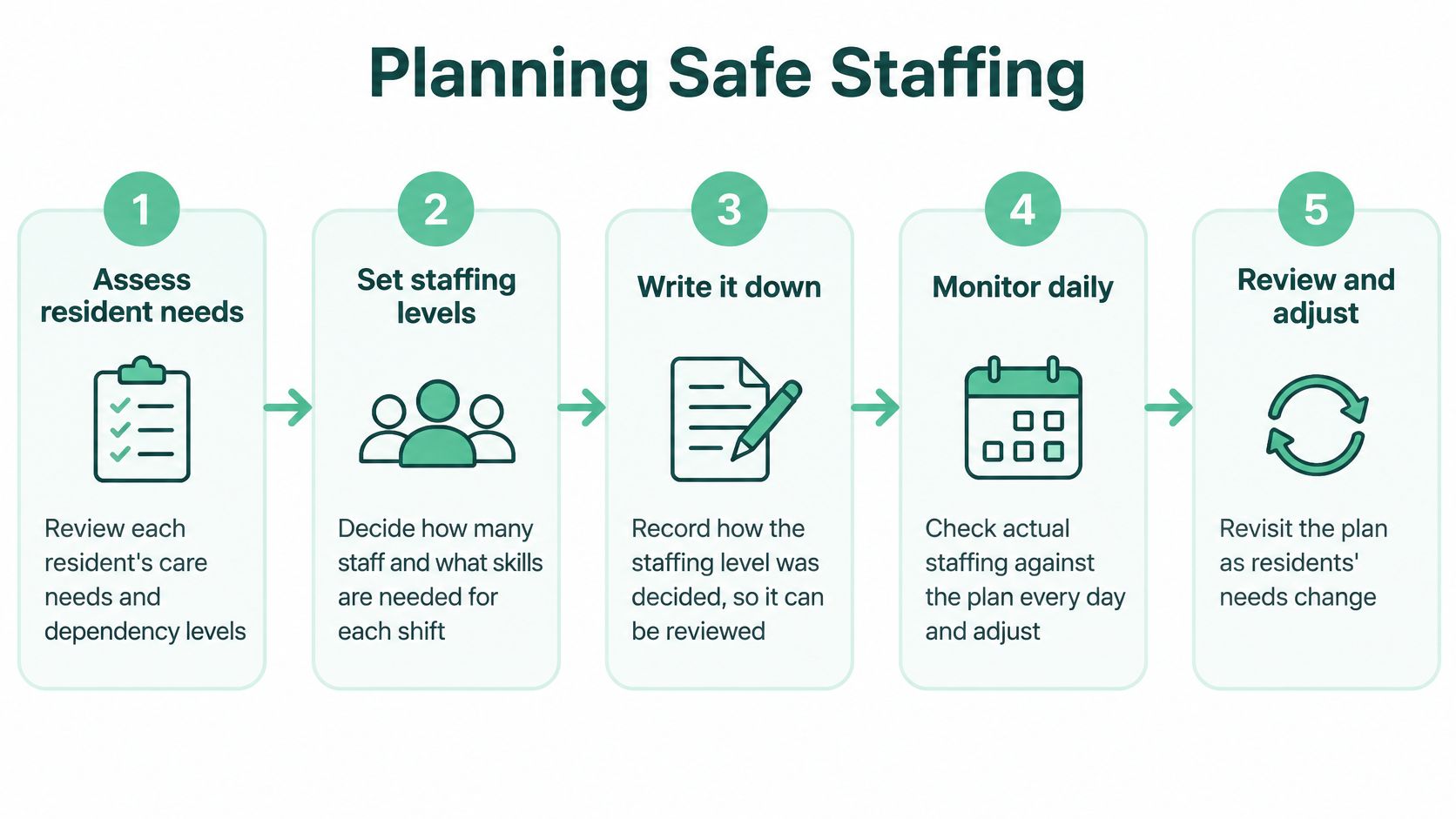
Each step is something an inspector can ask to see, so the assess, implement and review cycle belongs in the job description as a stated duty. Strong people management helps managers put it into practice when rotas change at short notice.
What the role is really like
Is the workload sustainable? Skills for Care's England workforce report records about 26,400 Registered Managers in post in 2024/25, an 11.4% vacancy rate, about 3,400 vacant posts, and 17.0% turnover, roughly 4,400 leavers, while identifying 32% nearing retirement and an association between stable management and higher CQC ratings.
For care-home staff, CQC reports vacancies fell to 5.4% by the end of 2023/24, while turnover stood at 27%. These are different workforce measures, not manager-specific figures.
Vacancies can mean arranging agency cover, filling rota gaps and protecting supervision time. Alongside the rewards of a care career, applicants should consider employer support.
Ask who provides deputy cover and what happens when recruitment leaves the service short.
Success measures should include safe staffing, completed improvement actions and staff retention, not just inspection outcomes.
Routes into care home management
You can build towards management through frontline and supervisory experience. This visual shows one possible progression, not a compulsory sequence.
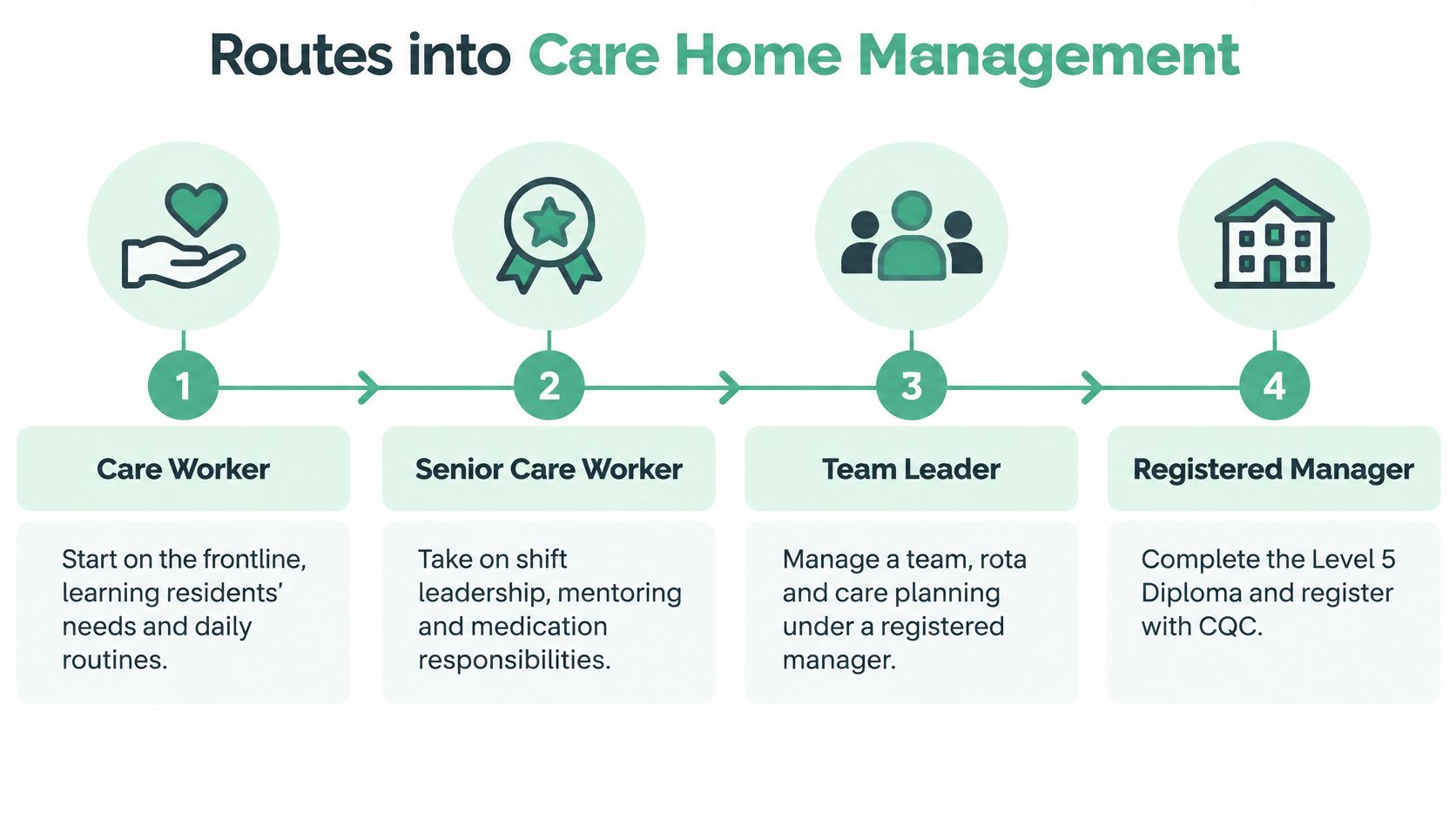
Each step works like a rung on a ladder. You gather frontline hours, take on supervisory duties, and add the leadership qualification once you hold a role that lets you complete it.
The National Careers Service profile for care home managers describes a common route: move into a deputy or manager post, then start the Level 5 Diploma in Leadership and Management within around three months of taking up the role, completing it in two to three years.
Routes into care home management
| Starting role | Typical next step | Qualification to work towards | Timescale |
|---|---|---|---|
| Care Worker | Senior, then Deputy Manager | Level 5 Diploma in Leadership and Management | Experience-led progression |
| Senior Care Worker | Team Leader, then Deputy Manager | Level 5 Diploma in Leadership and Management | Same diploma timetable |
| Registered Nurse | Clinical Lead or Deputy, then Manager | Level 5 Diploma in Leadership and Management | Same diploma timetable |
| Team Leader from another sector | Care-home management trainee | Level 5 Diploma in Leadership and Management | Build care-sector experience first |
Log shift leadership early. It becomes application evidence. When you later apply for registration, inspectors test whether you can do the duties on paper, so a clear record of real supervisory work carries weight.
This video offers further career context.
Choosing a health and social care course to start your route
A care home manager job description reads like an inspection checklist: safe staffing, medicines oversight, safeguarding, records and registered-manager accountability. Pick a course that builds towards duties a CQC inspector can test, and match it against where you are now.
The TQUK Level 5 Diploma in Leadership and Management for Adult Care (RQF) is one option to weigh against your experience and career goals. Study is 100% online, with personalised support from qualified tutors and a flexible subscription you can pause or cancel without a long-term credit agreement. The modular structure and monthly fee make it easier to fit learning around shifts and family life.
Before you enrol, read the description, qualification, requirements, syllabus, assessment and what's included tabs on our Health and Social Care course pages. Check the practical requirements carefully: the right course should suit both your current role and the registered-manager duties you are working towards.
Visit Stonebridge Associated Colleges to compare courses and choose the one that fits your route into management.