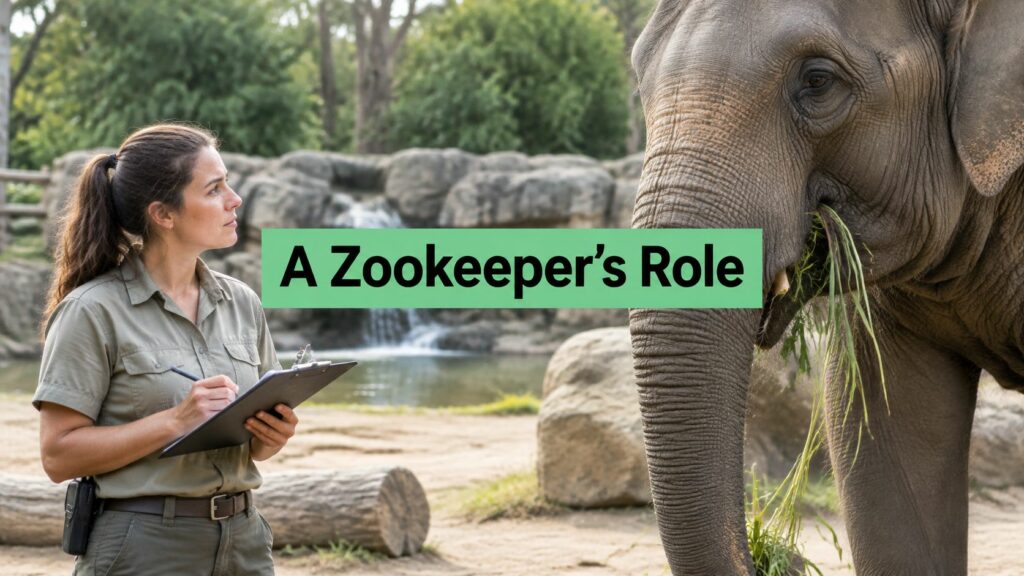
Think a Zookeeper job description is mostly about feeding animals and chatting with visitors? Read a real UK advert closely and you'll spot a different story. Modern zookeeping is built around legal welfare checks, sharp behavioural observation, heavy daily cleaning, and accurate paperwork. Learn British zoos' expectations for you, and how to judge if the role fits.
What a zookeeper job description covers
What does a Zookeeper do all day? According to the UK National Careers Service Zookeeper profile, employers group daily work into six core areas that stretch far beyond feeding rounds.
| Duty area | What it involves |
|---|---|
| Animal husbandry | Preparing and distributing food, cleaning enclosures and changing bedding |
| Health monitoring | Checking animals for injury, distress or disease and working with veterinary staff |
| Habitat and environment | Monitoring temperature and humidity and maintaining or developing habitats |
| Conservation and research | Collecting conservation research data and supporting wider conservation work |
| Education | Delivering talks and workshops for visitors |
| Supervision | Supervising Trainee Zookeepers, Animal Care Workers and volunteers |
A typical morning starts before visitors arrive. You check every animal in your section, prepare species-specific diets, and tackle thorough hygiene rounds. As the British and Irish Association of Zoos and Aquariums (BIAZA) careers guide notes, sweeping, hosing, scrubbing, shovelling, and window cleaning fill a big share of your shift across roughly 350 public zoos, safari parks, bird gardens, and aquaria in Britain, where around 3,000 people work full time.
Tasks shift sharply by species. Looking after hoofstock demands heavy lifting and outdoor mucking out, while reptile or bird sections focus heavily on climate controls and tiny dietary adjustments. Whatever you look after, noticing a subtle change in appetite or posture is the craft.
Skills and qualifications employers look for
UK zoos don't insist on one fixed qualification. Instead, you can enter through college or university study, apprenticeships, volunteering, or progression inside a zoo or aquarium.
| Entry route | Typical qualifications |
|---|---|
| Technical pathway | 4 or 5 GCSEs at grades 9 to 4, including English and maths |
| Foundation degree or higher national diploma | 1 or 2 A-Levels |
| Degree route | 2 or 3 A-Levels, including a science subject |
Guidance from the National Careers Service animal care overview puts typical training at three to four years. Biology and animal-care courses are common starting points, while employed staff often work towards the Diploma in Management of Zoo and Aquarium Animals. For a closer breakdown of your options, read our guide on what qualifications you need to be a Zookeeper.
Hands-on experience counts just as much as formal study. Employers look for six core strengths:
Close observation to learn each animal's normal habits and catch early warning signs.
Physical stamina for lifting feed sacks, barrowing waste, and staying active all shift.
Strict hygiene habits that stop infection spreading between enclosures.
Accurate record-keeping so colleagues and vets always work from current facts.
Dependable teamwork when coordinating safe animal moves or medical checks.
Clear visitor communication during talks, workshops, and unplanned questions at the fence.
Legal and welfare duties in the role
Welfare isn't a vague ideal in British zoos. It's a strict legal duty set by the Animal Welfare Act 2006 in England and Wales and the Animal Health and Welfare (Scotland) Act 2006 in Scotland. The graphic below summarises the core legal framework and welfare principles behind every keeper's shift.
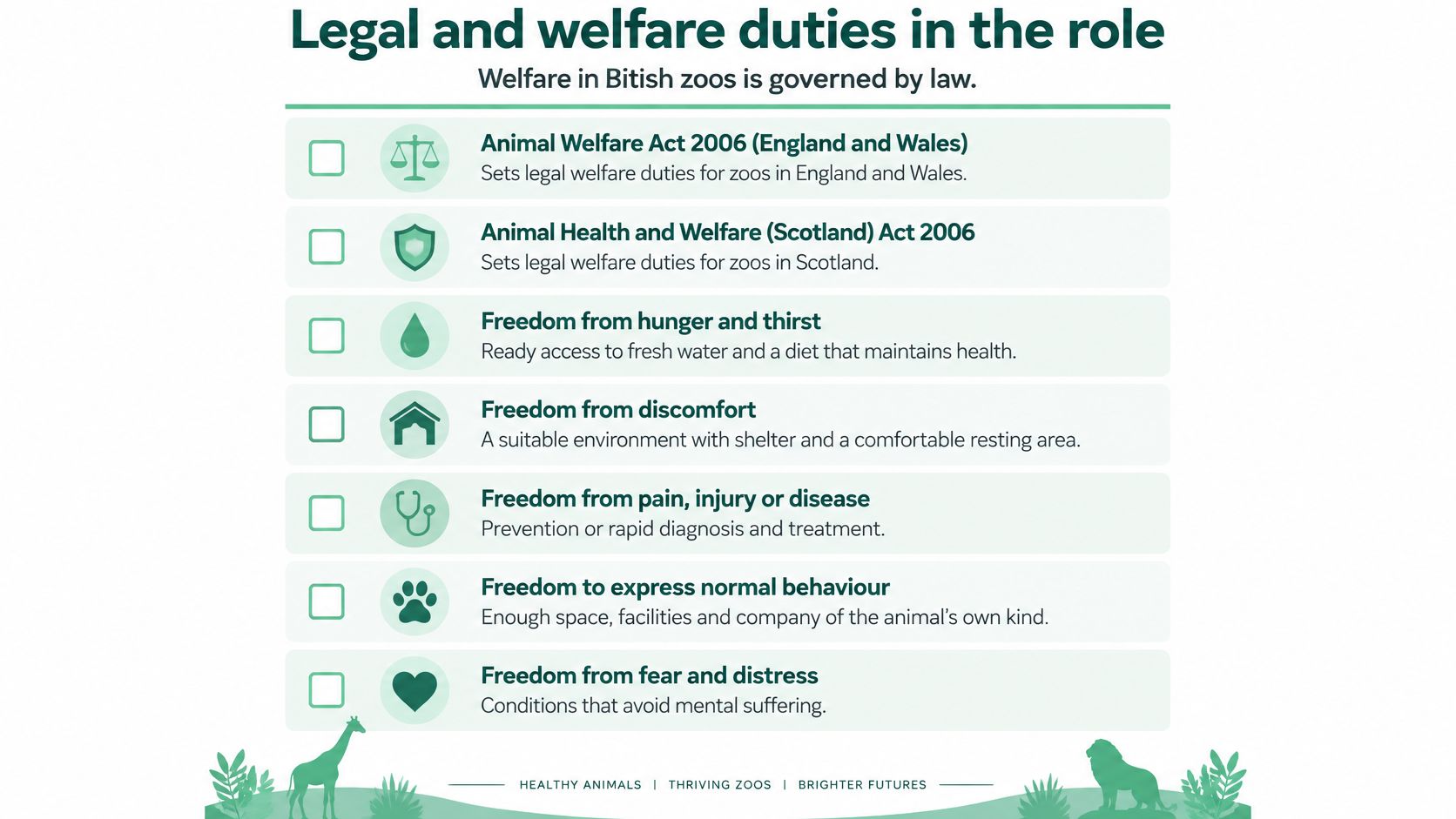
Under the UK Government's Standards of Modern Zoo Practice, keepers must meet the Five Needs for every animal:
Suitable environment: Safe shelter, space, and enclosure conditions matched to the species.
Suitable diet: Correct nutrition and fresh water without overfeeding or deficits.
Normal behaviour: Enrichment and routines that let animals act naturally.
Appropriate housing: Living with compatible group members or apart when solitary by nature.
Health protection: Prevention and prompt care for pain, suffering, injury, or disease.
Those same standards require the person directly responsible for an animal to check its condition, apparent health, and behaviour at least twice daily without causing unnecessary stress. That's why paperwork sits right beside practical care. The Skills England Keeper and Aquarist occupational standard requires you to interpret diet sheets, report changes promptly, and update health and welfare logs on paper or electronically, including temperature and humidity readings.
Practical reality: If you spot a limping wallaby or a drop in vivarium heat and fail to log it, the next shift walks in blind. Timely notes protect animals.
To explore the principles behind these standards, read our article on why we need animal welfare. The short video below also shows how these welfare checks look during a real working shift.
Pay and career progression
Competition for roles is tight, and starting pay reflects that. According to the Prospects Zookeeper profile, updated in 2026, UK salaries start at roughly £19,000 and rise to £28,000 with experience. Careerpilot lists the same £19,000 to £28,000 keeper band, while noting an average UK salary across all occupations of £37,430 in 2024 from the Office for National Statistics.
Ignore economy-wide averages when budgeting for this career and compare keeper-specific adverts instead. Starting figures still vary by employer, region, and your prior animal experience. Once you prove yourself on a section, progression usually leads to Senior Zookeeper or supervisory duties, or specialist work in conservation programmes and public education. Always check the pay scale in the job advert and ask at interview how progression works on that site.
Is zookeeping the right fit for you
Before applying, test yourself against the daily routine. Do you enjoy early starts and repetitive physical cleaning in pouring rain or winter frost? Can you stay patient while observing quiet behaviour changes, then sit down and log accurate welfare notes before heading home?
Take three practical steps before committing:
Volunteer first: Spend time at a zoo, farm, or wildlife centre so you experience the pace of husbandry work.
Check shift patterns: Ask at interview about weekend, evening, and bank holiday rotas, because animals need care every day of the year.
Research the species: Look closely at what the site houses, as reptile, bird, and mammal rounds feel completely different.
A few weeks of hands-on volunteering will tell you more about this career than twenty job adverts ever could.
Start studying the Zookeeping Level 3 Diploma
If this honest picture of a Zookeeper's day still excites you, structured study is the sharpest way to show employers you're serious. Our Zookeeping Level 3 Diploma (RQF) builds the animal welfare, husbandry, behaviour, and conservation knowledge that UK job descriptions demand.
We also offer wider Veterinary Science and Animal Care pathways, including Veterinary and Zoology Qualifications, alongside subjects like Nursing, Midwifery, and English and Maths Functional Skills. You study 100% online with personalised support from qualified tutors, through a modular subscription with an affordable monthly fee. You can pause or cancel your subscription at any time without long-term credit agreements.
Stonebridge Associated Colleges is accredited by the UK Register of Learning Providers and regulated by the Financial Conduct Authority. As a learner or alumnus of the learndirect Digital Group, you'll also get access to the learndirect: Community Hub app, connecting you to topic-specific communities, discussion groups, and interactive forums so you never study alone.
Ready to turn your interest in animal welfare into recognised skills that fit around work and home life? We deliver flexible, subscription-based online qualifications across Veterinary and Zoology, healthcare, education, and more, backed by dedicated tutor support. Visit Stonebridge Associated Colleges today to explore your course options and start learning on your terms.