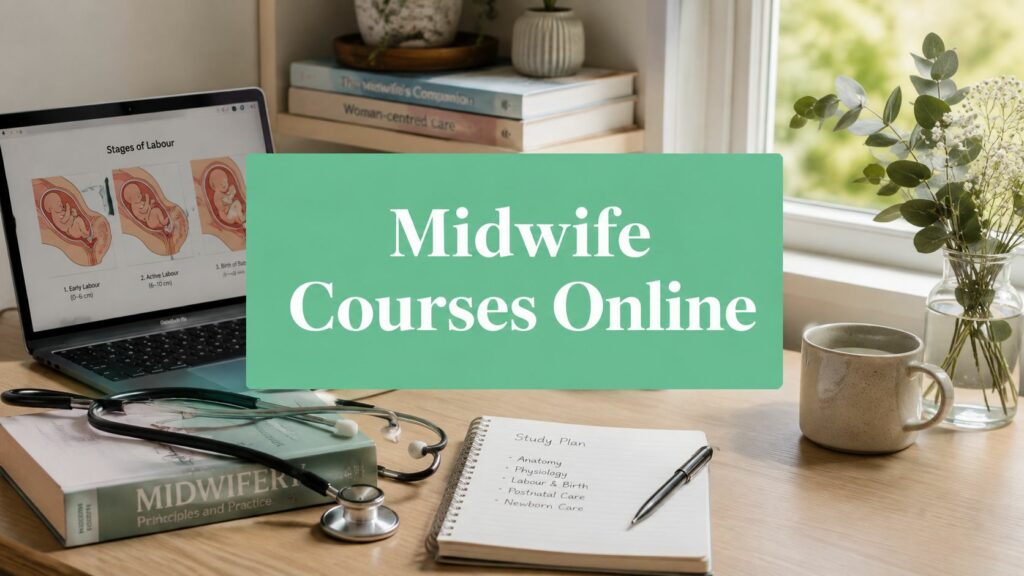
You might be wondering whether midwifery is still possible if you're working, raising a family, or haven't touched formal study in years. That's a common place to start, and it's exactly why midwife courses online have become such a practical first step for adult learners who need flexibility without giving up the long-term goal of registration.
For UK learners, the question is rarely whether you want the career. It's whether there's a route that fits your life now and still leads you towards a university midwifery degree later. An online Access to Higher Education Diploma in Midwifery gives you that bridge, while keeping the next stage clear, because the degree itself still has to be completed through university study and clinical placement.
Starting Your Midwifery Journey
A lot of people reach this point after years of thinking, “I'd love to work with mothers and babies, but I can't step away from everything else.” That might mean shifts, childcare, money pressures, or not having A-levels from a long time ago. For those learners, midwife courses online can turn a vague ambition into something you can plan around.
The appeal is straightforward. You can begin building the academic side of the profession without pretending life is on pause. In the UK, that matters because midwifery is tied to workforce need, with NHS England reporting about 38,000 registered midwives in England in 2023 and the NHS Long Term Workforce Plan aiming to grow the NHS maternity workforce by around 3,000 additional midwives by 2031/32, which helps explain why access routes matter for adult learners and the NHS pipeline alike (Mercy College of Midwifery overview of UK workforce context).
Practical rule: if you want the career, start by looking for the pathway, not the shortcut.
That's the inherent value of an online access route. It can help you move from interest to entry without demanding that you give up work or family commitments first.
Understanding the Access to Higher Education Diploma
The Access to Higher Education Diploma in Midwifery is a Level 3 pathway qualification, not a licence to practise. UK providers commonly expect learners to be 19 or over and to already hold Level 2 English and Maths, such as GCSEs or an equivalent (learndirect Access to HE Midwifery entry guidance). That makes the course a preparation route, not a clinical registration route.

What it gives you
The diploma focuses on numeracy, literacy, and independent study. It prepares you for university-style learning, which is why it's useful for adults who haven't studied recently or who need a route that doesn't depend on A-levels.
What it doesn't do
It does not make you a registered midwife. In the UK, midwifery is a regulated profession, so you still need to progress to an approved pre-registration programme before you can register and practise.
A UK provider also notes that learners must study for a minimum of six months before results can be ratified, with assignments submitted regularly against an Individual Learning Plan (learndirect course details). That pacing matters, because online study still has structure, deadlines, and compliance requirements.
Your goal isn't to finish quickly. Your goal is to reach university ready and academically confident.
Benefits of Studying with Stonebridge
Stonebridge Associated Colleges offers 100% online study, which suits adults who need to fit learning around paid work, caring responsibilities, or unpredictable schedules. Its subscription-based model is built around monthly fees, and learners can pause or cancel their subscription at any time without long-term credit agreements. For someone who's comparing options, that removes a lot of the pressure that comes with committing to a fixed route too early.
The other practical advantage is support. Stonebridge says learners get personalised support from qualified tutors, along with a modular structure that lets them progress through the course in manageable pieces. That can be reassuring if you're returning to study after a break and want a steadier pace than a traditional classroom timetable usually allows.
Stonebridge also states that it is accredited by the UK Register of Learning Providers and regulated by the Financial Conduct Authority, which gives learners clearer signals around academic and financial oversight. For adult learners, that combination of flexibility and structure is often the deciding factor.
If you're comparing providers, you might also want to look at how they present practical requirements upfront. UK course pages commonly expect basic digital confidence, a laptop or computer, and reliable internet access before you begin (How College online midwifery access listing). Stonebridge sits in that same practical space, with the emphasis on fitting study into real life rather than forcing life to fit the course.
What Online Study Can and Cannot Provide
Online learning works well for the academic side of midwifery preparation. You can build research skills, strengthen your essay writing, and develop the background knowledge that helps you understand maternity care in context. The flexibility is especially useful if your week already includes shift work, childcare, or other responsibilities.

What the online route can cover
It can support your understanding of theory, study habits, and preparation for higher education. It also gives you time to work through topics carefully, which is valuable if you're building confidence after time away from education.
What still needs clinical learning
It can't replace supervised placement. Clinical judgement, communication with women and families in real situations, and hands-on care all depend on in-person training. UK learners should treat the access diploma as the academic front door, not the full professional journey.
That distinction matters because many search pages blur the line between course, degree, and registration. The more clearly you understand the boundary, the easier it is to choose a route that matches your goal of becoming a practising midwife.
Getting Started on Your Course
Before you enrol, check the practical basics. You'll need a laptop or computer, reliable internet access, and enough digital confidence to use online learning platforms. Providers also commonly use interviews, written assessments, or enrolment checks before confirming a place, so it helps to be ready for a short application process rather than expecting instant access.
A good study routine matters as much as the tech. If you're balancing work and family, block out regular time slots before you begin, because online study still needs consistency and regular assignment submission.
A course becomes manageable when the timetable is realistic.
That's why many adult learners do well with modular study. It lets you focus on one piece at a time, rather than trying to absorb everything in a rush.
Your Complete Pathway to Becoming a Midwife
The pathway is clear once you see it in order. Start with an online Access to Higher Education Diploma in Midwifery, then apply through UCAS to a university midwifery degree. After that comes the hands-on degree programme, which includes the clinical placements needed before you can move towards NMC registration.
The key thing to remember is that online study opens the door, but it doesn't finish the job. That's not a weakness, it's the reality of a regulated health profession where academic preparation and supervised practice both matter.
If you've been waiting for a route that fits around real life, Stonebridge Associated Colleges offers a 100% online Access to Higher Education Diploma in Midwifery with flexible monthly subscription study and tutor support. Visit Stonebridge Associated Colleges to see whether this pathway is the right first step towards your university application and future midwifery career.