You might be looking at radiography because you want a career that feels practical, respected and connected to real patient care. At the same time, you may also be thinking, “How could university even be possible now?” If you left school without A-Levels, work full time, or have family responsibilities, that question can feel heavy.
That's exactly where many adult learners start.
Access courses for radiography exist for people who need a realistic route into higher education without going back and rebuilding everything from scratch. Instead of trying to fit your life around a traditional college timetable, you look for a pathway that helps you study the right science, build academic confidence and move towards a radiography degree in a structured way.
At Stonebridge, that's how this route is viewed. Not as a shortcut, and not as a vague stepping stone. It's a clear academic pathway for adults who want to move forward.
Practical rule: If your end goal is diagnostic or therapeutic radiography, the first question isn't “Am I too late?” It's “What entry route do universities accept for someone in my position?”
Many learners also worry that they need to understand every detail of UCAS points, graded credits and university entry rules before they can even begin. You don't. You just need the route explained plainly.
The rest becomes much easier once you understand what the diploma is, what you'll study, what universities usually expect, and how online learning can fit around work and home life. That's where access courses for radiography start to feel less confusing and far more achievable.
Introduction
A common situation looks like this. You're interested in medical imaging. You can see yourself working in a hospital setting, helping patients through diagnosis or treatment. But you didn't take the usual school route, or your qualifications are older and no longer feel enough for a university application.
That doesn't mean the door is closed.
An Access to Higher Education Diploma in Radiography is built for adult learners who need a recognised route into university study. It gives you a focused Level 3 pathway, rather than expecting you to return to a full A-Level programme.
Why adult learners look at this route
Radiography is a science-based subject. Universities need to know that applicants can handle the academic side of the degree, especially in areas linked to biology, physics, maths and written coursework.
That's why access courses for radiography are structured in a very deliberate way. They help you prepare for degree-level study while keeping the end goal in sight.
A lot of confusion comes from the word “access”. It can sound informal, almost like a short introductory course. It isn't. This is a recognised qualification route with defined credits, academic expectations and a clear progression purpose.
The question most people really want answered
Most adults aren't asking whether radiography is interesting. They already know it is.
They're asking whether they can still get there without A-Levels, and whether online study can fit around their life. Both questions matter. Both deserve a straight answer.
Access courses for radiography can absolutely form part of that route, but success depends on choosing a course carefully, understanding entry requirements early and planning your university progression from the start.
What an Access to Higher Education Diploma in Radiography Really Is
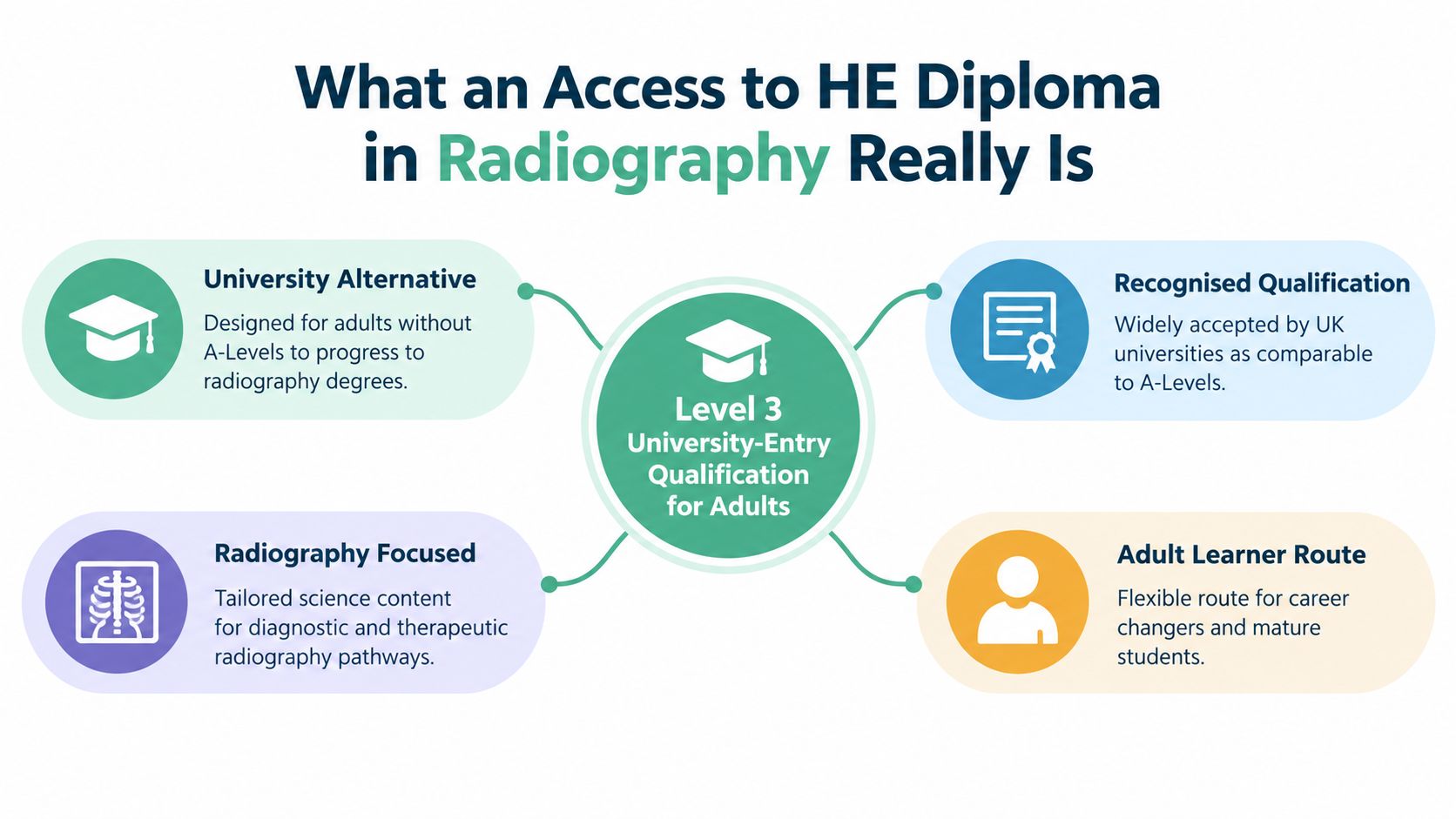
An Access to HE Diploma in Radiography is a Level 3 qualification for adults. According to OCN London's radiography course directory, it is widely accepted by universities and carries UCAS tariff points comparable to three A-Levels.
That comparison helps many learners relax. It tells you this isn't a side route with unclear value. It's a formal university-entry qualification.
Think of the credits as building blocks
The diploma has a set structure. OCN London lists it as 60 credits in total, made up of 45 graded credits and 15 ungraded credits, with guided learning hours of 450 to 600 in its published framework on its radiography Access to HE page.
A simple way to picture that is to think of the course as a wall built from blocks:
The 45 graded credits are the blocks universities look at most closely.
The 15 ungraded credits still matter, but they don't affect your grade profile in the same way.
The full 60-credit structure shows that this is a complete academic programme, not a short taster.
It's not a niche pathway
Some adult learners worry that an Access diploma sounds unusual or unfamiliar to universities. In practice, this route is embedded in further education.
Access to radiography isn't about starting again from zero. It's about entering through a route designed for adults.
Who this qualification tends to suit
This route often suits people who:
Missed the traditional route: You didn't take A-Levels, or your school qualifications don't match current university expectations.
Want a career change: You're moving from another line of work into healthcare.
Need a focused path: You want study that points directly towards radiography rather than a broad, less targeted qualification.
If you've been trying to work out whether access courses for radiography are “real” qualifications, the answer is yes. They are structured, measured and designed to support university entry.
Who Can Apply and What You Need Before You Start
Entry requirements can catch people out because there isn't one single rule used everywhere. Different centres set slightly different expectations, and that's why checking the detail before you apply matters so much.
The important thing to remember is this. Being ready to start the diploma is not the same as being ready for university entry later on. Those are linked, but they aren't identical.
What providers often ask for
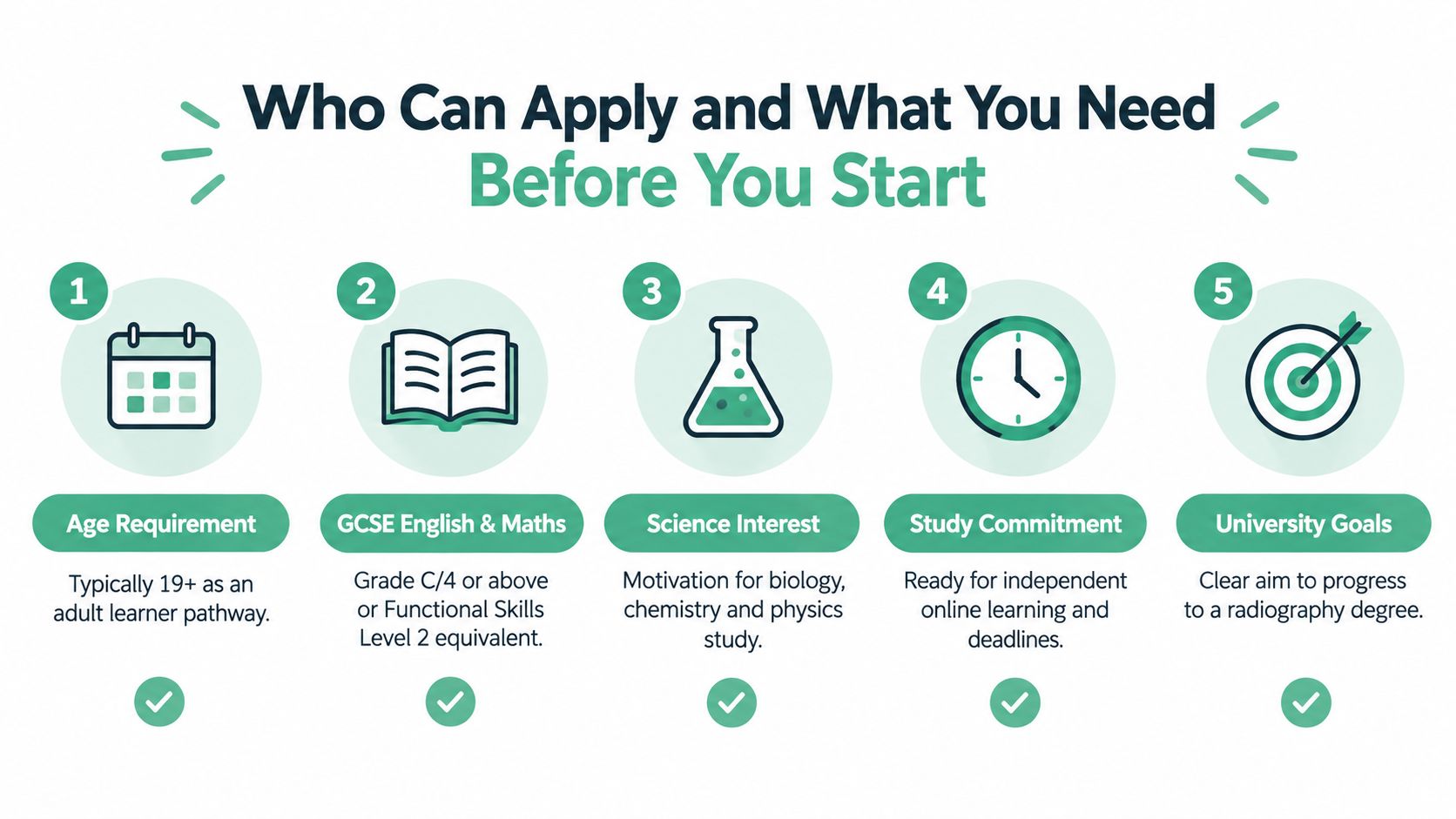
Published UK course listings show variation. One provider requires GCSE English and maths at grade 4/5 plus a literacy and numeracy assessment, another accepts GCSE English Language at grade 4/C with maths preferred, while another option requires GCSE English and maths at grade 4/C or Functional Skills Level 2 plus a pass in an entry assessment.
That means you shouldn't assume your local or chosen provider will ask for exactly the same thing as another one.
A sensible readiness check
Before starting, gather the basics and check them properly:
Your English and maths evidence: Find your GCSE or Functional Skills certificates.
Your study setup: Online learning works best when you have dependable internet access and space to focus.
Your reason for applying: A clear goal helps when the workload gets busy.
Some providers also use an entry assessment. That doesn't mean they expect you to know radiography already. They're usually checking whether you can cope with the level of reading, writing and numeracy involved.
A good question to ask before enrolling: “What do you need from me before I start, and what will universities need from me once I finish?”
Why this matters for online learners
Online study gives flexibility, but it also asks for consistency. If you've been away from education for a while, it's worth brushing up on maths and written English before your course begins.
For some adults, a Functional Skills course is the missing piece that makes the whole plan workable. That can be especially helpful if you know your university applications will need a stronger foundation in maths or English alongside your Access diploma.
What You Will Study and How You Will Be Assessed
When learners ask what access courses for radiography involve, the answer is usually reassuring. The content is science-based, but it's organised to build your confidence step by step rather than throwing everything at you at once.
Stonebridge's Access to Higher Education Diploma in Radiography is designed as a Level 3 pathway for adults preparing for university study in a science-based subject. Learners can review the course structure, entry requirements, syllabus and assessment details directly on the course page, which makes it easier to judge how the programme fits their goals and weekly routine.
The subjects usually included
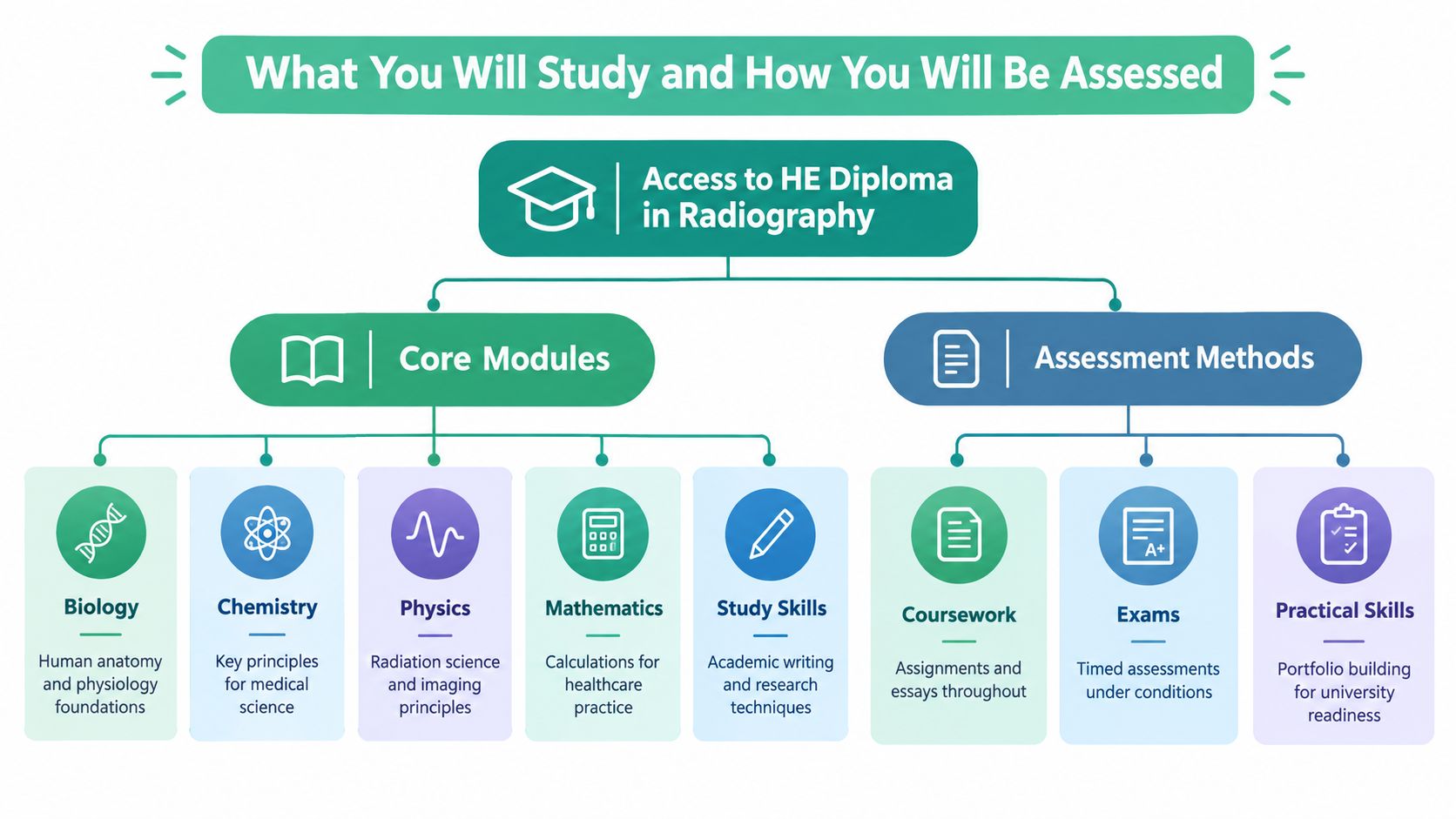
Most access courses for radiography include a mix of:
Biology: Often linked to anatomy, physiology and human systems.
Chemistry: Useful for scientific thinking and health-related study.
Physics: Especially relevant because radiography sits close to imaging science.
Mathematics: Important for calculations and confidence with data.
Study skills: Academic writing, research and assignment technique.
That mix isn't random. Radiography degrees are science-heavy, so Access courses are designed to prepare you for that kind of learning.
Here's a short video that can help bring the subject area to life before looking at study expectations in more detail.
Why coursework suits many adults
For learners returning to education, coursework can feel more manageable than high-pressure final exams. It lets you show understanding across the year, not only in one timed sitting.
Coursework also helps you practise the exact academic habits universities expect:
Planning assignments
Reading carefully
Using evidence properly
Meeting deadlines
Improving after feedback
That steady pattern can be a real advantage if you're balancing study with work and family.
Coursework-based learning often suits adult learners because progress comes from consistent effort, not from one exam day.
What the workload feels like
The pace is still serious. A one-year Level 3 science route is compact by design. If you leave everything until the last minute, it becomes stressful very quickly.
Learners who do best usually treat study as a fixed weekly commitment. Regular smaller sessions are often easier to sustain than trying to rescue everything in one long weekend.
How Access Courses Lead to a Radiography Degree
This is the point where many learners want precision. They understand the diploma in principle, but they want to know how it turns into an actual university application.
The link is through a mix of UCAS tariff points, graded Level 3 credits, and any extra requirements for maths and English.
What universities may ask for
One university example shows how specific this can be. Keele University states that applicants may need 128 UCAS points from an Access to HE Diploma with biology, chemistry or physics-related content, including Distinction in at least 30 Level 3 credits and Merit in at least 15 Level 3 credits, alongside maths and English requirements, on its Diagnostic Radiography and Medical Imaging course page.
That tells you something important. Universities don't just want proof that you finished. They often care about the pattern of your grades within the diploma.
Typical University Expectations for Access to Radiography Applicants
| Requirement Area | What Universities Often Ask For | What It Means for You |
|---|---|---|
| Access qualification | A science-based Access to HE Diploma | Choose a radiography or science-relevant route |
| Credit profile | Strong graded Level 3 credits, often with Distinctions and Merits | Your assignment grades matter throughout the course |
| Subject content | Biology, chemistry or physics-related study | Science units are central, not optional extras |
| Maths | GCSE maths or Level 2 equivalent may be required | Check this early so you're not caught short |
| English | GCSE English or accepted equivalent | Written communication is part of admissions readiness |
Why the route still matters
Radiography remains closely tied to a busy healthcare system. NHS England reported 50.0 million imaging tests in England in the 12 months from October 2024 to September 2025 in its diagnostic imaging statistical release. That gives a sense of how central imaging is to patient care.
There's also longer-term workforce pressure. Parliamentary evidence from the Society of Radiographers stated that staffing levels needed to rise by a further 18% in diagnostics and 16% in therapeutics between 2021 and 2026, with diagnostic radiography needing to grow by about 6% a year, according to the written evidence submitted to Parliament.
That doesn't guarantee an easy university place. It does show why radiography continues to attract attention as a meaningful career direction.
A better way to think about progression
Don't treat the Access diploma as something to “just get through”. Treat it as your first serious academic stage in becoming a radiography applicant.
The strongest applications usually come from learners who:
Check university requirements early: Don't wait until the end of the course.
Aim high in graded science units: Your profile matters, not only the final award.
Keep maths and English in view: Missing these can slow down an otherwise strong application.
Why Study Your Access Course Online With Stonebridge
For many adults, the biggest challenge isn't motivation. It's fitting a demanding science course into an already full life.
That's where the study model matters as much as the subject itself.
Flexibility needs to be practical
Stonebridge Associated Colleges offers an online Access to Higher Education Diploma (Radiography) that is designed for learners who need to study around work, family life and existing commitments. The course is available through this Access to Higher Education Diploma in Radiography page, where learners can review the course description, qualification, requirements, syllabus, assessment and what's included.
The subscription model is especially relevant for adults because it gives you room to study without a long-term credit agreement. You can pause or cancel your subscription on your course of choice at any time, which can make planning feel far more manageable if life changes unexpectedly.
Support matters when the subject is science-heavy
Online learning works best when you don't feel isolated. That's why tutor support can make such a difference on a course like this, where learners may be rebuilding confidence in science and academic writing after time away from education.
Stonebridge courses are studied 100% online, with personalised support from qualified tutors and a modular structure that helps you work steadily through the course. For some learners, that combination is what turns a difficult ambition into a workable weekly routine.
There's also the learndirect: Community Hub app for learners and alumni of the learndirect Digital Group. It gives you a space to join discussions, connect with others, ask questions and feel part of a wider learning community.
Studying from home doesn't have to mean studying alone.
Why busy adults often choose this route
The right online Access course can suit learners who need:
Flexible scheduling: Study in the gaps your week gives you.
Affordable monthly access: A subscription model can be easier to budget for than large upfront costs.
A direct progression focus: You're studying with a clear higher education goal in mind.
Your Next Steps Towards a Career in Radiography
If radiography still feels like the right destination, the next step is simple. Check whether your current qualifications meet the entry requirements for an Access diploma, then look closely at the course structure and university progression expectations.
That early check can save a lot of uncertainty later.
A strong plan usually starts with four practical actions:
Confirm your English and maths position
Review the science content of the diploma
Check the admissions criteria of radiography degrees you may want later
Choose a study format that fits your real life, not your ideal week
Access courses for radiography work best when they're approached with a clear target. You're not only enrolling on a Level 3 course. You're building a route towards university and, from there, towards professional practice.
If you're weighing up whether now is the right time, it may help to remember this. Adult learners rarely begin with perfect conditions. They begin when the route finally makes sense.
Questions are part of the process, so if you're still unsure about entry requirements, workload or online study, keep asking. Getting clear before you start is a strength, not a delay.
Stonebridge Associated Colleges offers flexible online study for adults who want a realistic path into higher education, including routes linked to healthcare and science-based progression. If you're exploring access courses for radiography and need study that can fit around work or family life, visit Stonebridge Associated Colleges and explore the available course options in more detail.