Do you picture working in a zoo as spending your days cuddling animals? Most zoo work looks very different. You're cleaning, checking, recording and talking to visitors, often in all weathers. That routine can still be satisfying, but you'll make a better choice if you're clear about the duties, pay and entry routes first.
The main roles in a UK zoo
A UK zoo relies on a wider team than the keeper role. Each job supports animal welfare in a different way, from daily care to the records, habitats and visitor flow that keep the site safe.
| Role | Main work |
|---|---|
| Animal Keeper | Husbandry, feeding, enclosure cleaning, records and visitor talks |
| Aquarist | Water quality, tanks and aquatic animal care |
| Veterinary Professional | Health checks, treatments and support for keepers |
| Educator | Keeper talks, workshops and school visits |
| Conservation Staff | Research and conservation projects |
| Horticulturalist | Planting and maintaining animal habitats |
| Visitor and Operations Staff | Catering, retail, maintenance and administration |
Evidence presented to the UK Parliament in 2012 linked British and Irish Association of Zoos and Aquariums members to approximately 11,000 permanent jobs and around £658 million of economic activity; one zoo cited had more than 310 permanent employees, rising to roughly 600 in peak season.
For a first route in, look past job titles and match the work to your evidence: comfort with routine, accuracy with records, and calm behaviour around animals and visitors. If keeper posts are full, compare related options in our guide to interesting roles working with animals.
What a zoo keeper does each day
Your first job is usually a round of checks before visitors arrive. A keeper's day is built around welfare and records, so the animals set the schedule.
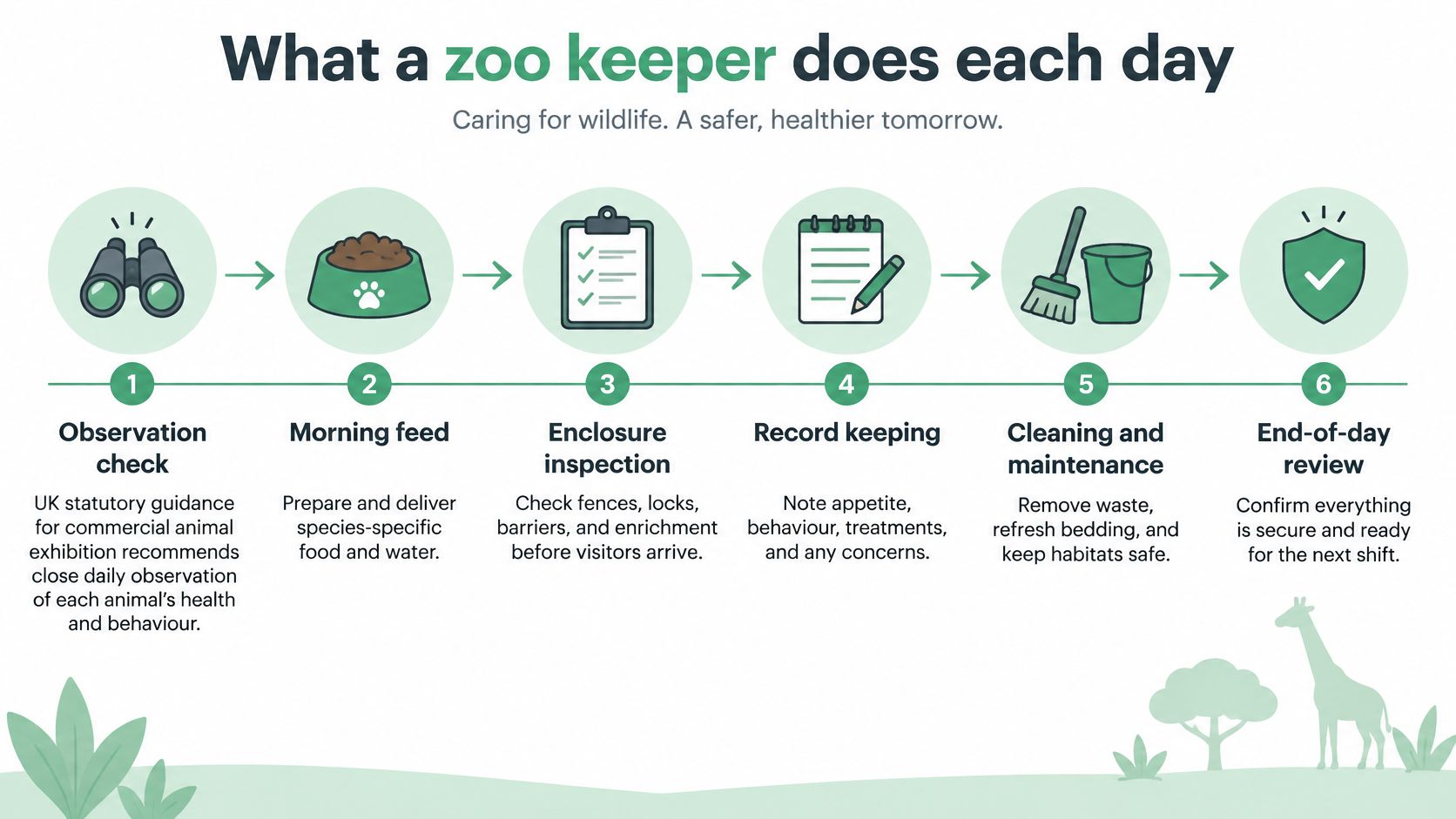
You check animals at regular intervals throughout the day. On each round you look at enclosure security, food and water, droppings, movement, breathing and social behaviour. Anything unusual goes to a Vet or Supervisor promptly, and you write down what you saw and when. Those notes matter because a small change in appetite or behaviour can be the first sign of illness.
The routine below shows how those checks fit around practical work.
Early checks: Confirm animals are present and well, gates and fences are secure, and overnight damage is noted.
Food preparation: Follow the diet sheet for each species, weigh portions and keep prep areas clean.
Cleaning: Remove waste, refresh bedding and water, and maintain ponds.
Handling and moves: Help only where trained and supervised, including restraint for health checks.
Public sessions: Give talks, answer visitor questions and watch safety near barriers.
Leeds City Council bundles similar duties into its Animal Keeper role at Tropical World, including health checks that may involve restraint.
Some days are wet, repetitive and physically tiring, and a sick animal or an emergency can change the plan fast. If you have no zoo experience, a realistic first step is volunteering or an entry-level animal care post where supervised checks and accurate record-keeping are part of the work.
Pay, hours and working conditions
Pay starts modestly, so check each advert rather than relying on one average.
| Source | Figure | What it shows |
|---|---|---|
| National Careers Service | £21,000 | Indicative starter salary |
| National Careers Service | £28,000 | Indicative salary for an experienced zookeeper |
| National Careers Service | 30 to 37 hours | Typical working hours per week |
| PayScale, 2025 | £17,000 | Average UK zookeeper base salary |
The National Careers Service zookeeper profile gives £21,000 for a starter and £28,000 for an experienced zookeeper, with 30 to 37 hours per week. PayScale reported in 2025 an average UK zookeeper base salary of £17,000 per year.
Those sources measure different groups, and employers set different bands. Expect outdoor work in all weathers, manual lifting, early starts and weekends. Peak visitor periods can also feel very different from quieter winter shifts.
Entry requirements and routes in
Don't judge yourself only by animal experience. Written records matter from the first shift.
| Route | What it involves | Why it helps |
|---|---|---|
| English, maths and science | Often requested at GCSE level or equivalent | Supports daily written records and data entry |
| Degree or equivalent experience | Listed as desirable for some trainee keeper posts | Shows depth of understanding of animal biology |
| Prior zoo or animal experience | Requested by some keeper adverts | Shows you can handle routine husbandry |
| Working towards the DMZAA | Some trainee adverts ask for willingness to study it | Builds zoo-specific management knowledge |
| Animal-sector volunteering | Practical hours with animals, often unpaid | Builds evidence when paid experience is limited |
A BIAZA-listed keeper vacancy asks for education including English, mathematics and science or equivalent qualifications. Pair study with documented practical tasks, because a qualification alone doesn't guarantee a role. Read our guide on what qualifications you need to be a Zookeeper to plan your level, minimum, competitive or specialist.
How zoo work is regulated and recorded
Paperwork protects animals, visitors and you. The checklist below shows why records sit at the centre of the job.
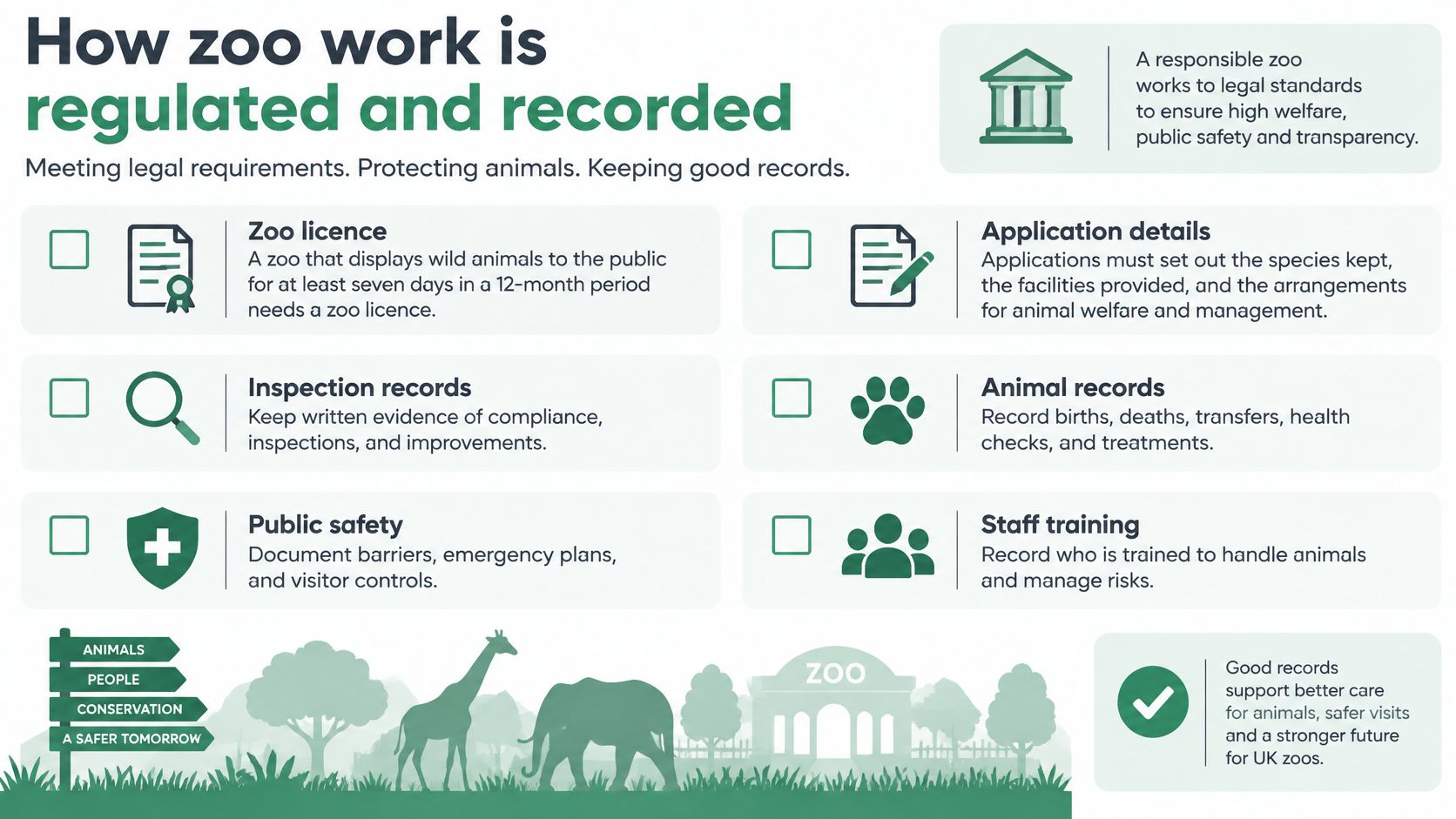
Under GOV.UK guidance on keeping zoo animals, a zoo displaying wild animals for at least seven days in a 12-month period requires a zoo licence. Applications cover species and numbers, housing, staffing duties, visitor volumes, access points and conservation arrangements.
Keepers feed that system through daily logs of feed, weights, behaviour, treatments, temperature, humidity and incidents. Operators also record acquisitions, births, deaths including causes, disposals and escapes. Licences are initially renewed after four years and generally last six years after renewal, so accuracy isn't occasional admin.
The hard side of zoo work
Liking animals won't remove the hardest parts. Welfare-led work can mean restraining an animal for treatment, supporting it through illness or accepting euthanasia when that's the kindest option. Dangerous species add strict barriers and routines, and welfare needs may limit public access even when visitors are disappointed.
The physical side wears people down too. Cleaning, feeding and enclosure work repeat daily, whatever the weather. Early starts and weekends affect your life outside work.
Follow the written procedure and escalate early. You shouldn't carry a difficult welfare decision alone.
Team handovers, Vets and Supervisors spread that pressure. Before applying, ask yourself candidly whether you can stay calm around illness, follow rules you don't personally control and enjoy steady, unglamorous care. If not, a related education or conservation role may suit you better.
Start your zookeeping training online
A zoo will want evidence that you understand the work before it lets you near an enclosure, so the realistic first step without experience is building knowledge of husbandry, welfare, record-keeping and the rules zoos operate under. Studying first works like learning the Highway Code before your driving lessons: it proves you are serious before anyone hands you real responsibility.
The Zookeeping Level 3 Diploma (RQF) covers that ground and is studied 100% online with support from qualified tutors. Check the course description, qualification, requirements, syllabus, assessment and what's included before you enrol. If you want a broader route, Stonebridge also offers Veterinary Science and Animal Care courses, including Veterinary and Zoology Qualifications.
Through the Student Zone you get the Student Learning Community, tutor feedback on marked assignments, optional reading lists, a study guide, free online games and free courses such as Goal Setting and Time Management, plus details on the Referral Programme. Study runs on a flexible subscription: a monthly fee you can pause or cancel at any time, with no long-term credit agreement. Stonebridge has over twenty years of experience, is accredited by the UK Register of Learning Providers and is regulated by the Financial Conduct Authority.
Ready to turn your interest in working in a zoo into recognised training you can fit around work and life? Explore flexible online animal care and zookeeping study with Stonebridge Associated Colleges and choose the route that matches your next step.