Thinking about getting a university degree but don't have the A-Levels you need? Don't worry, that dream is still within reach. A foundation course for university is a popular and effective pathway designed to bridge the gap between your current qualifications and a degree programme. Think of it as your launchpad, giving you the subject-specific knowledge and academic skills to not just get into university, but to succeed once you're there.
This guide will walk you through your options, comparing university-led foundation years with the more flexible Access to Higher Education Diploma, helping you find the right path to your degree.
Can You Go to University Without A-Levels?

It’s a common myth that A-Levels are the only ticket to higher education. The truth is, thousands of people—from adult learners changing careers to young people who took a different educational route—get into university every year using alternative qualifications. In fact, universities today actively welcome the diverse experiences these students bring.
There are two main pathways that open the door to university without traditional A-Levels. Both are designed to prepare you for the challenges of undergraduate study, so you can walk onto campus feeling confident and ready to learn.
Exploring Your Pathway Options
Your journey to a degree can follow one of two key routes. Each has its own benefits, and the best choice for you will depend on your goals, lifestyle, and how you prefer to learn.
-
University Foundation Year: Often called 'Year 0', this is part of a specific degree at a specific university. It’s a great option if you are certain about the exact course and institution you want to attend.
-
Access to Higher Education (HE) Diploma: This is a nationally recognised qualification accepted by universities across the UK. It offers far more flexibility, allowing you to apply to a range of different universities after you qualify.
The most important thing to remember is this: not having A-Levels does not have to stop you from earning a degree. Foundation courses are a proven, effective stepping stone, giving you the academic foundation you need to thrive.
Making the Right Choice for You
So, how do you pick between the two? It comes down to what you need. A university foundation year offers a structured, on-campus experience, immersing you in university life from day one. The main drawback is that it ties you to one university and typically follows a rigid timetable.
An Access to HE Diploma, on the other hand, provides incredible freedom. Many providers, like Stonebridge Associated Colleges, deliver them entirely online. This means you can study around your job, family, or any other commitments. For many adult learners, this flexibility is a game-changer.
University Pathway Options at a Glance
To help you see the differences more clearly, here’s a quick comparison. This should give you an idea of which route might be the best fit for your circumstances.
| Feature | University Foundation Year | Access to HE Diploma |
|---|---|---|
| Commitment | Binds you to one specific university and degree course | Allows you to apply to multiple universities |
| Learning Environment | Typically on-campus with a fixed schedule | Often available online for flexible, self-paced study |
| Best For | Students who know exactly where and what they want to study | Learners needing flexibility and multiple uni options |
| Pace of Study | Follows a standard academic year | Can often be completed faster (e.g., in 9-12 months) |
For a more detailed look at your options, check out our guide on how to go to university without A-Levels. Whichever route you choose, a university degree is well within your grasp.
What Are Foundation Courses for University?

So, what exactly is a university foundation course? The simplest way to think about it is as an academic bridge. It’s a preparatory programme designed to give you the subject knowledge, study skills, and confidence you need to succeed in a full undergraduate degree.
These courses are your ticket to higher education if your current qualifications don't meet a university's direct entry requirements. They build the essential groundwork, ensuring you're ready to hit the ground running from your very first lecture.
The Foundation Year: An Integrated Pathway
The most common type of foundation course for university is an integrated 'Year 0'. This is a full year of study that comes before the first year of a degree, effectively turning a standard three-year bachelor’s into a four-year programme.
Think of it as an academic apprenticeship. You’ll learn the ropes of being a university student directly at the institution where you plan to graduate. This means getting used to the campus, teaching style, and expectations of higher education in a supportive environment. Once you successfully complete Year 0, you automatically progress to Year 1 of your chosen degree at that same university.
A Rapidly Growing Route to Higher Education
The popularity of foundation years has soared in recent years. Their growth shows a wider recognition that talent and potential come from all backgrounds, not just from those with a perfect set of A-Levels. This route has become a mainstream and respected pathway into higher education.
To put it in perspective, back in the 2011/12 academic year, there were just 678 foundation year courses offered in the UK. By 2021/22, that number had surged to 3,717, and student numbers shot up eightfold to 69,325 in only a decade. This highlights just how effective these programmes are at opening up university to thousands of students every year.
What You Will Learn in a Foundation Year
A foundation year is about more than just one subject. It’s designed to give you a well-rounded academic toolkit. While the specifics vary depending on your chosen field, most courses focus on three core areas:
-
Core Subject Knowledge: You’ll get to grips with the fundamental concepts essential for your future degree, whether in science, business, or the arts.
-
Essential Academic Skills: This is a big one. It includes learning how to write university-level essays, conduct research, think critically, and deliver presentations.
-
Study and Time Management Techniques: You'll learn how to organise a heavy workload, manage deadlines, and study effectively—all crucial for independent learning.
A foundation year isn't a remedial year; it's a preparatory one. It’s designed to build you up, fill in any knowledge gaps, and give you the confidence to tackle a full degree head-on.
While an integrated foundation year is a fantastic option if you're committed to a particular university, it’s not the only path forward. The Access to Higher Education Diploma offers far more flexibility. To learn more, it's worth understanding what an Access to Higher Education course is and how it compares.
Who Should Consider a Foundation Course?
Is a foundation course the right move for you? The answer depends on your personal story, your academic past, and your future goals. These courses support a wide range of learners from different walks of life.
Let’s break down some of the most common situations where a foundation course is the perfect fit.
Mature Learners Returning to Education
If you’ve been out of the classroom for a few years—or even a few decades—jumping straight into a degree can feel daunting. A foundation course for university provides a structured, supportive space to ease back into academic life. You’ll refresh your knowledge, build confidence, and learn the study habits essential for success at degree level.
Students Who Missed Their A-Level Grades
It happens to students every year. You work hard, but for whatever reason, your A-Level results don’t quite meet the entry requirements for your dream degree. An integrated foundation year can be a lifeline, giving you a second chance at your first-choice university. It’s an opportunity to prove your ability and guarantee a spot on the full degree programme once you pass.
Career Changers Needing New Skills
Thinking of moving into a new industry like nursing, engineering, or business, but don’t have the right subject background? A foundation course is the perfect tool to make that change. It allows you to build the specific, essential knowledge you need to get into a degree programme in a completely new field.
The core purpose of a foundation course is to open doors. It acknowledges that talent and determination aren't always reflected in traditional qualifications, offering a clear and respected alternative route into higher education.
Learners with BTECs or Vocational Qualifications
Students holding vocational qualifications like BTECs also benefit greatly. While these are excellent credentials, they don't always align perfectly with the entry requirements for every university degree. A foundation year helps bridge any specific academic gaps.
Universities actively welcome students from diverse educational backgrounds, which is why entry requirements for foundation years are generally more flexible. For instance, some courses ask for 72 UCAS tariff points, which could be equivalent to a Pearson BTEC Level 3 National Extended Diploma at MMP. You can discover more insights about flexible university entry routes on UCAS to see how your qualifications might stack up. Mastering effective textbook study methods is also a skill that will serve you well throughout your entire academic journey.
Comparing Foundation Years and Access to HE Diplomas
When you're looking at foundation-level study, you have two main options: the university foundation year and the Access to Higher Education (HE) Diploma. Both act as a bridge to a degree, but they work in fundamentally different ways. The right choice for you depends on your career goals, lifestyle, and how much flexibility you need.
Think of it like this: a university foundation year is a direct ticket to one destination, whereas the Access to HE Diploma gives you the freedom to choose your destination after you've qualified.
Key Differences in Structure and Flexibility
The biggest difference boils down to commitment versus choice. A foundation year is an integrated part of a degree programme. Once you pass, you automatically move on to Year 1 at that same university. This offers security, but it also locks you in early.
An Access to HE Diploma, however, is a standalone qualification. It's designed to give you the UCAS points and academic skills needed to apply to a wide range of degrees at various institutions. This freedom is a massive advantage, especially for adult learners who might want to explore different universities or subjects after finishing their diploma.
This flowchart can help you see if a foundation course fits with where you're at right now.
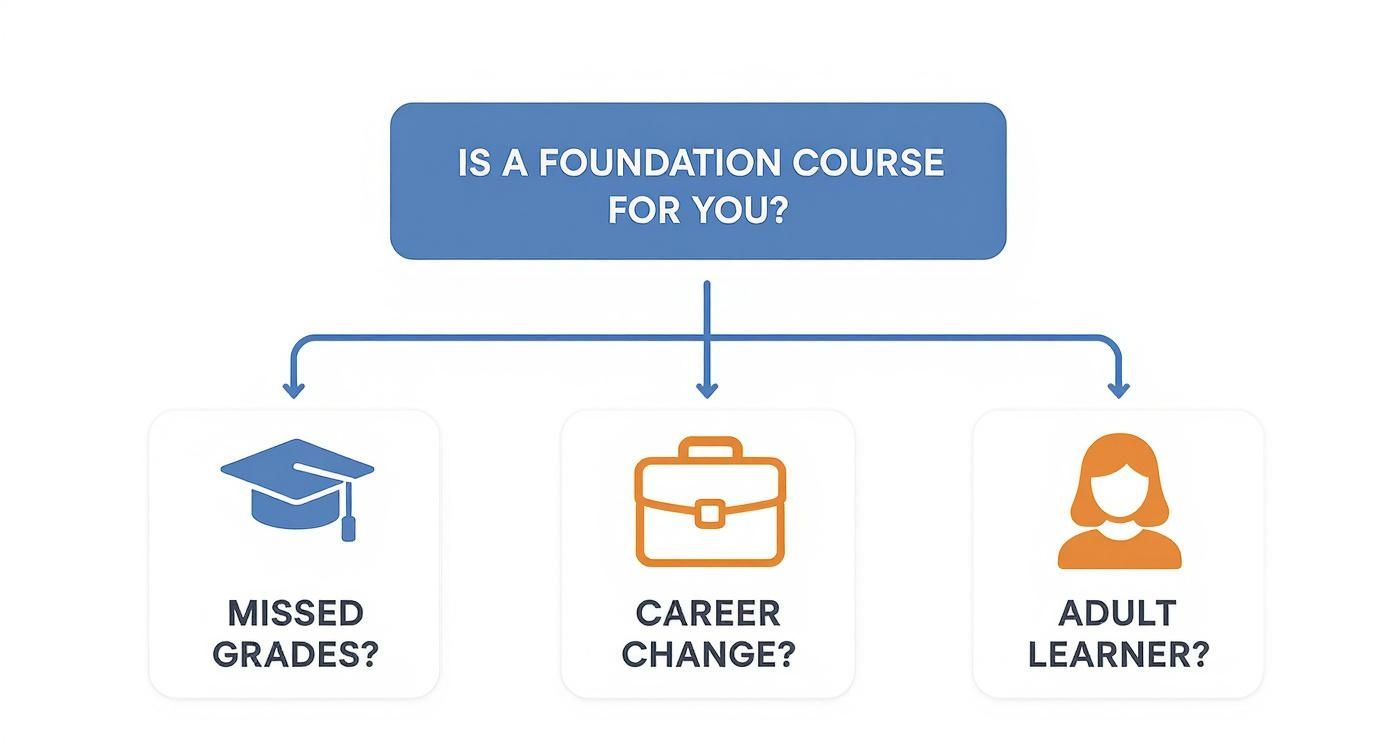
As you can see, whether you're returning to education, switching careers, or just missed the grades you needed, these pathways are built to get you where you want to go.
Learning Environment and Lifestyle
Your day-to-day study experience will also differ dramatically. A university foundation year is almost always delivered on-campus, following a traditional academic timetable. You get the full campus experience, but it requires you to be physically present and stick to a rigid schedule.
This is where an Access to HE Diploma truly shines, particularly if you're juggling other commitments. Many providers, like Stonebridge Associated Colleges, offer these diplomas 100% online. This model puts you in complete control, letting you study around your job, family, or other responsibilities.
Foundation Year vs Access to HE Diploma
To make the decision clearer, let's break down the core features of each pathway side-by-side.
| Attribute | University Foundation Year | Access to HE Diploma |
|---|---|---|
| University Choice | Locked into one specific university from the start. | Gives you the freedom to apply to multiple universities. |
| Flexibility | Rigid, on-campus timetable with fixed classes. | Highly flexible, often available for online, self-paced study. |
| Best For | Students certain about their chosen university and course. | Adult learners and career changers needing flexibility and choice. |
| Qualification | An internal progression route within a single university. | A nationally recognised, standalone Level 3 qualification. |
| Cost | Usually higher, with tuition fees around £9,250 per year. | Often more affordable, with flexible payment options available. |
Ultimately, for many adult learners, the benefits of an online Access to HE Diploma are undeniable. It provides a high-quality, recognised qualification that fits seamlessly into a busy life, opening up a world of university possibilities.
The Benefits of an Online Access to HE Diploma

If you need a foundation course for university that understands the demands of modern life, an online Access to Higher Education (HE) Diploma is your ideal solution. This pathway puts you in control, allowing you to earn a university-ready qualification on your own terms.
For over 20 years, Stonebridge Associated Colleges has helped thousands of adult learners achieve their goals. We understand that a traditional campus-based course isn’t practical for everyone. That’s why our Access to HE Diplomas are delivered 100% online, giving you the freedom to study when and where you want.
Education That Fits Your Life
Imagine studying after the kids are in bed, on your lunch break, or on a quiet weekend morning. With Stonebridge, you can. You work through the materials at a pace that suits you, without the stress of a rigid timetable or a daily commute. Every part of our courses is designed for flexibility, with all your digital resources and assignments accessible from your computer or tablet.
A Financial Model Built for You
We believe cost should never be a barrier to education. University foundation years often come with tuition fees of around £9,250, usually requiring a student loan. At Stonebridge, we do things differently with a simple, flexible subscription model.
Instead of taking on long-term debt, you pay an affordable monthly fee. This straightforward approach covers your tuition, dedicated tutor support, and all course materials. There are no hidden costs or complicated credit agreements.
This subscription gives you incredible freedom:
-
No Long-Term Contracts: You are never tied into a lengthy financial commitment.
-
Pause or Cancel Anytime: If life gets in the way, you can pause or cancel your subscription without penalties.
-
Affordable Monthly Payments: Our model makes it easy to budget for your education.
This means your path to university is not only flexible in how you learn, but also in how you pay. With Stonebridge, you can invest in your future without putting your present on hold. Whether you’re aiming for a career in nursing, business, or education, our range of Access to HE Diplomas offers a clear, manageable route to your degree.
Your Questions Answered
Choosing the right path to university can bring up a lot of questions. To help you feel confident in your decision, we’ve answered some of the most common queries about Access to HE Diplomas.
Does an Access to HE Diploma Guarantee a University Place?
An Access to HE Diploma doesn't tie you to a single university like a foundation year does. Instead, it opens doors to many. It is a nationally recognised Level 3 qualification—equivalent to three A-Levels—and is welcomed by the vast majority of UK universities. Securing an offer depends on meeting the university's entry requirements and submitting a strong UCAS application.
Is the Workload Similar to A-Levels?
The workload for an Access to HE Diploma is rigorous, as it has to prepare you for degree-level study. The course is worth 60 credits and is comparable in academic challenge to studying three A-Levels. However, its modular structure and the flexibility of online study make it far more manageable for adult learners who need to fit learning around their lives.
An Access to HE Diploma gives you the academic weight of A-Levels but with a structure and flexibility designed for adult learners. It's about proving your current ability, not just relying on qualifications from the past.
Do Top Universities Accept Access to HE Diplomas?
Yes, many top-tier universities, including those in the prestigious Russell Group, accept Access to HE Diplomas. However, some of the most competitive courses may have very specific entry requirements. We always advise checking directly with the admissions departments of the universities you’re interested in before enrolling. This simple step ensures the diploma you choose aligns perfectly with your career ambitions.
Ready to take the next step towards your degree? Stonebridge Associated Colleges offers a wide range of career-focused Access to HE Diplomas, all delivered 100% online through a flexible subscription model. Find the perfect course for you and start your journey today.