If a course page calls itself accredited, does that tell you who checked it, or just that it sounds official? For adult learners choosing online study, that gap can cost money and time. We explain awards and certification in plain terms, then show you how to check recognition before you enrol.
What awards and certification mean
An award recognises something you've achieved or contributed. Certification shows you've met a defined standard, usually by passing an assessment.
Think of a gym card and a driving licence. A gym card proves you've signed up. A driving licence proves you've passed a test that someone independent checked.
Award and certification terms compared
| Term | What it confirms | Usually issued by | Typical example |
|---|---|---|---|
| Award | Recognition for a specific achievement or contribution | Employers, charities, professional bodies or government | Employee of the Year or an industry prize |
| Certificate of completion | You attended or finished a course | The training provider | A short workshop certificate |
| Certification | You met a defined standard, often through assessment | A certification body or awarding organisation | A first aid certificate that needs renewing |
| Regulated qualification | You met a national standard that a regulator oversees | An approved awarding organisation | A Level 3 Diploma listed on the Register of Regulated Qualifications |
| Accreditation | A recognised body has approved an organisation or course as meeting set standards | An accrediting or regulatory body | A training provider approved to offer a particular award |
Read the table by asking what decision the document must support. Is it for a job application, university entry or a legal requirement? A certificate of completion usually comes from the provider alone. A regulated qualification is awarded by an approved awarding organisation, meaning the body that sets and awards the qualification.
Qualification also covers far more than school exams. It includes vocational, technical and Functional Skills awards, which test everyday English and maths. Upon successful completion of a training course and meeting the required standards set by the relevant awarding body, learners receive certificates of qualification.
Practical rule: The more independent the check behind a certificate, the more weight it carries with someone who doesn't know you.
How accreditation gives a certificate its value
Accreditation means a body has checked an organisation or course against set standards and approved it. Value comes from a chain, not a badge on a webpage.
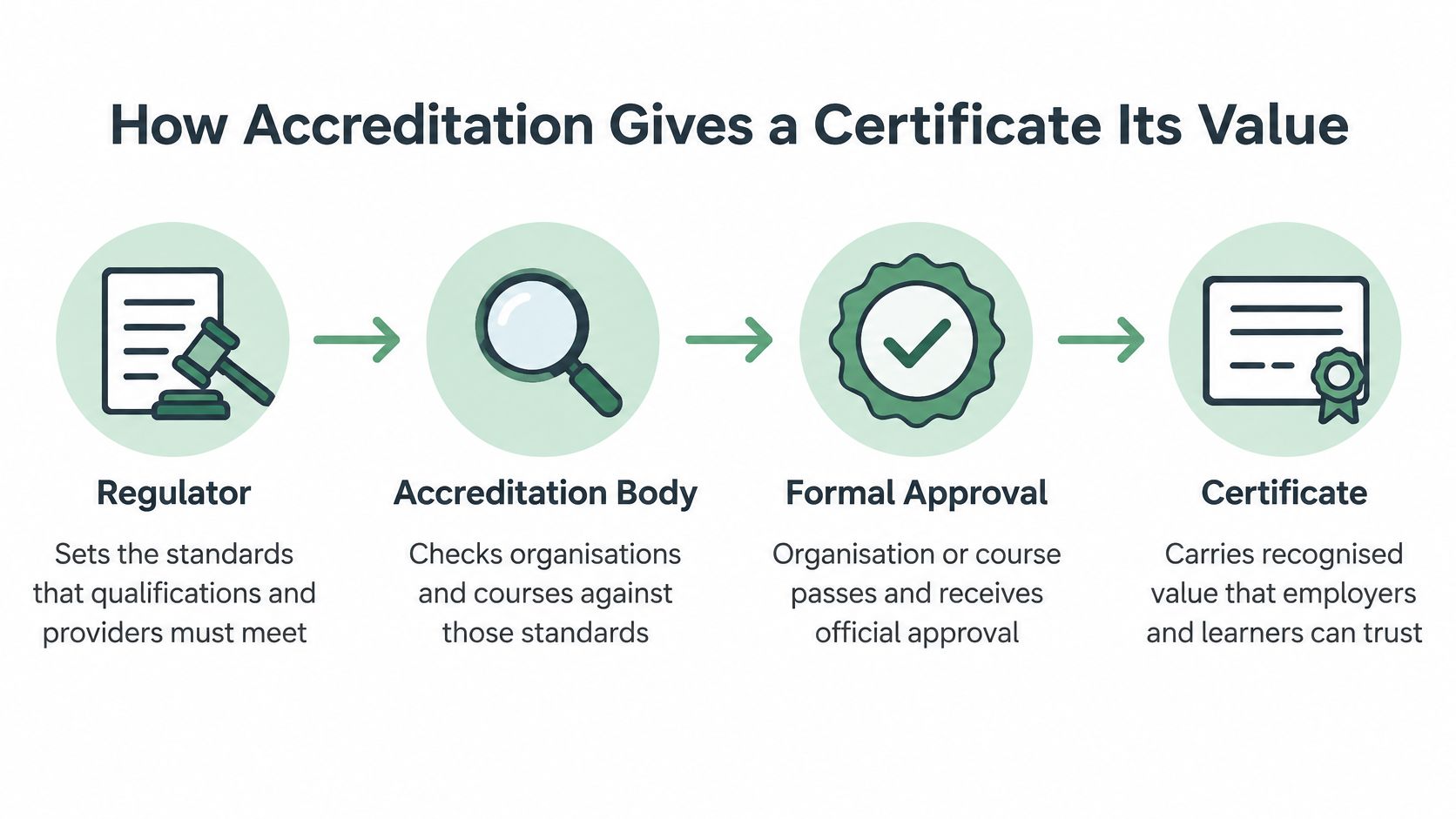
The chain works like this. The regulator sets and checks the rules. The awarding organisation designs the qualification and assessment. The provider teaches you. You then earn the certificate if you meet the standard.
In England, that regulator is Ofqual. The Ofqual annual report 2024 to 2025 states Ofqual regulated 255 awarding organisations and more than 10,100 active qualifications in 2023-24, generating 11.8 million certificates. It's a huge, varied system, so accredited on its own doesn't prove regulated status.
Our courses are certified by bodies including CACHE, NCFE, Open College Network West Midlands, ABC Awards and CMA. We're also accredited by the UK Register of Learning Providers and regulated by the Financial Conduct Authority, which covers financial conduct, not the qualifications themselves.
For background on levels, see our guide to the Regulated Qualifications Framework. A certificate is only as strong as the awarding body behind it.
How to check an award is genuinely recognised
Before paying, check whether the qualification itself is regulated, rather than relying on a provider's use of the word “accredited”.
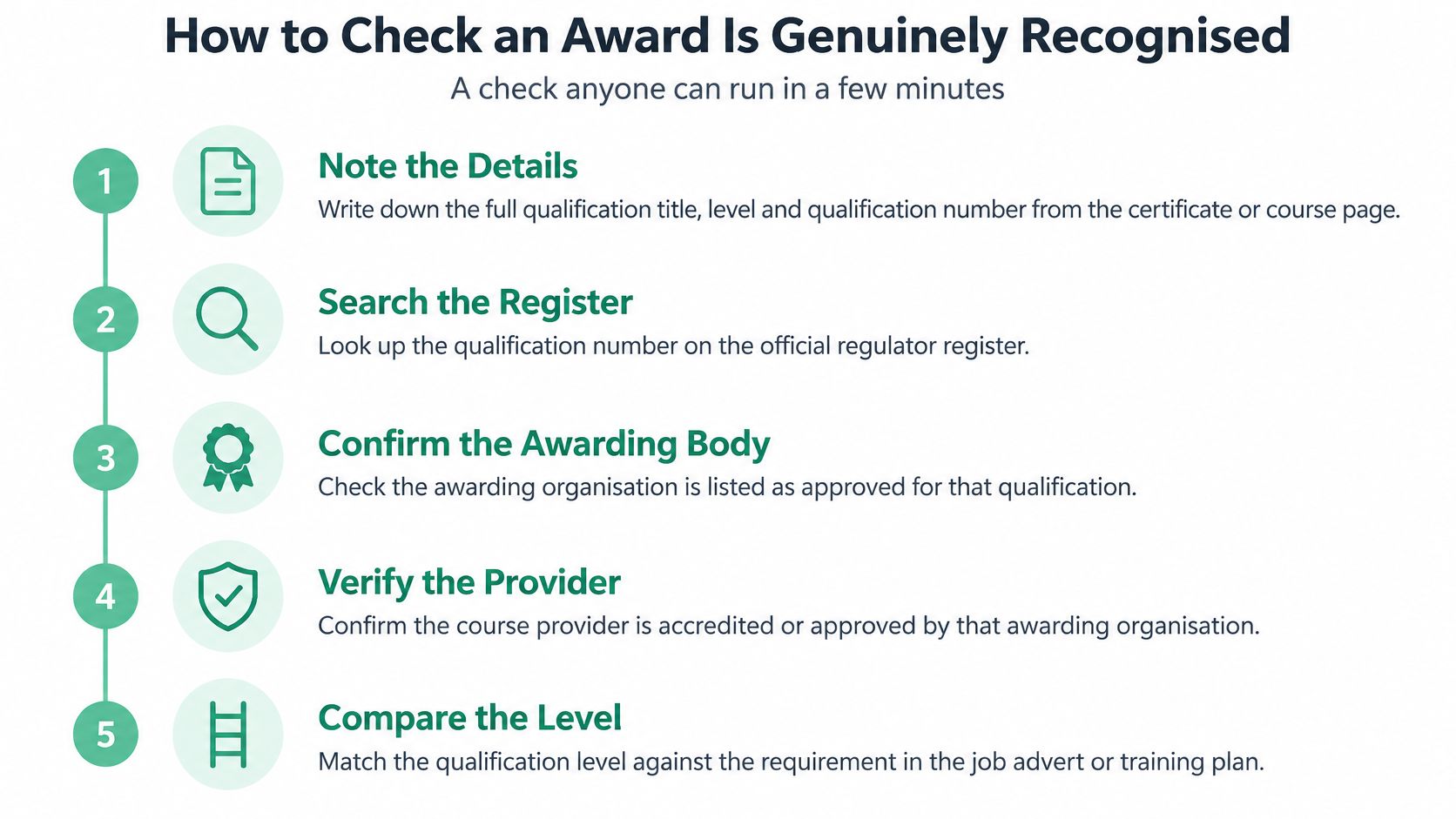
Note the details. Record the qualification's full title, level and number.
Find the awarding organisation. Check the course page or certificate for the organisation responsible for the qualification.
Search the Register of Regulated Qualifications on GOV.UK using the qualification number.
Compare the listing. Check that the title, level and awarding organisation match.
Check your nation. The Regulated Qualifications Framework (RQF) applies in England, Wales and Northern Ireland. RQF qualifications may not be recognised in Scotland in the same way.
Separate regulation from membership. Membership of a professional body is a different kind of recognition.
Check the requirement. Read the criteria set by the job, university or professional register you hope to enter.
Ofqual's strategy for 2025 to 2028 gives context for its regulatory role. A qualification's regulated status shows that it is subject to oversight, but does not guarantee admission or eligibility for a particular role. For distance learning, check whether the course and its qualification are recognised.
If a provider says “accredited” but cannot name the awarding organisation, ask for the full qualification details before paying. Use those details to check the register, then compare the listing with the requirements that matter to you.
Routes to gaining an award or certification
Routes differ in teaching, assessment and time. The right one depends on your life, not just the subject.
Routes to an award or certification compared
| Route | Who it suits | How you are assessed | What to expect |
|---|---|---|---|
| Full-time college course | School leavers and learners who want a set timetable | Coursework, exams and practical tasks | In-person teaching on a fixed weekly schedule |
| Apprenticeship | People already in work who want training on the job | Workplace evidence and an end-point assessment | Paid employment with study built in |
| Online distance learning | Adults fitting study around work, family or caring duties | Assignments, assessments and tutor feedback | Flexible pace with modular study and tutor support |
| Short workplace award | Staff who need one specific skill signed off | Practical observation and a short test | Often completed in a single day or a few sessions |
| Self-study and exam | Confident learners who prefer working alone | Formal exam set by an awarding organisation | You book and pay for the exam yourself |
Short awards can carry real weight. The Ofqual vocational and other qualifications quarterly for October to December 2024 recorded 5.2 million certificates for vocational and other qualifications during January-December 2024. In the fourth quarter alone, the most frequently issued qualification was the Qualsafe Level 3 Award in Emergency First Aid at Work (RQF), with 31,100 certificates.
Online and classroom routes can lead to the same regulated award. The precise title matters more than how you studied, so run the verification steps before enrolling anywhere.
Turning your certificate into career progress
Holding a certificate and proving skill aren't quite the same thing. This short video looks at presenting your achievement clearly.
Reflections on the 2025 Adult Participation in Learning Survey reported only 42% of UK adults had participated in learning during the previous three years, down from 52% in 2024. Its recommendations highlighted verified badges, microcredentials and a digital skills wallet.
Build a simple evidence folder. Include your certificate, portfolio work, supervised practice records, workplace examples and assessor feedback. Add a short note matching each item to the job requirements.

Some awards expire, so note renewal dates. We provide eCertificates, and printed certificates may be available for a fee. We issue certification within 12 weeks of successfully completing the qualification. You must also be subscribed for a minimum number of months, which varies by course type and doesn't need to be consecutive.
Pick your next step and start studying online
What would you like your next qualification to help you do? Stonebridge Associated Colleges, founded in 1997, offers flexible online courses through a subscription that you can pause or cancel at any time, without a long-term credit agreement. Modular study can fit around work and family commitments.
Each course includes study materials, a study guide, and tutor and administrative support. The course fee also covers awarding body registration and certification.
Choose a route that matches your goal. If you want to work as a Teaching Assistant, consider Supporting Teaching and Learning. For care work, explore Adult Care; for a pathway towards university, look at an Access to Higher Education Diploma. Functional Skills English and Maths Level 2 may suit learners building their core skills. Compare online distance learning courses to find a suitable option.
Before enrolling, check the qualification title and awarding organisation, and confirm what the course includes. A certificate is the outcome of meeting the course requirements, so make sure the award matches the next step you have in mind. Ready to begin? Explore Stonebridge Associated Colleges and choose a course that fits your goals and schedule.