Revision doesn't have to be a last-minute scramble. You're home from work, flicking through old notes, and wondering what to practise first. A steady weekly routine makes Functional Skills English revision feel more manageable.
If you're an adult learner returning to study, start with small, repeatable habits. Our Functional Skills courses must be completed within 12 months, so plan regular practice across that window rather than leaving everything until exam week.
1. Timed practice with past papers
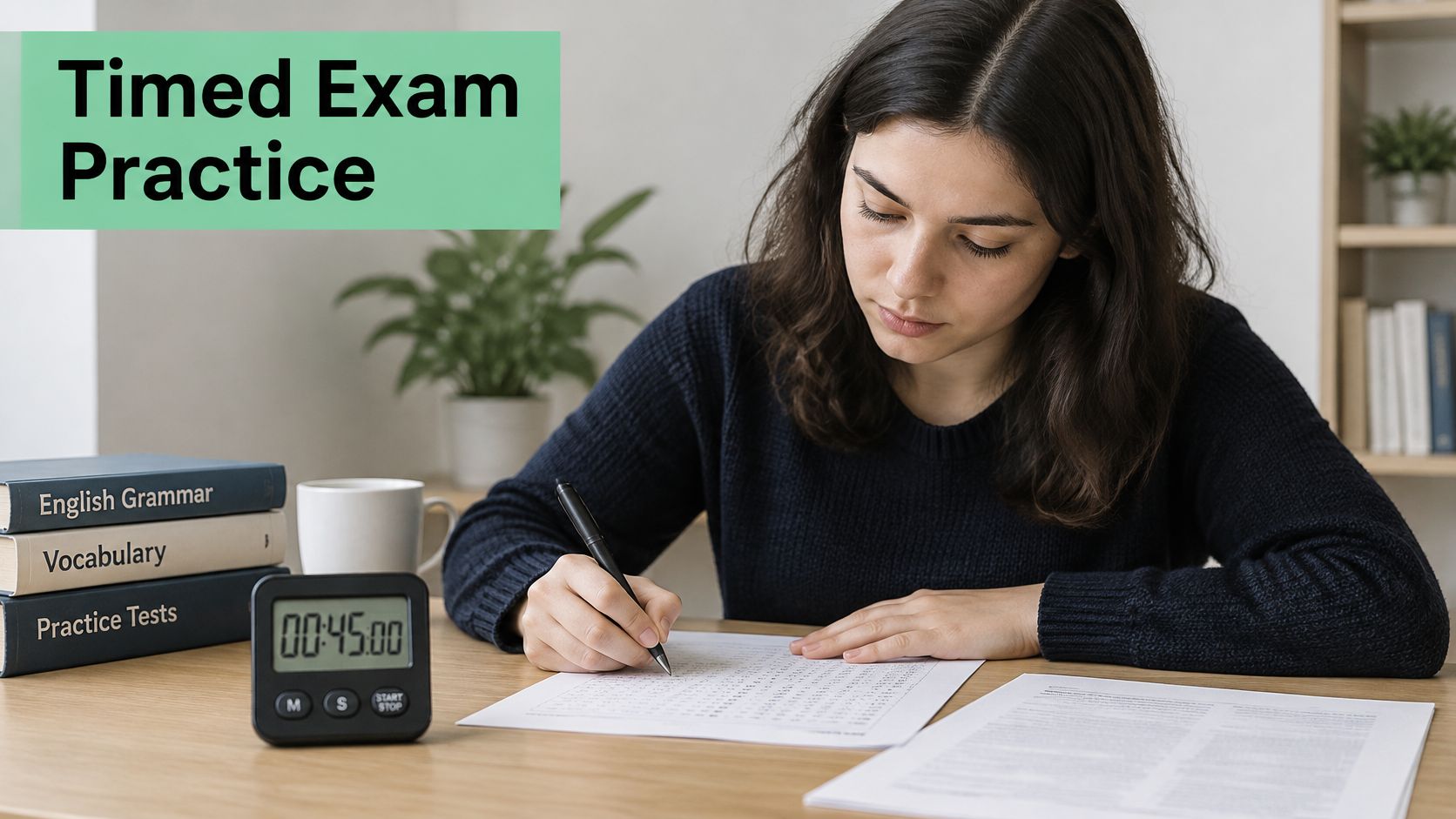
Use sample or past papers matched to your awarding organisation. Follow the paper's timing and permitted-materials instructions, then mark your answers carefully.
For example, if you miss a comparison question, practise explaining how the texts differ before attempting another full paper.
Record the problem: Note whether you misunderstood the question or struggled to find evidence.
Repeat the skill: Revisit that weakness during your next weekly session.
Explore our Functional Skills English & Maths Level 2 Including Exams course when planning your study route.
2. Reading news articles and identifying purpose

A local newspaper story about bus services can become useful reading practice. Skim it for the main point, then scan for specific details, such as which routes might change.
Ask who the writer wants to reach. Are they informing residents or persuading the council to act?
Support your answer with something the writer actually says, not just your impression.
Try BBC News health coverage alongside local opinion columns. Compare their tone and separate reported facts from the writer's opinions.
3. Writing formal letters and emails

Suppose a fictional energy company sends an incorrect bill. Write an email explaining the problem and the action you want.
Make the purpose clear
Open with the reason you're writing. Give relevant details, then finish with a polite request and suitable sign-off.
Replace an angry accusation with a precise explanation. For instance, explain that the billed meter reading differs from your recorded reading and request a corrected bill.
4. Spelling, punctuation and grammar drills

Practise the mistakes you make. If you confuse their and there, write workplace sentences that show the difference.
Spelling: Keep a personal word list and test yourself without looking.
Punctuation: Check where complete sentences begin and end.
Grammar: Match subjects and verbs, such as the learner writes and the learners write.
Read your work aloud to notice awkward sentences. Don't add a comma at every pause, though. Check how the sentence fits together.
5. Planning and structuring written answers
Before drafting a report about improving a staff room, identify your audience and purpose. Group suggestions under clear headings, then add reasons for each recommendation.
Planning habit: Check that every planned paragraph helps answer the task.
Keep your plan brief enough to leave time for writing and checking. Cross out interesting ideas that don't answer the question.
Our guide to writing an essay or report can help you organise longer answers.
6. Speaking and listening practice
Don't leave spoken communication until the end. Ofqual's Functional Skills English conditions require a Pass in all three components at the same level for an overall qualification pass.
Discuss a proposed change to working hours with a willing listener. Explain your view, invite theirs and respond to what they say.
Use this video as a prompt for spoken practice.
Practise alone: Record your explanation and listen for rushed speech.
Practise together: Ask your listener whether you answered their questions clearly.
7. Summarising and note-making
Take a council notice about changes to waste collections. Make brief notes covering what changes, who's affected and what residents need to do.
Keep the original meaning
Close the notice and explain its main message in your own words. Then reopen it and check that you haven't changed the meaning or missed an important exception.
A shorter version isn't a useful summary if it changes what the reader needs to understand.
Use keywords rather than copying whole paragraphs. This makes your notes easier to revisit.
8. Using free online practice tools alongside a structured course
Free tools work like a sparring partner: good for weekly rounds while your course plans the training across its 12-month window. BBC Bitesize English activities suit a short slot on one weakness, such as sentence boundaries. Choose exercises that match your assessment rather than assuming every quiz does.
Quick practice: Complete a relevant activity, then apply the skill in your own writing.
Deeper study: Take recurring difficulties to structured lessons, where tutor marking shows whether you're improving.
Stonebridge students can also join the Student Learning Community, where they can ask questions and share ideas with other learners.
Browse our additional study resources, but don't let resource-hunting replace practice.
How the eight revision habits compare
| Item | Main skill | Best for | Practise alone? |
|---|---|---|---|
| Timed practice with past papers | Exam technique and time management | Getting used to exam conditions and spotting gaps | Yes |
| Reading news articles and identifying purpose | Reading comprehension and inference | Practising with varied real-world texts | Yes |
| Writing formal letters and emails | Purpose, tone and structure | Developing practical writing skills | Yes |
| Spelling, punctuation and grammar drills | Spelling, punctuation and grammar | Improving accuracy through short daily practice | Yes |
| Planning and structuring written answers | Organising ideas and supporting evidence | Writing clear, focused answers under time pressure | Yes |
| Speaking and listening practice | Discussion, listening and responding | Building confidence in spoken communication | Partly; a listener helps |
| Summarising and note-making | Comprehension and concise writing | Identifying and retaining key points | Yes |
| Using free online practice tools alongside a structured course | Independent revision and guided learning | Supplementing structured study with free practice | Yes, with course support |
Start your revision plan this week
Choose a habit you can fit around your commitments. Put it in your diary, keep your work and review what needs attention next week.
Our English and Maths Functional Skills courses offer online study with qualified tutor support. Enrolment includes free access to a study guide and Improving Learning Skills course.
Stonebridge's subscription option lets you pause or cancel without a long-term credit agreement. Plan around your course completion deadline and keep building skills steadily.
Stonebridge Associated Colleges offers flexible online learning to support your Functional Skills English revision. Visit Stonebridge Associated Colleges to explore English and Maths study options and take your next step.