You've been asked to gain an English qualification for work, further study or a career change, but the thought of sitting a formal writing exam feels daunting. Perhaps you're unsure how long the paper lasts, what examiners want, or how much spelling, punctuation and grammar can affect your result. Functional Skills English Writing Level 2 is practical, focused and achievable when you know how the assessment works.
This guide explains the qualification, the exam format, the weighting given to SPaG, and the preparation habits that can help you write clearly under pressure. It also shows how flexible online study with Stonebridge can fit around work and everyday responsibilities.
Understanding Functional Skills English Writing Level 2
A learner may need English Level 2 to meet an employer's entry requirement, progress to further study or feel more confident with workplace communication. They might already write emails and messages every day, yet still worry about producing a structured response in an examination. That reaction is common, especially after time away from education.
Functional Skills English is a regulated qualification in England available at Entry Level, Level 1 and Level 2. Unlike a literature-based course, it concentrates on practical communication for employment, education and everyday life. The official annual qualifications market report shows that English certificates rose from 131,930 in 2020 to 2021 to 155,700 in 2022 to 2023, then reached 157,640 in 2023 to 2024 before easing to 155,480 in 2024 to 2025.
What the writing assessment asks you to do
At Level 2, writing is about communicating information for a clear purpose and a particular audience. You could be asked to produce a formal letter, an email, a report, an article, a review or another practical text. The exact task changes, but the central question stays the same: can you make your message clear, organised and suitable for the reader?
The writing component appears at both Level 1 and Level 2 in official guidance, so it forms a central part of Functional Skills English. Returning to study doesn't mean you need perfect writing already. It means you need to understand the expectations, practise deliberately and learn how to check your work.

What makes this qualification important
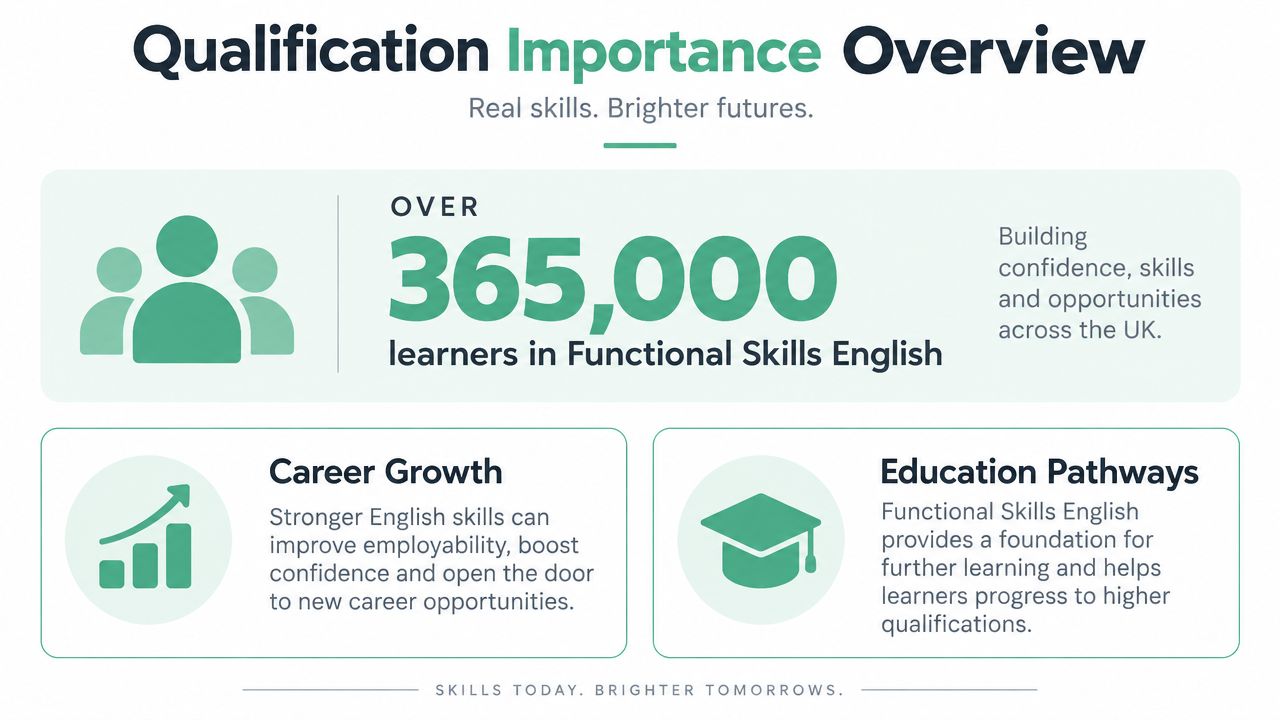
Functional Skills English Level 2 sits within a substantial adult education system. In the first nine months of 2025 to 2026, 365,530 adult learners participated in essential skills courses in England, while 274,480 participated in regulated essential skills qualifications, according to the Ofqual Functional Skills Qualifications outcomes dashboard. These figures place Level 2 writing within a nationally monitored skills pathway, rather than a small or unusual course area.
The same dashboard reports that regulated Level 2 participation fell 31.4% year on year, from 172,790 to 118,580 learners, so participation can fluctuate. That change doesn't reduce the value of developing the qualification. It shows why learners should check their own employer, college or course requirements and choose a preparation route that suits their circumstances.
A practical qualification with recognised assessment
Ofqual tracks reformed English Functional Skills Qualifications at Level 1 and Level 2, with outcomes recorded by year and awarding organisation. NCFE's published files include Level 2 Writing pass rates of 81% and 90% in the 2024 to 2025 reporting cycle, while AQA's June 2024 statistics list 8,362 candidates across Functional Skills Levels 1 and 2. These figures come from separate awarding-body reporting, so they shouldn't be treated as a single national pass rate.
For learners, the key point is simple. The qualification tests communication that people use outside the classroom. Clear reports, accurate emails and well-structured applications can support progression at work and in education. It also gives learners a defined target, with assessment criteria that can be practised rather than guessed.
Exam format and assessment structure
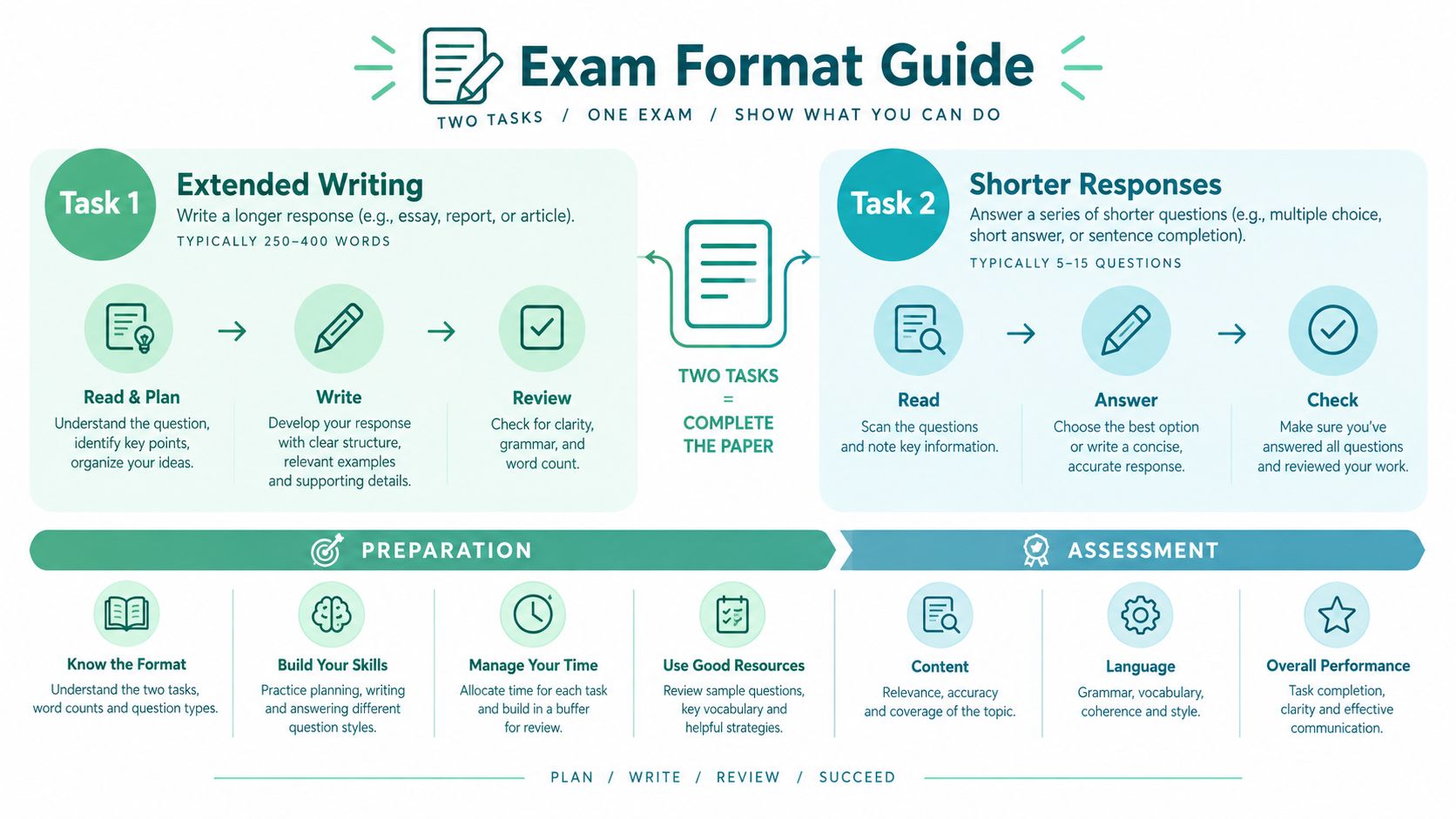
The writing assessment is typically a two-task paper completed in 1 hour and 20 minutes. A major awarding specification describes responses of about 250 to 300 words per task, while Pearson's examiner report suggests 250 to 300 words for Task 1 and 200 to 250 words for Task 2. Always follow the instructions on the paper you receive, because awarding organisations can set tasks differently.
A workable time plan
Pearson recommends an approximate split of 35 minutes for Task 1 and 25 minutes for Task 2. That leaves time to read the questions, plan and proofread. A useful approach is:
Read the task carefully. Identify the purpose, audience, format and every bullet point.
Plan before drafting. Note the order of your paragraphs and the detail you need to include.
Write with the reader in mind. Choose a tone and vocabulary that suit the situation.
Reserve time to check. Look for missing information, unclear sentences and SPaG errors.
The longer task may need more developed ideas, while the shorter task still requires a complete response. Don't spend so long perfecting Task 1 that Task 2 becomes rushed.
Practical rule: A clear plan protects your time. It also makes it easier to check whether every part of the task has been answered.
The mark allocation is important. One major specification divides marks broadly into 56% for composition and 44% for SPaG, while government requirements state that awarding organisations must allocate 40% to 45% of writing marks to accurate spelling, punctuation and grammar. Strong ideas alone aren't enough. A response can lose valuable marks if errors make the meaning unclear or reduce accuracy.
What you need to know about marking criteria
Examiners assess more than whether the response sounds interesting. The official Functional Skills English subject content requires learners to communicate information using words and phrases suited to the purpose and audience. It also requires information to be organised and structured for clarity.
That means audience and structure are assessment requirements, not optional style choices. A formal complaint needs controlled, respectful language. A review can sound more personal, but it still needs relevant information and a clear judgement. A report usually benefits from headings or a logical sequence so that a busy reader can find the main points.
Composition
For composition, examiners may look at whether you:
address the purpose of the task directly
include all the required bullet points
select relevant details rather than drifting away from the subject
organise ideas into logical paragraphs
use an appropriate tone and format
make your main message easy to identify
Start by asking who will read the text and what they need from it. If the task asks for advice, give advice. If it asks for an explanation, make the information easy to follow. Avoid writing a generic response that could fit any audience.
SPaG
SPaG covers spelling, punctuation and grammar. Check common problem areas such as sentence boundaries, apostrophes, capital letters, homophones and verb agreement. Complex sentences can show control, but they must remain accurate. NCFE guidance also emphasises paragraphs containing more than two sentences and the correct use of complex sentences and organisational markers.
Accuracy is part of the mark, not a final polish added after the real work is finished.
Use paragraphs to separate ideas, not to create a new line after every sentence. Organisational markers such as however, firstly, as a result and finally can help readers follow your reasoning, provided they are used naturally.
Effective study and revision strategies
Strong preparation comes from practice, feedback and deliberate checking. Start with short writing tasks, then build towards timed responses. Keep a corrections list of recurring errors and review it before each exercise. This turns mistakes into a revision plan rather than a vague worry about what to study.

Practise the examiner's priorities
The Pearson Level 2 Writing examiner report highlights four habits: cover every bullet point, plan the structure, proofread, and adapt writing to its audience and purpose. Use the same sequence in each practice session:
Mark the task: Tick every bullet point before writing and check each one again at the end.
Plan the order: Give each paragraph a clear job instead of copying the wording of the question.
Vary your audience: Practise formal and informal tasks so tone becomes a deliberate choice.
Proofread in passes: Check ideas first, then punctuation, spelling and grammar.
Word-count instructions can affect marks. The NCFE Level 2 Writing guidance states that responses with a set limit must stay within it. If no limit is given, aim for over 100 words. Shorter answers may be penalised, while longer answers are not penalised for length under this guidance.
Accuracy carries marks in its own right, not as an optional final polish. Use a timer for complete papers, but begin with untimed drafting. Once your structure and checking routine are reliable, reduce the available time gradually. Your target is a manageable rhythm: plan, write and check.
Here's a short video to support focused preparation:
Choosing your exam pathway
Learners generally need to decide how they'll prepare and where they'll sit the assessment. A local exam centre may suit someone who prefers a fixed venue, scheduled arrangements and direct contact with centre staff. Before registering, check the awarding organisation, assessment dates, identification requirements and whether the centre offers the exact Level 2 writing assessment needed.
Online study offers a different kind of flexibility. You can work through learning materials at home, fit activities around employment or caring responsibilities and return to difficult topics when needed. The exam itself still follows the awarding organisation's assessment arrangements, so confirm how booking and sitting the exam work before enrolling.
Comparing the practical choices
| Consideration | Local exam centre | Online preparation |
|---|---|---|
| Study routine | Often follows a set timetable | Can fit around existing commitments |
| Learning location | Usually includes attendance at a venue | Materials can be accessed online |
| Support | Centre-based guidance may be available | Tutor support may be available remotely |
| Exam arrangements | Managed through the centre | Must be confirmed with the course or awarding organisation |
The Functional Skills English & Maths Level 2 Including Exams course from Stonebridge Associated Colleges provides 100% online study, personalised support from qualified tutors and a subscription model that can be paused or cancelled at any time without a long-term credit agreement. Its modular format and monthly fee are designed for learners balancing study with work and life.
Learners and alumni of Stonebridge Associated Colleges also get access to the learndirect: Community Hub app, available to learners and alumni of the learndirect Digital Group. It includes discussion groups, topic communities and interactive forums where members can ask questions and share ideas, so online study doesn't have to feel isolated.
Taking the next step with Stonebridge
Functional Skills English Writing Level 2 rewards practical control. Learn to identify the audience, answer every part of the task, organise paragraphs, manage the 1 hour and 20 minute paper and protect marks through careful SPaG checking. With steady practice and appropriate support, the exam becomes a set of skills to develop rather than an unknown challenge.
Stonebridge Associated Colleges has over twenty years of experience delivering career-focused online programmes. The college is accredited by the UK Register of Learning Providers and regulated by the Financial Conduct Authority. Its subscription-based, modular courses let learners shape their study around existing commitments, with the option to pause or cancel without long-term credit agreements.
Stonebridge Associated Colleges offers flexible online study for Functional Skills English & Maths Level 2 Including Exams, with tutor support and a structure designed around working life. Visit Stonebridge Associated Colleges to explore the course and take the next step towards your English qualification.