When you hear the word ‘maths’, what comes to mind? For many, it’s the memory of dry, academic problems from a stuffy classroom. But what if maths wasn't about abstract formulas you’ll never use again? What if it was about feeling confident and in control of your daily life? That’s exactly where functional skills maths comes in.
Think of these skills as the essential, practical abilities you genuinely use every single day. They are the fundamental tools you need to solve real-world problems, from working out a monthly budget to drafting a professional email that gets you noticed for the right reasons. This guide explores why learning to use numbers is so crucial and how an online course can help you master this vital life skill.
Your Toolkit for Everyday Success
Functional skills are the practical building blocks for navigating the adult world with confidence. They’re less about abstract theories and more about applying core knowledge to the tangible situations you face daily. For many people, they represent a brilliant second chance to gain crucial qualifications that open doors to better jobs, further education, and greater personal independence.
And it’s clear that their importance is growing. In a recent academic year, an incredible 453,340 adults aged 19 and over in England enrolled in essential skills courses. That’s a huge 17.7% increase from the year before, showing a massive trend towards adults realising just how valuable boosting their foundational knowledge is. With millions in the UK facing challenges with basic literacy and numeracy, getting these skills under your belt is more important than ever.
Why Do They Matter So Much?
Unlike some traditional school subjects that can feel a bit disconnected from reality, functional skills are designed with one goal in mind: practical application. Employers across every industry are actively looking for candidates who can show they have these core competencies.
They want to know you can:
Communicate Clearly: Can you write professional emails, understand reports, and contribute effectively in team meetings?
Manage Numbers Confidently: Could you check a payslip for accuracy, calculate percentages for a sale, or help manage a project budget?
Solve Problems Logically: Can you use information to make smart decisions, whether it’s choosing the best mobile phone plan or planning a travel route?
These aren't just 'nice-to-have' abilities; they are the absolute bedrock of workplace efficiency and personal effectiveness. A Level 2 qualification in functional skills is widely recognised as equivalent to a GCSE grade 4 (what used to be a C), making it a valuable and respected credential on your CV.
Functional skills bridge the gap between classroom learning and real-world demands. They empower you to handle professional and personal tasks with competence and self-assurance, proving you have the practical intelligence to succeed.
A Quick Look at English vs Maths Skills
To give you a clearer picture, let's break down what each area focuses on. While they are separate subjects, they both share a common goal: applying knowledge to solve everyday challenges you'll encounter at home and in the workplace. This table highlights the key differences and practical applications of each.
| Skill Area | Functional Skills English Focus | Functional Skills Maths Focus |
|---|---|---|
| Core Competency | Effective communication through reading, writing, speaking, and listening. | Applying numerical principles to solve practical problems and interpret data. |
| Practical Application | Writing clear emails, understanding work instructions, participating in discussions, and creating reports. | Calculating budgets, working out percentages, measuring spaces, and interpreting graphs and charts. |
| Primary Goal | To ensure you can understand and convey information accurately and appropriately in different contexts. | To ensure you are confident using numbers to make informed decisions in financial and logistical situations. |
Ultimately, mastering these skills provides a solid foundation, not just for a specific job, but for lifelong learning and career progression. They are the essential toolkit you need to build a successful future.
Functional Skills or GCSEs: Choosing Your Best Path
Trying to decide between Functional Skills and GCSEs can feel like a tough choice, but it really just comes down to one simple question: what are your goals? Each qualification is its own distinct path, and getting to grips with what makes them different is the key to picking the right one for you.
Think of it like choosing a tool from a toolbox. If you need to build a piece of furniture right now, you’d reach for practical, hands-on tools that get the job done quickly and effectively. That’s Functional Skills. They’re designed for the real world, helping you solve the kinds of problems you’ll actually face at work or while managing your household budget.
GCSEs, on the other hand, are more like a comprehensive academic manual, covering a much broader range of theoretical knowledge. This path is usually better suited to learners in a traditional school setting, as it builds a wide academic foundation for further study like A-Levels. For many adult learners, the straightforward, practical approach of Functional Skills is a more direct route to their career ambitions.
The Practical Path vs The Academic Route
The biggest difference between the two is what they focus on. Functional Skills are all about context. The maths problems you’ll solve are tied to everyday situations, like working out a percentage discount in a shop or managing a budget. The English tasks will have you writing a professional email or making sense of a workplace report. It’s learning you can use straight away.
GCSEs are certainly valuable, but they’re assessed more theoretically. The exams cover a much wider curriculum, often including more abstract ideas. For someone who’s been out of education for a while, or who just needs a specific qualification to unlock a job opportunity, the practical nature of Functional Skills often feels far more relevant and manageable.
This decision tree gives a great visual breakdown of how these skills apply to your career and daily life.
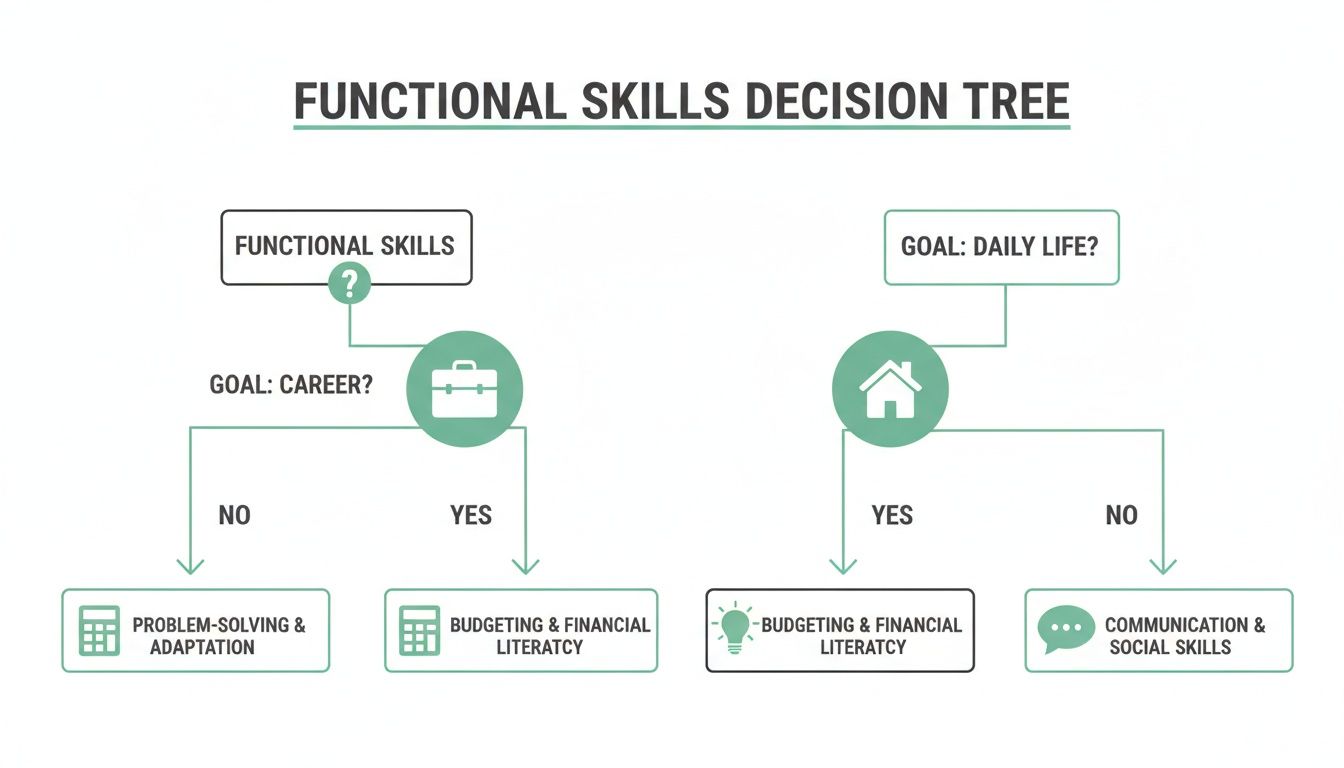
As you can see, Functional Skills branch out into really practical applications, whether that’s for getting ahead professionally or just managing personal tasks like budgeting more effectively.
A Focus on Attainable Success
For a lot of adults returning to study, success isn’t just about gaining new knowledge; it’s about getting a recognised qualification in the bag without unnecessary stress. The data shows that Functional Skills offer a highly effective route to a passing grade.
Functional Skills are specifically designed to build confidence by teaching practical, applicable knowledge. The goal is to empower you with the skills employers are actively looking for, in a way that feels relevant to your life.
Recent Ofqual data really backs this up. Pass rates for Functional Skills English at Level 2 reached 84.1% for Reading and 85.1% for Writing. Maths at Level 2 is known to be more challenging, but even with a pass rate of 61.3%, these figures show that Functional Skills are a very achievable goal for dedicated learners. For many, this proves to be a more successful path than going back to retake GCSEs. You can dig into the numbers yourself on the government's education statistics hub.
Choosing Your Path: Functional Skills vs GCSEs
To make the decision even clearer, let’s put them side-by-side. This table breaks down the key distinctions to help you see which qualification aligns best with your immediate and long-term ambitions.
| Feature | Functional Skills | GCSEs |
|---|---|---|
| Primary Focus | Practical, problem-solving skills for work and life. | Broad academic knowledge and theoretical understanding. |
| Assessment Style | Context-based tasks reflecting real-world scenarios. | Exams covering a wide curriculum, often including abstract concepts. |
| Ideal For | Adult learners, career changers, and those needing a recognised qualification quickly. | Students on a traditional academic path, often leading to A-Levels and university. |
| Pacing | Flexible, often available to study online at your own pace. | Structured, with fixed exam dates and a rigid academic year. |
Ultimately, choosing between Functional Skills and GCSEs is about matching the qualification to your needs. If your goal is to gain a respected, practical qualification that opens doors to employment or further vocational training without delay, Functional Skills are an outstanding choice.
Making Numbers Work for You in Real Life
Let’s be honest, for many of us, the word ‘maths’ brings back memories of abstract problems in a stuffy classroom. But what if maths wasn't about complex theories and formulas you’ll never use again? What if it was about feeling confident and in control of your daily life? That’s exactly where functional skills maths comes in, transforming numbers from a source of stress into a practical, everyday tool.
The whole point isn’t to memorise things for an exam and then forget them. It’s about learning to apply simple, clear logic to the real financial and practical hurdles you actually face. This is about becoming more self-reliant and ready for whatever life throws at you.
From Classroom Concepts to Real-World Confidence
Think about the last time numbers popped up unexpectedly. Maybe you were checking your payslip, trying to figure out a discount in a shop, or just making sure a household bill was right. These are the moments where functional maths skills become your secret weapon.
A good course zeroes in on these exact situations. It builds your confidence by linking core mathematical ideas—like percentages, fractions, and ratios—to things you can actually see and use.
For instance, you’ll learn to:
Master Your Budget: Feel on top of your income and outgoings without the usual stress.
Spot a Great Deal: Instantly work out percentages to know if that "sale" is genuinely a bargain.
Check for Errors: Feel secure in your ability to double-check payslips, invoices, and bills for mistakes.
Get Creative in the Kitchen: Easily adjust recipe ingredients using ratios, whether you’re cooking for two or ten.
This hands-on focus means every skill you pick up has a direct, immediate use, making your studies feel relevant and worthwhile right from the start.
Building Practical Skills with Stonebridge
This practical approach is central to the Functional Skills English & Maths Level 2 Including Exams course at Stonebridge. The 'Using numbers' module is designed specifically to build your abilities in a practical, problem-solving way.
You’ll cover everything from addition, subtraction, multiplication, and division to decimals, fractions, and percentages. The crucial difference is that you’ll learn how to use these skills to solve real problems. You'll explore using ratios in recipes and at work, making decisions about purchases, or working out if your bills are correct.
The course focuses on building your ability to apply logic and reasoning to everyday financial and practical challenges, transforming maths from a subject to a life skill.
Throughout the module, you'll be tested with quizzes and a tutor-marked assignment, ensuring that you're ready to sit your final exam with confidence. This method ensures the knowledge actually sticks because you are seeing its value in action.
Flexible Learning That Fits Your Life
At Stonebridge Associated Colleges, we understand that adult learners need flexibility. That's why our courses are offered on a simple, affordable monthly subscription. There are no scary long-term credit agreements, and you have the freedom to pause or cancel whenever you need to.
This model gives you complete control over your learning journey. You can study 100% online, fitting it all in around your work and family commitments. You'll have the full support of a qualified tutor as you learn, ensuring you can tailor your studies around your life.
By choosing Stonebridge, you’re not just signing up for a course; you’re investing in practical, valuable skills that will serve you for a lifetime, all on your own terms.
Getting to Grips with the Levels and Exams
Starting a new qualification can feel a bit like looking at a Tube map for the first time – you know your destination, but the lines and stops look complicated. It’s the same when you hear terms like ‘Level 1’ or ‘Level 2’ thrown around. Let’s clear up that confusion and break down exactly what the Functional Skills levels mean and what the exams are really like.
So, What Do the Levels Actually Mean?
Think of the levels as steps on a ladder. Each one is designed to meet you where you are right now and help you climb to where you want to be, building your skills and confidence along the way.
It’s actually quite straightforward:
Entry Levels (1, 2, and 3): These are the very first rungs. They’re perfect if you’re looking to build your confidence with the basics of English and Maths, giving you a solid foundation to build on.
Level 1: This is a fantastic next step if you’ve got some foundational knowledge but want to sharpen it up for everyday use at work. It’s widely recognised as being on par with a GCSE grade 2 (what used to be an E or D).
Level 2: This is the big one. It’s the highest level and the one most employers and colleges are looking for. Nailing a Level 2 in Functional Skills is broadly accepted as the equivalent of a GCSE grade 4 (the old grade C).
For most people, Level 2 is the goal. It’s the key that unlocks doors to new jobs, apprenticeships, or further education. It proves you’ve got the essential literacy and numeracy skills to really get stuck in and succeed professionally.
What to Expect on Exam Day
Just the word ‘exam’ can be enough to make anyone nervous, but Functional Skills assessments are cut from a different cloth. They aren’t designed to catch you out with abstract, academic questions. Instead, they’re all about seeing how you apply your skills to realistic, everyday situations.
The whole process is refreshingly down-to-earth and designed to be achievable. With the right preparation, you can walk in feeling ready and confident.
The whole point of a Functional Skills exam is to test what you can do, not just what you can remember. It’s about using English and Maths to solve the kind of problems you’ll actually face at work and in daily life.
A Closer Look at the Assessments
Both the English and Maths exams are structured to test specific, real-world abilities. Let’s pull back the curtain on what each one involves so you know exactly what’s coming.
Functional Skills English Exam:
Reading: You’ll be given a few different types of texts – things like emails, articles, or leaflets – and asked questions to check you’ve understood them. It’s all about seeing if you can pick out key information, get the main gist, and figure out the tone of the writing.
Writing: This part is about producing useful documents yourself. You might be asked to draft a formal email, write a letter of complaint, or put together a short report. They’ll be looking at your spelling, punctuation, grammar, and how clearly you can organise your thoughts.
Speaking, Listening, and Communication: This is often a group discussion or a short presentation. It’s a chance to show how well you can get your ideas across, listen to what others are saying, and contribute to a conversation.
Functional Skills Maths Exam:
Calculator and Non-Calculator Papers: The maths exam is usually split into two parts. One lets you use a calculator for the trickier calculations, while the other tests your core mental arithmetic and problem-solving skills without one.
Real-World Problems: The questions are all based on practical scenarios. You won’t just be asked to "solve for x." You might need to figure out which mobile phone contract is the best value, calculate the area of a room for new carpet, or make sense of data in a chart.
Knowing this structure helps take the fear out of it. It shows that these exams aren't about abstract theory; they're about practical skills, and with a bit of focused prep, they are completely within your grasp.
Why Learn Functional Skills Online with Stonebridge?
For most busy adults, flexibility isn't just a nice-to-have; it's an absolute deal-breaker. Juggling work, family, and everything in between means traditional college timetables, rigid deadlines, and the daily commute just aren't an option. This is where studying Functional Skills online completely changes the game, putting you firmly back in the driver's seat of your education.
Choosing an online provider like Stonebridge Associated Colleges means you can finally learn on your own terms. Imagine fitting your studies into a quiet evening after the kids are in bed, grabbing an hour on your lunch break, or making progress on a Sunday morning with a coffee. With 100% online learning, your classroom is wherever you need it to be, turning what once seemed impossible into a perfectly achievable goal.

A Modern Approach Built for Real Life
We get it. Adult learners need a system that adapts to their lives, not the other way around. That’s why Stonebridge has scrapped the old-fashioned model of hefty enrolment fees and strict schedules. Instead, we offer a simple, straightforward subscription for our courses, including the Functional Skills English & Maths Level 2 Including Exams course.
This approach brings some powerful, real-world benefits:
Total Flexibility: You can pause or cancel your subscription at any time. If work gets manic or a family emergency pops up, you won’t lose your progress or your money.
No Long-Term Debt: Forget about tangling with student loans or getting tied into long-term credit agreements. Our affordable monthly fee makes getting qualified accessible and easy to budget for.
All-Inclusive Price: Your subscription covers everything. We’re talking course materials, dedicated tutor support, and even the cost of your final exams. No hidden fees, no nasty surprises.
We designed this model to knock down the financial and logistical barriers that so often get in the way of professional development. It’s education built for how we live now.
Personalised Support Every Step of the Way
Studying online doesn’t mean you’re going it alone. Far from it. The moment you enrol with Stonebridge, we’ll assign you a dedicated personal tutor who is an expert in their subject. They’re your guide, your mentor, and your biggest supporter throughout your learning journey.
Your tutor is there to:
Answer any questions you have about the course material.
Provide detailed, constructive feedback on your assignments.
Offer encouragement and guidance to keep you motivated and on track.
This one-to-one support is a core part of how we do things. We want to make sure you feel seen, heard, and supported at every stage, giving you the confidence you need to succeed.
Stonebridge’s combination of a flexible subscription model and dedicated tutor support creates a learning environment where you are empowered to achieve essential qualifications without putting your life on hold.
Practical Modules for Immediate Impact
The Functional Skills English & Maths Level 2 course is structured to deliver practical, useful knowledge right from day one. Take the 'Using Numbers' module in the maths section. It covers everything from basic arithmetic to decimals, fractions, and percentages.
But here’s the crucial part: it doesn’t just stop there. Every concept is immediately tied to a real-world problem you might actually face. You’ll learn how to use ratios to adjust a recipe, how to calculate discounts to be a smarter shopper, and how to check your bills for accuracy. You’ll then complete quizzes and a tutor-marked assignment to lock in that knowledge and make sure you’re fully prepped for the final exam.
By focusing on these practical applications, the course ensures that the Functional Skills you learn aren't just for passing an exam—they're skills for life.
Ready to take control of your future on your own terms? Learn more about the Functional Skills course with Stonebridge and start your journey today.
Your Questions About Functional Skills Answered
Taking the next step in your education is a big decision, and it’s completely natural to have a few questions before you commit. We want to make sure you have all the information you need to feel confident and excited about getting started.
This final section tackles the most common queries we get about studying Functional Skills online. Think of it as the last piece of the puzzle, designed to clear up any lingering doubts so you feel completely ready to jump in.
How Long Does It Take to Complete a Functional Skills Course Online?
The beauty of a flexible online course is that you’re the one in the driver's seat. With a provider like Stonebridge Associated Colleges, there are no rigid deadlines or term times to worry about. You set a pace that works for you and your life.
Some learners are highly motivated and have the time to power through the course material in just a few months. Others prefer a steadier approach, fitting their studies around a full-time job, family, or other commitments.
That’s exactly why the subscription model works so well. It puts you in charge, allowing you to learn comfortably without the pressure of a traditional academic calendar. This means you can achieve your qualification in a way that feels manageable, not stressful.
Are Online Functional Skills Qualifications Recognised by Employers?
Absolutely. This is a crucial question, and the answer is a definite yes. Functional Skills qualifications are regulated by Ofqual, the official body that oversees qualifications, exams, and assessments in England. This means they are nationally recognised and highly respected by employers and educational institutions.
A Level 2 qualification, in particular, is widely accepted as equivalent to a GCSE grade 4 (what used to be a C). Nailing this proves to potential employers, colleges, and universities that you have the essential English and Maths skills they’re looking for. It’s a valuable credential that genuinely strengthens your CV.
A nationally recognised, Ofqual-regulated Functional Skills qualification is a powerful signal to employers that you have the practical, real-world abilities needed to succeed in the workplace.
What Kind of Support Will I Get Studying Online?
One of the biggest myths about online learning is that you're left to figure it all out on your own. At Stonebridge, nothing could be further from the truth. We believe that proper support is essential for success, which is why studying online never means studying alone.
As soon as you enrol, we assign you a dedicated personal tutor who is an expert in their subject. They are your go-to person for everything related to your course.
Your tutor is there to:
Answer your questions and clear up any concepts you find tricky.
Provide constructive, detailed feedback on your assignments to help you improve.
Offer guidance and encouragement to keep you motivated and on track.
This one-on-one support, combined with expertly designed course materials, ensures you have a clear and supported path from day one all the way to the finish line.
Is the Exam Included in the Course Subscription Fee?
Yes, it is, and we know this is a huge plus for our learners. When you enrol in the Functional Skills English & Maths Level 2 Including Exams course with Stonebridge, the cost of your exams is included in your affordable monthly subscription.
We believe in a transparent, all-in-one approach. There are no surprise costs or hidden fees down the line. This makes it a straightforward and budget-friendly way to gain a valuable qualification, allowing you to focus on what really matters: your learning.
Ready to gain the qualifications you need with a flexible and supportive approach? With Stonebridge Associated Colleges, you can achieve your goals on your own terms.
Explore the Functional Skills English & Maths Level 2 course and start your journey today!