
A senior care worker has started leading shifts, supporting colleagues and speaking up when something goes wrong. The next step may be a Deputy Manager role, but practical experience alone can leave difficult questions unanswered. How should staffing, safeguarding, quality, supervision and regulation be handled when responsibility grows?
Leadership and management Level 5 in the social care space is designed for that step up. This guide explains what the qualification means, who it suits, how workplace assessment works and how online study with Stonebridge can fit around shifts and family life. It's written for current and aspiring managers in adult care who want a clear route towards more confident, accountable leadership.
What Leadership and Management Level 5 Actually Means
The TQUK Level 5 Diploma in Leadership and Management for Adult Care (RQF) combines knowledge with evidence of competence. In simple terms, you won't only learn what good management looks like. You'll show how you apply it in a real adult care setting.
On the UK Regulated Qualifications Framework, Level 5 sits above Level 3 and below Level 7. It's commonly understood as comparable with higher-level study such as an HND or foundation degree, although qualifications at the same level can differ in content and purpose. The most useful point is its professional focus. This qualification prepares learners for operational leadership, rather than purely academic study.
The Skills for Care national workforce report estimates that 33% of people in manager roles hold a qualification at Level 5 or above. It also estimates that 61% of Registered Managers hold a social care qualification at Level 5 or above, while half are specifically qualified to Level 5.

Why the level carries practical weight
A Level 5 learner explores how to manage people, resources and risk while maintaining person-centred care. The work connects directly with responsibilities often held by managers, including:
Governance: keeping systems organised and accountable.
Safeguarding: recognising concerns and leading appropriate action.
Staff oversight: supervising performance and supporting development.
Service quality: reviewing practice and responding to improvement needs.
The qualification is therefore more than a label. It's a structured way to demonstrate that you can make sound decisions when the work becomes more complex.
Who the Level 5 Qualification Is For
This qualification suits people who already understand adult care and are ready to take greater responsibility. You might be a Registered Manager, Deputy Manager, Team Leader or Senior Care Worker. You might work in a residential home, supported living service, domiciliary care, day service or another adult care environment.
The course is especially relevant if your role gives you opportunities to lead colleagues, contribute to support planning, attend meetings, manage concerns or help improve daily practice. Workplace access matters because assessment depends on gathering evidence from what you do, not reading course material.
Check your readiness before enrolling
Stonebridge course requirements should always be reviewed before you apply. In general, learners benefit from:
Adult care experience: paid work or volunteering in a suitable setting.
Communication skills: literacy and numeracy around Level 2, often compared with GCSE grade 4 or C.
Leadership exposure: existing management duties are useful, although aspiring managers may also be suitable.
Workplace support: a supervisor, manager or assessor who can confirm practice and help arrange observations.
Some mature learners without traditional qualifications may still be considered after an initial assessment. An admissions conversation can clarify whether your experience provides a workable starting point.
You'll also need suitable identification and may need to discuss reasonable adjustments. Adjustments can help learners access assessment fairly without changing the required learning outcomes. It's sensible to raise support needs early, rather than waiting until an assignment or observation is due.
Practical rule: before enrolling, ask who can observe your work, confirm your evidence plan and check that your workplace can support the assessment process.
Typical Units Covered in the Level 5 Diploma
The diploma brings together units that reflect the decisions managers make every day. Exact unit choices depend on the qualification specification and your setting, but the subject areas usually connect closely with adult care leadership.
Person-centred practice and professional development
Learners explore how to lead support that reflects each person's needs, preferences and outcomes. This can include person-centred assessment, support planning and reviewing whether care remains appropriate.
Professional development also has a personal side. You may examine your leadership style, identify development needs and plan how to improve your practice. Units covering team leadership, supervision and professional practice help turn self-awareness into practical action.
For example, a learner might review how a team meeting is run, consider whose voice is missing and propose a more inclusive approach. The written work then links that reflection to leadership principles and workplace evidence.
Governance, safeguarding and quality
Managers need to understand how services remain safe, lawful and accountable. Relevant themes include:
Safeguarding and protection: leading responses to concerns involving adults at risk.
Regulatory processes: understanding how legislation, policies and inspection expectations affect practice.
Quality assurance: using reviews, feedback and records to identify improvement needs.
Risk management: balancing safety with people's rights, independence and choices.

How You're Assessed and How Long It Takes
The Level 5 Diploma uses a workplace portfolio, rather than relying on formal written examinations. You'll usually build evidence over time and show that you can apply the required knowledge and skills in your role.
Evidence may include reflective accounts, written assignments, professional discussions, observation records and witness testimonies from managers or colleagues. An assessor may observe practice directly, while a workplace supervisor can confirm that an activity took place and was completed appropriately.
What a portfolio might contain
A portfolio could include:
A reflective account explaining how you handled a safeguarding concern.
An observation record showing how you led a team discussion.
A professional discussion about regulatory responsibilities.
A witness testimony confirming your supervision of a colleague.
An assignment connecting policy and leadership theory to your workplace.
You'll need to protect confidentiality. Remove identifying details and follow your employer's policies when using records or examples.
The diploma's credit value depends on the specific qualification route. The course information should be checked carefully before enrolment, particularly because generic Level 5 management awards and adult care diplomas can have different structures.
The CMI Level 5 qualification framework shows how Level 5 awards can be offered at different sizes, from an Award through to an Extended Diploma. Its benchmark learning loads range from 14 GLH, 40 TQT and 4 credits for an Award to 216 GLH, 540 TQT and 54 credits for an Extended Diploma.
The adult care diploma usually takes 12 to 18 months to complete. Your pace may vary according to your workload, access to evidence and the support available at work.
How Level 5 Compares with Level 3 and Level 7
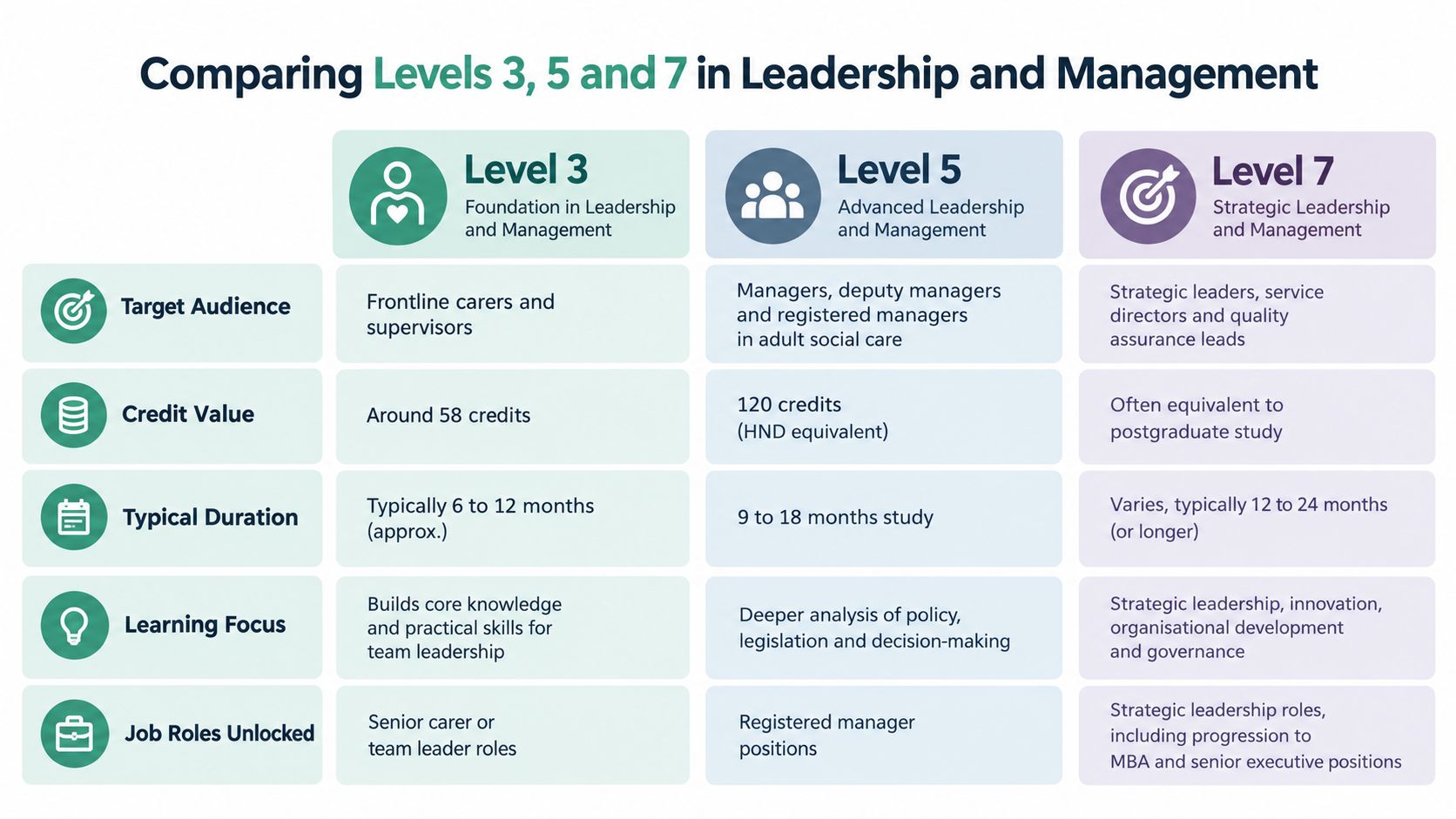
Choosing the right qualification level depends on your current role and the decisions you're expected to make. Level 3 usually supports frontline practice and first-line supervision. Level 5 focuses on operational management in adult care. Level 7 is more suited to strategic leadership and senior organisational responsibility.
| Feature | Level 3 | Level 5 | Level 7 |
|---|---|---|---|
| Target audience | Frontline carers and supervisors | Managers, Deputy Managers and Registered Managers | Strategic leaders, service directors and quality assurance leads |
| Credit value | Often around 58 credits, depending on the qualification | Depends on the specific diploma and awarding structure | Varies by programme |
| Learning focus | Foundational care knowledge and practice | Policy, legislation, governance and operational decision-making | Strategic leadership, organisational direction and advanced analysis |
| Typical progression | Senior Care Worker or Team Leader | Registered Manager or broader management roles | Service Director, strategic lead or postgraduate progression |
The decision in everyday terms
If you're still developing core care skills, Level 3 may be the more appropriate starting point. If you're already leading staff or preparing for a management position, Level 5 is likely to match your responsibilities more closely.
Level 7 shouldn't be treated as a better version of Level 5. It serves a different purpose. A learner managing one service may need practical skills in supervision, compliance and quality assurance, while a strategic leader may focus on organisational policy, service development and wider governance.
Studying Level 5 Online with Stonebridge
Online learning suits adult care professionals who can't step away from work for regular classroom sessions. With Stonebridge, learners study the TQUK Level 5 Diploma in Leadership and Management for Adult Care (RQF) through an online platform, using digital course materials and structured units.
You can plan study around shifts, supervision duties, family commitments and changing workloads. A quieter evening may work for one learner, while another may prefer short study sessions across several days. The online format gives you control over when you engage with the material and when you prepare workplace evidence.
Support while you study
Tutor support is an important part of distance learning. Learners can submit work for marking, receive feedback and ask questions through the available support channels. That feedback can help you understand what an assessor expects and improve future submissions.
Stonebridge Associated Colleges offers flexible, subscription-based courses with 100% online study, qualified tutor support and a modular structure. The subscription model spreads payments through a monthly fee, and learners can pause or cancel without entering a long-term credit agreement.

A connected learning experience
Learners and alumni of Stonebridge Associated Colleges also get access to the learndirect Community Hub app, which is available to learners and alumni of the learndirect Digital Group. It provides discussion groups, topic communities and forums where people can share questions and perspectives during their learning journey.
Stonebridge is also listed with the UK Register of Learning Providers and regulated by the Financial Conduct Authority. Check the course page for the current qualification specification, requirements, assessment details and what's included before making your decision.
Frequently Asked Questions About Level 5
Is Level 5 recognised by adult care employers?
A regulated Level 5 adult care qualification can support applications for management roles across adult social care. Employers will still consider experience, leadership ability, references and the needs of the particular service. NHS employers may set their own person specifications, so check each vacancy rather than assuming every role has identical requirements.
Do Registered Managers have to hold Level 5?
Requirements can depend on the role, service type and regulatory expectations. The Care Quality Commission considers whether a Registered Manager is suitable, competent and able to manage the service effectively. A Level 5 qualification is widely used as the main benchmark for formal adult social care leadership, but it doesn't replace the need to check current CQC guidance and the employer's requirements.
Is Level 5 the same as a foundation degree?
It can sit at a comparable qualification level, but it isn't the same type of programme. A foundation degree is an academic higher education qualification. The adult care Level 5 diploma focuses on management competence, workplace evidence and the responsibilities of running care services.
Can Level 5 lead to Level 7 study?
It can provide a useful progression point for learners who want to move towards strategic management or postgraduate-level study. Entry decisions belong to the next institution or awarding body, so review its requirements before applying.
Will a Level 3 qualification shorten the course?
Existing learning may help demonstrate knowledge, but it won't automatically remove units or workplace evidence. The awarding organisation and centre must decide whether prior learning is relevant and current. Discuss your Level 3 certificate with admissions before enrolling so the correct route can be confirmed.
Are exams part of the diploma?
The qualification is built around portfolio evidence and workplace assessment, although written assignments and professional discussions may form part of the assessment. Your course information should explain the evidence required for each unit.
Taking the Next Step with Stonebridge
Start by reviewing the TQUK Level 5 Diploma in Leadership and Management for Adult Care course page. Read the course description, qualification information, entry requirements, syllabus, assessment approach and included support carefully. The right course should match your current duties and give you realistic access to workplace evidence.
Next, consider your working pattern. Identify when study could fit into your week, who could support observations and which responsibilities could provide useful evidence. A short conversation with the admissions team can help clarify your suitability, previous learning and practical questions about the subscription.
Stonebridge's monthly subscription option is designed for learners who need flexibility around work and life. You can study online, access tutor support and pause or cancel your subscription if your circumstances change, without a long-term credit agreement.
The qualification won't remove every challenge that comes with management. It can give you a clearer framework for handling those challenges, from supervising staff to reviewing quality and making accountable decisions. If you're ready to move from helping lead a team to managing with greater confidence, exploring Level 5 is a sensible next step.
Stonebridge Associated Colleges offers flexible online courses, including the TQUK Level 5 Diploma in Leadership and Management for Adult Care, with tutor support and a subscription model designed around working learners. Visit Stonebridge Associated Colleges to explore the course and take the next step towards adult care leadership.