Typing “access to maths” into a search bar after a long shift can leave you with more questions than answers. Do you need GCSE maths, Functional Skills, or an Access to Higher Education route?
This guide is for adult learners who need a practical bridge from their current maths confidence to the qualification required for further study, work, or career progression. You'll learn what the route means, what Level 2 maths covers, and how flexible online study can fit around everyday life.
What most people mean when they search for access to maths
In UK search results, access to maths usually refers to one of two routes.
The first is an Access to HE Diploma, which helps adults prepare for university study. The second is standalone maths provision, such as Functional Skills maths or GCSE maths, which builds core ability and may meet an entry requirement.
Both routes are useful. The right choice depends on where you are now and what you need next.
If a university course asks for GCSE maths or an equivalent qualification, Functional Skills Level 2 may provide a practical starting point. If you already meet the maths requirement but need preparation for degree-level learning, an Access to HE Diploma could be more suitable.
Adult maths remains an important part of the UK skills system. In the first nine months of the 2025/26 academic year, 146,390 adults participated in maths essential skills courses, according to the Department for Education's further education and skills statistics.
The important question isn't just, “Which course is available?” It's, “Which maths step removes the barrier in front of me?”
What access to maths really means in the UK
Access to maths is best understood as the step between your current level and the maths qualification you need.
You may remember some school maths but feel rusty with fractions, percentages, or algebra. You may have left school without the grade required for your next course. You might just want proof of your ability before applying for a new role.
A Functional Skills Level 2 course focuses on practical problem-solving. You could work with money, measures, charts, ratios, and everyday calculations. GCSE maths is a more academic qualification, with formal work across areas such as algebra, geometry, statistics, and number.
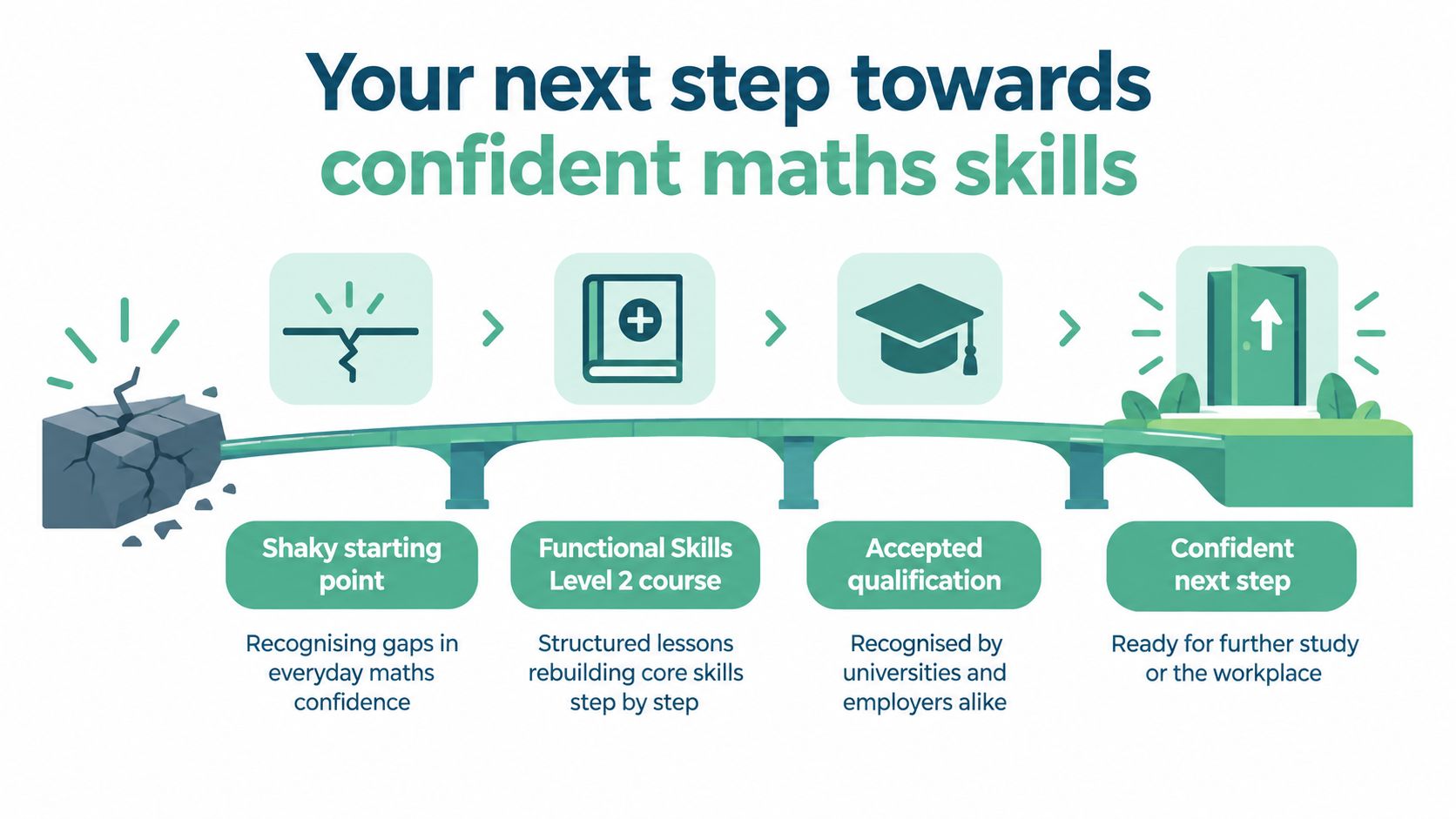
Think of the difference as a bridge. Your current knowledge is one bank. Your next course, job, or professional goal is the other. Functional Skills maths can help rebuild the crossing, while GCSE maths may be the better route if a specific institution requires it.
The need for this bridge is not new. Parliamentary evidence cited the 2011 Skills for Life survey, which found that 24% of adults aged 16 to 65, around 8.1 million people, lacked functional numeracy skills. The same Parliament research briefing recorded that around 37% of 19-year-olds in 2012 had not achieved GCSEs at A* to C, or equivalent qualifications, in both English and maths.
You don't need to be naturally confident with numbers. You need a clear route and steady practice.
What you will actually learn on a Level 2 maths course
A Level 2 maths course turns familiar situations into manageable skills. Lessons typically cover:
Numbers and the number system: Read, compare, and calculate with numbers used in bills, prices, and measurements.
Fractions, decimals, and percentages: Compare discounts in shops, adjust recipes, or understand changes in household spending.
Ratio and proportion: Work out mixtures, scale drawings, serving sizes, or material requirements.
Money: Use budgets, calculate costs, and check whether figures on a payslip or invoice make sense.
Measures and units: Convert and compare measurements used in cooking, building, travel, and household tasks.
Geometry: Calculate perimeter, area, and volume when measuring a room, planning flooring, or estimating storage space.
Charts and data: Read graphs and tables so you can understand information at work or in the news.
Averages and simple statistics: Summarise a set of results, such as attendance figures, delivery times, or survey responses.
Formulae and problem-solving: Substitute values into a formula and choose the right operation for a practical question.
The course isn't about memorising rules without context. You'll learn how to decide which method fits the problem in front of you.
That approach can be reassuring if school maths felt abstract. You're not starting from nothing. You're bringing experience from managing money, organising work, following instructions, and solving everyday problems.
Who the maths route is designed for
Jade is 28 and wants to move towards nursing. She left school without the GCSE maths grade her preferred route requires. Her next sensible step is to check the entry conditions for an Access to HE Diploma or healthcare degree, then use a Level 2 maths course to work towards the requirement she's missing.
Marcus is 42 and works as an electrician. His employer wants evidence of maths competence before he supervises apprentices. A recognised Level 2 qualification could support his professional development, alongside checking the exact requirements for his workplace and any relevant professional body.
These examples represent common situations, not guaranteed outcomes. The qualification you need will depend on the university, employer, training provider, or professional body involved.
Before enrolling, check:
The entry requirement: Is GCSE maths required, or will Functional Skills Level 2 be accepted?
The qualification route: Does your next course ask for a particular grade or awarding body?
The assessment method: Are exams included, and can you arrange them around your responsibilities?
Your starting point: Would a diagnostic activity help identify the topics needing most practice?
England still has a sizeable low-skills base. The 2023 OECD Survey of Adult Skills national report for England found that around 20% of adults aged 16 to 65 had low basic skills in literacy, numeracy, or both, estimated at 8.5 million adults.
Feeling uncertain doesn't make you unsuitable. It tells you where structured support can help.
Where this qualification can lead next
Your next destination should guide your choice of maths course.
| Progression route | Typical destination | Level 2 maths required? |
|---|---|---|
| Access to HE Diploma | Nursing, teaching, social work, health, or humanities degrees | Often required, check the course |
| Higher apprenticeship | Skilled employment with further study | May be required |
| Policing or emergency services | Application and role-specific training | Requirements vary |
| Trade progression | Plumbing, electrical work, or construction management | Often useful, check the role |
| GCSE maths | A more academic maths outcome | Not applicable |
Functional Skills Level 2 can be a flexible starting point for adults who need to rebuild core skills before making a larger study decision. You can study online rather than arranging evening classes around work, school runs, or care responsibilities.
The pass rate for Level 2 Functional Skills maths assessments was 61.3% between 2021 Q4 and 2024 Q4, compared with 80.0% for Functional Skills English reading and writing combined, according to the outcomes information linked through this BBC report on Functional Skills. Maths can be a demanding qualification, so time for practice, tutor guidance, and exam preparation matters.
Check the exact requirements of your intended destination before you choose. A maths qualification can open a route, but the receiving organisation decides what it accepts.
How online study with Stonebridge works in practice
Stonebridge's Functional Skills English and Maths Level 2 Including Exams course is delivered online. The learning is organised into manageable topics, so you can return to a difficult area instead of trying to cover everything in one sitting.
A typical study routine might look like this:
Choose a short study session. Set aside time after work, before a school run, or during a quieter part of the weekend.
Work through one topic. Practise the method, then apply it to questions based on everyday situations.
Ask for support. A dedicated subject tutor can provide explanations, feedback, and reassurance through the learner portal.
Build towards assessment. When you feel ready, use the course resources to prepare for the included exam.
The course includes full online access, study resources, tutor support, and exam booking. The subscription model lets you spread payments through a monthly fee, and you can pause or cancel without a long-term credit agreement.
A practical rule: Choose a routine you can repeat. Regular short sessions are easier to protect than a large block of study you rarely have time to use.
Learners and alumni of the learndirect Digital Group can also access the learndirect: Community Hub app. It includes discussion groups, topic communities, and forums where people can ask questions, exchange tips, and study alongside others.
Online learning won't remove every challenge, but it can remove the need to travel to classes. That makes a difference when your week includes shifts, caring responsibilities, or changing family routines.
Accessible content helps learners find and use information. GOV.UK publishing guidance recommends short sentences, short paragraphs, meaningful subheadings, and bullet points. These same choices make online study materials easier to access.
Your next step towards confident maths skills
Access to maths doesn't have to mean choosing a full university route immediately. It can mean taking one practical step from uncertain foundations towards a qualification that supports your next application.
Functional Skills Level 2 gives you a structured way to practise number work, percentages, measures, data, and problem-solving. Studying online with Stonebridge lets you fit lessons around work and family life, use tutor support when a topic feels difficult, and manage payments through a flexible monthly subscription.
The bridge metaphor is simple. You begin with the skills you have today. Each lesson strengthens a section of the crossing. The exam gives you a recognised result to take towards further study, training, or work.
You don't need to decide about university today. Start by checking the Functional Skills English and Maths Level 2 Including Exams course, reviewing the requirements for your intended goal, and choosing a study routine you can maintain.
Stonebridge Associated Colleges offers flexible, subscription-based online courses for learners building foundational English and maths skills or preparing for further study. Visit Stonebridge Associated Colleges to explore the Functional Skills route and take your first step towards more confident maths.