
What does a Social Worker do when the list of duties is clear, but time, vacancies, and urgent referrals keep changing the day? If you're considering this career, you'll need that honest picture before you choose a route in.
Social work roles and responsibilities across UK settings
In England, social work is a regulated profession. You must be registered with Social Work England and stay fit to practise. Scotland, Wales and Northern Ireland have their own regulators, so check the register for your nation. The scale is significant. The Social Work England annual report and accounts 2024 to 2025 records 34,300 full-time-equivalent child and family social workers in post at 30 September 2024. Explore the different types of Social Worker roles and find the row below that matches your interests.
| Role | Typical setting | Main focus |
|---|---|---|
| Children and Family Social Worker | Local authority children's services | Safeguarding, family support and care planning |
| Adult Social Worker | Local authority adult care teams | Care Act assessments and adult safeguarding |
| Mental Health Social Worker | NHS trusts and local authority teams | Mental health assessments and care coordination |
| Approved Mental Health Professional | Mental health services | Deciding whether compulsory care under the Mental Health Act is needed |
| Hospital Social Worker | NHS hospitals | Discharge planning and safe return home |
| Practice Supervisor or Team Manager | Any social care team | Supervising practice, decisions and staff support |
Core duties a social worker carries every week
The image below sums up the tasks you'll return to most weeks.
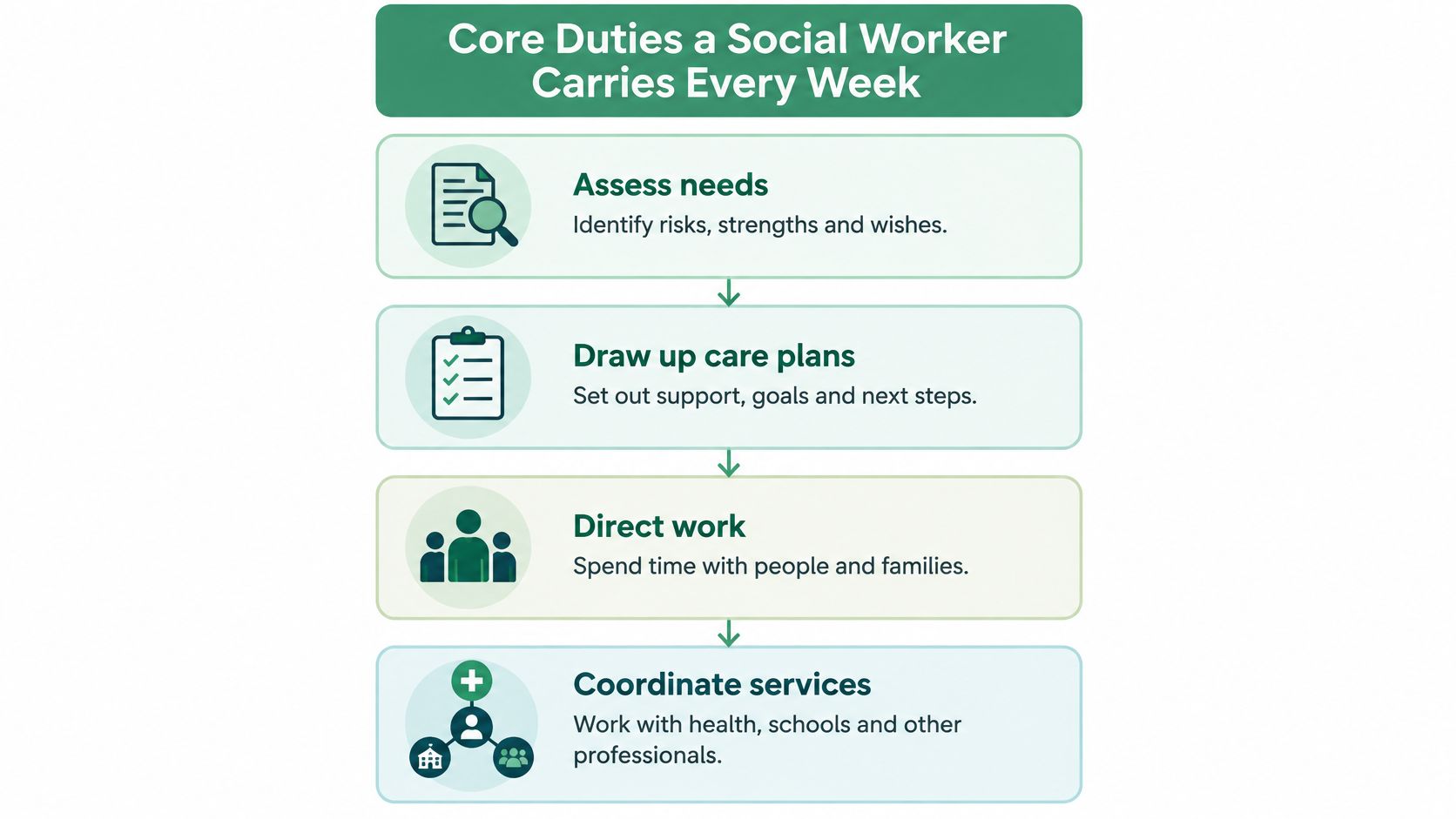
Assess needs: identify strengths, wishes and risks.
Plan support: agree care and support plans with clear goals.
Work directly: spend time with people and families.
Coordinate services: work with health, schools, housing and police.
Record clearly: keep case notes that show your reasoning.
Review progress: check what's changing and what isn't.
Advocate: speak up for people who can't easily speak for themselves.
What a typical week can look like
Monday might start with new referrals and a call to a school about a child. Later, you'd visit a parent at home to talk through a support plan. Tuesday could bring a multi-agency meeting, then time writing up Monday's visit while details are fresh. Duties overlap, so one visit can feed an assessment, a plan and a safeguarding check. If that rhythm sounds right, you're probably looking at the right kind of work.
Safeguarding and legal duties in practice
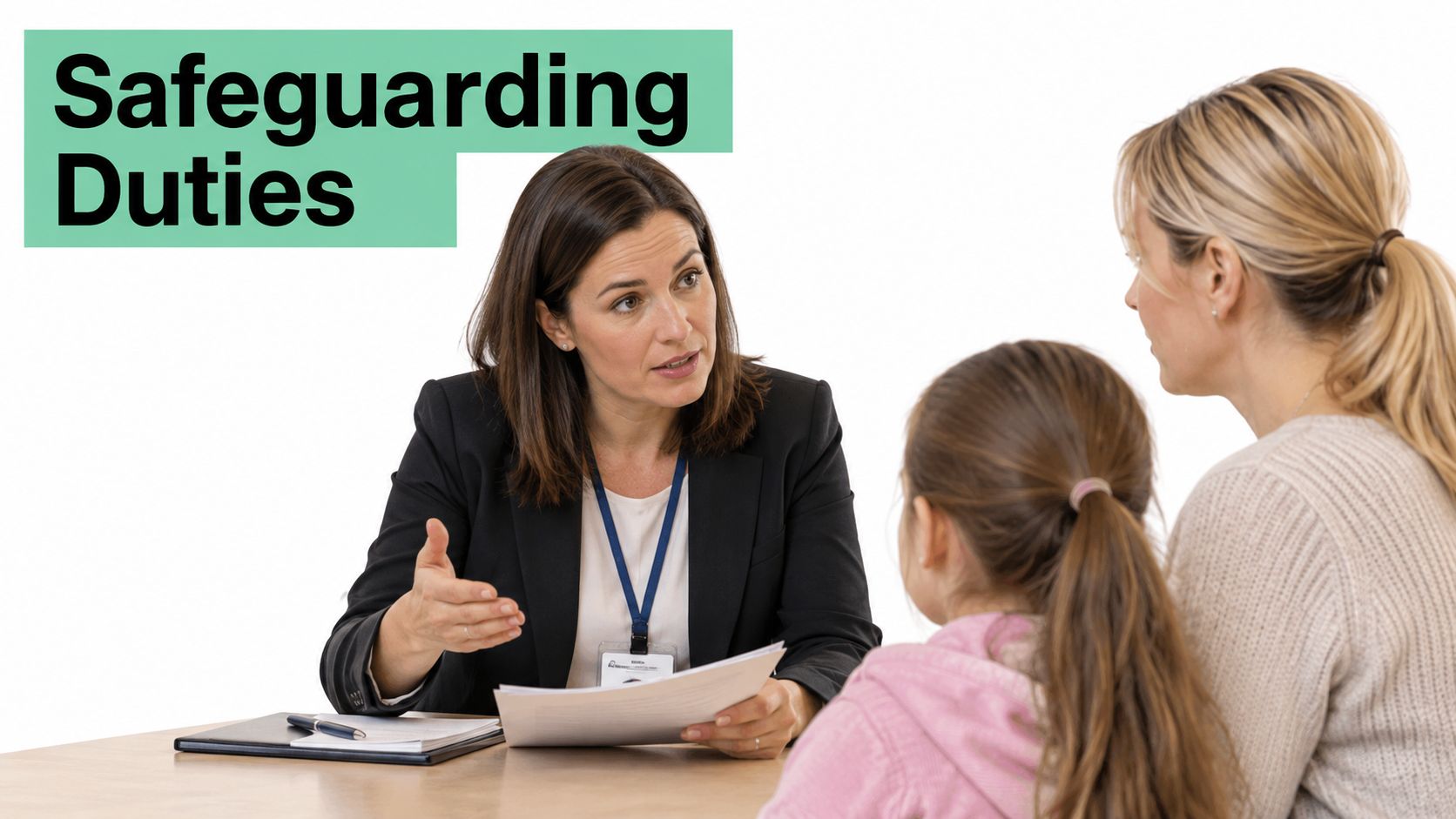
Safeguarding isn't an optional extra. It's a legal duty. The photo below shows the calm, face-to-face side of work that also carries serious legal weight.
Under sections 42 to 46 of the Care Act 2014, local authorities must make or arrange enquiries where they reasonably suspect an adult is experiencing, or is at risk of, abuse or neglect, as set out in the Care and support statutory guidance. Social Workers usually lead or oversee this process.
Screen the referral.
Ask the adult for their views and desired outcome.
Assess how serious and urgent the risk is.
Decide whether a formal section 42 enquiry is needed.
Coordinate partners such as police and health services.
Record decisions and reasons.
Escalate unresolved danger.
Child protection follows a separate route under section 47 of the Children Act 1989. In adult work, keep the person's voice central and choose the least intrusive safe action. Clear records make each decision defensible.
The video below adds useful context on safeguarding in practice.
Skills and professional standards you need
You'll use clear communication and active listening daily. Say a teenager says very little. You'd slow down, allow silence and check you've understood. With an interpreter, you'd speak to the family directly, not to the interpreter. That shows respect and cultural sensitivity.
Kindness alone isn't enough. You also need sound judgement, careful risk weighing, accurate recording, emotional resilience and self-awareness. Our guide to the skills needed for a career in social work explains how these skills fit together.
The Social Work England professional standards require you to respect rights, wishes, dignity and privacy. You must use professional power only when it's necessary, proportionate and in the person's best interests, handle personal information lawfully and report harm or dangerous practice.
Confidentiality is conditional. You may share information when safety is at risk, but sharing more than needed can breach privacy.
Regular supervision and ongoing learning help you keep pace as law and practice change.
Caseloads and pressures in day-to-day practice
The duties on paper don't always match the working week. The Children's social work workforce 2025 statistics show 36,200 full-time-equivalent workers in post in September 2025, yet 6,000 posts were vacant, a 14% vacancy rate. Turnover was 12%, and the average annual caseload was 15.2 children per worker. The Children's social work workforce 2024 statistics show 76% of children's social-work vacancies were covered by agency workers in 2024, so continuity is harder to keep.
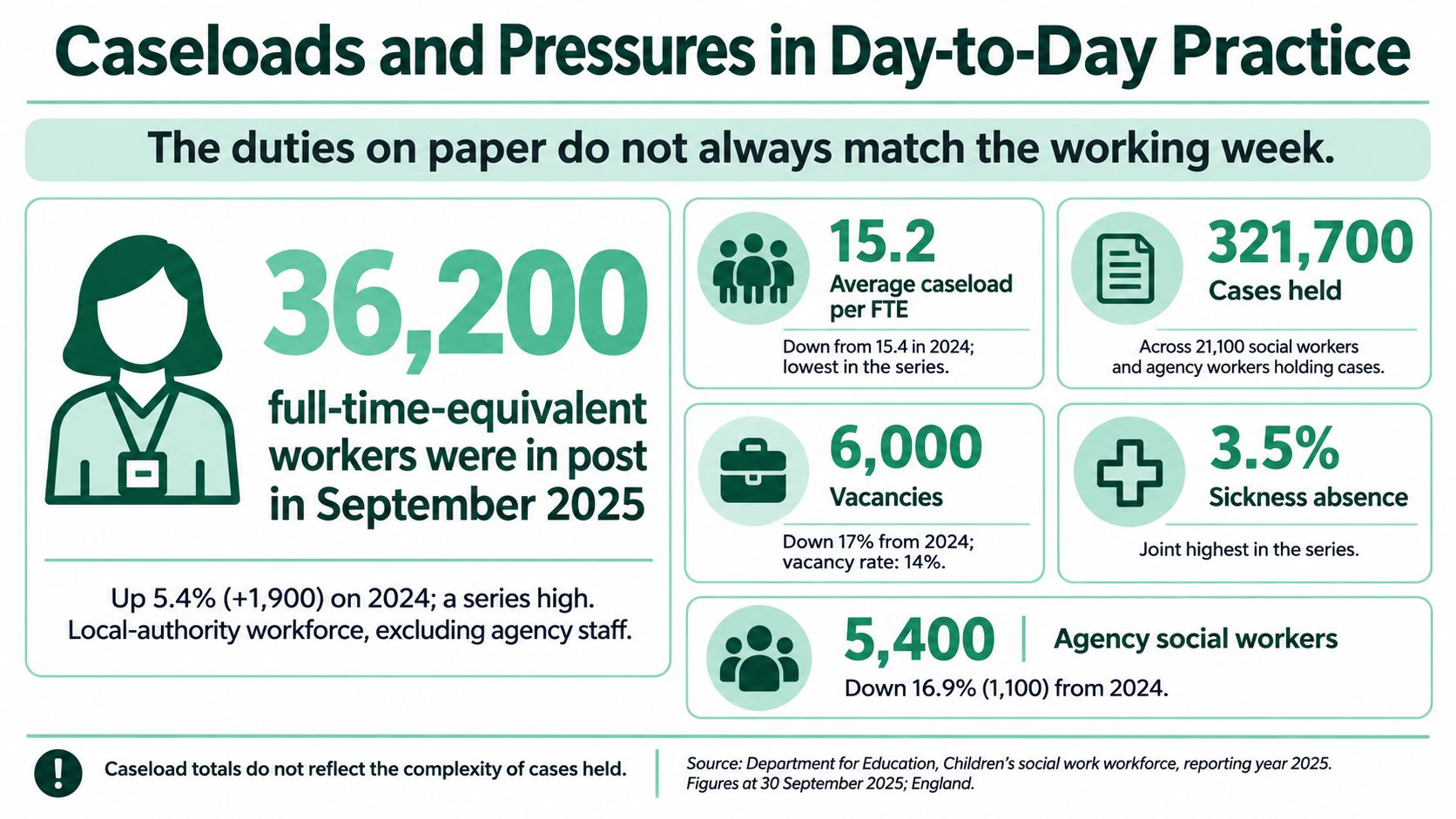
| Measure | Figure | Period |
|---|---|---|
| Full-time-equivalent workers in post | 36,200 | September 2025 |
| Vacant posts | 6,000 | September 2025 |
| Vacancy rate | 14% | September 2025 |
| Turnover | 12% | Year to September 2025 |
| Average caseload per worker | 15.2 children | Year to September 2025 |
| Vacancies covered by agency workers | 76% | 2024 |
In practice, you'd triage urgent safeguarding first, keep planned work moving and record why priorities changed. You'd also tell families if a visit is delayed, then use supervision to reset priorities. Falling vacancies don't automatically mean better practice, because demand and regional differences still limit time for relationship-based work. Before you commit, consider how you'd handle a full caseload on a difficult week.
Start studying social work online with Stonebridge
Everything you've read so far, the statutory duties, the safeguarding calls, the caseload pressure, is what a social work degree prepares you to carry. Our Access to Higher Education Diploma (Social Work) gives adult learners a recognised starting point towards a social work degree approved by Social Work England. You'll need a recognised qualification before you can register and practise in England, so the route begins here.
Study is 100% online, with personalised support from qualified tutors and a modular structure that fits around work and family. Your monthly subscription can be paused or cancelled at any time, without long-term credit agreements, which matters if you're already working in care or supporting dependants. We're accredited by the UK Register of Learning Providers and regulated by the Financial Conduct Authority.
If social policy interests you, our Social Science pathway also covers Foundations of Social Policy and The Origins of The Welfare State, useful grounding for understanding why services look the way they do. You can compare routes in our guide to studying social work courses.
Check the entry requirements, syllabus and assessment on the course page before you enrol. That's your first practical step.
Ready to start your route into social work? Explore flexible, 100% online learning with expert tutor support at Stonebridge Associated Colleges, and choose the Access to Higher Education Diploma (Social Work) to build the knowledge you'll need for degree-level study.