Ever finished a clinical placement, internship, or group project and been asked to write a reflective essay? It’s a common task in many courses, but it’s much more than just describing what happened. A reflective essay is your chance to dig deeper—to analyse your experiences, connect them to your studies, and plan how you'll grow professionally.
Mastering this skill is crucial, especially if you're aiming for a career that demands constant learning and self-awareness. Let's explore how to write a reflective essay that not only earns you top marks but also prepares you for your future career.
What Is a Reflective Essay and Why Does It Matter?
A reflective essay isn't a diary entry or a simple summary of an event. Think of it as a structured investigation into your own professional development. You are the subject, and your goal is to understand how an experience shaped your thinking, challenged your assumptions, and prepared you for what’s next.
It's all about connecting theory to practice. For example, if you're studying an Access to HE Diploma in Nursing, you might reflect on a challenging patient interaction. Your essay would link the communication strategies you used (or didn't use) back to the theories you learned in your course. This demonstrates to your tutor that you can apply your knowledge in the real world.
A Skill for Your Future Career
Learning how to write a reflective essay is about more than just passing an assignment; it’s about building a professional mindset. This skill is vital in careers where continuous self-improvement is part of the job.
With a qualification from Stonebridge Associated Colleges, you could enter fields where reflective practice is essential:
-
Healthcare (Nursing, Midwifery, Radiography): Practitioners constantly reflect on patient care to improve outcomes, handle complex situations, and manage the emotional demands of the job.
-
Social Work: Professionals must analyse their own actions and biases to ensure they provide fair, effective support to vulnerable individuals and families.
-
Education: Teachers regularly reflect on lesson delivery and classroom dynamics to adapt their methods and better meet the needs of their students.
In these careers, reflection is a daily habit for growth. Learning this skill now gives you a significant advantage.
Key Features of a Strong Reflective Essay
So, what are your tutors actually looking for? Here’s a breakdown of the essential ingredients.
| Element | What It Means | Why It's Important |
|---|---|---|
| Personal Experience | Writing about a specific, real event you were involved in. | Grounds your reflection in reality, making your insights more authentic and credible. |
| Critical Analysis | Moving beyond description to question why things happened as they did. | Shows you can think deeply about your actions and their consequences, not just recount them. |
| Link to Theory | Connecting your experience to academic concepts, models, or theories from your course. | Demonstrates your ability to apply academic learning to practical, real-world situations. |
| Future Orientation | Concluding with a clear plan for what you will do differently in the future. | Proves that you have learned from the experience and are focused on professional development. |
This table shows that a reflective essay is a blend of personal storytelling and academic rigour, a combination that truly showcases your growth as a learner and future professional.
A Cornerstone of UK Higher Education
Reflective writing is a central part of modern assessment. In fact, research shows that students who engage in regular reflective practice often see significant improvements in their overall grades. You can explore more data on the impact of reflective practice in higher education.
A strong reflective essay tells your marker not just what you did, but what you learned. It showcases your ability to think critically about your own development, turning raw experience into meaningful professional growth.
Ultimately, learning to write reflectively is an investment in your future. It gives you the analytical tools you need to do well in demanding, people-focused professions. At Stonebridge Associated Colleges, our courses are designed to help you build these practical skills. With our flexible, subscription-based online learning, you can study for a new career in healthcare, business, or education on your own terms. You can start your journey today, building the qualifications and professional skills you need, with the freedom to pause or cancel anytime.
Choosing the Right Framework for Your Reflection
Staring at a blank page can be daunting. Where do you begin? Instead of starting from scratch, you can use a structured model to guide your thoughts. Think of these frameworks as a map for your reflection, ensuring you move beyond simple description and into the deep analysis your tutors want to see.
Two of the most popular models are Gibbs' Reflective Cycle and Schön's model of reflection. Understanding them will help you pick the right one for your assignment.
Gibbs' Reflective Cycle: A Detailed Post-Event Analysis
Gibbs' Reflective Cycle provides a clear, six-stage process for looking back on an experience after it has happened. It’s perfect for a detailed breakdown where you have time to consider every angle.
The six stages are:
-
Description: What happened? Be factual.
-
Feelings: What were you thinking and feeling at the time?
-
Evaluation: What went well and what didn’t?
-
Analysis: Why did things happen that way? Connect theory to practice here.
-
Conclusion: What did you learn? What could you have done differently?
-
Action Plan: If it happened again, what would you do?
If you’re a student studying a degree that your Access to HE Diploma allowed you to study, and you're reflecting on an incident from a work placement, this model is ideal. Structuring your essay around these six stages forces you to dig deep.
Schön’s Model: Reflecting in the Moment
Donald Schön’s model is different. It’s less about a rigid cycle and more about the ongoing process of learning as you go. It focuses on two types of reflection: reflection-in-action (thinking on your feet) and reflection-on-action (looking back afterwards).
This model is excellent for analysing situations where you had to make a quick decision. Imagine you're on a Business Management degree and had to make a snap judgment during a group project. Schön’s model allows you to explore what was going through your mind in that moment (in-action) and what you learned from the outcome later (on-action).
At its heart, Schön's model is about how we learn in the real world—by tackling problems as they come up and thinking critically while we're still in the thick of it.
The flowchart below shows how simple questions can turn a basic summary into a powerful piece of reflection.
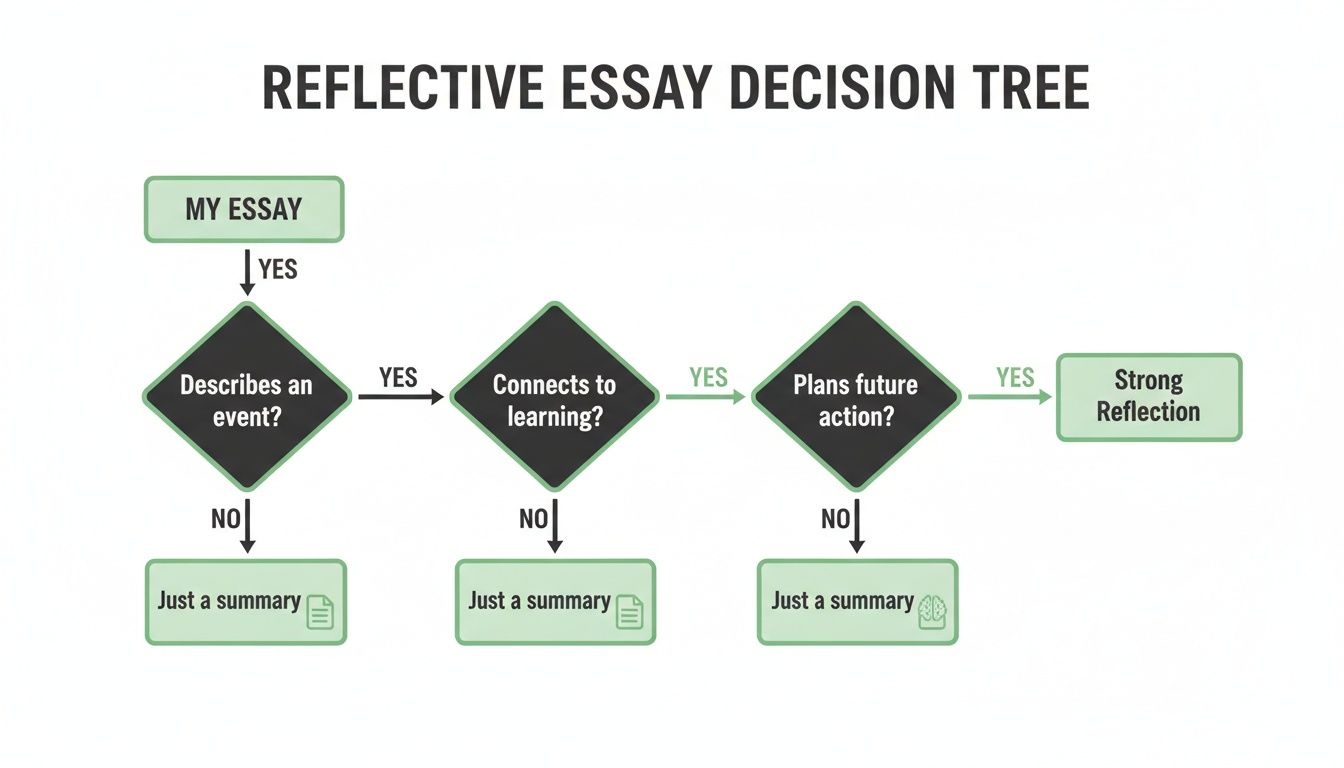
As you can see, genuine reflection always links experience back to learning and makes a plan for the future.
Comparing Gibbs' Cycle and Schön's Model
To help you decide, let's put them side-by-side. The best choice depends on what you're writing about.
| Feature | Gibbs' Reflective Cycle | Schön's Model |
|---|---|---|
| Best For | Detailed analysis of a single, completed event. | Dynamic situations, quick decisions, or ongoing processes. |
| Structure | Highly structured with six clear, sequential stages. | More flexible, focusing on two types of reflection (in-action and on-action). |
| Focus | Looking back on an event from a distance to dissect it. | Exploring the thought process during and after an event. |
| Example Use | A nursing student breaking down a clinical placement incident. | A business student analysing a real-time decision made in a team project. |
So, Which Framework Should You Choose?
The right choice comes down to the experience you're reflecting on.
If your essay is a deep dive into one specific, finished event (like a case study), Gibbs' Reflective Cycle gives you the perfect structure. It’s a checklist that ensures you cover all your bases.
If you're writing about something more fluid—a series of events, a developing situation, or a moment of fast thinking—Schön's model will likely serve you better. It gives you the flexibility to explore the messy reality of thinking on your feet.
No matter which one you pick, the goal is the same: to turn your experience into meaningful learning.
Building Your Essay for Maximum Impact
A powerful reflective essay isn’t just a stream of consciousness; it's a carefully structured piece of academic work. The classic structure of an introduction, main body, and conclusion is your foundation. Let’s break down how to make each part work for you.

Crafting a Compelling Introduction
Your introduction is your chance to grab your reader’s attention. A strong opening should:
-
Set the scene: Briefly introduce the experience you'll be reflecting on.
-
State your core insight: Give the reader a hint of the main thing you learned. This acts as a thesis statement and gives your essay direction.
-
Outline your structure: Mention the reflective model you plan to use so your tutor knows you have a clear plan.
Structuring the Main Body
This is where the deep analysis happens. The most effective way to organise this section is by following the stages of your chosen reflective model, like Gibbs'. Dedicate a paragraph or two to each stage to ensure your reflection is thorough.
If you were using Gibbs' model, your paragraphs might flow like this:
-
Description: Explain what happened, keeping it factual and concise.
-
Feelings: Explore your thoughts and emotions during the event.
-
Evaluation: Discuss what went well and what didn't.
-
Analysis: This is the most important section. Connect your experience to theories from your course. Ask yourself why things happened as they did.
-
Conclusion (of the model): Summarise what you learned from this situation.
A common mistake is spending too much time describing the event. Aim for a balance of roughly 70% analysis and 30% description to show you're thinking critically.
Writing a Forward-Looking Conclusion
A reflective essay conclusion isn't just a summary. It's your chance to show genuine growth.
First, briefly revisit the main learning points from your experience. More importantly, present a clear action plan. Spell out exactly what you will do differently next time. Be specific. Instead of "I'll communicate better," try, "In future group projects, I will schedule a five-minute check-in at the start of each meeting to ensure all members are aligned on their tasks." This shows you’ve turned reflection into a solid plan for improvement—a skill highly valued in careers like nursing, social work, and education, which a Stonebridge Access to HE Diploma can prepare you for.
Finding Your Professional Voice in Reflective Writing
One of the trickiest parts of a reflective essay is balancing personal experience with an academic tone. You need to use 'I'—it’s your reflection, after all—but the goal is to elevate your personal thoughts into professional observations.

This skill is essential for anyone on a vocational course. If you’re studying an Access to HE Diploma in healthcare or education, your reflective essays demonstrate your readiness for professional standards.
Transforming Emotion into Analysis
The language you choose is key. You need to show that you can process your emotions and analyse them objectively.
Let's look at an example. Imagine a student on an Access to Radiography Diploma felt overwhelmed during their first clinical placement.
-
Before (Descriptive): "I was really scared when I had to operate the X-ray machine for the first time on my own. I thought I was going to mess it up."
-
After (Reflective): "My initial apprehension during my first solo operation of the X-ray equipment stemmed from a lack of familiarity with the procedure in a live clinical setting. This experience highlighted a gap between my theoretical knowledge and its practical application."
The second version doesn't hide the fear; it rephrases it professionally. It analyses the source of the feeling and identifies a specific learning need. This is what tutors want to see.
Shifting your language from purely emotional to analytical is the single most effective way to add academic weight to your reflective writing. It proves you can step back from an experience and assess it with a critical eye.
Building Your Analytical Vocabulary
Using precise, analytical language will make your insights more effective.
-
Instead of "I think…", try "Upon reflection, it became apparent that…"
-
Instead of "This made me realise…", try "This experience served as a catalyst for understanding…"
-
Instead of "Next time, I'll do better," try "Moving forward, my action plan involves developing skills in…"
This subtle shift in wording demonstrates a more mature and thoughtful approach.
The Importance in UK Vocational Training
For students embarking on careers in teaching, reflective writing is a core part of their training. Research has shown a strong link between in-depth reflection and improved professional practice and assessment performance.
This confirms that mastering reflective writing isn't just about passing an essay. It’s a foundational skill that directly impacts your professional competence.
Whether you're aiming for a career in education through an Access to HE Diploma (Education Professions) or another vocational path, developing this professional voice is essential. It shows you're becoming a thoughtful, self-aware practitioner.
Common Mistakes and Advice from Tutors
Learning how to write a reflective essay involves a few common missteps. The good news? Once you know what to look for, they are easy to avoid. Here’s some insider advice from tutors to help you secure those extra marks.

Pitfall 1: Getting Stuck in Storytelling Mode
The most common mistake is spending the whole essay just describing what happened. Your tutor wants to see what you learned from the experience, not just hear the story.
The Tutor Tip: After every descriptive sentence, ask yourself: "So what?" This prompt forces you to move from description to analysis. For example, after writing, "The patient became agitated," asking "So what?" pushes you towards an answer like, "This highlighted a gap in my ability to manage patient anxiety, which connects to the communication theories we studied."
Pitfall 2: Forgetting to Connect Theory to Practice
Many students write a good personal reflection but forget the academic side. You must connect your real-world experiences to the theoretical concepts from your course. This is what turns a personal story into academic writing.
The Tutor Tip: Before you start writing, jot down two or three key theories from your modules that are relevant to your experience. Make it your mission to explicitly name and apply them in your analysis. This proves you can use your knowledge to make sense of your professional practice. You can discover more insights into reflective writing strategies for UK students.
Pitfall 3: A Weak or Missing Action Plan
An essay that ends without a clear, forward-looking action plan feels incomplete. Tutors look for a concrete plan because it shows you’ve learned something and are committed to your development.
The Tutor Tip: Make your action plan SMART (Specific, Measurable, Achievable, Relevant, and Time-bound).
-
Weak Plan: "I will try to be more organised next time."
-
SMART Plan: "For my next group project, I will use a digital task manager to break down my responsibilities. I will set a specific deadline for each component and check my progress at the end of each day."
This level of detail shows you’re serious about your growth—a quality that’s highly valued in any career you pursue after completing a diploma from Stonebridge Associated Colleges.
Ready to Take the Next Step in Your Career?
Learning how to write a reflective essay is a massive step towards a successful career in fields like healthcare, business, or education.
If you’re ready to turn your career goals into reality, Stonebridge Associated Colleges can help. Our flexible, 100% online Access to Higher Education Diplomas are designed for adult learners like you who are juggling studies with work, family, and life.
Learning That Fits Around You
Stonebridge Associated Colleges offers a flexible subscription-based courses across a wide range of vocational and academic subjects. With over twenty years of experience, the college delivers more than a hundred career-focused programmes, including Access to Higher Education Diplomas, health and social care, nursing and midwifery, business management, education, and veterinary science. Learners benefit from 100% online study, personalised support from qualified tutors, and the freedom to pause or cancel their subscription on their course of choice at any time without long-term credit agreements. Stonebridge’s modular structure and affordable monthly fee allow students to tailor their learning journey around work and life commitments, ensuring both convenience and cost-effectiveness.
Developing your reflective writing skills is an investment in your future. Stonebridge offers a flexible way to get there, giving you the power to earn the qualifications you need, completely on your own terms.
Find Your Path to a New Profession
Do you see yourself in a busy hospital, a vibrant classroom, or a dynamic business environment? Whatever your ambition, we have a course to help you get there.
Here are just a few of the pathways you can start with us:
-
Access to HE Diploma (Nursing)
-
Access to HE Diploma (Social Work)
-
Access to HE Diploma (Business)
-
Access to HE Diploma (Education Professions)
Take the first step towards the career you’ve always wanted. Explore our full range of Access to Higher Education Diplomas today. Your future is waiting.
Got Questions About Reflective Essays?
Still have questions about writing your reflective essay? No problem. Here are answers to some common queries.
How Do I Choose a Good Topic for a Reflective Essay?
The best topics come from meaningful experiences that made you stop and think. Did you handle a difficult situation, overcome a challenge in a group project, or have a 'lightbulb moment' applying a new theory? Pick an event that sparked a strong emotional or intellectual reaction—that’s where the richest material for reflection lies.
What’s the Real Difference Between Describing and Reflecting?
Description tells the 'who, what, when, and where' of a situation. Reflection explores the 'why' and 'so what?' It’s where you analyse your own thoughts, feelings, and assumptions, connecting the experience back to academic theories.
As a rule of thumb, aim to spend no more than 20-30% of your word count on pure description. The rest should be your analysis and plans for the future. That’s where you’ll earn the high marks.
Is It Okay to Be Critical of Myself in the Essay?
Yes, absolutely! Honest, constructive self-criticism is a sign of a strong reflection. It shows self-awareness and a commitment to improving. The key is to keep it professional. Don't just list your faults. Instead, analyse why a mistake happened and explain the concrete steps you'll take to avoid it in the future. This shows maturity and a capacity for professional growth.
Ready to build the skills for your dream career? With Stonebridge Associated Colleges, you can gain recognised qualifications entirely online with a flexible subscription that fits your life.