Found an early years educator job description that looks perfect? Before you rush to apply, it's crucial to understand what the recruiter is really asking for. Think of that job description not as a simple list of duties, but as a blueprint. It's the employer's guide to their ideal candidate, detailing the exact skills, qualifications, and personal qualities they need to nurture and educate young children, typically from birth to five years old.
This guide will show you how to break down that blueprint, decipher the language, and tailor your CV and cover letter to prove you're the perfect fit.
How to Decode an Early Years Job Description
Looking at a job description can feel like trying to crack a code. What do phrases like "a passion for child development" or "creating a stimulating environment" actually mean in practice?
The key is to see it as a map. Your task is to read between the lines, understand the core needs of the nursery or school, and then show them how your skills and experience align perfectly. To do this, you need to break the job description down into its main parts. Each section is a signal, highlighting what that employer values most.
The Three Core Components
Almost every early years educator job description is built on three pillars. The strength of your application depends on how well you can prove you have each one covered.
-
Responsibilities: This is the day-to-day work. It includes everything from planning activities based on the EYFS framework and observing children’s progress to maintaining a safe and welcoming environment.
-
Qualifications: These are the non-negotiables. Here you’ll find requirements for specific certifications, like a Level 3 diploma, alongside essential safeguarding or first-aid training.
-
Skills: This section explains how you’ll do the job. It’s a mix of practical skills (like record-keeping) and crucial soft skills—such as patience, brilliant communication, and a creative spark.
As you can see, a top-tier candidate needs that perfect balance of practical duties, official qualifications, and personal strengths. Grasping this helps you pinpoint exactly where you need to provide solid evidence on your CV. If you want to dive deeper into the specifics of the role, our guide on what is an early years practitioner is a great place to start.
Now, let's translate some of that common recruiter language. This table breaks down what those typical job description phrases actually mean and gives you a clear idea of how to respond with confidence.
Translating Recruiter Language into CV Evidence
| Job Description Phrase | What It Really Means | How to Demonstrate It on Your CV |
|---|---|---|
| "A passion for child development" | They want someone who is genuinely enthusiastic and knowledgeable, not just looking for any job. | Mention a specific developmental theory you enjoy applying, or describe a successful activity you led that supported a particular EYFS milestone. |
| "Excellent communication skills" | This covers everything—chatting with children, updating parents, and collaborating with colleagues, often in sensitive situations. | Give a concrete example of how you successfully discussed a child's progress with a parent or worked with your team to deliver a project. |
| "Ability to create a stimulating environment" | They need a proactive and creative person who can turn a simple space into a hub of learning and discovery. | Describe how you designed a new learning corner or transformed an area to spark curiosity, linking it directly to a learning outcome. |
| "Knowledge of safeguarding procedures" | This is non-negotiable. They need to trust you implicitly to prioritise the safety of children above all else. | Clearly state your safeguarding training level and the date it was completed. Briefly note your understanding of reporting processes. |
By translating these phrases into real-world evidence from your own experience, you move from simply listing skills to proving you have them. This is what makes an application truly stand out.
The True Responsibilities of an Early Years Educator
When you look at an early years educator job description, you'll see phrases like "planning activities" and "observing children." But what does that look like day-to-day? Forget a simple checklist; this role is a dynamic blend of artistry and science, where you become the architect of a child’s first experiences with learning.
Your main responsibility is to create a safe, stimulating, and nurturing environment where young children feel confident enough to explore, discover, and grow. This goes far beyond just supervising playtime. It’s about being an intentional educator who crafts meaningful learning experiences out of every moment.

Orchestrating Learning Through Play
One of your core duties is to plan and carry out activities that align with a guiding curriculum. In the UK, this is the Early Years Foundation Stage (EYFS) framework, which sets the standards for the learning, development, and care of children from birth to five years old.
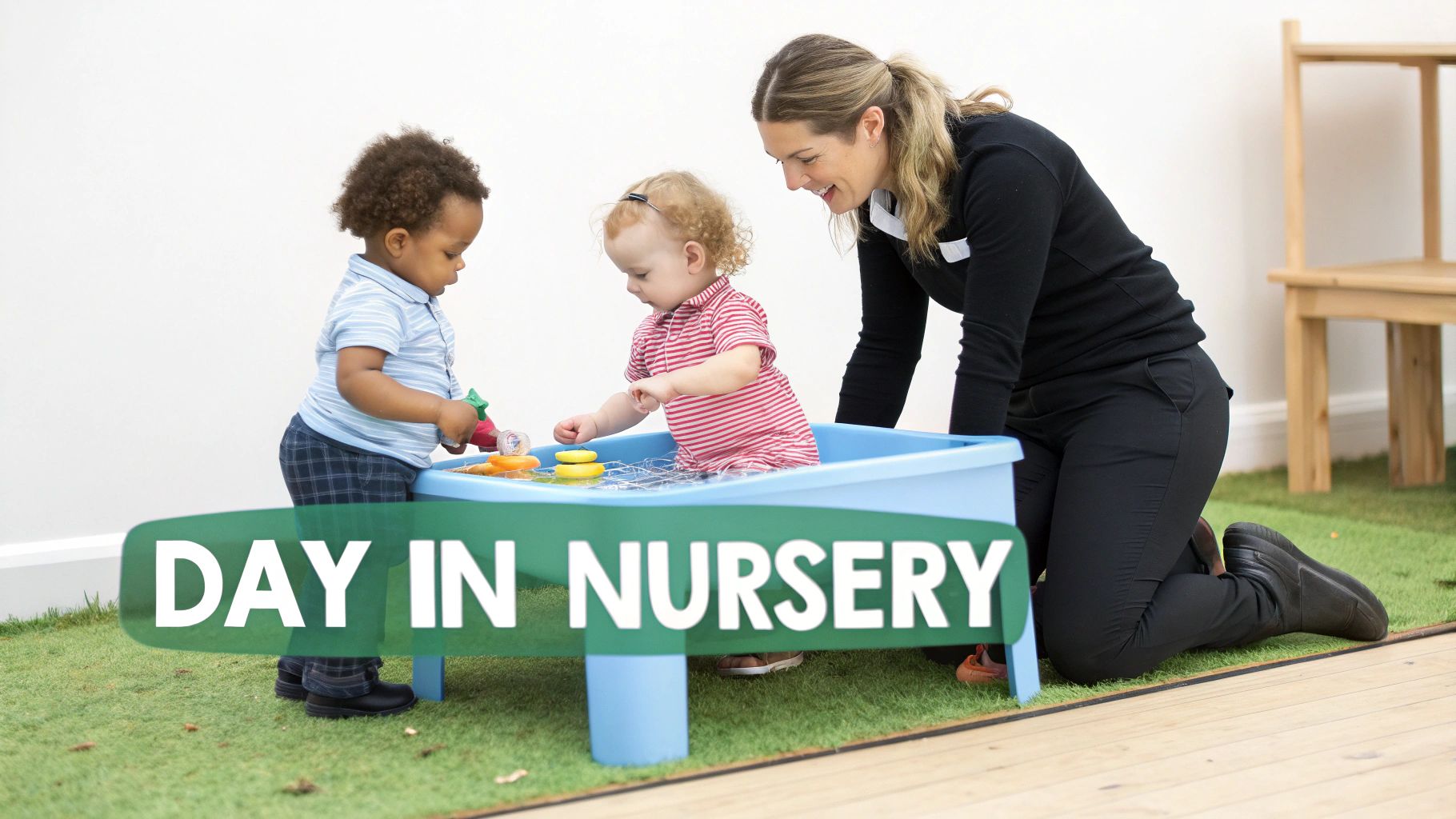
This framework isn’t just paperwork; it’s the backbone of your daily practice. For example, setting up a simple water table is more than just splashing around. It’s a planned activity designed to introduce early science concepts like floating and sinking, develop fine motor skills as children pour and scoop, and build language as they describe what they see.
A typical day might involve:
-
Morning Circle Time: Leading songs and stories to build communication and listening skills.
-
Outdoor Exploration: Guiding activities that encourage physical development and a love for nature.
-
Creative Stations: Setting up painting, building blocks, or sensory trays to spark imagination.
-
Quiet Reading: Creating a cosy corner to instil a love of books from an early age.
Each of these moments is a chance to observe, assess, and gently guide a child's development.
More Than Just an Educator
The role of an early years educator is incredibly multifaceted. You’re part observer, part planner, and part caregiver, all rolled into one.
Being an early years educator means you are a child's first mentor outside their family. You are responsible for fostering not just their academic readiness but their emotional resilience, social skills, and overall wellbeing.
This holistic approach is central to the profession. You'll be tasked with tracking each child’s progress, identifying their strengths, and providing extra support where needed. This involves meticulous record-keeping and, crucially, open and compassionate communication with parents to build a strong partnership in the child's development. You can get a more detailed breakdown in our complete guide to working as an early years practitioner.
Guided by National Frameworks
The job of an early years educator in the UK is shaped by national frameworks. The EYFS Profile, for instance, is made up of 17 early learning goals across seven areas of learning. In a recent academic year, children on average reached the expected level in 14.11 of these goals, showing steady progress nationwide.
What this means for you is that a huge part of your role is planning activities that directly support progress in everything from mathematics to physical development. You can dive deeper into these statistics on the official government education hub.
Ultimately, your responsibility is to lay the foundation for a lifetime of learning. It’s a career that requires immense patience, creativity, and a deep understanding of child development—and it's one of the most profoundly rewarding jobs you can have.
Essential Skills and Qualifications Recruiters Demand
When you’re looking at an early years educator job description, the skills and qualifications section is where recruiters separate promising candidates from the rest. Think of it as your roadmap, showing you exactly what a nursery needs to see on your CV.
These requirements aren't arbitrary. They're directly linked to regulatory standards and have a massive impact on a child's safety and development. Getting this part right is your first step towards securing an interview.
Non-Negotiable Qualifications
In the early years sector, some qualifications are simply non-negotiable. They are the baseline requirements that prove you have the foundational knowledge to work safely and effectively with young children.
The cornerstone is a recognised Level 3 qualification. The sector has evolved, with a much greater emphasis on formal qualifications. In fact, the number of staff delivering funded early education and childcare has hit a new high, with over 110,000 staff in the last year alone. The biggest jump? Those holding Level 3 qualifications, which saw an increase of 13.8%. You can see the full breakdown in the Department for Education's latest statistics.
A Level 3 Diploma isn't just a piece of paper; it’s a signal to employers that you understand the EYFS framework, safeguarding protocols, and child development. It confirms you’re ready to be counted in staff-to-child ratios, making you an essential team member from day one.
Other must-have qualifications typically include:
-
Paediatric First Aid Certificate: An absolute essential.
-
Safeguarding/Child Protection Training: Shows you understand how to keep children safe.
-
Enhanced DBS Check: A mandatory background check for anyone working with children.
Desirable Skills and Training
Once you've ticked the essential boxes, employers look for what extra value you bring. These "desirable" skills are often what make you stand out.
Specialised training is a huge plus. For instance, experience in supporting children with Special Educational Needs (SEN) or those who speak English as an Additional Language (EAL) is highly sought after. It shows you can create an inclusive environment where every child can flourish. A solid grasp of child development theories, like scaffolding in child development, is also key.
The Soft Skills That Make All the Difference
While qualifications get your foot in the door, it’s your soft skills that prove you’ll excel in the role. Recruiters will be looking for evidence of these in your application and interview.
1. Patience and Empathy: This is about understanding the emotion behind a tantrum and guiding a child through their big feelings.
2. Creativity and Resourcefulness: Can you turn cardboard boxes into a spaceship? This is about sparking imagination and making learning fun with whatever you have to hand.
3. Communication: You must be a master communicator, simplifying complex ideas for a toddler, giving a reassuring update to a parent, and collaborating clearly with your team.
4. Resilience and Adaptability: No two days are the same. You need the ability to handle the unexpected with a calm and positive attitude.
If you're looking to gain the core qualification recruiters demand, the TQUK Level 3 Diploma for Working in the Early Years Sector is the industry standard. With Stonebridge Associated Colleges, you can study entirely online, fitting your learning around your commitments through a flexible subscription model. It's a fantastic way to gain the credentials you need to launch a rewarding career.
Crafting Your Standout CV and Cover Letter
So, you’ve decoded the early years educator job description and know exactly what they’re looking for. The next step is to translate that insight into a compelling application. Your CV and cover letter are your first handshake; they need to tell a story that proves you’re the perfect candidate.
It’s a reality that many larger nurseries use software to screen applications. Before a person even sees your CV, it's often scanned by a machine. Understanding Applicant Tracking Systems (ATS) can give you a real edge. This software looks for specific keywords and phrases taken directly from the job description.
Mapping Keywords to Your Experience
To get past the digital gatekeeper, you need to do some keyword mapping. It sounds technical, but it’s a simple and effective technique.
Grab the job description and a highlighter. Pick out all the key skills, qualifications, and duties the employer mentions repeatedly.
You’ll likely find phrases like:
-
"EYFS framework"
-
"Safeguarding and child protection"
-
"Observation and assessment"
-
"Partnership with parents"
-
"Creating a stimulating environment"
Carefully weave these exact phrases throughout your CV and cover letter. This not only beats the software but also shows the human recruiter that you’ve paid close attention and your experience is a direct match.
Transforming Duties into Accomplishments with STAR
Just listing your previous duties won’t cut it. Recruiters know what an early years educator does. What they really want to see is the impact you made. The best way to show this is by using the STAR method.
The STAR method (Situation, Task, Action, Result) is a storytelling technique that turns a simple duty into a powerful, evidence-based accomplishment. It adds context and shows the positive outcome of your work.
Instead of a generic bullet point like "Responsible for planning activities," the STAR method helps you build something more compelling.
Let’s see how it works:
-
Situation: Briefly set the scene. ("In a nursery room with 12 toddlers…")
-
Task: What was your goal? ("…my objective was to improve their communication skills in line with EYFS goals.")
-
Action: What did you do? ("I designed and led weekly themed sensory story sessions using puppets and interactive props.")
-
Result: What was the measurable outcome? ("This led to a 15% improvement in observed communication skills over one term.")
Put it all together, and your CV bullet point goes from bland to brilliant: "Designed and led EYFS-aligned weekly learning plans for 12 toddlers, improving observed communication skills by 15%." That's the kind of concrete detail that gets you an interview.
If you're looking to build the qualifications that form the foundation of these accomplishments, the TQUK Level 3 Diploma for Working in the Early Years Sector (Early Years Educator) is the perfect starting point. With Stonebridge Associated Colleges, you can study 100% online through a flexible subscription, fitting your learning around your life.
Navigating the Challenges of the Early Years Sector
To give you the full picture, we need to talk about the realities of the role. Working in early years is one of the most rewarding jobs out there, but the sector faces hurdles that shape the day-to-day life of every educator.
Understanding these issues helps you see why qualities like resilience, passion, and resourcefulness are so highly valued. When a job description asks for an "adaptable team player," it's often a nod to the real-world pressures of the sector.

The Impact of Funding and Staffing
There's no getting around it: funding and staffing are tight. A recent Department for Education survey revealed that over half (52%) of providers said their income didn't cover their costs.
This pressure often leads to bigger workloads and more stress, as educators find themselves looking after larger groups with fewer resources. You can dive into the full findings on the Early Years Alliance website. This financial squeeze is why being resourceful and creative aren't just nice-to-haves; they're essential skills.
How Sector Challenges Shape Your Role
When you look at a job description, connect the dots between these sector-wide issues and the specific duties listed.
-
Larger Group Sizes: Staffing shortages can mean a higher child-to-educator ratio. This makes strong classroom management and organisational skills vital.
-
Limited Resources: A tight budget might mean fewer materials. This is where your creativity shines—turning everyday objects into fantastic learning tools.
-
Increased Workload: Roles can be demanding. An ability to manage your time, prioritise tasks, and keep a positive attitude under pressure is something recruiters will actively look for.
Understanding these challenges transforms you from just another applicant into a savvy professional. It shows you're walking into this field with your eyes wide open, ready to make a real difference in a demanding but vital sector.
If you’re ready to build the robust skills needed to thrive in this environment, the TQUK Level 3 Diploma for Working in the Early Years Sector (Early Years Educator) provides the comprehensive grounding you need. At Stonebridge Associated Colleges, you can study 100% online via a flexible subscription model, letting you learn at your own pace.
Your Path to Becoming a Qualified Educator
You've read the early years educator job description, understood the demands, and pictured yourself in the role. The next step is getting qualified. The key is earning a credential that nurseries and preschools actively look for.
This is where the TQUK Level 3 Diploma for Working in the Early Years Sector (Early Years Educator) comes in. It’s widely recognised as the industry standard, built to give you the precise knowledge and hands-on skills you need.
A Modern Way to Learn with Stonebridge
At Stonebridge Associated Colleges, we know that fitting studies around work and family is a juggling act. That’s why we’ve designed our courses to be flexible and accessible.
-
100% Online Study: Learn from anywhere, anytime. The entire course is online, so you have the freedom to study around your existing commitments.
-
Dedicated Tutor Support: You’ll have one-to-one support from qualified tutors who are experts in the early years sector, ready to guide you.
Introducing Subscription-Based Learning
Stonebridge Associated Colleges offers a flexible subscription-based model across a wide range of career-focused programmes. With over twenty years of experience, we deliver more than a hundred courses, including Access to Higher Education Diplomas, health and social care, and education. Learners benefit from 100% online study, personalised support from qualified tutors, and the freedom to pause or cancel their subscription at any time without long-term credit agreements.
With our subscription-based learning, you’re in the driver’s seat. There are no long-term credit agreements or big upfront fees. You just pay a simple, affordable monthly fee, giving you the power to study at a pace that suits your life and your budget.
This model gives you ultimate flexibility. You can pause your subscription and restart when you’re ready, or cancel if your circumstances change. It takes the financial pressure off, letting you focus on what really matters: your learning. It’s a cost-effective and convenient way to earn the qualification that will make your CV truly stand out.
Common Questions About Early Years Job Descriptions
Diving into job applications can be confusing. To help, we've answered some of the most common questions candidates have when they’re looking at an early years educator job description.
What Is the Difference Between a Level 2 and Level 3 Qualification?
Think of it like this: a Level 2 qualification is your starting block. It gets you into the sector and prepares you to work in an assistant role, usually under supervision.
A Level 3 Diploma, however, is the gold standard for becoming a fully-fledged Early Years Educator. This qualification allows you to work unsupervised and, most importantly, be counted in the official staff-to-child ratios. You'll find that almost any role advertised as an 'Educator' or 'Practitioner' will list a Level 3 qualification as essential.
Is Experience More Important Than Qualifications?
This is like asking if an engine is more important than the wheels on a car – you really need both! A formal qualification, like a Level 3 Diploma, often gets your CV past the first screening. It proves you have the foundational knowledge of frameworks like the EYFS.
But experience, even from volunteering, is where you prove you can put that theory into practice. The best applications weave them together. Use powerful examples from your experience to show your qualifications aren't just a piece of paper – they’re a toolkit you know how to use.
How Do I Show Knowledge of Safeguarding with Little Experience?
Safeguarding is the bedrock of any early years setting, and employers must see that you get it. Even without years of hands-on experience, you can still show you're a safe pair of hands.
If you’ve completed a robust qualification like the TQUK Level 3 Diploma from Stonebridge, you'll have covered safeguarding in depth – so highlight this specific training on your CV. Beyond that, be ready to talk about the core principles, like how you’d spot signs of concern and who you would report them to.
Showing that you’ve taken the initiative to learn these critical policies speaks volumes. It tells an employer that you’re a responsible professional they can trust to put the safety and wellbeing of children first.
Are you ready to gain the qualification that ticks all the right boxes for recruiters? At Stonebridge Associated Colleges, you can study the TQUK Level 3 Diploma for Working in the Early Years Sector (Early Years Educator) entirely online. Our flexible subscription model means you can learn at your own speed, with a dedicated tutor to support you and no long-term credit agreements. Start your journey today and build a CV that gets you noticed.