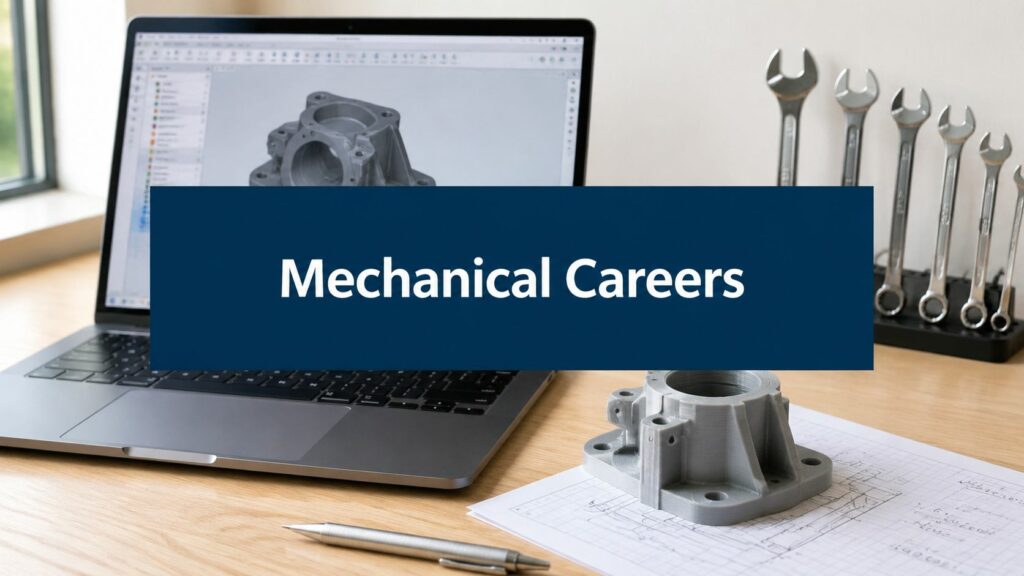
You might be reading this while working full-time, raising a family, or trying to figure out whether engineering is still realistic without the usual school route. That uncertainty is common. A lot of advice about engineer mechanical jobs assumes you left school with the right A-levels, moved straight into university, and never changed direction.
Real life rarely works like that.
Mechanical engineering is still one of the clearest routes into technical, respected, practical work. If you like understanding how things move, why machines fail, how systems can be improved, and how ideas become real products, this field deserves a serious look.
Your Guide to a Career in Mechanical Engineering
Mechanical engineering often attracts people who ask practical questions. Why does this part overheat? Why does that pump vibrate? Why does one design last longer than another? If that sounds like you, this discipline can feel far more natural than a purely theoretical subject.
Compared with other engineering branches, mechanical engineering is broad. Electrical engineering focuses more on circuits, power, and control systems. Civil engineering centres on roads, bridges, and structures. Mechanical engineering sits in the middle of the physical world of moving parts, machines, thermal systems, production equipment, and built environments.
Why many learners choose mechanical engineering
For adult learners, that breadth is a major advantage.
It keeps your options open: You can move into manufacturing, energy, transport, maintenance, product design, HVAC, and other sectors.
It mixes theory with practical work: You're not only learning formulas. You're applying them to equipment, products, and real faults.
It rewards problem-solvers: Employers want people who can spot issues, test ideas, and improve performance.
Mechanical engineering makes sense for people who want to work on real systems, not just study them in isolation.
Some people worry that mechanical engineering is too maths-heavy to start later in life. It does involve maths and physics, but many adults do better than they expect because they already bring discipline, time management, and practical judgement from work and life.
Why it's worth serious consideration
In the UK, mechanical engineering isn't a niche path. The Office for National Statistics reported 211,400 mechanical engineers in employment in 2024, showing that it's a large and established occupation across manufacturing, energy, transport, and building services, as noted in this UK mechanical engineering job market overview.
That matters. A large profession usually offers more than one entry route, more than one type of employer, and more than one way to build a career over time.
What Do Mechanical Engineers Actually Do?
Think of mechanical engineers as the people who turn physical ideas into working reality. They design parts, test systems, solve failures, improve equipment, and help products move from concept to production.

A typical day depends on the role, but the job often includes design work, analysis, documentation, testing, and communication with other teams. That's why modern engineer mechanical jobs don't fit the old stereotype of someone sitting alone drawing parts all day.
The four core parts of the job
Designing components and systems
Engineers use tools such as CAD to create parts, assemblies, and layouts. This could mean a bracket, a gearbox housing, a pipework arrangement, or a cooling system.Checking whether the design will work
At this stage, analysis matters. Engineers look at stress, heat, vibration, fatigue, movement, and materials to see whether the design can survive real conditions.Helping manufacture or install it properly
A design that looks good on screen still has to be made, assembled, inspected, and maintained. Mechanical engineers often work with production teams and suppliers to make sure that happens.Improving equipment that already exists
Many roles focus on fixing recurring issues, reducing downtime, improving energy performance, or making maintenance easier.
It's a hybrid job, not a design-only job
One of the most useful things for career changers to understand is this. Mechanical engineering work is often hybrid. A vacancy highlighted by Ametek includes turning concepts into manufacturable designs, creating 3D models, maintaining bills of materials and work instructions, supporting customer design reviews, and working with sales during quotation stages, as shown in this mechanical engineer job description example.
That means you might be:
Using CAD software to model parts
Writing clear documentation so production teams can build correctly
Speaking to customers or colleagues about design choices
Checking manufacturability so a part can be made efficiently
Troubleshooting faults when something doesn't perform as expected
Practical rule: If you enjoy both technical thinking and solving real-world problems with other people, mechanical engineering usually fits better than a purely desk-based technical role.
Exploring Common Mechanical Engineering Jobs and Industries
Mechanical engineering can take you into more sectors than is often realised. One person may end up in a factory improving production equipment. Another may work on heating and ventilation in buildings. Someone else may move into transport, energy, or medical devices.

Here's a helpful overview before you narrow your direction.
Common roles you'll see
| Job title | What the work often involves |
|---|---|
| Design Engineer | Creating parts, assemblies, drawings, and revisions |
| Manufacturing Engineer | Improving how products are made and assembled |
| Project Engineer | Coordinating technical work, timelines, and delivery |
| HVAC Engineer | Working on heating, ventilation, and cooling systems |
| Maintenance Engineer | Diagnosing faults and improving equipment reliability |
Where these jobs appear
Manufacturing: Machinery, tooling, plant equipment, process improvement
Energy: Thermal systems, maintenance, power-related equipment
Transport: Vehicle systems, rail equipment, component design
Building services: Heating, cooling, ventilation, and related systems
Multidisciplinary systems roles: Testing, reliability, integration, and troubleshooting
Why the sector range matters
A lot of career guides talk about mechanical engineering as if it only leads to product design. That's too narrow. Mechanical skills also transfer into maintenance, systems work, plant improvement, reliability, and broader technical roles where testing and integration matter.
That flexibility is useful if you're changing career later in life. You might not want a pure design office role. You may prefer site work, technical coordination, or work that combines analysis with hands-on fault finding.
Some of the strongest opportunities sit in roles that blend design, testing, operations, and communication.
Essential Skills and Qualifications for Your Career
Mechanical engineering employers usually look for a mix of technical depth and practical judgement. You don't need to know everything at the start, but you do need a solid base.
Your technical toolbox
UK employers commonly value hands-on competence in design verification, FEA, thermofluid analysis, and systems integration, because those skills help reduce rework during commissioning and safety sign-off, according to this occupational skills summary for mechanical engineers.
In plain English, that means you need to understand how to check whether something will work.
Key technical areas include:
CAD: Creating 2D drawings and 3D models
FEA: Simulating how parts behave under load or stress
Thermofluids: Understanding heat transfer, airflow, pressure, and fluid movement
Materials and mechanics: Choosing suitable materials and understanding failure risks
Systems integration: Seeing how parts interact inside a bigger machine or process
Your human blueprint
Technical ability matters. So does how you work with people.
A good mechanical engineer often needs to:
Explain clearly: You may need to talk to production staff, managers, clients, or suppliers
Solve problems calmly: Faults and delays happen
Stay organised: Drawings, revisions, testing notes, and specifications all matter
Work across teams: Engineering rarely happens in isolation
What qualifications are usually needed
Many mechanical engineering routes align with degree-level study plus practical experience. That can sound intimidating if you don't have traditional qualifications, but it's better to see it as a sequence.
First, build your academic foundation. Then move toward degree study. Then add practical experience through projects, placements, or early roles.
Employers don't only look for academic knowledge. They also look for evidence that you can apply it.
Your Flexible Pathway to a Mechanical Engineering Degree
At this point, many adult learners hit the same question. You can see the career, but the route in still looks built for someone else. Someone who stayed in school, took the expected subjects, and moved straight into university.
That is not the only route.

Why an Access diploma makes sense
An Access to Higher Education Diploma in Engineering is designed for adults who need a second route into degree study. It helps you rebuild the academic foundation that engineering courses usually expect, especially in maths, science, and written study skills.
A simple way to view it is this. A-levels are one doorway. An Access course is another doorway that leads to the same kind of next step, university-level study.
That matters if you are:
returning to education after several years away
changing careers from a non-engineering job
aiming for university but missing standard entry qualifications
fitting study around work, children, or other responsibilities
How to make the route manageable
The process feels less intimidating when you break it into stages.
Choose the type of engineering degree you want
A broad mechanical engineering degree can suit you if you are still exploring. If you already know you are drawn to design, manufacturing, energy systems, or building services, that can shape your choices earlier.Check entry requirements before you enrol
Universities do not all ask for the same subjects or grades. Looking early helps you pick an Access course that matches the degree you want later.Pick a study setup that fits your real week
This part matters more for adults than many guides admit. A course only works if it fits around shifts, bills, school runs, or caring duties.Keep proof of what you are learning
Hold on to assignments, sketches, CAD practice, calculations, and project notes. They can help you show commitment and progress when you apply.
One realistic option for adult learners
Stonebridge Associated Colleges offers subscription-based online courses across vocational and academic subjects, including an Access to Higher Education Diploma in Engineering. Learners study 100% online, receive tutor support, and can pause or cancel their subscription at any time without long-term credit agreements, which can suit adults who need more control over pacing and costs.
That kind of setup can make the difference between “I'd like to do this one day” and “I can start this year.”
Why life experience can help you
Adult learners often assume they are behind. In practice, many already have part of the toolkit.
If you have worked in maintenance, construction, logistics, operations, customer service, or team leadership, you may already be used to solving practical problems, following processes, communicating clearly, and keeping records. Engineering study builds on those habits. It does not ask you to become a completely different person.
For example:
Maintenance work often builds fault-finding habits
Supervisory roles develop communication and accountability
Trade or hands-on experience improves practical judgement
Office-based work strengthens documentation and organisation
You are not starting from zero. You are adding technical knowledge to experience you already have.
Salary and Job Market Trends in the UK for 2026
If you're investing time and money in a new direction, you need to know whether the career is viable. Mechanical engineering compares well because it offers both professional status and a stable labour market.

What the UK figures show
The UK Government's National Careers Service states that mechanical engineers earn a median salary of about £42,000, with typical starting salaries around £27,000 and experienced engineers able to reach roughly £70,000. It also reports around 6,700 annual job openings in the UK, driven by both expansion and replacement demand, as summarised in this mechanical engineering salary and demand report.
How to read those figures
These numbers matter in three ways.
Entry is realistic: A starting salary gives you a foundation while you build experience.
Progression is meaningful: The profession rewards deeper skill, stronger judgement, and responsibility.
Demand appears steady: Openings are created not only by growth but also by replacement hiring.
That last point is useful for adult learners. You're not relying on one narrow hiring trend. You're entering a profession with established demand.
A good career change usually needs two things. A clear entry route and enough demand at the other end to justify the effort.
Practical Job Search and CV Tips for Aspiring Engineers
When you're moving into engineering from another field, your CV needs to do more than list jobs. It needs to explain your direction.
What to put on your CV
Start by showing evidence of relevant ability, even if your background is indirect.
Course projects: Include assignments where you designed, analysed, tested, or improved something
Software skills: Mention CAD or any technical tools you've used
Problem-solving examples: Show where you diagnosed issues, improved processes, or handled technical detail
Transferable skills: Planning, communication, quality awareness, teamwork, and documentation all count
A weak CV says, “Worked in retail for five years.”
A stronger version says, “Managed stock accuracy, handled equipment issues, trained colleagues, and followed process controls in a fast-paced environment.” That second version starts to sound more relevant to engineering employers.
How to talk about career change positively
Don't apologise for changing direction. Explain it clearly.
You might say that your earlier work helped you realise you prefer technical problem-solving, practical systems, and structured improvement work. That shows intent, not indecision.
Employers usually respond well when a career change sounds deliberate and well thought through.
Interview habits that help
When you get to interview stage, be ready to discuss how you think.
Focus on:
How you approached a project
What constraints you had
Why you chose one option over another
What you learned when something didn't work
If you've completed an Access course, use your assignments as talking points. Even simple academic projects can become strong interview examples if you explain them well.
A small portfolio can also help. That might include CAD screenshots, design notes, written reflections, or neatly presented coursework. It doesn't have to be flashy. It just needs to show that you can think, learn, and communicate like a future engineer.
Taking Your First Step into Mechanical Engineering Today
You might be reading this after a late shift, wondering whether a technical career is still realistic now that school is years behind you. It is. Mechanical engineering has room for people who arrive by different routes, including adults who are retraining while balancing work, family, and bills.
That matters because this field is broader than many people expect.
Some roles focus on design. Others centre on testing, maintenance, production, quality, or improving how equipment works day to day. If you like solving practical problems and understanding how systems fit together, there is more than one way to build a place for yourself here.
A lot of career advice in engineering is aimed at 18-year-olds with strong A-level results. Adult learners often need a different map. An Access to Higher Education Diploma in Engineering can provide that starting point by helping you build the maths, science, study habits, and confidence needed for degree-level learning.
It works like a bridge between where you are now and the kind of job you want next.
Your first move can be small. Research a course. Compare entry requirements. Set aside regular study time. Write down the technical tasks you have already handled at work, even if your current job title has nothing to do with engineering. Those small actions turn a vague idea into a real plan.
Stonebridge Associated Colleges offers online study options for adult learners who need to fit education around work and life.