
A busy classroom can change in seconds. One learner may need instructions broken into smaller steps, another may become overwhelmed by noise, while the Teacher is trying to keep the whole class engaged. A skilled Teaching Assistant with special needs support training can help without taking over, giving each learner the right assistance while keeping them part of the wider lesson.
At Stonebridge Associated Colleges, we created this guide for adult learners considering a career as a Teaching Assistant, especially those who want to support pupils with special educational needs and disabilities. It answers the questions that often come first: which skills schools value, how specialist support should work, what training can cover, and how online study with Stonebridge can fit around work and family life.
The Growing Demand for Specialist SEN Teaching Assistants
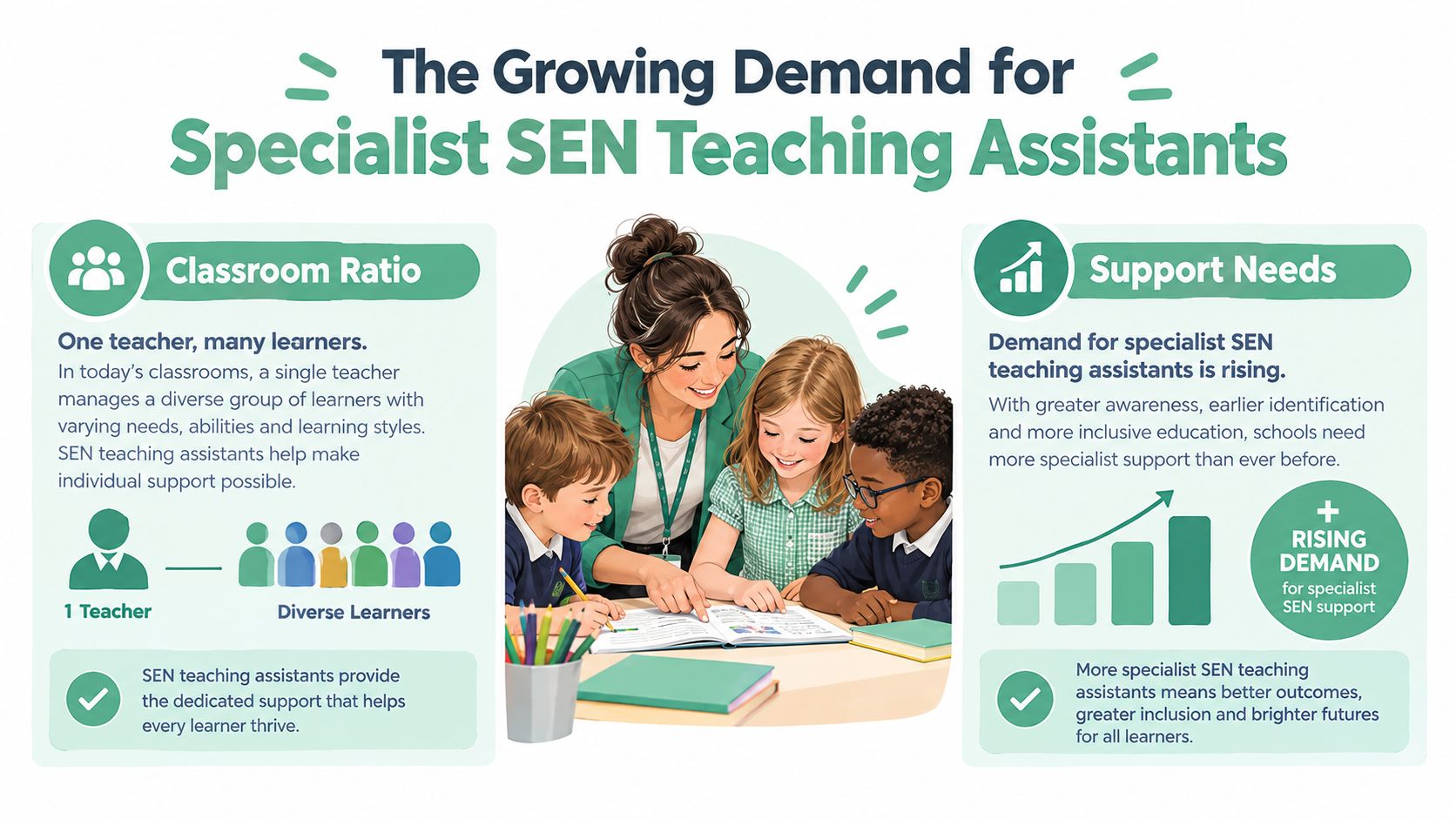
A Teacher may be guiding a reading activity while pupils need different forms of support. One learner may need a visual prompt, another may need help communicating, and a third may need a calm explanation after losing focus. The Teaching Assistant helps remove those barriers without taking the lesson away from the Teacher. Good support works like a bridge: it gives the learner access to the task while keeping the learner connected to the class.
England's school workforce figures show how widely this role is used. The Department for Education School Workforce Census recorded 288,800 full-time-equivalent Teaching Assistants in state-funded schools in November 2024, an increase of 5,900 on the previous year, or approximately 2.1%. The longer-term increase was 67,300 FTE since 2011.
Why general classroom experience may not be enough
Teaching Assistants made up roughly three in ten members of England's school workforce, while support staff reached 517,500 FTE in 2024/25, according to the same workforce statistics. Around 65% of Teaching Assistants worked in nursery and primary schools, and approximately 17% worked in special schools and pupil-referral units.
These settings can require structured communication, personal assistance, adapted activities and close teamwork with Teachers and specialists. General supervision experience provides a starting point, while SEN-focused knowledge shows how to adjust an activity, support communication, follow safeguarding procedures and respond to behaviour in a planned way. Those skills help a Teaching Assistant provide access without creating dependence.
Staffing pressure makes this specialist preparation more relevant. A UK and Ireland science-education survey found that 61% of respondents said their school was understaffed for Teaching Assistants. 70% said more Teaching Assistants would improve the equitable experience of pupils with SEND or ALN in science lessons, as reported by the Royal Society of Chemistry.
Practical rule: Specialist value comes from knowing when to support access, when to encourage participation and when to step back.
Key Skills Every SEN Teaching Assistant Needs
A pupil pushes a worksheet away and looks distressed. A skilled Teaching Assistant pauses before prompting again, checking whether the instructions, noise or fear of failure has created the barrier. That small change in approach turns support from supervision into purposeful practice.
Empathy helps a Teaching Assistant understand the pupil's experience without guessing at the cause. Observation should guide the response. A learner who refuses to begin may need clearer instructions, a quieter position or reassurance that mistakes are part of learning.
Behaviour support requires calm, consistent action. Notice early signs of distress, reduce unnecessary demands and follow the school's agreed approach. Record relevant information so the Teacher and SENCO can identify patterns. Safety matters, but so does dignity. The aim is to help the pupil regain access to learning, rather than just stop the behaviour.
Communication works in both directions. Use clear, accessible language with the learner, then share brief, factual observations with the Teacher or SENCO. Listen to the pupil, follow agreed boundaries with families and external professionals, and check that your support matches the lesson's purpose.
Collaboration turns support into a planned intervention
A Teaching Assistant works under the classroom Teacher's direction and needs to understand how the SENCO contributes to planning. Before a task begins, staff should agree the learning barrier, intended outcome, prompts and signs that support can reduce. Like temporary scaffolding around a building, effective help should provide stability while the learner develops independence.
The EEF's updated guidance on Teaching Assistants, synthesising evidence from more than 52 studies, recommends that TAs supplement rather than replace Teacher instruction. These practices address the specialist skill gaps schools can face and distinguish dependable SEN support from having another adult in the room.

How to Choose the Right Qualification Pathway
Choosing training becomes easier when the decision is based on the work you want to do. Start by asking whether you need broad classroom preparation, specialist SEND knowledge, or both.
Check the role you want. Read local school vacancies and note recurring requirements. Look for references to supporting learning, communication, behaviour, safeguarding and collaboration with the SENCO.
Match the qualification to your starting point. A Level 3 Diploma in Supporting Teaching and Learning can provide a structured foundation for people entering school support work or formalising existing experience. Specialist content is useful if you want to support pupils with additional needs more confidently.
Review the syllabus before enrolling. Check whether the programme deals with real classroom decisions, such as adapting activities, encouraging independence, supporting behaviour and recording progress. A course should help you connect theory with what a Teacher asks you to do during a lesson.
Check the assessment and support model. Adult learners need to know how work is assessed, how tutors provide feedback and whether the study format fits around employment or caring responsibilities.
The Specialist Support for Teaching and Learning in Schools course is designed for learners seeking focused preparation for Teaching Assistant work. Its online format allows learners to develop relevant knowledge without attending a fixed classroom timetable.

The qualification route should still be considered alongside employer expectations. Schools may have their own recruitment, induction, safeguarding and supervision processes. A qualification can strengthen your preparation, but it doesn't remove the need to work within the school's policies and the Teacher's direction.
Evidence-Based Strategies for Effective SEN Support
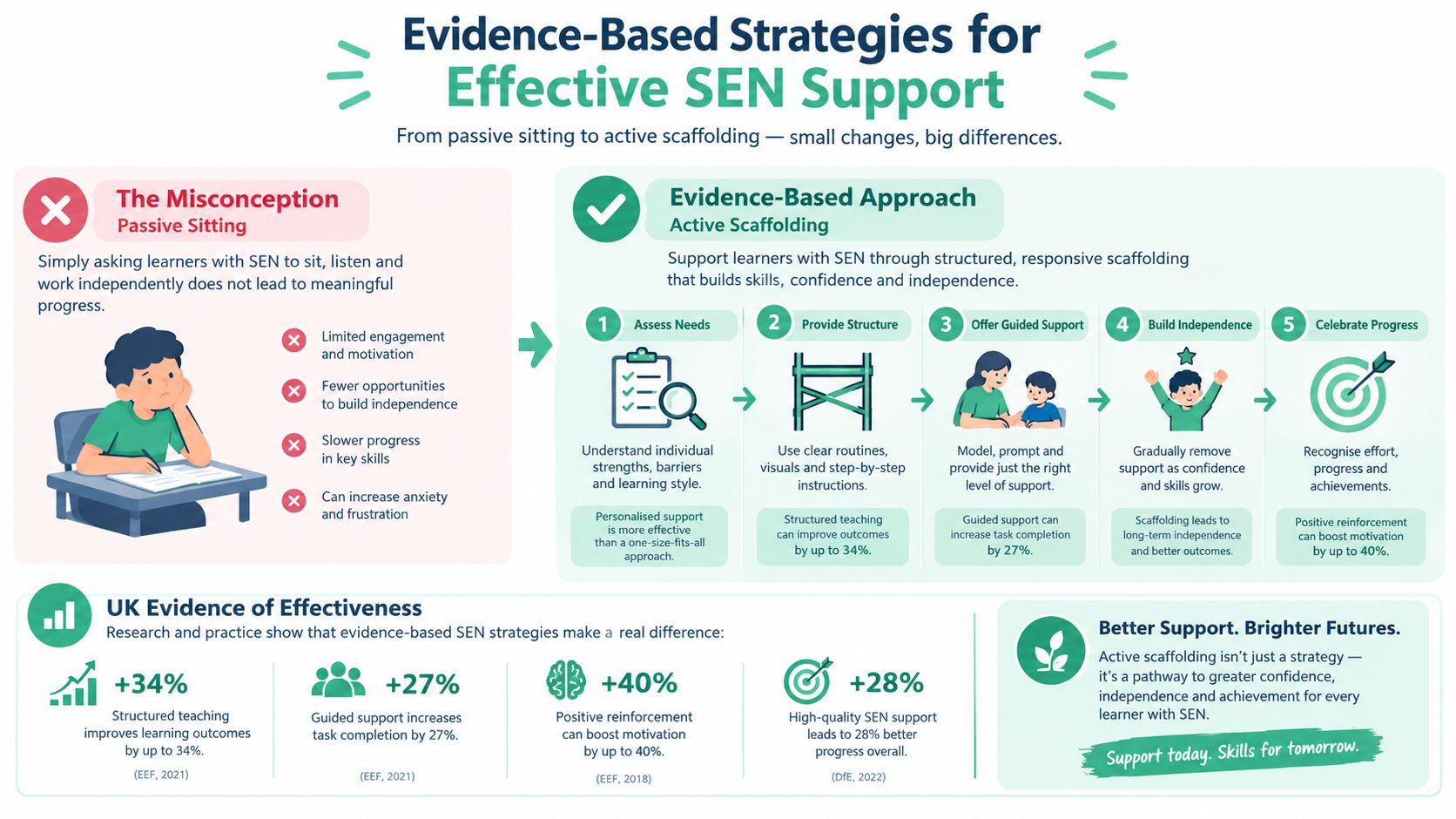
A pupil struggles to begin a writing task. The Teaching Assistant does not take over. Instead, they identify the barrier, provide a carefully chosen prompt and help the pupil rejoin the learning. Good SEN support works like a bridge: it provides access while helping the learner move towards greater independence.
Effective practice starts with a learning barrier identified by the Teacher. The Teaching Assistant prepares through shared planning and a clear understanding of the learner's SEND profile. Support during the session can follow this sequence:
Model the task: Show the process and make the thinking visible.
Guide the attempt: Use prompts and questions rather than completing the work.
Practise deliberately: Give the learner opportunities to retrieve and apply the skill.
Fade assistance: Reduce prompts as confidence and accuracy improve.
Review the outcome: Record brief information and discuss the next step with the Teacher.
The EEF guidance recommends structured interventions and scaffolding that develops independence. Scaffolding is temporary support, much like training wheels on a bicycle. It should help a learner reach the next stage without becoming a permanent substitute for thinking, communication or participation.
Avoiding over-reliance on one adult
Specialist skills also involve knowing when one-to-one support may limit inclusion. The DfE research on Teaching Assistant deployment reports concerns that pupils who regularly work out of class with Teaching Assistants can become socially excluded or over-reliant on a single adult.
Review whether the pupil returns to core teaching, communicates with peers and needs fewer prompts. Avoid creating a parallel programme with lower expectations. A Teaching Assistant with special needs skills helps the pupil join the same learning community, using reasonable adaptations where required.
Raw attainment differences do not show that Teaching Assistants cause poor outcomes. Pupils with the greatest needs often receive the most support, so progress should be judged against a clear baseline and an agreed outcome.
What You Will Learn in the SEN Specialist Course
A useful course should connect the qualification to the moments that make school support demanding. Knowing a definition of SEN is less helpful than understanding how a learner's needs affect communication, participation, behaviour and access to classroom activities.
The Specialist Support for Teaching and Learning in Schools course covers the knowledge needed to support pupils with a range of additional needs. This includes emotional, behavioural, social, sensory and physical special educational needs, alongside approaches for helping learners engage with teaching and learning.
Learning that relates to classroom practice
The course also develops understanding of positive behaviour support. Rather than treating disruption as a standalone problem, learners can explore how routines, communication, clear expectations and appropriate responses contribute to a calmer learning environment.
Safeguarding is another essential area. Teaching Assistants work with children and young people who may be vulnerable, so they need to recognise concerns, follow reporting procedures and understand the limits of their role. The course includes safeguarding knowledge alongside communication skills, helping learners prepare for professional conversations and accurate written records.
| Course focus | How it supports the role |
|---|---|
| Additional needs | Helps learners consider how different needs can affect access and participation. |
| Behaviour support | Builds a planned, respectful response to behaviour and distress. |
| Safeguarding | Clarifies responsibilities when a concern arises. |
| Communication | Supports clear information-sharing with Teachers, SENCOs and other professionals. |
| Teaching and learning support | Connects classroom assistance with pupil progress and independence. |
The course is not a promise of automatic employment. Recruitment depends on the vacancy, school setting, contracted hours and the responsibilities attached to the post. It can, however, give adult learners a more focused basis for applications and conversations about school-based induction and supervision.
Making the Switch, Why Study Online with Stonebridge
Schools need Teaching Assistants who can contribute thoughtfully, yet entering the sector can feel difficult when vacancies and working arrangements vary. Independent UK research found that three in four school leaders surveyed in 2025 struggled to recruit Teaching Assistants, while 15% of support staff surveyed wanted to work more hours, according to the National Foundation for Educational Research. The same research highlights differences in hours and pay, so learners should ask employers about the contract, supervision, training and progression before accepting a role.
Online study offers a practical way to build preparation around existing responsibilities. Stonebridge Associated Colleges provides 100% online courses, personalised support from qualified tutors and a subscription model with an affordable monthly fee. Learners can pause or cancel their subscription without entering a long-term credit agreement, which gives more control when work or family commitments change.
The college offers courses across vocational and academic subjects, including education, health and social care, nursing and midwifery, business management and Access to Higher Education Diplomas. It has over twenty years of experience, is accredited by the UK Register of Learning Providers and is regulated by the Financial Conduct Authority, according to the publisher information.
Learners and alumni of Stonebridge Associated Colleges also get access to the learndirect: Community Hub app, which is available to learners and alumni of the learndirect Digital Group. The app includes discussion groups, topic-specific communities and interactive forums where people can ask questions and share perspectives during their learning journey.
For a future Teaching Assistant, the important question isn't whether a qualification removes every challenge. It's whether the course helps build the knowledge, judgement and professional language needed to support pupils without limiting their independence.
Stonebridge Associated Colleges offers flexible, subscription-based online courses, including specialist preparation for Teaching Assistant work supporting pupils with additional needs. Visit Stonebridge Associated Colleges to explore the course, check the study options and take your next step towards a career in inclusive education.