If you've spent time helping pupils read, calm down, get started, or stay on task, you may already be doing parts of the job people mean when they ask what is a Higher Level Teaching Assistant. The confusing bit is that HLTA is not just a fancier title. It's a status that sits inside school support staff, with real responsibility, real limits, and a real trade-off between autonomy and workload.
For many adult learners, the next question is simple. Is there a practical route into it that fits around work and family life? A Level 3 Diploma in Supporting Teaching and Learning is often the sensible first step, because it builds the classroom knowledge, language and confidence schools look for before HLTA-style responsibility becomes realistic.
Where HLTAs Fit in the Classroom
The school day often starts with one teacher, a room full of pupils, and several adults moving around different groups. One adult might be helping a child sound out words, another might be listening to a small group, and someone else may be preparing the next activity. That mix is where the difference between a standard Teaching Assistant and a Higher Level Teaching Assistant starts to matter.

A Higher Level Teaching Assistant is an experienced senior member of school support staff. In plain English, that means someone who already understands the flow of a classroom and can take on more responsibility for teaching and learning while still working within the teacher's direction. The role is assessed against nationally agreed standards, not handed out because someone has been in the room for a long time.
A useful way to think about it is this, a TA helps the lesson run, an HLTA can help deliver parts of the lesson and judge how pupils are doing.
That's why the role can look different from school to school. In one setting, an HLTA might lead a planned intervention with a small group. In another, they might supervise pupils, support whole-class learning, or cover teacher planning time. The thread that holds it together is responsibility, not a new teaching qualification.
The 33 Professional Standards Explained Simply
What the standards ask for
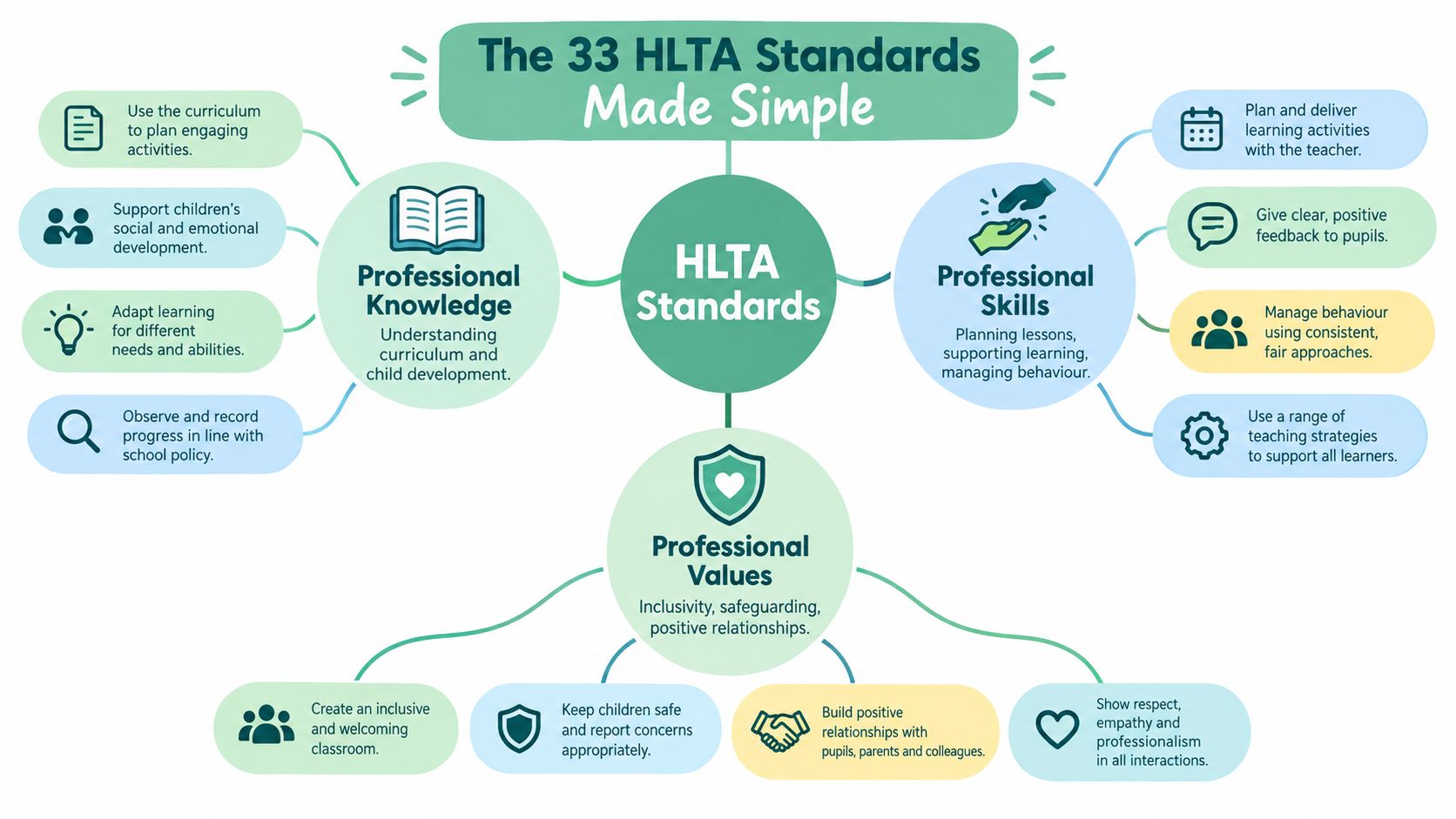
The national HLTA framework contains 33 standards and groups them across professional attributes, knowledge, planning, assessment, and teaching and learning activities. That sounds formal, but the content is very familiar to anyone who has worked closely with children. It includes understanding special educational needs, safeguarding-related responsibilities, curriculum objectives, assessment, and how to help pupils make progress. You can see the same idea in the HLTA standards guidance, which says the role covers planning, monitoring, behaviour, safe organisation of learning and directing other adults, all under qualified teacher supervision, as set out by HLTA standards guidance.
For example, one part of the framework is about professional knowledge. In a real classroom, that could mean knowing why a pupil needs a different explanation, or why a support strategy that worked yesterday isn't working today. Another part covers planning and expectations, which shows up when an adult prepares a short guided task for a reading group rather than just repeating the teacher's words.
What it looks like in practice
The skills side is easier to picture if you think about daily routines:
Planning activities: setting up a focused reading or maths task that matches the teacher's objective.
Monitoring learning: noticing when a pupil is guessing rather than decoding, then adjusting support.
Assessment: using what you've seen to tell the teacher what happened and what to try next.
Directing others: supervising another support adult so the group stays on track.
That last point matters more than many people realise. The framework doesn't describe the HLTA as a spare pair of hands. It expects someone who can take structured responsibility, spot learning barriers, and respond in the moment.
Practical rule: if your work already involves targeted support, feedback, and careful observation, you're closer to HLTA thinking than you might think.
How an HLTA Differs From a TA and a Teacher
The easiest way to understand the role is to compare it with the two jobs people mix it up with most often. A Teaching Assistant supports learning. A Teacher carries the formal responsibility for planning, teaching and assessing the class. An HLTA sits between those two, with more independent classroom responsibility than a TA, but without becoming a qualified teacher.
| Role | Main responsibility | Planning input | Accountability | Supervision structure |
|---|---|---|---|---|
| Teaching Assistant | Support pupils and help the teacher | Limited, usually follows teacher direction | Works to the teacher's plan | Under close teacher direction |
| Higher Level Teaching Assistant | Lead planned learning activities and targeted interventions | More active, may help prepare and adapt work | Works within school policy and teacher direction | Under qualified teacher supervision |
| Teacher | Plan, teach and assess the class | Full responsibility | Holds overall class responsibility | Responsible for the class and staff working with it |
That middle position is what creates the attraction, and the pressure. HLTA practice can include leading whole-class sessions, supervising pupils or other support staff, and covering protected teacher-planning time, but it still happens inside the school's systems and under qualified teacher direction. So it isn't "almost a teacher", and it isn't "just a TA with a new title" either.
A good way to read an HLTA job description is to look for words like planned learning, assessment, intervention, and supervision. Those terms usually signal that the school wants someone who can do more than routine classroom help.
How HLTA Status Came About in UK Schools
HLTA status grew out of UK school workforce reform in the early 2000s. The aim was to create clearer progression for teaching assistants and give schools a way to redistribute appropriate classroom responsibility without pretending every support role was the same. That's why HLTA became a status assessed against standards rather than a simple course title.
The national standards were developed by the Teacher Training Agency, later the Training and Development Agency for Schools. Accredited HLTA programmes were then introduced in two stages, with Phase 1 in 2005 and Phase 2 in 2006. By the time a published Open University study looked at the picture, more than 21,000 teaching assistants had achieved HLTA status. The same research also recorded support staff growth from approximately 60,000 in 1997 to 163,000 in 2007, an increase of about 103,000 staff, or roughly 172 percent. Those figures are reported in the school workforce methodology published by the Department for Education's statistics service, which also explains that HLTAs are grouped within the broader teaching-assistant category, school workforce in England.
Why that history still matters
That history explains why schools treat HLTA as more than a badge. It was built for a workforce that was already growing and already carrying more of the day-to-day learning support load. In other words, it came from real school need, not from a branding exercise.
It also explains why the role can feel a bit different from one employer to another. The status is national, but the job is still shaped locally.
Qualification Routes and What Schools Really Look For
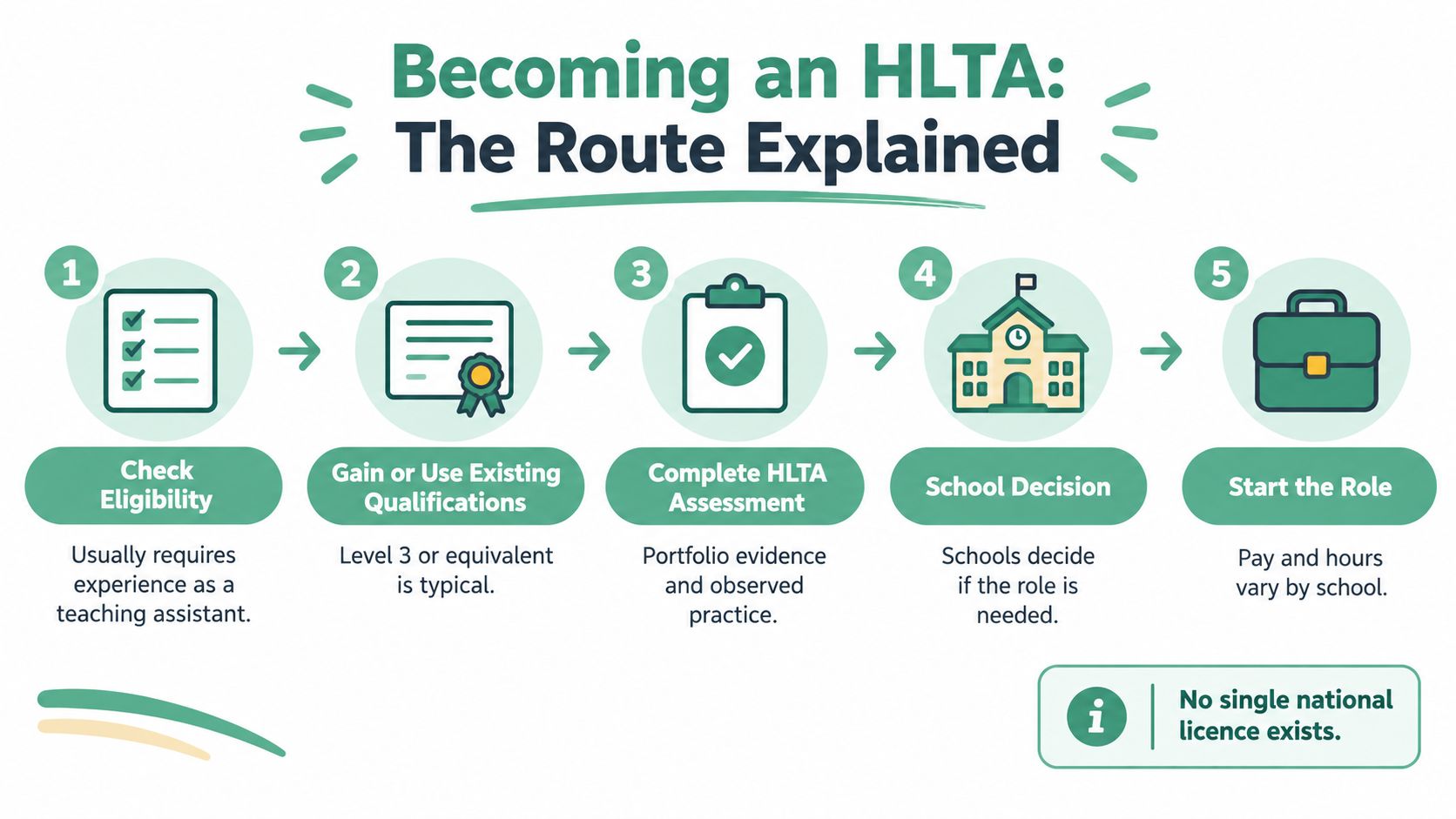
The honest answer is that there isn't one universal licence for HLTA. The National Careers Service says schools set their own entry requirements, and that teaching assistants can progress through experience and further study rather than a single compulsory national route. That means the question isn't only “what course do you need?” It's also “what does the school expect you to bring with you?”
Typical expectations include experience as a Teaching Assistant or in a related role, Level 2 literacy and numeracy, and evidence that you can support pupils with SEND. East Sussex County Council describes HLTA as a status rather than a qualification and identifies at least two years' teaching-assistant or related experience, plus Level 2 literacy and numeracy, as typical prerequisites, as noted in the HLTA professional standards document from Birmingham City Council. A local vacancy also shows how varied the picture can be, because one HLTA post asked for an NVQ Level 3 TA qualification or equivalent experience, GCSE English and maths, and support for pupils with SEND, while accepting applicants working towards HLTA status.
Where a Level 3 diploma fits
A Level 3 Diploma in Supporting Teaching and Learning (RQF) makes sense as a first step. It does not magically hand over HLTA status, but it does build the kind of understanding schools expect to see, including assessment literacy, inclusive practice, behaviour strategies, curriculum awareness and the ability to judge whether an intervention is helping. That lines up neatly with the kind of classroom evidence HLTA assessment looks for.
The important point is that a diploma and school experience do different jobs. The course gives structure and knowledge. The workplace gives the observed practice, planning evidence and real classroom examples that employers want to see.
Good question to ask yourself: will this course help you meet a school's person specification, and will it give you enough language to talk confidently about learning, not just support?
Pay, Hours and the Responsibility Trade-Off
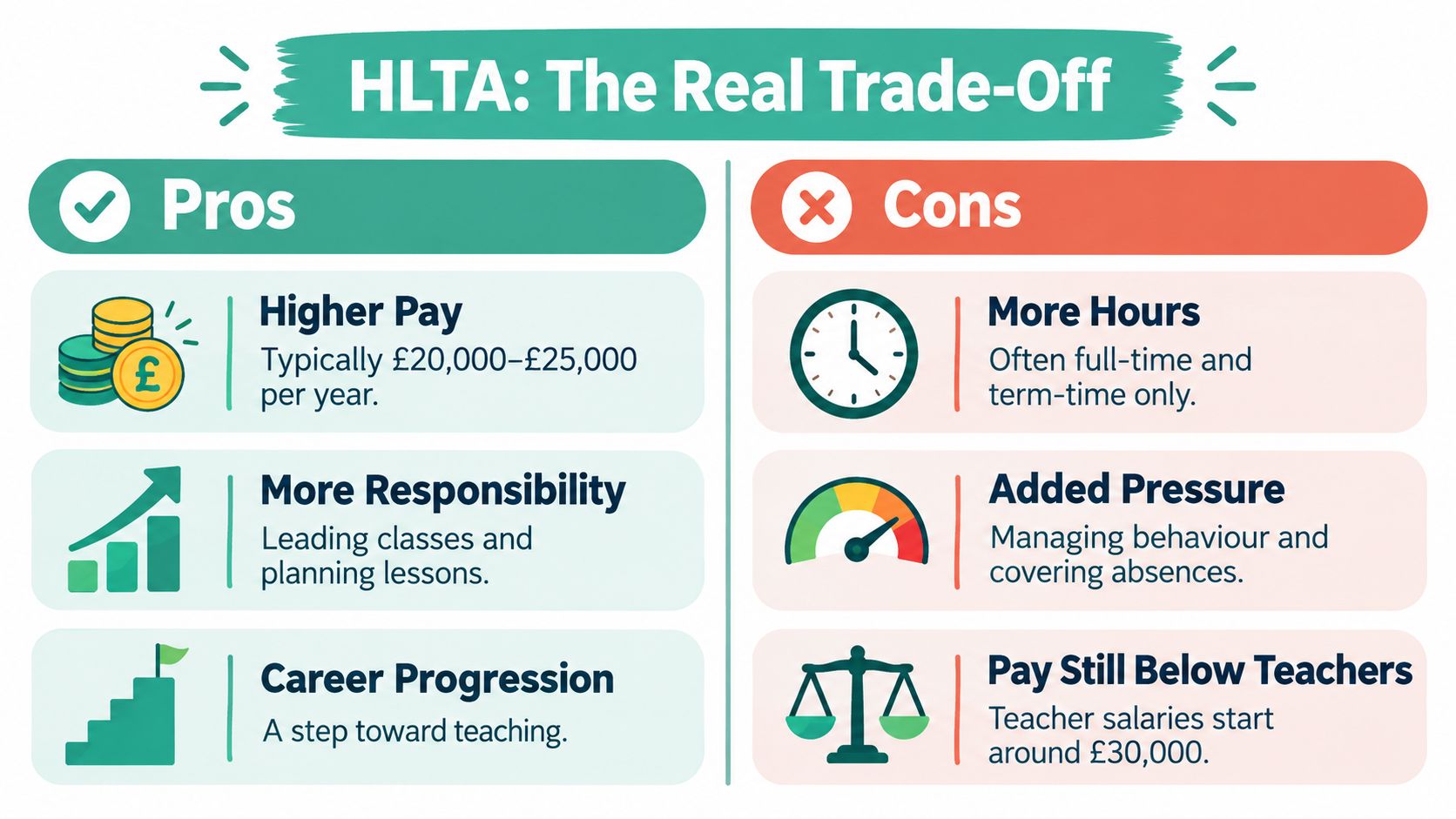
HLTA is best understood as greater responsibility with mixed working conditions. The role can include planning support, behaviour management and classroom cover, while the hours may still be term-time or part-time. That is the part many people miss when they focus only on the title.
A current HLTA vacancy advertised £22,557 to £24,915 actual salary against £32,061 to £35,412 FTE for the post, which shows how different the headline and actual figures can be. England had 295,200 full-time-equivalent teaching assistants in the 2025/26 school workforce statistics, up 6,200 in a year and 73,200 since 2011, according to the same statistics service as above. That points to steady demand, but it does not mean every HLTA post offers full-year work or a big pay jump, teaching vacancies example.
What to check before you apply
Contracted hours: term-time only, part-time, or full-time.
Pay point: look at actual salary and FTE, not just one figure.
Duties: ask whether the role includes whole-class cover, planning or interventions.
Release time: find out whether there's time set aside for preparation and record-keeping.
Progression support: check whether the school supports further study or assessment.
A role with more responsibility can be a good move, but only if the working pattern fits your life as well as your career goals.
How Stonebridge Can Help You Take the First Step
The clearest starting point is a Level 3 Diploma in Supporting Teaching and Learning, because it gives you a solid base before you move towards higher-level responsibility. Stonebridge offers this as a 100% online course with flexible subscription study, personalised tutor support, and a modular structure that can fit around work and family life. Stonebridge Associated Colleges also provides learners and alumni with access to the learndirect: Community Hub app, where they can join discussion groups, topic-specific communities and interactive forums.
That kind of course matters because HLTA work is strongest when support is planned, targeted and reviewed, not just added into a busy classroom at random. If you want a route into school support that feels realistic and structured, a Level 3 course is the sensible next step.
If you're ready to move from supporting learning informally to building a recognised school support career, Stonebridge Associated Colleges can help you start with a flexible online route that fits real life. Explore the Stonebridge Associated Colleges study options and see how the Level 3 Diploma in Supporting Teaching and Learning could be your first step towards HLTA status.