
The Level 3 Diploma in Adult Care is a Level 3 qualification for people who work, or want to work, in adult social care in England. It builds on Level 2 foundations, and it isn't a legal requirement to start care work. Many new staff assume passing a diploma clears them for every shift duty, so why do employers still run extra checks? Understanding that gap helps you choose the right route before you enrol.
What Level 3 in adult care means for you
Studying Level 3 in adult care takes you beyond basic daily tasks into confident, independent practice. The Department of Health and Social Care role guidance treats Level 3 as a progression standard on its Care Workforce Pathway, offering optional units suited to your care setting.
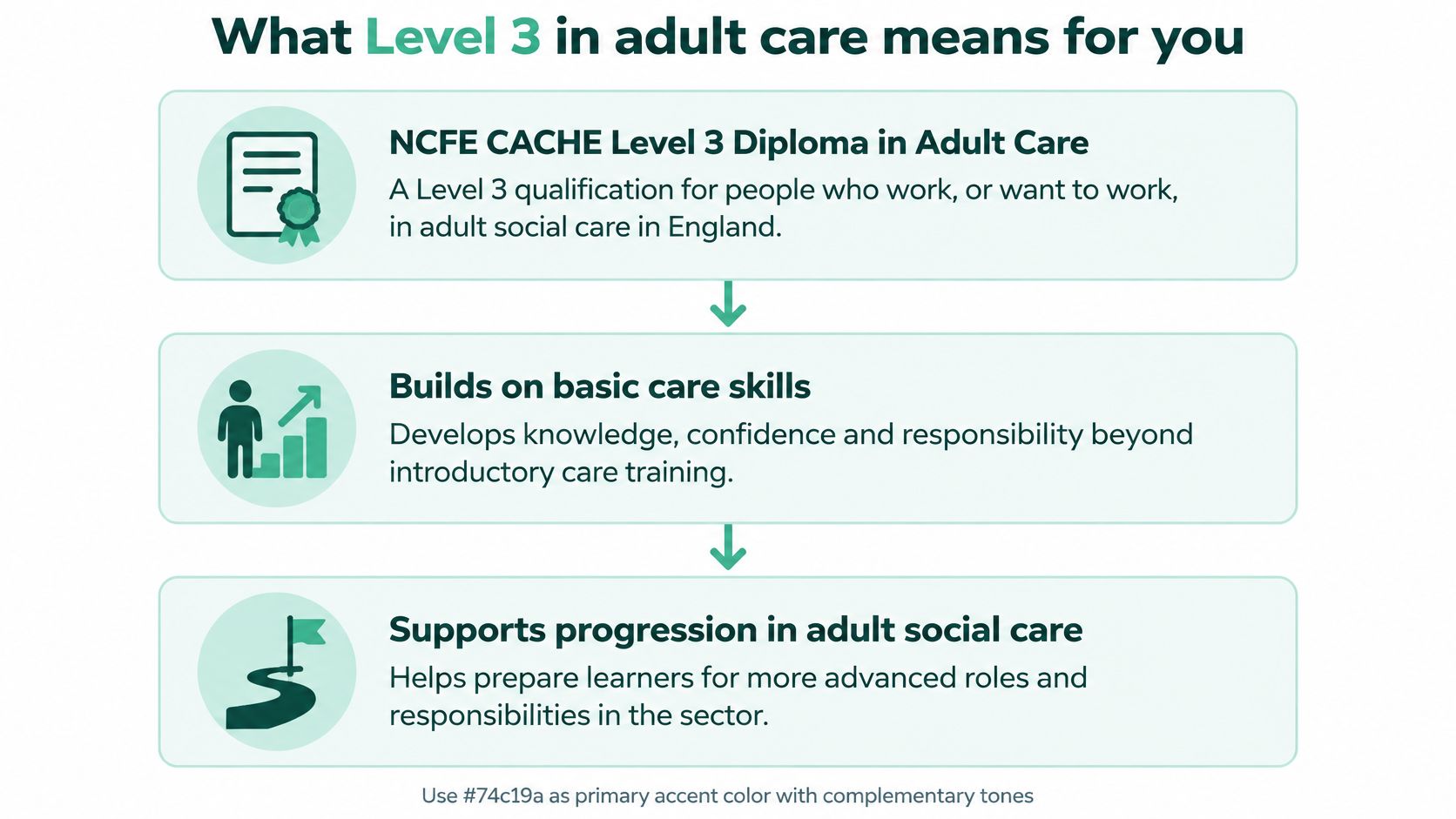
Think of care qualifications as a ladder. Level 2 builds your grounding, Level 3 develops deeper judgement and wider responsibility, and Level 4 or above suits leadership roles. If you're exploring what adult care involves, this diploma suits working Care Workers and career changers who want self-paced online study with qualified tutor support.
Who can take the course and what you need first
You don't need a diploma just to start working in care. According to the Skills England sector assessment, most adult social care staff aren't registered with a regulator, apart from Registered Managers, and generally need no minimum qualification to work in the sector. In 2023/24, just under half of England's direct-care workforce held a relevant social care qualification, with Level 2 at 18% and Level 3 at 17%.
A qualification isn't always needed to enter care work, yet Level 3 proves occupational competence when you're ready to progress.
Check the Requirements tab on our course page for age rules, English and Maths expectations, and placement details, or read whether Level 3 adult care requires experience. Before enrolling, ask yourself:
Workplace access: Can you arrange employment or a placement in a suitable adult care setting, with a supervisor or manager able to verify your practical work? Stonebridge's course requirements include workplace experience and direct observation, so online study alone will not complete the diploma.
Weekly time: Can you protect regular study hours around your shifts and home life?
What you will study on the course
Before committing, review the units and learning requirements.
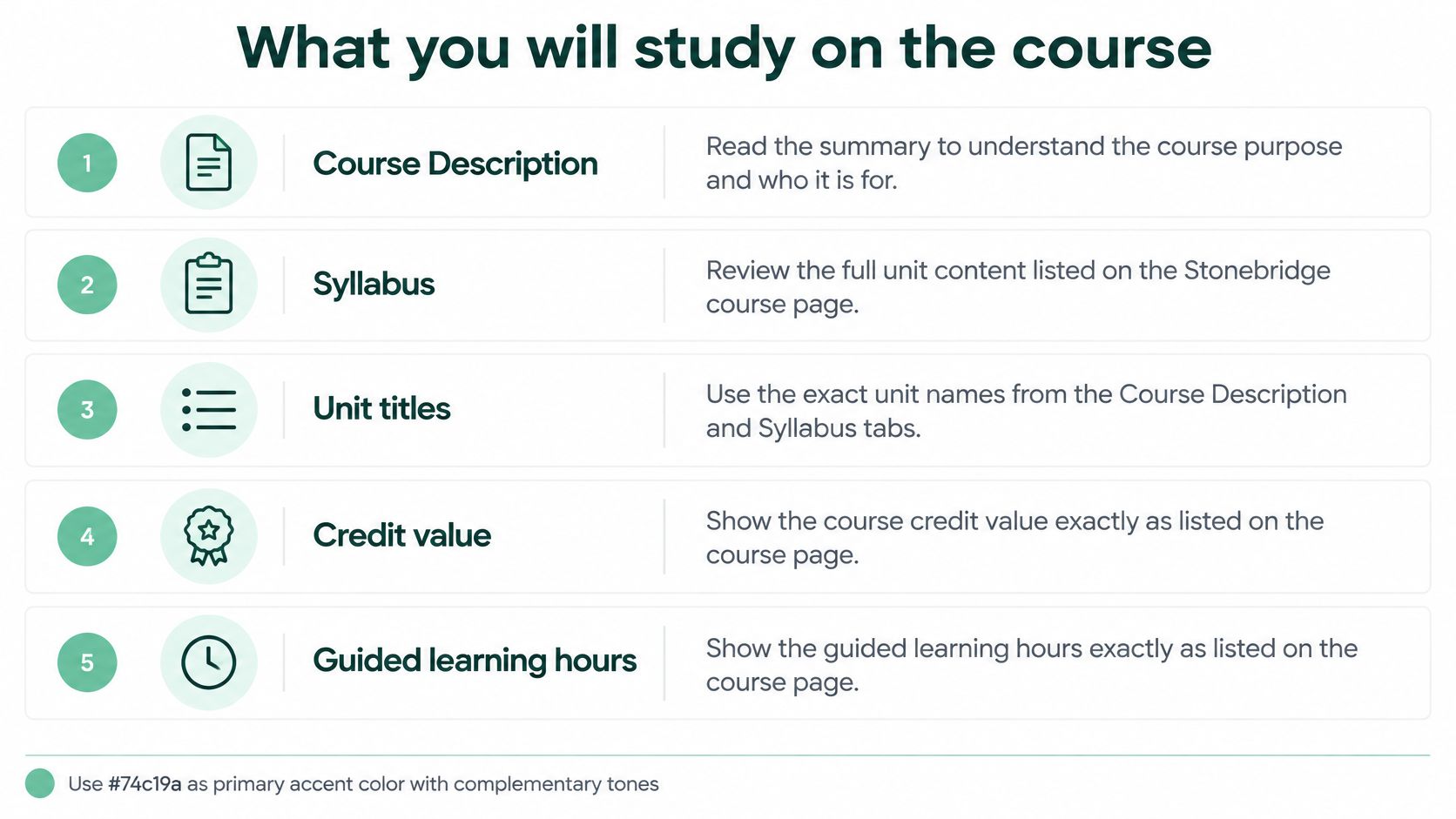
You study the learning materials online at your own pace, but you must also demonstrate practical skills in a suitable care setting. The current course syllabus covers communication, health and wellbeing, mental capacity and restrictive practices, alongside other adult care competencies. Core areas connect directly to daily shifts:
Person-centred support: Helping individuals make everyday choices about their routines and personal goals.
Safeguarding adults: Spotting signs of abuse or neglect and reporting concerns promptly.
Communication and inclusion: Adapting how you listen and share records with residents and visiting clinicians.
Health and wellbeing: Upholding safe infection control and dignity during personal care.
How you will be assessed
Explaining care theory on paper is different from proving it on shift. Stonebridge's Assessment tab lists written questions, case studies, witness statements, professional discussions and workplace observations. Direct observation in a suitable workplace is mandatory, so arrange access to a care setting and an appropriate supervisor or manager before enrolling.
Use this simple routine to stay organised:
Read the Assessment tab early and note every evidence type.
Start a dated portfolio during your first week.
Agree workplace observation dates with your manager well ahead of time.
Ask your tutor for feedback before submitting each unit.
Steady habit: Write brief reflective notes straight after a shift while the details are still fresh.
Choosing between the diploma and an apprenticeship
Your choice depends on how you want to study and what support your employer can provide. A diploma is a qualification; an apprenticeship combines study with a structured programme of workplace training. They are related, but not interchangeable.
| Route | Who it suits | How you study | Employer involvement |
|---|---|---|---|
| Level 3 Diploma through online distance learning | Workers fitting study around shifts and home life | Flexible online study alongside workplace requirements | Agree support for workplace observations before enrolling |
| Level 3 Adult Care apprenticeship | Staff with employer backing for structured training | Planned study combined with on-the-job training | Employer supports the apprenticeship and work-based goals |
| Level 2 Adult Care Worker Apprenticeship, then Level 3 | Newer workers wanting a step-by-step pathway | Build a foundation before progressing to Level 3 | Discuss support for each stage with your employer |
Immediate start: Ask about enrolment dates and workplace arrangements rather than assuming you can begin straight away.
Employer funding: Ask your manager whether an apprenticeship and planned study hours are available through your workplace.
Whichever route you choose, the qualification supports progression. It does not automatically meet every employer's requirements for a particular role.
Check the official government qualifications record when considering funding options. Always confirm current funding eligibility with us before enrolling.
Careers and roles open after Level 3
Adult social care employed an estimated 1.47 million people in 2024/25, and Skills England's 2026 sector analysis projects that 79% of additional employment in adult social care priority occupations through 2035 will require Level 2 or Level 3 qualifications.
Building recognised skills opens clear progression across frontline care teams.

Learners commonly move into Senior Care Worker, Team Leader, or Activity and Support Coordinator roles, or progress to Level 4 specialist study. Yet the diploma doesn't replace every workplace check. As the Skills for Care Workforce Strategy explains, employers may still ask for role-specific induction, medication training, or safeguarding updates, and workers should normally reach Level 3 competence within three years of joining the sector.
Watch this short overview to see how adult care qualifications support day-to-day practice.
Read the job description for your target role, check which mandatory training your employer requires, and explore how to develop your career in adult social care.
Start your Level 3 study with Stonebridge
Ready to turn care experience into a recognised Level 3 credential? Stonebridge Associated Colleges is a 100% online college with over twenty years of experience, accredited by the UK Register of Learning Providers and regulated by the Financial Conduct Authority. The Level 3 Diploma in Adult Care (RQF) is studied through flexible online modules on a monthly subscription, with no long-term credit agreement, so you can pause or cancel if life gets busy.
A qualified tutor supports you throughout, and the qualification gives employers a recognised benchmark while they still confirm the role-specific checks their setting requires. Open the course page, review the course description and what is included, then enrol when you are ready.
Stonebridge Associated Colleges offers flexible, subscription-based online study backed by qualified tutors so adult learners can fit recognised care qualifications around work and family life. Visit Stonebridge Associated Colleges today to explore the Level 3 Diploma in Adult Care (RQF) and take your next step in adult social care.