You might be reading this while sitting at a desk job that no longer feels right, or while wondering whether a more technical career is still possible later in life. That's a common place to start.
Electrical engineering can look intimidating from the outside. In practice, it's a career built around solving real problems. The systems you use every day, from lighting and transport to building services and modern energy networks, all need people who can design, test, improve, and keep them safe.
Spark Your Interest in Electrical Engineering
Think about how much of daily life depends on reliable electrical systems. Homes need safe wiring. Hospitals need dependable backup power. Offices, transport networks, lifts, heating controls, and charging infrastructure all rely on carefully planned electrical design.
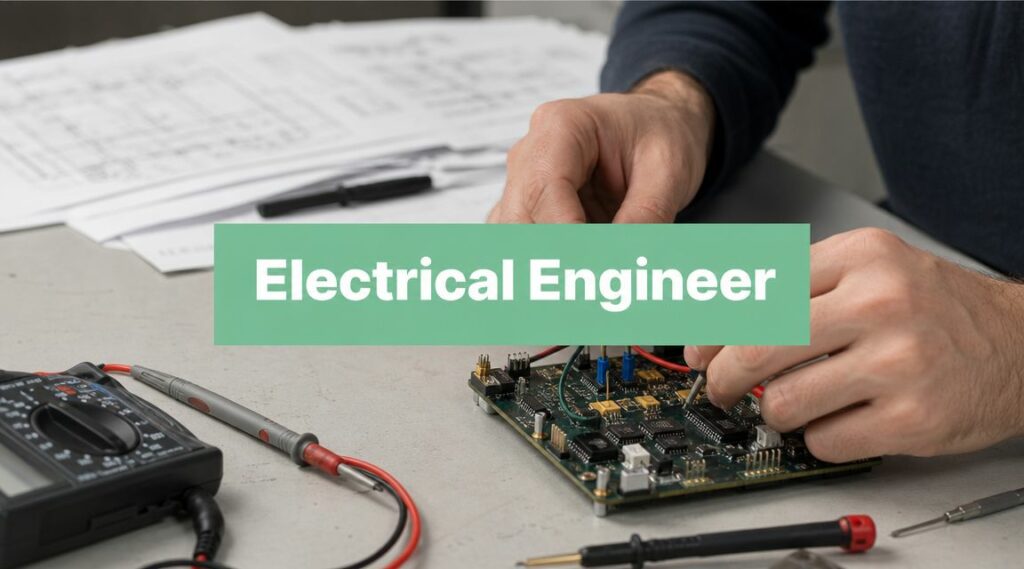
That's where the electrical engineer job role comes in. An electrical engineer works on systems and equipment that use electricity. They may help design new installations, improve existing ones, test whether systems perform properly, or make sure work meets safety standards.
For many career changers, the attraction is simple. The work is practical, skilled, and tied to industries that matter. It also connects to areas that feel modern and future-facing, such as building services, electrification, digital infrastructure, and low-carbon energy systems.
Electrical engineering isn't only about wires and circuits. It's about making complex systems safe, useful, and reliable in the real world.
What an Electrical Engineer Actually Does
A lot of people assume electrical engineers spend all day doing calculations in isolation. Some do detailed design work, but the role is broader than that.
Day-to-day work
One engineer might help design the power layout for a new building. That can mean planning circuits, choosing suitable cable sizes, and making sure protective devices work together properly.
Another might work in manufacturing, where a fault on a production line needs urgent troubleshooting. In that setting, the engineer could test equipment, trace the source of a problem, and coordinate repairs so operations can restart safely.
A different role might focus on energy or infrastructure projects, where the engineer helps integrate systems such as lighting, ventilation, controls, or power distribution.
Safety and compliance matter
In the UK, the role is strongly tied to compliance. Designs for circuits, protection, and cable sizing must follow standards such as BS 7671 (IET Wiring Regulations) to reduce the risk of fire and electric shock, as explained in Go Construct's overview of electrical engineers.
Practical rule: An electrical engineer doesn't just ask, “Will this work?” They also ask, “Is it safe, compliant, and properly documented?”
That mix of design, testing, collaboration, and safety thinking is what makes the job varied.
Skills and Qualifications You Need to Succeed
If you're considering this path, it helps to separate the role into two parts. First, there's the technical knowledge. Second, there's the way you work with problems and people.
Core technical skills
-
Maths and physics confidence helps you understand how current, voltage, power, and systems behaviour fit together.
-
Circuit understanding matters because many tasks come back to how components connect, perform, and fail.
-
Design awareness is useful for reading plans, interpreting specifications, and thinking through how a system will operate in practice.
-
Testing and fault-finding are important because engineers often need to verify performance and diagnose issues methodically.
Essential workplace skills
-
Problem-solving is central. You need to stay calm, think logically, and work through faults step by step.
-
Communication matters because engineers explain technical choices to colleagues, clients, contractors, and managers.
-
Teamwork is part of the job in most settings, especially on larger projects where several disciplines overlap.
-
Attention to detail makes a real difference when safety, specifications, and documentation are involved.
What qualification route is common
For the professional electrical engineer route in the UK, a university degree is the standard entry point. That can feel like a barrier if you don't already have the right qualifications, especially if you're changing careers as an adult.
The good news is that there are access routes designed for exactly that situation.
Career Paths and Salary Expectations
A useful way to picture this stage of the profession is to ask a simple question: where could this career take you after you qualify? Electrical engineering does not point to one narrow job. It opens into several areas, which is one reason it appeals to career changers who want options rather than a single fixed track.
One graduate might help improve how electricity is generated, distributed, and used across power networks. Another might work on building services, helping design the electrical systems that keep offices, hospitals, or transport hubs operating safely. Others move into automation and control, where sensors, software, and machinery need to work together reliably.
There is also strong interest in lower-carbon projects. That can include EV charging, battery storage, smart grids, and wider electrification work. If you are looking for a field connected to long-term change in how the UK powers homes, transport, and industry, electrical engineering sits close to the centre of that shift.
Pay reflects the level of responsibility involved. According to the UK Office for National Statistics Annual Survey of Hours and Earnings, electrical engineers earn well above the all-employee median, with median full-time gross annual pay around £47,600 in the latest cited data from the ONS earnings dataset. Exact salaries vary by region, sector, experience, and whether you move into senior technical or project roles.
That range matters. You are not stepping into a job with only one salary ceiling. You are entering a profession where your earnings can grow as your knowledge deepens and your responsibilities widen.
Your Flexible Pathway to an Engineering Degree
A missing set of traditional A-levels does not have to end your plans. For many adult learners, an Access to Higher Education Diploma in Engineering is the bridge between where they are now and a university engineering course.
Why this route suits career changers
Career changes rarely happen under perfect conditions. You might be working full time, raising a family, or returning to study after years away from classrooms and exams. An Access to HE Diploma is built with that reality in mind. It prepares adults for higher education in a more practical and manageable way than going back and starting a traditional sixth-form route.
That matters because the biggest barrier is often not ability. It is fitting study into real life.
Stonebridge Associated Colleges offers an online Access to Higher Education Diploma (Engineering) on a subscription model. You study from home, get tutor support, and can pause or cancel without a long-term credit agreement. For someone testing a new direction before fully committing, that setup can feel far more realistic than rearranging your whole life around fixed-term study.
Why timing matters
Engineering in the UK continues to face skills shortages, particularly as employers replace retiring workers and build capacity in areas linked to infrastructure, energy, and technology. EngineeringUK's workforce and skills evidence points to the scale of that challenge and the need to bring more people into engineering pathways.
For a career changer, that creates a genuine opening. Employers and universities are not only looking at school leavers. They also need adults who bring work ethic, maturity, and a clear reason for choosing the field.
A flexible route works like an access ramp rather than a locked gate. It gives you a structured way to build the academic foundation for university entry, without assuming your life still looks like it did at 18.
If electrical engineering has started to feel like the right next step, choosing a study route you can maintain is often what turns interest into progress.
Start Your Engineering Journey Today
Electrical engineering can offer meaningful work, strong earning potential, and a path into sectors that keep modern life running. If you've been looking for a career change that feels practical and future-focused, this field is worth serious consideration.
You don't need to assume the traditional school route is your only option. A flexible access course can help you build the qualifications and confidence needed for university entry and the next step after that.
If you're ready to explore a flexible route into engineering study, take a look at Stonebridge Associated Colleges and review whether the Access to Higher Education Diploma (Engineering) fits your goals, schedule, and next career move.