Which part of an engineering technician's job are you applying for? Most adverts don't say. They list "supporting the engineering team" and "general maintenance duties", then leave you to work out whether you'd be signing off a commissioning test or handing tools to someone who does.
That gap matters if you're about to spend money on training. So this guide treats the role as a set of accountabilities, the things you're answerable for, and gives you a checklist to test any vacancy against before you commit.
What does an engineering technician do day to day
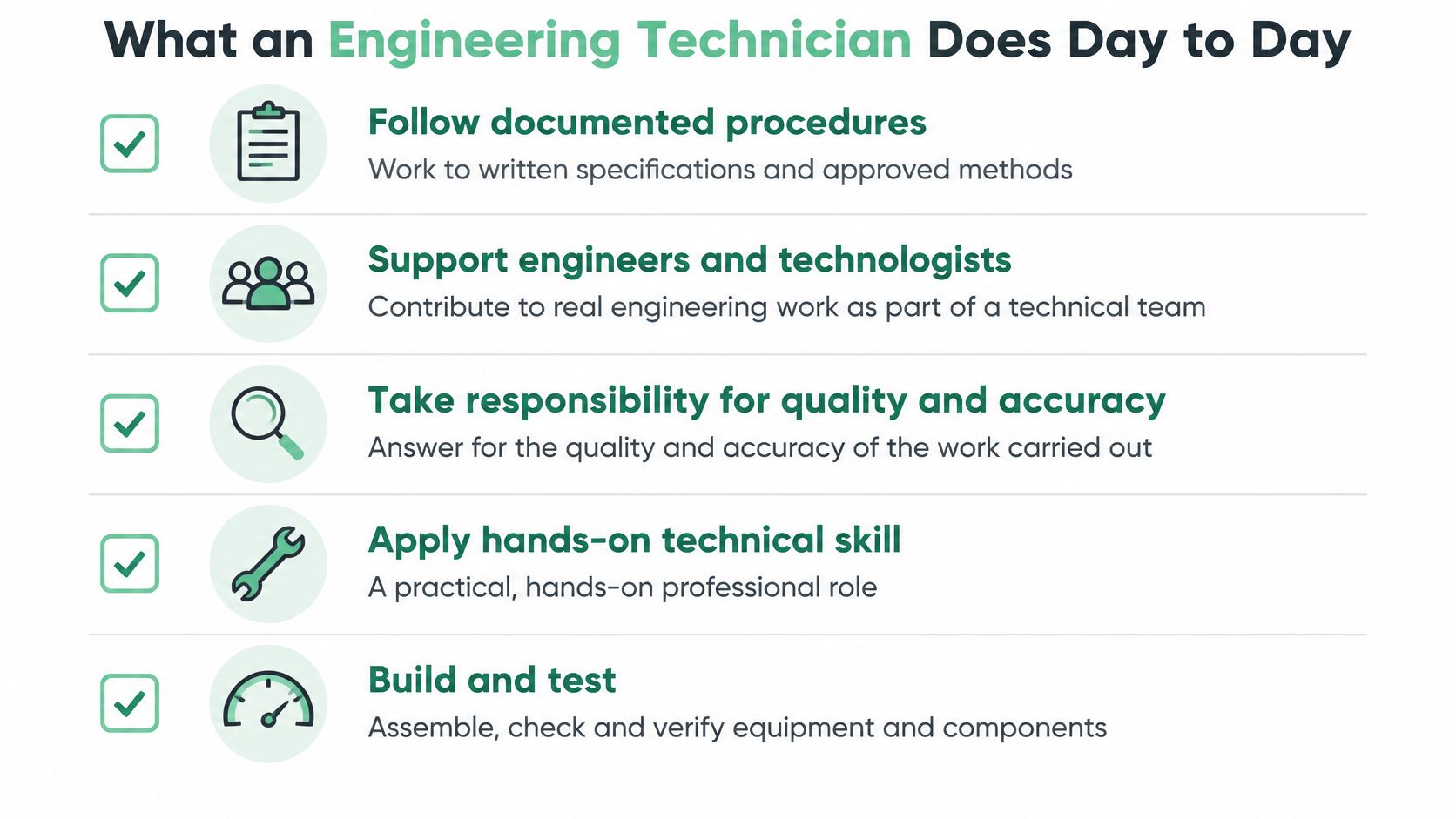
An engineering technician is a hands-on technical professional who contributes to real engineering work under documented procedures, and answers for the quality and accuracy of that work within the limits of their authority. That second half is the bit adverts tend to skip.
The Skills England occupational standard for engineering technicians spells out the contribution. Technicians work in at least one stage of the engineering lifecycle: design and development, quality assurance, manufacture, installation and commissioning, operation and maintenance, and where relevant decommissioning. They apply documented procedures, interpret engineering drawings and data, and comply with statutory, quality, environmental and health and safety requirements.
A typical week follows a sequence you can picture. You read drawings, job instructions and quality documents, then select the right tools for the task. You carry out inspection, testing and compliance checks, record the work in approved systems, and pass on any fault beyond your authority rather than improvising a fix.
Sectors vary widely, from aerospace and aviation to automotive, maritime, defence and advanced manufacturing, but the technical foundation barely changes.
Skills and qualifications employers look for
Employers group their requirements by what you'll do, not by subject.
Read the paperwork: engineering drawings, graphical symbols, formulae and job instructions
Do the maths: measurement, calculation and data interpretation using scientific principles
Draw it: CAD for technical plans and assembly drawings
Work safely: safe systems of work and compliance with statutory rules
Diagnose faults: structured fault-finding rather than swapping parts until something works
Report clearly: accurate records and handover notes for Engineers, Operators and non-technical colleagues
That last one catches people out. Technicians pass information to engineers and to people who don't share their technical language, so plain writing and speaking count as much as ability with a spanner.
Demand is shifting too. A 2025 Institution of Engineering and Technology survey of 1,316 engineering and technology managers, reported in the Digital and Technologies Jobs Plan, found 76% of employers had trouble recruiting for key roles. Automation and cyber security were each named by 38% as important digital skills, while sustainability was both the most needed skill (39%) and the most often missing (35%).
In everyday terms, that means knowing how automated equipment and production data feed decisions, and thinking about energy and waste in routine work.
Practical rule: bring safety awareness, numeracy and careful documentation. Expect your employer to teach you their specific plant, systems and software.
Maths and report writing can be built up step by step, which is exactly what adult study is for. The habit employers value most is continuing professional development, the willingness to keep updating your technical knowledge.
Specialisms and pay compared
The same technician title can describe quite different accountabilities. Mechanical technicians work with machinery and its moving parts; electrical technicians focus on power and control systems; electronics technicians test and repair electronic systems.
| Specialism | Typical duties | Annual pay range (UK) |
|---|---|---|
| Mechanical engineering technician | Read technical plans in CAD, install and test machinery, and service motors, gearboxes and turbines | £27,000–£47,000 |
| Electrical engineering technician | Install and maintain switchgear, motors, drives and PLC panels, and carry out safety inspections | £24,000–£48,000 |
| Electronics engineering technician | Test and repair electronic systems and circuit boards | £26,000–£42,000 |
The National Careers Service mechanical engineering technician profile gives a typical annual salary range of £27,000 to £47,000 for mechanical engineering technicians. Its profile covers mechanical work, so electrical pay and working hours can vary by role and employer.
For electronics technicians, the National Careers Service careers listings give an annual range of £26,000 to £42,000. Treat these figures as starting points: region, employer and experience affect pay.
To compare a vacancy with your interests, look at what you would be accountable for each day. Mechanical work may suit you if you like understanding how machine parts fit together. Electrical roles centre on power and control, while electronics work calls for careful testing of smaller systems and components.
How your career can progress
The role is a starting point, not a fixed job. Here's the shape of the route.
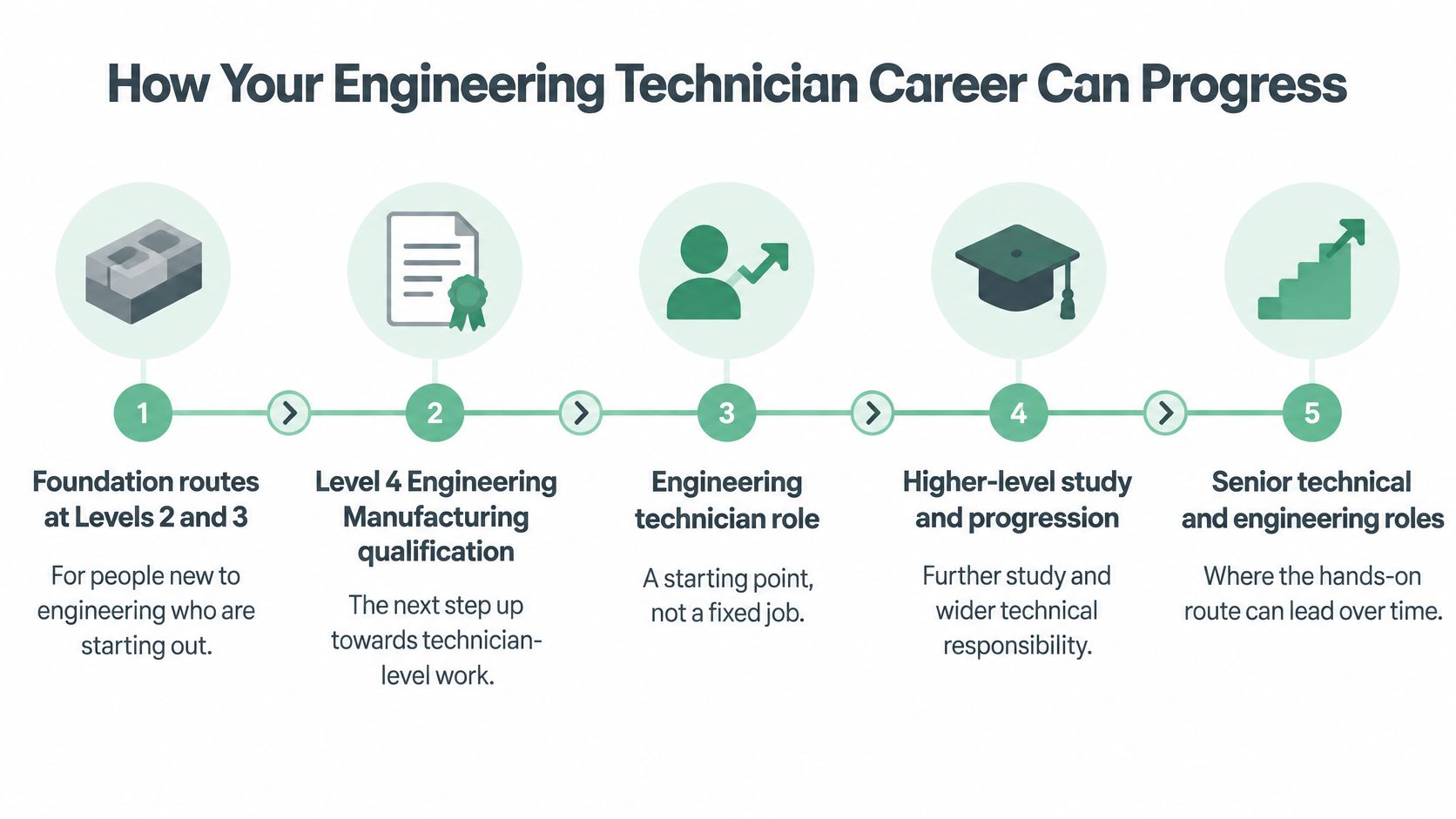
Foundation routes at Levels 2 and 3 suit people new to engineering. Level 4 is the technician stage. A Level 6 degree-linked apprenticeship brings project work, automation and more independent decisions. Beyond that comes supervising others, specialising in areas such as robotics or power generation, gaining EngTech recognition, or studying for a degree.
What moves you up is evidence, not time served. A completed qualification, a signed-off competence record, a project you ran yourself.
Pay changes sharply between stages. A 2025 Level 4 Engineering Manufacturing Technician apprenticeship advertised £15,078 to £21,713 a year, while a Level 6 role started at £17,573 and could reach £33,000 by completion, according to the Find an apprenticeship vacancy listing.
If a degree is the goal but A-Levels aren't in place, our guide on becoming an engineer without A-Levels covers the alternatives.
| Stage | What the work involves | Pay signal |
|---|---|---|
| Level 4 Engineering Manufacturing Technician apprenticeship | Practical production, testing and maintenance support | £15,078–£21,713 advertised in 2025 |
| Level 6 degree-linked apprenticeship | Project work, automation and more independent decisions | Starts at £17,573, up to £33,000 by completion |
| Team or project management | Supervising technicians and planning work | Set by the employer once in a supervisory post |
| Degree study | Engineering design, research and development roles | No trainee rate, pay follows the graduate engineering role |
How to check a vacancy against the role
Look past "repair equipment." A real advert names the activities: condition monitoring, planned maintenance, complex fault diagnosis, confirmation testing and handover, as the Skills England standard describes.
Find the accountability line. It should say what you're responsible for and when you must escalate.
Identify the level. Foundation, Level 4 or Level 6 changes both duties and pay.
Name the kit. Switchgear, motors, circuit boards or turbines tell you which specialism it is.
Check the pay matches the level described. A senior-sounding advert on a trainee rate is a warning.
See what development is offered. Training, qualifications or continuing professional development should be stated.
Read the formatting. Plain language, clear headings and real text rather than words inside an image make an advert readable on a phone and through a screen reader, which is what GOV.UK's accessible documents guidance asks publishers to do.
Most boxes ticked means the advert describes the work covered here.
Study online with Stonebridge
Could an online course fit around your work, caring responsibilities or shift pattern? Stonebridge Associated Colleges offers flexible, 100% online study, with qualified tutor support and a modular structure you can fit around daily life.
The Access to Higher Education Diploma in Engineering offers a route towards university-level engineering study. Read the course page's description, qualification details, entry requirements, syllabus, assessment information and what's included before enrolling. This helps you check whether the course fits your current qualifications and career plans.

The subscription-based course has an affordable monthly fee, and you can pause or cancel at any time without a long-term credit agreement. Stonebridge is accredited by the UK Register of Learning Providers and regulated by the Financial Conduct Authority.
Before you start, write down your career goal, compare the entry requirements with your current qualifications, and choose a start date that works for you.
Stonebridge Associated Colleges has offered online adult education since 1997. If the engineering roles you have read about match your goals, visit the Stonebridge course page, review the course details and check the entry requirements before enrolling.