There's no single national percentage pass mark for Level 2 Functional Skills Maths. Each awarding organisation sets its own boundary for every version of the paper, and your result comes back as a straight Pass or Fail. That surprises adults who've been told to aim for 60 percent. The number they're hunting for doesn't exist in the form they think it does, and once you understand how boundaries work, you can stop guessing and look up the figure that applies to you.
The Level 2 pass mark at a glance
Level 2 Functional Skills Maths is regulated by Ofqual and reported as one overall Pass or Fail, rather than separate thresholds for each part of the assessment (the Ofqual conditions and requirements for Functional Skills Mathematics). The boundary belongs to your awarding organisation, not to a national rulebook.
So the goal isn't a percentage. It's knowing how marks are earned and finding the boundary for the paper you're sitting. A Level 2 Pass is generally treated as equivalent to GCSE grade 4 (C), the benchmark many employers and college courses ask for, and our Functional Skills English and Maths Level 2 Including Exams course is built around that standard. The lookup steps are below.
Why there is no single percentage pass mark
Start with the rule that replaces the myth. Under Ofqual's rules, each awarding organisation must set one boundary mark for a Pass for every version of its assessment, so the number of marks needed can vary between organisations, paper versions and assessment series instead of staying fixed at 50% or 60% (Ofqual's Functional Skills Mathematics conditions and requirements). The reformed requirements took effect on 9 August 2019, and current Level 2 qualifications follow that framework. Where a paper has separate components, your combined mark is judged against that single boundary.
The system is designed that way. A harder paper carries a lower boundary, an easier one carries a higher boundary, and the standard stays level across both. Two learners can each score 60 marks on different papers and get different results, because the paper version and the awarding organisation decide what 60 marks is worth.
Practical rule: find your awarding organisation first, then look up its current boundary information for your series. A pass mark quoted without a named awarding body is incomplete, and it can be misleading.
Your official mark scheme or results documentation is the only reliable answer. Everything else is guesswork dressed up as advice.
How to find your awarding organisation's pass boundary
You can settle this in one sitting. Work through it in order.
Check your enrolment documents or ask your tutor which awarding organisation issued your assessment.
Open that organisation's current Level 2 Functional Skills Maths specification on its own website.
Download the sample assessment materials and mark scheme for the series you're sitting, so you can see how marks are allocated.
Look for published boundary or grade information for that series. Boards usually release it after results are issued.
Ask if it isn't published. Your provider or the awarding organisation can confirm the figure for your paper.
That route gives you a real answer. A figure you found on a forum, with no board attached, doesn't.
How the Level 2 maths assessment is scored
| Element | Requirement | What it means for you |
|---|---|---|
| External assessment | 100% of weighting at Levels 1 and 2 | No internal grade counts towards the result |
| Question type | At least 75% open response | You need to show calculations and written answers, not just pick options |
| Underpinning skills | 25% of available marks | Accurate basic methods still matter, but they're not the whole test |
| Problem solving | 75% of available marks | Multistep, real-world problems with at least two connected steps |
| Process skills | Representing, analysing and interpreting | Marks can be earned for method as well as the final answer |
The split above sits in Ofqual's assessment requirements, which allocate 25% of available marks to underpinning skills and 75% to problem solving (Ofqual's functional skills subject content for mathematics). All of the weighting at Levels 1 and 2 is external, and at least 75% of questions are open response, so working and written answers earn credit (Ofqual's functional skills criteria for mathematics). Level 2 problems are expected to be complex, typically a multistep process with at least two connected steps, and some combine numbers, measures, shape and space, and handling information and data. A sound method can pick up marks even when the final answer slips.
How Level 2 compares with GCSE and apprenticeships
Readers often want to know where the qualification sits next to the maths they did at school.
| Qualification | Level | Rough GCSE equivalence |
|---|---|---|
| Functional Skills Maths Level 1 | Level 1 | Below GCSE grade 4 |
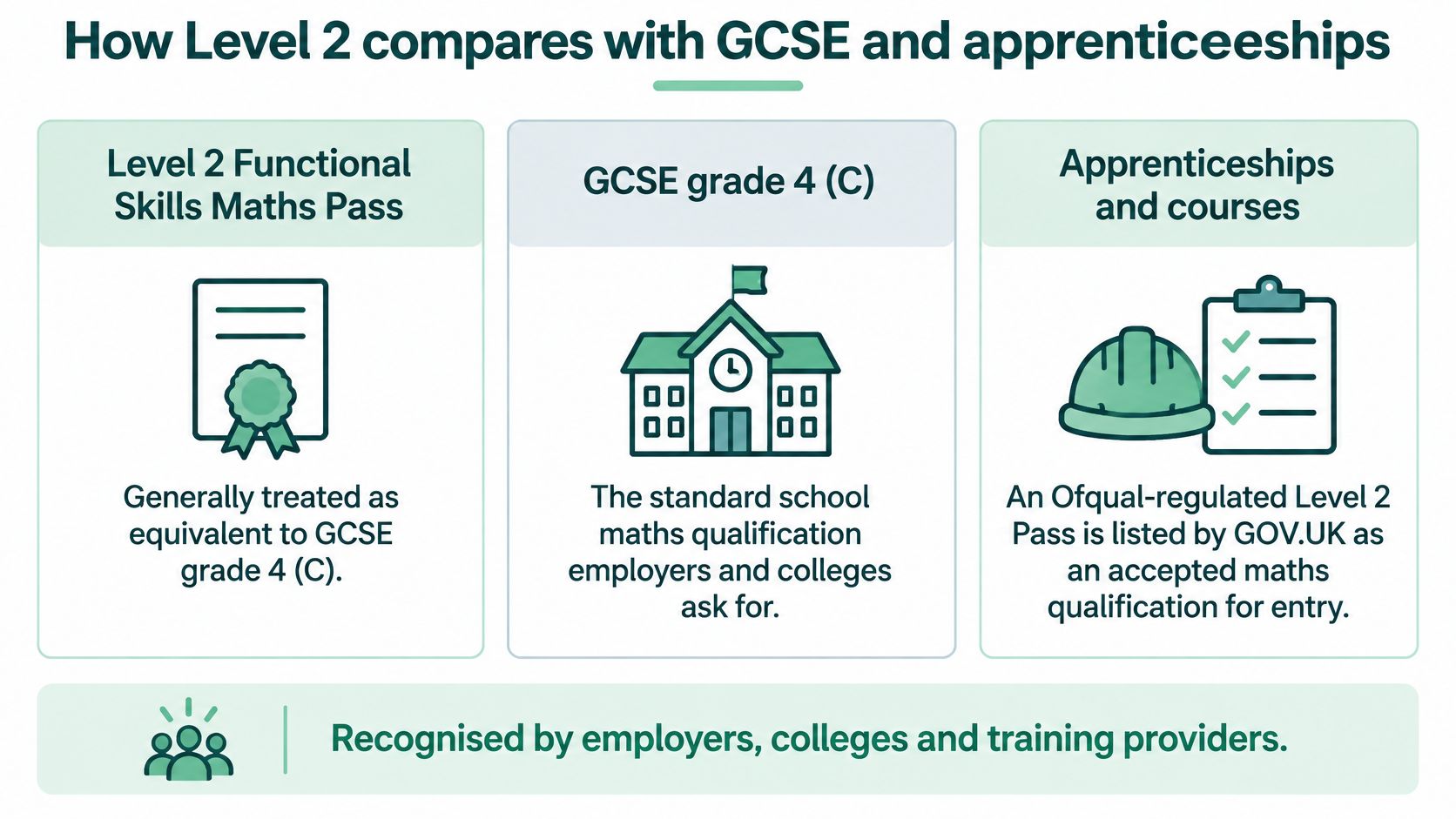
| Functional Skills Maths Level 2 | Level 2 | GCSE grade 4 (C) standard |
| GCSE Maths | Level 2 | Grade 4 (C) and above |
GOV.UK lists an Ofqual-regulated Level 2 Functional Skills Maths qualification with a minimum acceptable grade of Pass as an accepted maths equivalent for a Level 2 apprenticeship (maths qualifications for apprenticeships). The equivalence is a general benchmark, not a promise, so confirm the exact entry rule with the college, university or employer you're applying to. If you want the wider picture, our guide to how the GCSE grading system works puts grades 4 and 5 in context.
How to give yourself the best chance of a pass
Passing is harder than many returning learners expect, and the evidence backs that up. Most providers surveyed reported that fewer learners were passing Level 1 and Level 2 Functional Skills maths after the reform than before September 2019, even though reviews judged legacy and reformed assessments broadly similar in demand (the Ofqual review of reformed functional skills assessments).
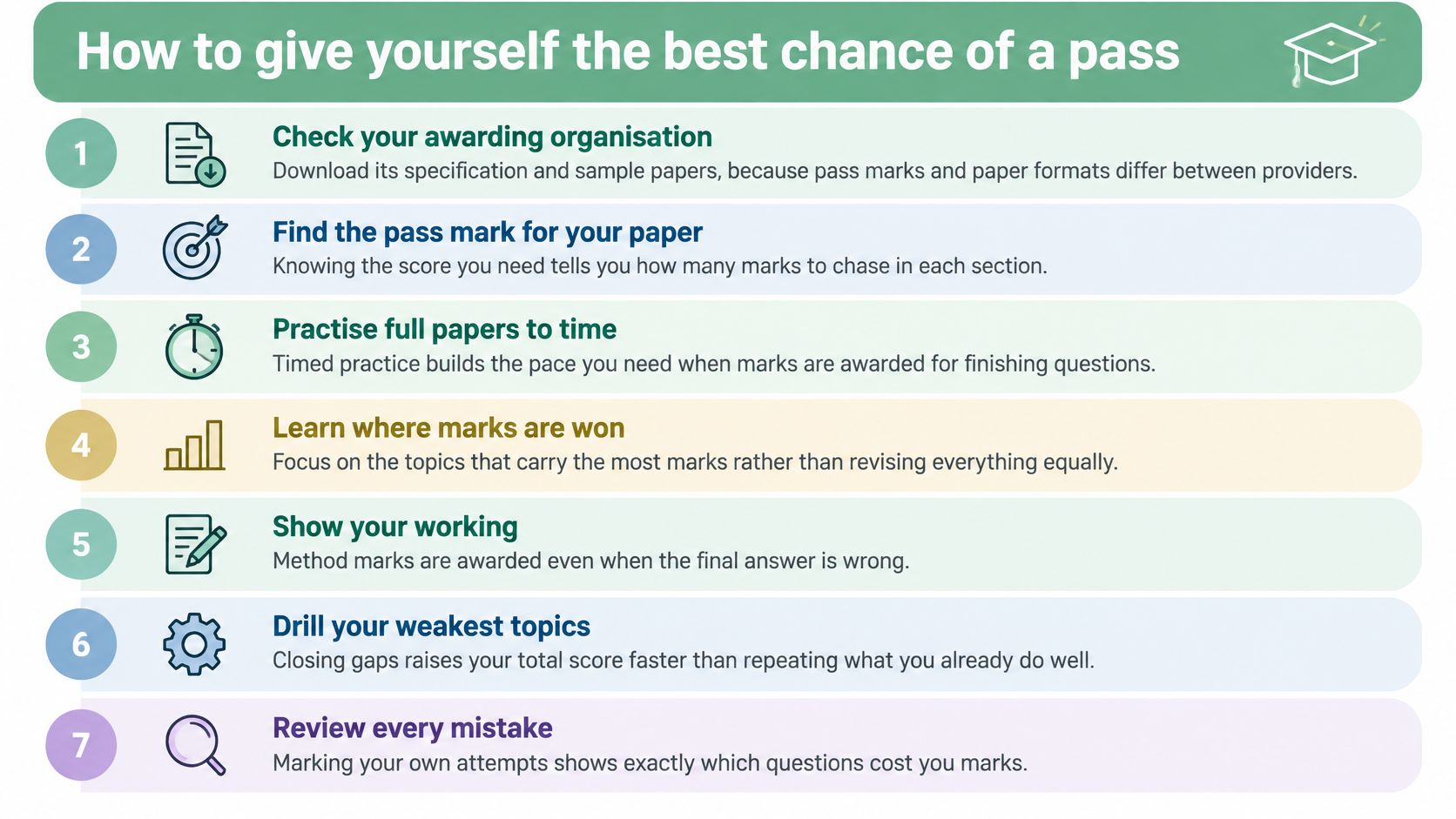
So how do you prepare for a target that moves? The boundary works like a finish line that shifts slightly from race to race. You cannot memorise it, but you can train well past it. Five habits do most of the work.
Confirm your awarding organisation and download its specification and sample papers. Boundaries and paper formats differ between boards, so generic revision can leave gaps.
Practise multistep, real-world questions. Level 2 asks you to connect two or more steps, such as calculating a quantity and then using it in a second calculation.
Show every step of your working. Process marks can still be earned when the final answer is wrong, so a blank method line throws away marks.
Review practice results by skill and question type, not just the total. A score of 60 tells you little; knowing the marks were lost on interpreting graphs tells you exactly what to fix.
Plan weekly study targets and use tutor feedback on marked work to decide what to build next. Our English and maths functional skills courses are structured around that kind of steady, marked practice.
A short walkthrough of the exam itself is worth a few minutes before you start timing papers.
Questions learners ask about the pass mark
Is a Level 2 result a grade?
No. The overall result is Pass or Fail, not a numbered grade. Your aim is to meet the boundary set by your awarding organisation for your series, which is why the board matters.
What happens if you don't pass first time?
You resit. Learners who fail to meet the required standard must re-sit examinations or re-submit assessments, which may incur additional costs confirmed in advance, and the number of retries may be limited by industry or awarding organisation standards. Before you rebook, look at your feedback by skill so the next attempt targets the actual gap.
Start your Level 2 maths studies with Stonebridge
Our Functional Skills English and Maths Level 2 Including Exams course is studied 100% online, with personalised support from qualified tutors. Its modular structure lets you organise learning around work and home life. Functional skills courses must be completed within 12 months, so build your study routine around that deadline. You'll need an active training course subscription to submit an assignment for marking.
Marked submissions come with constructive, supportive feedback, and an assessor can answer questions as you go.
Stonebridge Associated Colleges offers a flexible monthly subscription that you can pause or cancel without long-term credit agreements. Keep the completion deadline in mind when planning a break. We're accredited by the UK Register of Learning Providers and regulated by the Financial Conduct Authority.
Your target is your awarding organisation's pass boundary, rather than a single percentage for everyone. Visit Stonebridge Associated Colleges to explore your study options and choose how learning could fit into your week.