You're working shifts, caring for family, or returning to education after a long break. A move into care may feel worthwhile, but choosing the right health and social care Level 3 online route can be confusing. Course titles often sound similar, yet qualifications can differ in assessment, recognition, workplace requirements, and progression value.
This guide focuses on the practical questions adult learners ask before enrolling. It explains what Level 3 means, what you'll study, how online assessment works, and how flexible learning can support a route into employment or higher education. It also highlights why checking the qualification type matters before you commit.
Why more adults are choosing care careers right now
A typical learner might finish a late shift, help with family responsibilities, then search for a career with more purpose. Care work can appeal because it combines practical responsibility with human connection. It also offers routes into employment without requiring a degree at the outset.
The UK adult social care workforce remains substantial. Skills for Care estimates about 1.59 million filled posts in England in 2025/26, with around 96,000 vacancies on any given day. The vacancy rate was 6.2%, the lowest recorded since 2015/16, but the figures still show continuing demand for people entering and progressing through care roles. Skills for Care's adult social care workforce data provides the wider context.
The sector includes far more than one job title. Depending on experience and employer requirements, newcomers may explore roles such as:
Care Worker: Supporting daily routines, personal care, dignity, and independence.
Support Worker: Helping people live safely in residential or community settings.
Healthcare Assistant: Assisting patients and clinical teams within an employer's required scope.
Home-care Worker: Visiting people in their own homes and following individual care plans.
A realistic view of demand
Care work can offer meaningful progression, but it isn't easy work. You may need to manage sensitive conversations, follow safeguarding procedures, record information accurately, and stay calm when circumstances change. Employers also assess reliability, communication, attitude, and practical competence alongside certificates.
Online study removes some barriers. You don't need to travel to a college for every lesson, and fixed classroom timetables may not suit rotating shifts. You still need a dependable study routine, access to the internet, and the willingness to complete work independently.
Practical rule: Choose a course for the job or progression route you want, not simply because its title includes Level 3.
What a Level 3 qualification means and where it leads
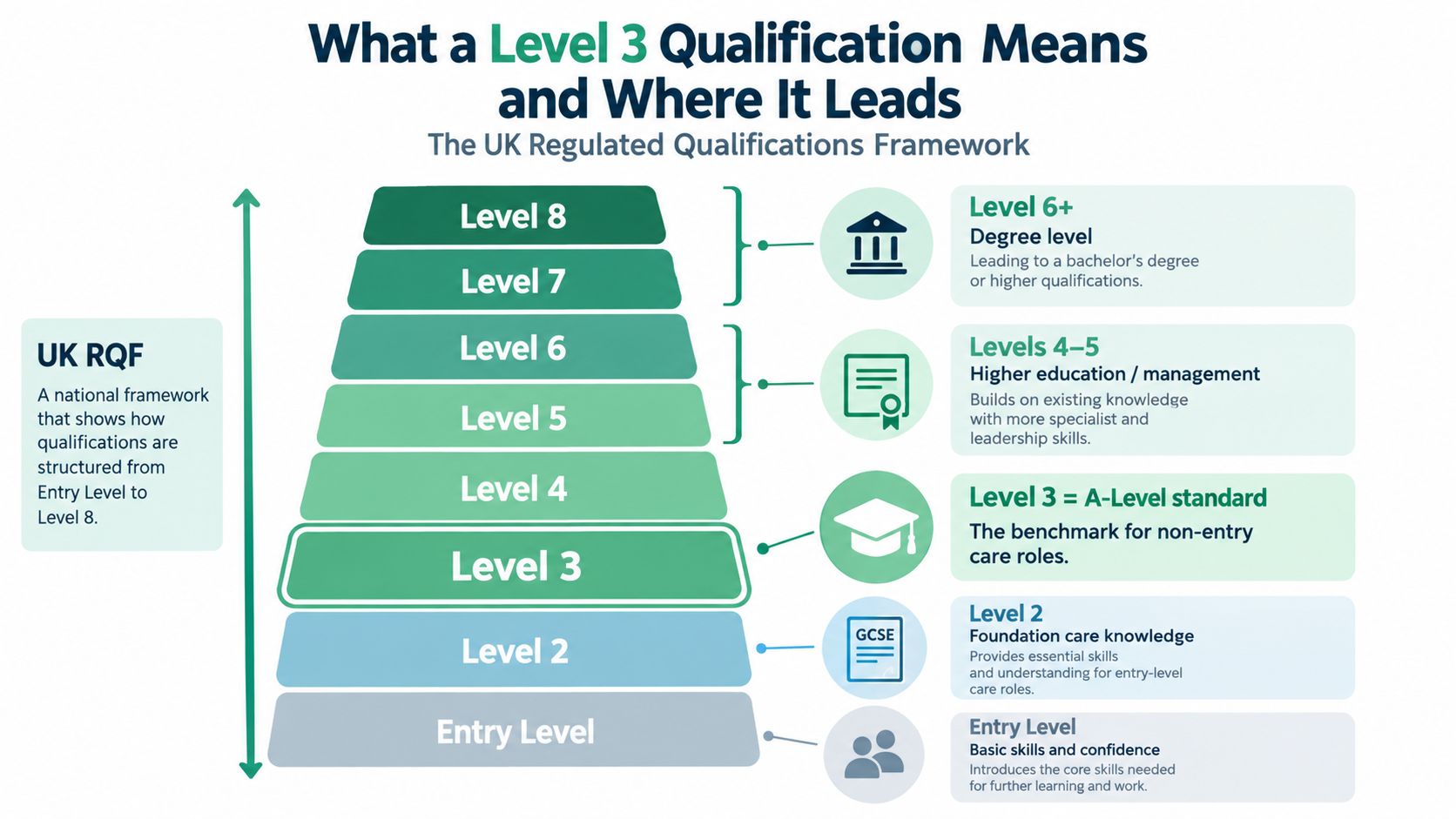
Level 3 describes a qualification level, not one single type of course. In broad terms, it sits around the standard of an A-Level, but the qualification's purpose and assessment still matter. An academic Access to Higher Education Diploma, a vocational diploma, and a CPD-style course can all use Level 3 language while serving different goals.
Think of Level 3 as a stepping stone. Level 2 can provide foundation knowledge and may suit someone taking a first step into care. Level 3 usually involves greater responsibility, wider understanding, and stronger preparation for roles beyond basic awareness. Levels 4 and 5 move towards higher technical, leadership, and management study, while Level 6 represents degree-level learning.
Why the level matters in care
The UK Government's 2026 health and adult social care sector skills assessment projects that 79% of additional employment in adult social care priority occupations up to 2035 will require Level 2 or Level 3 qualifications. The assessment also records 13,920 Level 2 and Level 3 health and social care apprenticeship achievements in 2023/24. Read the Skills England sector skills assessment.
A Level 3 route can support progression towards senior care work, supervision, or further study. It doesn't guarantee a job, a pay band, university admission, or registration. Employers and universities set their own requirements, so check the exact course and role before enrolling.
The Lead Adult Care Worker standard shows the operational nature of Level 3 progression. The programme is typically 1 year 6 months and prepares learners for roles such as Lead Care Worker or Supervisor, according to the official apprenticeship listing. That's why applied evidence matters. Care employers need people who can use knowledge safely, not only recall terminology.
What you actually study on a Level 3 health and social care course
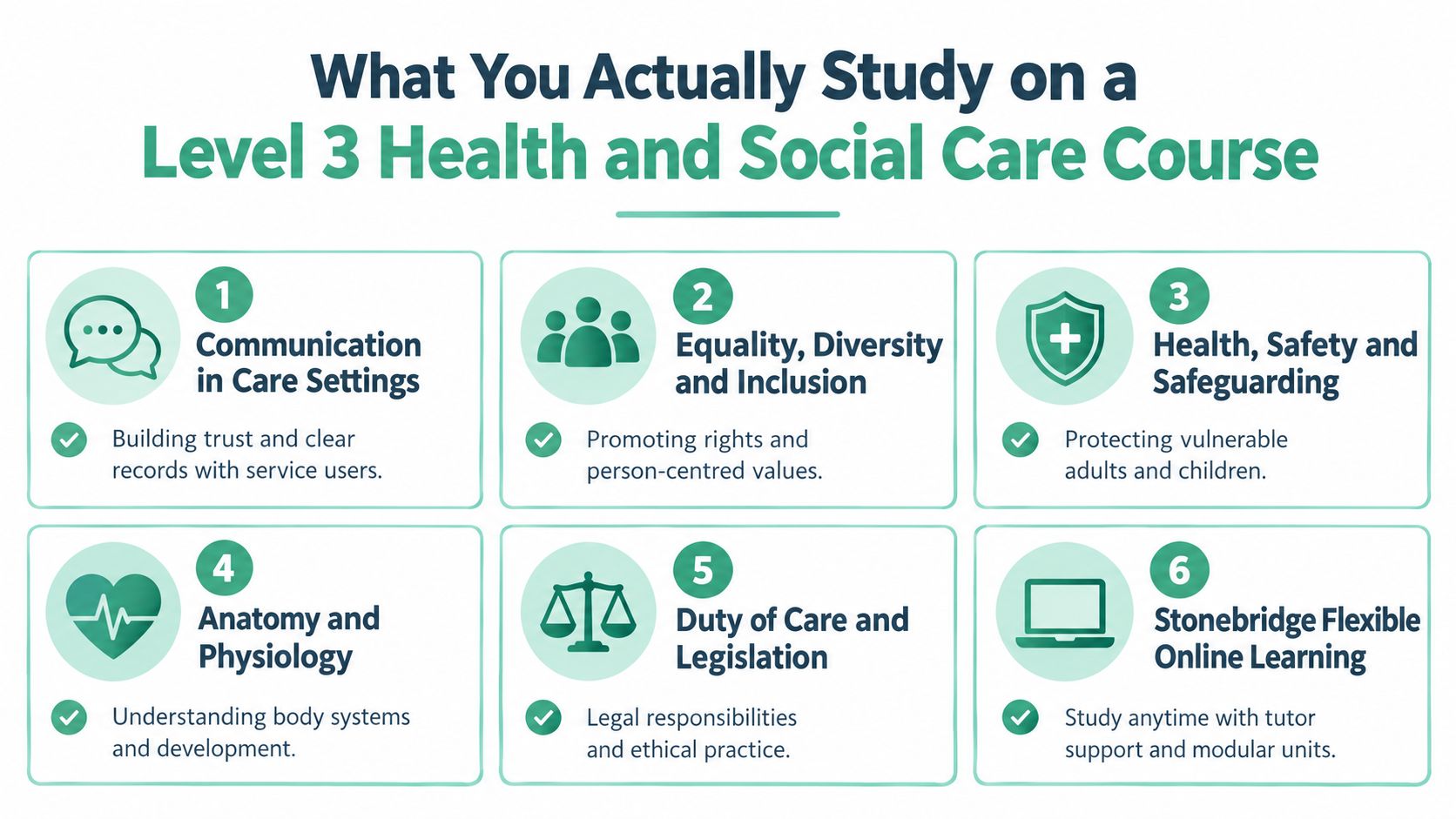
A suitable programme should connect theory with situations you may meet in care settings. Typical learning includes communication, safeguarding, person-centred support, equality and diversity, anatomy and physiology, mental health, dementia, and support for people with learning disabilities.
Person-centred care means starting with the individual rather than treating everyone in the same way. You'll consider preferences, dignity, consent, independence, and the person's right to be involved in decisions. Safeguarding work focuses on recognising concerns, recording them clearly, and following the correct reporting process.
Learning through a flexible online format
Stonebridge Associated Colleges offers a Level 3 Diploma in Adult Care (RQF) with 100% online learning. The course information describes 19 units and 380 guided learning hours. Explore the Level 3 Diploma in Adult Care course to review the current syllabus, assessment approach, and course inclusions.
Units are delivered through an online learning portal in manageable sections. That can help you study around work or home responsibilities, although the workload still needs planning. A short session after work may be more realistic than waiting for a free weekend that never arrives.
The course level also affects what you should expect from the learning. A strong programme asks you to apply ideas to care scenarios, explain decisions, and reflect on safe practice. It shouldn't feel like a collection of disconnected quizzes.
Entry requirements and how to get started
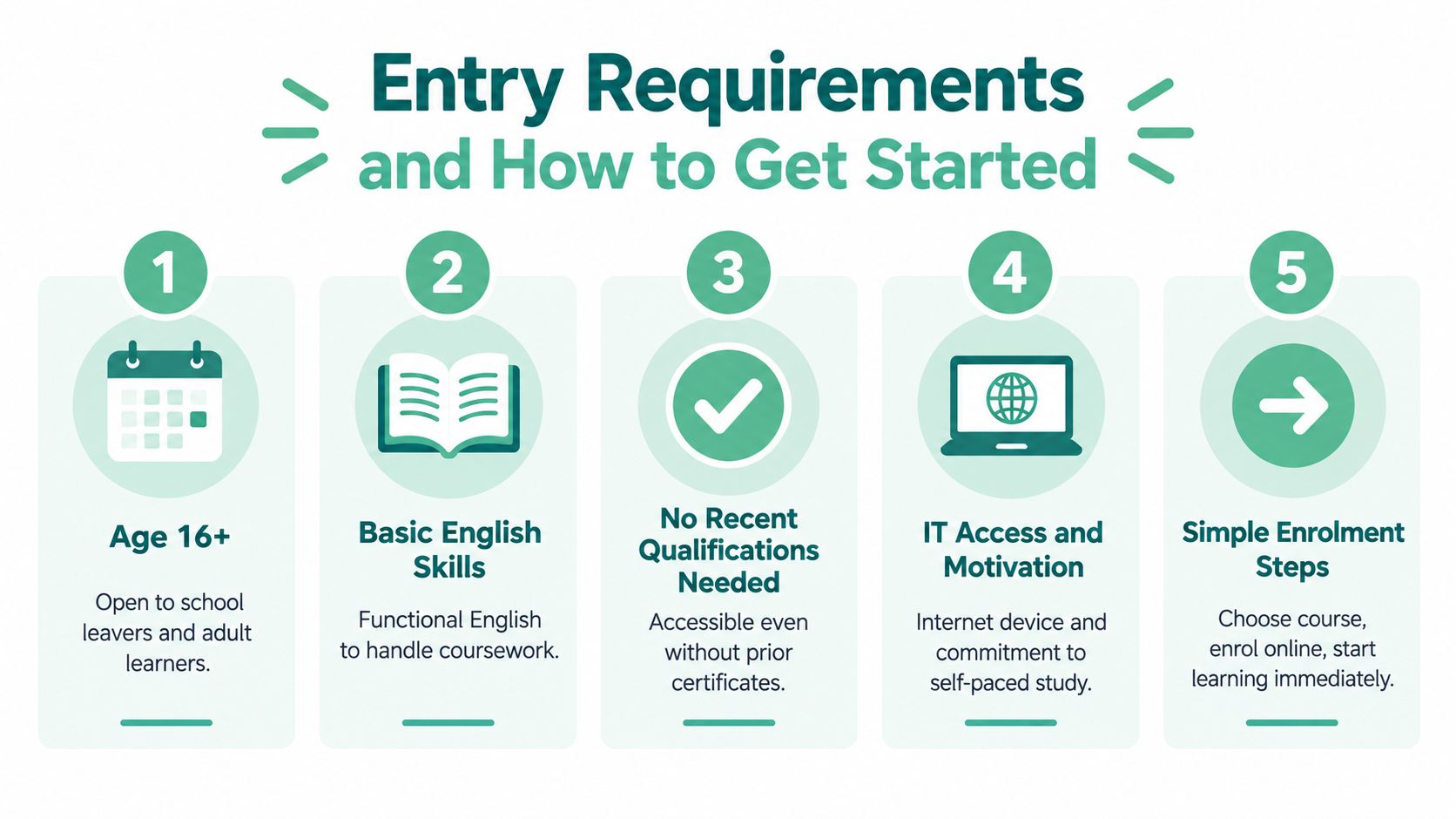
Online Level 3 study can suit school leavers, career changers, existing care workers, and adults returning to education. You may not have recent certificates, and that doesn't automatically prevent you from exploring the route.
Common expectations include:
Age: Many programmes accept learners aged 16 or above, although course-specific rules apply.
English and maths: You need enough functional English and maths to understand lessons, write assignments, and work with basic care information.
Digital access: A suitable device, reliable internet, and the ability to use online systems are important.
Motivation: Self-paced study gives you flexibility, but you'll need to organise your time and submit work.
Role requirements: A workplace, interview, or DBS check may become relevant if your chosen progression route includes placement or direct care duties.
The enrolment process
Start by identifying your goal. Are you preparing for a first care role, building knowledge before applying, progressing in an existing job, or aiming for university?
You'll normally choose the programme, create an account, provide relevant details, and complete any initial checks requested by the provider. Previous certificates may help advisers understand your starting point, but adult learners shouldn't assume that a long gap from education means they're unprepared.
Funding and eligibility can depend on your circumstances, including residency status and the type of programme selected. If you're unsure, contact the admissions team before enrolling. A straightforward conversation can clarify whether the course suits your background and intended outcome.
How learners are assessed
Assessment reveals what a course is really preparing you to do. Multiple-choice quizzes can check recall, but care roles also demand judgement, communication, record-keeping, and the ability to respond to risk.
Online Level 3 programmes may use written assignments, short-answer questions, reflective work, and portfolio tasks. The exact approach depends on the qualification and provider. Workplace-assessed regulated routes need suitable practical evidence, while knowledge-focused online courses may assess understanding through submitted work and online tests.
| Assessment type | What it measures | Relevance to care roles |
|---|---|---|
| Written assignments | Understanding of care principles and legislation | Helps you explain decisions and communicate professionally |
| Short-answer questions | Knowledge of key terms and processes | Checks whether you understand core procedures |
| Reflective work | Ability to review actions and learning | Supports safer, more thoughtful practice |
| Portfolio evidence | Development over time | Can demonstrate applied competence where the route requires it |
Support with academic work
Many adult learners worry about essay structure, referencing, or formal writing. Tutor guidance and study-skills resources can make those tasks more manageable. The aim isn't to use complicated language. It's to present a clear point, support it with relevant information, and link it to the care situation.
Assessment should help you practise the kind of thinking care work requires. A safeguarding scenario may ask what action you would take and why. A care-planning task may test whether you can respect the individual's choices while considering risk.
Why the Stonebridge subscription model suits working adults
Traditional college attendance can create problems for people working shifts or managing childcare. Fixed sessions may clash with a rota, and missing one lesson can make the next topic harder to follow.
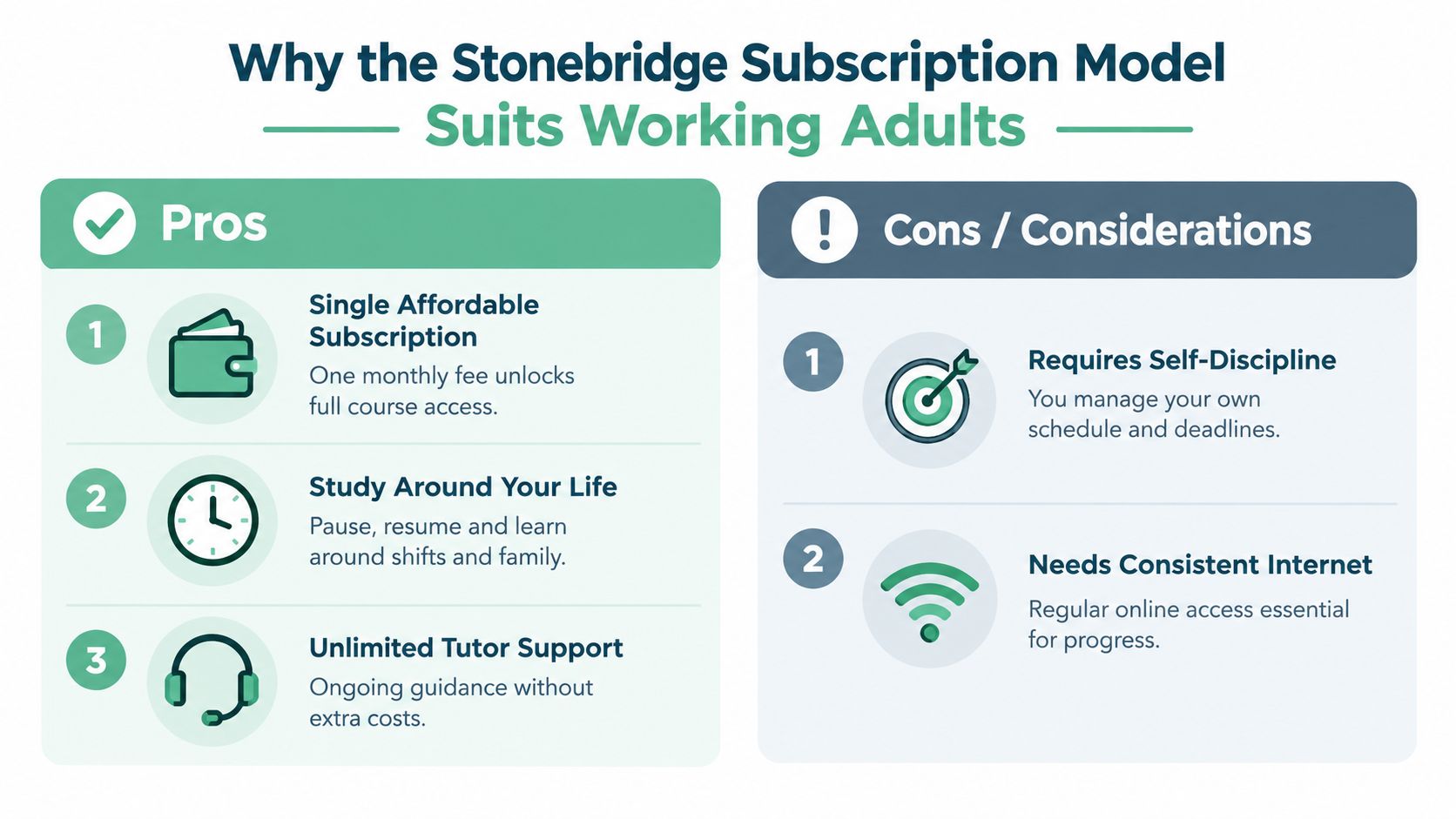
Stonebridge's subscription model offers a different arrangement. A monthly fee provides access to the chosen course, learning materials, tutor support, and study resources. Learners can pause or cancel their subscription without a long-term credit agreement, which gives more control when work or family circumstances change.
Flexibility still needs structure
Online learning doesn't remove the need for commitment. It moves more responsibility to you, so a weekly routine helps. You might reserve several evenings for reading and assignments, then use a quieter weekend period to review feedback.
The monthly model can make study easier to manage financially than a large upfront payment. It also lets you adjust your pace when life becomes unpredictable. That flexibility is useful for adult learners, but it shouldn't encourage rushed study or skipped topics.
Learners and alumni of Stonebridge Associated Colleges also get access to the learndirect: Community Hub app, available to learners and alumni of the learndirect Digital Group only. The app includes discussion groups, topic communities, interactive forums, and spaces where people can ask questions and share ideas. Online study feels less isolated when you can connect with others following their own learning journeys.
A flexible course works best when the provider supports both your timetable and your questions.
Where Level 3 can take you next
Level 3 can form part of a wider route through health and social care. Immediate opportunities may include Care Worker, Support Worker, Healthcare Assistant, or Key Worker roles in residential, domiciliary, and community settings. Each employer decides what experience, checks, training, and qualification evidence the role requires.
With workplace experience, some learners move towards Senior Care Worker, Team Leader, or specialist support responsibilities. A qualification can strengthen your application, but it won't replace employer induction, supervised practice, or role-specific training.
Progression into higher education
Learners considering nursing, social work, or another health-related degree should check university requirements before selecting a course. Universities decide which qualifications they accept, whether an Access to Higher Education Diploma is needed, and what subject preparation or placement experience applies.
Stonebridge offers an Access to Higher Education Diploma in Health and Social Care for learners seeking an online route towards higher education. The right choice depends on your destination. A vocational adult care qualification may suit employment and workplace progression, while an Access Diploma may be more relevant to degree applications.
The wider sector also needs progression at higher levels. The Skills England assessment identifies Level 2 and Level 3 routes as central to projected adult social care employment needs, while higher-level qualifications support further technical and leadership development. In Scotland, the SSSC Workforce Skills Report states that registered workers must hold, or be working towards, a qualification suitable for their role. Requirements differ across the UK, so check the rules for the nation and job you're targeting.
Clear online writing also helps learners compare courses and make decisions. UK guidance recommends short sentences, active voice, subheadings, and concise paragraphs, principles reflected in Government guidance on clear language and Nottinghamshire County Council's web style guide. When you're comparing routes, look for equally clear information about the qualification, assessment, support, and progression outcome.
Stonebridge Associated Colleges offers flexible, 100% online courses in adult care and Access to Higher Education Health and Social Care, supported by qualified tutors and a subscription model you can pause or cancel. Visit Stonebridge Associated Colleges to compare your options and choose a practical next step towards care work or higher education.