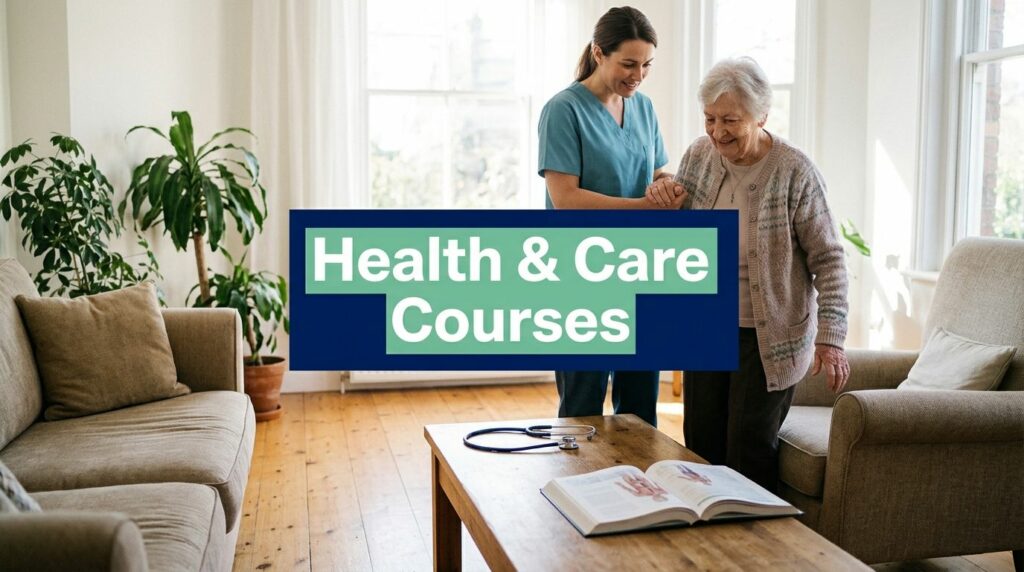
Are you looking at a health and social care course and wondering what you'd study, what level you need, and whether “funded” really means free for you?
That confusion is common, especially for adults who are trying to fit study around work, children, or other commitments. Course pages often jump straight to career promises, but they don't always explain the basics clearly. That leaves people asking practical questions. Is this a beginner course or a university pathway? Will I need GCSEs first? Does online study still include placement? Will the qualification help with real jobs outside the NHS?
Health and social care courses can be a flexible route into care work, support roles, further study, and leadership positions. They can also be a poor fit if you choose the wrong level, misunderstand the funding rules, or expect a guaranteed job at the end.
Introduction
For many adult learners, the challenge isn't motivation. It's logistics. You may want a new career in care, but still need to keep earning, manage family life, and study at times that work for you.
That's why the question What is Health and Social Care Courses matters more than it first appears. People aren't only asking for a definition. They're trying to work out whether these courses match their current qualifications, career goals, and daily routine.
In simple terms, health and social care courses teach you how to support people safely, ethically, and practically. Some are designed for first steps into care work. Others prepare you for university or management responsibilities.
Practical rule: Don't choose a course by title alone. Choose it by level, study mode, and where it can realistically lead.
A good course choice starts with a few clear questions:
Your starting point: Do you already have GCSEs, care experience, or previous study?
Your goal: Are you aiming for entry-level work, university, or a supervisory role?
Your schedule: Do you need part-time or fully online learning?
Your budget: Are you eligible for funded study, or will you need to pay fees?
By the end, you'll have a clearer picture of what these courses include, how qualification levels work, where people often get misled, and how to choose a route that makes sense for your life.
Understanding Health and Social Care Courses
Health and social care courses sit between theory and real human support. They teach you about people's physical health, mental wellbeing, communication needs, safeguarding, and the systems that shape care delivery. That means you're not only learning facts. You're learning how to apply them in everyday situations.
In the UK, these courses form part of a substantial education pipeline. In the 2021/22 higher education system, there were 26,580 total social work student enrolments across all years of study, with 5,580 enrolments leading directly to social worker registration, according to social work enrolment data published in the 2025 article on Taylor & Francis Online. That gives useful context. Formal training in care isn't a niche option. It's a recognised route into regulated and support-based professions.

What you actually learn
Most courses combine foundational knowledge with practical care skills. A beginner may study communication, human development, equality, and safeguarding. A more advanced learner may look at leadership, care planning, mental health support, or service delivery.
A simple way to think about it is this:
| Course element | What it means in practice |
|---|---|
| Knowledge | Understanding anatomy, psychology, ethics, and how care systems work |
| Skills | Supporting service users, recording information, communicating clearly, planning care |
| Professional behaviour | Working safely, respecting dignity, following procedures, protecting vulnerable people |
Where these courses can lead
These courses can support entry into roles such as care assistant, support worker, or assistant practitioner. They can also prepare learners for university-level progression in related fields.
A health and social care course isn't just about getting information into your head. It's about learning how to respond well when another person needs support.
That's why they matter internationally too. Even though qualification names vary between countries, the core themes are widely relevant. Safety, ethics, communication, dignity, and person-centred care matter in every care setting.
Course Types and Qualification Levels
The biggest source of confusion is usually the word level. Many adults assume a higher number means “harder”. It does mean a more advanced qualification, but it also signals something more important. It shows your likely entry point, the depth of study, and the kind of progression the course supports.

Health and social care qualifications in the UK sit within the Regulated Qualifications Framework, often shortened to RQF. According to this explanation of health and social care course levels from TWC London, these courses commonly appear at RQF Levels 1 to 5, and Level 3 diplomas typically require four to five GCSEs including English and Maths and take one to two years full-time to complete.
A simple level-by-level view
Here's the plain-English version of the main routes.
Level 2
Basic introduction. This suits learners who are new to the sector and want to build confidence with core care knowledge.Level 3
Strong next step for many adults. This level is often used for workforce entry or as a bridge to higher study.Access to Higher Education Diploma (Also Level 3)
Best thought of as a university access route for adults who need a recognised pathway into degree-level study.Level 4
More specialised and often suited to learners building responsibility in practice.Level 5
Usually linked to leadership, management, and more accountable roles within adult care services.
Later-stage qualifications also become more structured. For example, the Pearson specification for the BTEC National Extended Diploma in Health and Social Care states that a Level 3 qualification requires 1,080 Guided Learning Hours, and that this supports progression to routes that may require 96 to 112 UCAS Tariff points. A related university example appears in the UCLan course entry page for BSc Health and Social Care, which lists 96 to 112 UCAS Tariff points as a typical degree entry range.
A helpful visual summary sits below.
How to match a level to your goal
If you're unsure where you fit, use this quick comparison:
| Your situation | Course level that may fit |
|---|---|
| You're new to care and want an introduction | Level 2 |
| You want a recognised qualification for care work or future study | Level 3 |
| You want to move towards university as an adult learner | Access to HE Diploma |
| You already work in care and want to deepen specialist knowledge | Level 4 |
| You're aiming for supervision or management in adult care | Level 5 |
If a course page sounds exciting but doesn't clearly explain the level, pause there. That's often where costly mistakes start.
Typical Curriculum and Assessments
What do you do on a health and social care course day to day? Usually, you'll work through a mix of core topics, applied tasks, and practice-based learning.
The exact units vary by awarding body and level, but the pattern is familiar. You study how to communicate with different people, how to recognise risk, how to protect dignity, and how care plans support safe and person-centred practice. Some courses also include themes such as mental health, dementia care, health promotion, and professional values.
Common curriculum areas
Most learners can expect content in areas such as:
Communication skills: speaking, listening, recording, and adapting your style for different service users
Safeguarding: recognising concerns, following reporting procedures, and understanding duty of care
Person-centred care: supporting individuals as people, not as diagnoses
Health and wellbeing: understanding how physical, emotional, and social needs connect
Working practices: confidentiality, equality, inclusion, and professional boundaries
Assessment is usually broader than a final exam. Many providers use written assignments, case-based tasks, reflective work, portfolios, and practical evidence. That matters for adult learners who may perform better through applied work than timed testing.
Why placement matters
A health and social care course can't stay entirely theoretical. At some point, learners need to show they can use what they've studied in a live setting.
That placement requirement acts like the driving practice in a driving course. You can study road rules for weeks, but until you handle a real car in real traffic, your learning is incomplete.
Classroom knowledge tells you what good care looks like. Placement shows whether you can deliver it when another person is depending on you.
For adult learners studying online, this is one of the most important questions to ask early. If placement is required, find out who arranges it, how it's evidenced, and whether your current workplace can support it.
Who the Courses Are For and Delivery Modes
Some learners arrive with care experience but no formal qualification. Others are switching careers after years in retail, admin, hospitality, or parenting. Some already work in support settings and want a qualification that reflects what they do every day.
That range is one reason these courses work well in flexible formats. Many adults can't step away from earning or family life to attend a traditional timetable. They need study that fits around shifts, mornings, evenings, and weekends.

Who usually takes these courses
A broad mix of learners tend to choose health and social care study:
Career changers: people who want more meaningful work and a clearer vocational path
Existing care staff: workers who need a recognised qualification for progression
Adults returning to study: learners building confidence after a gap in education
Internationally minded learners: people who want UK-recognised course structures and terminology
Delivery modes usually fall into three broad groups. Some courses are fully online. Others are blended, with a mix of digital study and practical attendance. Some are classroom-based. The right choice depends less on preference and more on your life pattern, internet access, and whether placement needs can be met locally.
Where jobs are likely to be
This is where many course descriptions become too narrow. They often highlight NHS careers first, because those roles are familiar and attractive. But that isn't the whole picture.
According to this discussion of UK adult care workforce realities on YouTube, over 60% of adult care workers are employed by private providers or local authorities, even though course marketing often leans heavily towards NHS pathways. That matters because job conditions, progression, and expectations can differ across sectors.
A realistic view helps. Your first role after study may be in residential care, domiciliary care, supported living, community services, or a local authority-linked setting rather than a hospital.
Don't judge a course only by the most visible employer. Judge it by the range of settings it prepares you to work in.
Accreditation Regulations and How to Choose a Course
A course title can sound impressive and still leave you with a qualification that doesn't fit your goal. That's why accreditation matters. You need to know who regulates the qualification, whether the course matches the level claimed, and whether it's recognised for the kind of progression you want.
For regulated qualifications, learners often look for links to Ofqual-regulated awarding organisations. For higher education pathways such as Access to HE, quality assurance and progression recognition also matter. If your long-term goal is university, registration in care work, or a management role, these checks aren't optional.

A practical course-checking list
Use this before you enrol:
Check the qualification type
Is it an RQF diploma, an Access to HE Diploma, or a non-regulated short course?Look at the awarding or validating body
The course page should tell you who stands behind the qualification.Match the level to your goal
Entry-level work, university progression, and management routes need different qualifications.Ask about support
Tutor feedback, deadlines, placement guidance, and learner services matter more than glossy marketing.Read the cost terms carefully
Confirm fees, instalments, funding conditions, and any extra costs linked to placement or exams.Check fit, not just reputation
A well-known provider still might not suit your timetable or learning style.
One example in the distance-learning market is Stonebridge Associated Colleges, which offers online options including the Level 3 Diploma in Adult Care, an Access to Higher Education Diploma in Health and Social Care, and the Level 5 Diploma in Leadership and Management for Adult Care. The key point isn't the brand name. It's whether the course level, delivery model, and support structure fit your own plan.
Stonebridge Course Examples and Next Steps
Once you understand levels and funding caveats, course choice becomes much easier. You're no longer asking, “What sounds good?” You're asking, “What fits my current level and next goal?”
Three common routes stand out for adult learners in online study:
Matching course type to learner aim
The Level 3 Diploma in Adult Care (RQF) suits learners who want a recognised care qualification linked to practice. It makes sense for people entering the sector or formalising experience they already have.
The Access to Higher Education Diploma in Health and Social Care fits adults who want a route towards university-level study in related subjects. If your long-term aim is a degree pathway, this is often the more strategic option.
The Level 5 Diploma in Leadership and Management for Adult Care is better suited to those moving towards senior responsibility. It's a management-facing qualification, not a beginner course.
Practical next actions
Keep your next step simple:
Compare modules: look for overlap between course content and the work you want to do
Ask about delivery: confirm how online learning works in real life, not just in marketing language
Check support: find out how tutors give feedback and how quickly help is available
Discuss funding early: don't assume eligibility
Clarify progression: ask what the qualification can lead to, and what it can't
A free prospectus, a conversation with an adviser, and a close reading of the course details will usually tell you more than any sales phrase.
Take your next step today
Health and social care courses are structured routes into care knowledge, practical skills, and recognised progression. Some help learners start in frontline support roles. Others open the door to university or management responsibilities. The right choice depends on your starting point, the qualification level, and the kind of role you want.
For adult learners, the details matter. Level matters. Placement matters. Accreditation matters.
If you've been searching for what is health and social care courses, the clearest answer is this. They are not one single course. They are a ladder of qualifications that can take you from first steps in care to higher study or leadership, provided you choose the rung that matches your life and your goal.
Take your time with the decision. Read course pages carefully. Ask direct questions. Choose a route that works with your schedule, not against it.
If you want a flexible online route into care study, explore the course options at Stonebridge Associated Colleges. Compare the Level 3 Diploma in Adult Care, the Access to Higher Education Diploma in Health and Social Care, and the Level 5 Diploma in Leadership and Management for Adult Care, then speak with an adviser about study fit, support, and funding before you enrol.