You might be reading this while juggling work, family, and the nagging feeling that you want a career with more purpose. If health, movement, and helping people appeal to you, exercise physiologist jobs are worth a close look.
In the UK, this field isn't limited to hospital rehab gyms. There are routes into clinical care, corporate wellness, digital health, and performance settings. For adult learners, that matters. It means there may be more than one way in, and more than one kind of role waiting at the other end.
What Does an Exercise Physiologist Do?
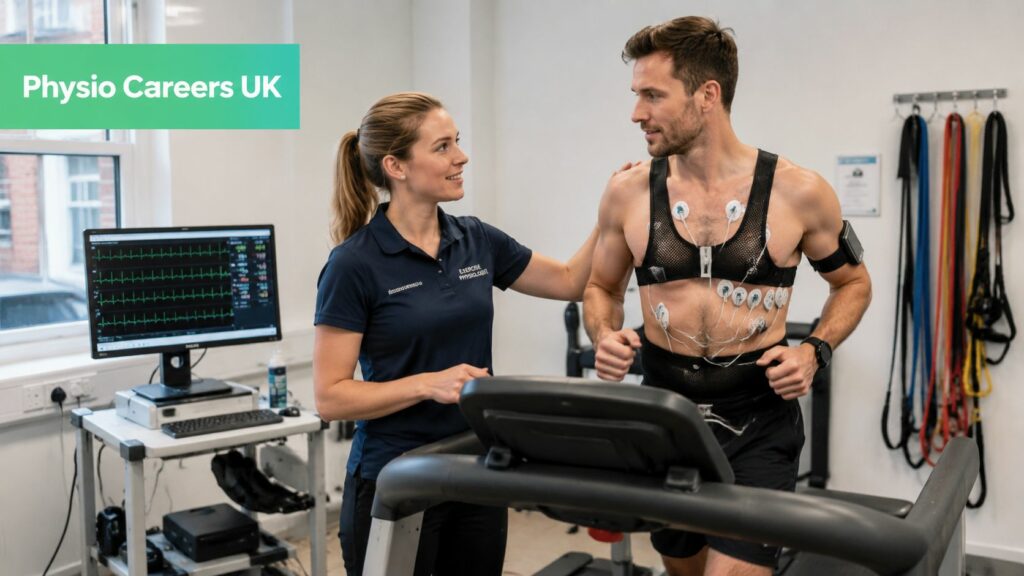
An exercise physiologist uses movement as a structured tool to improve health, recovery, and physical function. That sounds technical, but the day-to-day work is practical. You assess a person's current ability, identify risks or limitations, then build an exercise plan that is safe, progressive, and specific to their goals.
For one person, that could mean helping them regain confidence after a cardiac event. For another, it could mean designing activity plans that support diabetes management or long-term mobility. In sports settings, it may involve improving endurance, recovery, or training efficiency.
The work in real life
A typical role often includes:
Assessing physical capacity using health history, movement screening, and fitness testing
Designing exercise programmes for rehabilitation, prevention, or performance
Monitoring progress and adjusting plans when symptoms, motivation, or goals change
Working with other professionals such as physiotherapists, nurses, GPs, coaches, or occupational health teams
Explaining the why so clients or patients understand what they are doing and stick with it

Some people get confused about the difference between an exercise physiologist and a personal trainer. The overlap is that both use exercise. The difference is the level of clinical reasoning and the populations served. Exercise physiologist jobs often involve people with medical conditions, recovery needs, or more complex risk factors.
Practical rule: If the job asks you to connect exercise with health conditions, rehabilitation, or monitored risk, you're moving into exercise physiology territory rather than general fitness instruction.
Where they work
Exercise physiologist jobs can appear in several settings:
| Setting | What the work may involve |
|---|---|
| NHS and hospital services | Cardiac rehab, chronic condition support, recovery programmes |
| Private clinics | Health assessments, rehab support, specialist exercise delivery |
| Sports performance environments | Testing, conditioning support, return-to-performance work |
| Community health programmes | Physical activity support for local populations |
| Workplace wellbeing teams | Corporate wellness and prevention-focused programmes |
What attracts many adult learners is that the role combines science and people skills. You need to understand the body, but you also need patience, clear communication, and the ability to build trust. If you enjoy helping people turn advice into action, that's a strong sign this path could suit you.
Your Educational Pathway to Getting Qualified
You might be looking at exercise physiologist jobs and wondering whether there is only one narrow route in. For many UK adults, the path is more like joining a train line with several stations. The final destination is the same, but your starting point can differ depending on your qualifications, work history, and responsibilities outside study.
For many roles, employers expect a clear academic base. That usually means a BSc Hons in Exercise Science or a closely related subject, often with attention to whether the course aligns with the standards used by the British Association of Sport and Exercise Sciences (BASES).
The practical point is simple. If you want access to the widest range of exercise physiologist jobs, especially roles linked to healthcare, rehabilitation, and specialist assessment, a relevant degree is still the strongest foundation. It also gives you room to branch out later into areas such as workplace wellbeing, population health programmes, digital coaching platforms, and health tech services that need staff who understand exercise and risk.
The main route most learners follow
If you're starting from scratch, break the process into three stages.
Get the entry qualification
Start by checking the entry requirements for a university degree in sport and exercise science or a related subject. Universities may ask for A levels, an Access to Higher Education Diploma, or other accepted qualifications.
Choose your degree with care
Course titles can be misleading. One programme may focus heavily on sports performance, while another gives more attention to health, physiology, and applied practice. Read the module list closely. If your long-term goal includes clinical, community health, corporate wellness, or digital health roles, choose a course that builds strong scientific understanding and applied communication skills.
Work towards professional recognition
A degree is the base layer. Professional recognition can strengthen your credibility and help employers see that your training meets an accepted standard. Check the current guidance directly with BASES before you apply, so you understand what academic study and supervised experience may be needed for the route you want.

If you don't have the usual entry requirements
This is the point where many adult learners hesitate.
You may have left education years ago. You may have strong people skills from care, fitness, teaching, or office-based roles, but no science degree yet. You may also need a study option that fits around work, parenting, or both.
That does not shut the door.
An Access to Higher Education Diploma can act as a bridge into university study. For this career path, a route linked to sport, physical activity, or health can help rebuild your academic confidence and prepare you for degree-level work in anatomy, physiology, and research.
One option in this space is Stonebridge Associated Colleges. It offers subscription-based online learning across vocational and academic subjects, including Access to Higher Education Diplomas. Learners study online with tutor support and can pause or cancel their subscription without long-term credit agreements, which may suit adults balancing study with work and family commitments.
A flexible route isn't a lesser route. For many adults, it's the route that gets finished.
What to look for before you enrol
Choosing a course works a bit like checking a map before a long journey. The course title tells you the destination in broad terms. The details tell you whether the road will take you where you need to go.
Check these points before you commit:
Progression value
Make sure the qualification supports entry to higher education if your goal is a degree.Subject fit
Look for content that supports exercise science, health-related exercise, rehabilitation, or human physiology rather than general fitness alone. This Stonebridge option would be a great fit.Study format
Online learning can suit adults who need control over when and where they study.Support structure
Tutor access, clear milestones, and manageable modules often matter more than polished marketing copy.Long-term career range
Choose options that keep more doors open later, including NHS-related roles, private practice, corporate wellbeing, and digital health services.
A common mistake is choosing a short course and expecting it to carry the same weight as a degree pathway. In most cases, it will not. If your goal is to compete for exercise physiologist jobs, build the foundation first. It takes longer, but it gives you a broader platform for the newer parts of the field as well as the traditional ones.
Building Essential Experience and a Standout CV
Qualifications help you qualify. Experience helps you get shortlisted.
Employers want evidence that you can work with real people, follow professional boundaries, and apply your knowledge calmly. If you haven't had a formal exercise physiology role yet, don't panic. You can still build relevant experience in ways that count.
Where to gain useful experience
Start with settings that expose you to health-focused exercise delivery and professional teamwork.
Community health projects can show that you can support behaviour change and communicate clearly
Rehabilitation environments help you understand caution, progression, and record-keeping
Fitness and wellbeing roles can still be relevant if you worked with older adults or clients managing long-term conditions
Shadowing opportunities in clinics or sports performance settings can help you learn how professionals assess, explain, and document
The key is to notice what skills you're developing. Employers look beyond job titles.
Turn duties into evidence
A weak CV lists tasks. A strong CV shows judgement and contribution.
Before:
Assisted with exercise sessions
Worked with clients in a gym
Helped with admin
After:
Supported supervised exercise sessions for mixed-ability participants and adapted instructions to individual needs
Built client rapport and encouraged adherence through clear, simple coaching
Maintained accurate session notes and followed safeguarding and confidentiality procedures
Don't write your CV as a diary of what you did. Write it as proof that you can do the job safely and professionally.
A simple CV structure that works
Use sections that make your relevance obvious:
Profile with a short summary of your focus and strengths
Education with the most relevant qualifications first
Relevant experience including volunteering and placements
Skills such as assessment support, exercise delivery, communication, and documentation
CPD and memberships if applicable
If you've changed careers, don't hide it. Translate it. A former care worker may bring empathy and patient communication. A sports coach may bring instruction and motivation skills. A desk-based manager may bring organisation and professional reporting. The goal is to connect your past work to the demands of exercise physiologist jobs.
Where to Find Exercise Physiologist Jobs in the UK
You finish work, open a job board, and type “exercise physiologist.” A handful of clinical posts appear. It is easy to assume the UK market is narrow. In practice, the job search works more like using a map with several layers. Hospital and rehabilitation roles are one layer, but corporate wellbeing, occupational health, and digital health are layers many adult learners miss.

Clinical and healthcare roles
The most familiar route sits in healthcare and rehabilitation. These roles often focus on people who need structured exercise support because of illness, recovery, or long-term health conditions.
Look for vacancies across:
NHS services such as rehabilitation programmes and specialist clinics
Private healthcare providers offering supervised exercise support
Community health programmes linked to prevention, recovery, and condition management
Useful places to search include NHS Jobs and BASES careers and professional information.
The wider UK market beyond clinics
The wider opportunity is easy to miss because employers do not always use the title “exercise physiologist.” A workplace wellbeing company may advertise for a wellness specialist. A digital health provider may want someone who can interpret exercise data, coach remotely, and support behaviour change. An occupational health team may need someone who understands activity, function, and return-to-work support.
For UK-based adult learners, that matters. If your background is in fitness, sport, health promotion, care, teaching, or workplace wellbeing, you may already fit parts of these roles. The job title changes, but the core value stays similar: helping people use safe, structured physical activity to improve health, function, or performance.
You can explore market information for related health and wellbeing roles through the UK government job profiles service.
These non-clinical roles may include:
Corporate wellness delivery for employee health and wellbeing programmes
Occupational health support with a focus on activity, work capacity, and absence reduction
Sports tech and digital coaching where apps, wearables, and remote contact shape the service
Private wellbeing services aimed at prevention, adherence, and lifestyle support
How to search more effectively
A better search starts with employer language. If you only type one exact title, you can miss suitable roles that ask for the same skills under different labels.
Try combinations such as:
| Search term | Why it helps |
|---|---|
| Exercise physiologist | The direct match |
| Clinical exercise specialist | Common in health-focused settings |
| Rehabilitation exercise instructor | Useful for entry-level searches |
| Cardiac rehab exercise | Narrows towards clinical rehabilitation |
| Corporate wellness specialist | Opens non-clinical roles |
Read the person specification as closely as the title.
That is often where the main clue sits. A broad title may include exercise testing support, behaviour change coaching, health screening, or physical activity delivery. Those duties may suit you well even if the headline wording looks unfamiliar. In the same way, a perfect-sounding title can turn out to be aimed at another profession entirely.
One practical approach is to split your search into three buckets each week: clinical, community, and commercial or digital. That keeps you from putting all your effort into one corner of the market and helps you spot patterns in what employers ask for.
Nailing the Interview and Building Your Portfolio
Interviews for exercise physiologist jobs aren't just tests of memory. They are checks on judgement. Employers want to know whether you can communicate clearly, stay within your competence, and respond calmly when a session doesn't go to plan.
That means preparation beats winging it.
Questions you may face
You might be asked technical questions, but you'll also get scenario-based prompts.
For example:
How would you adapt an exercise session for a participant who becomes anxious midway through
How would you explain exercise intensity to someone with no fitness background
What would you do if a client wanted to push beyond the plan you considered safe
A good answer has three parts. State what you would do, explain why, then show awareness of safety and communication.
What to bring in a portfolio
A portfolio makes your experience visible. It doesn't need fancy design. It needs order and relevance.
Include:
Qualifications and certificates in a neat, easy-to-skim format
Anonymised case examples that show planning, adaptation, and reflection
CPD records with short notes on what you learned
Placement or volunteer evidence such as role summaries or supervisor feedback
A customised CV that matches the specific vacancy
If you say you're reflective, organised, and committed to learning, your portfolio should prove it within the first few pages.
A stronger way to answer
Instead of saying you work well under pressure, show it.
Try this pattern:
Briefly describe the situation
Explain your decision
Show the outcome or learning point
That structure helps you sound professional without sounding rehearsed. It also makes it easier for the panel to picture you in the job.
Your Career Path Salary Progression and Future Trends
A lot of adult learners assume this career has a single ladder. Start in a clinic, gain experience, become senior, then maybe move into management. In practice, exercise physiology works more like a rail network. You can begin in one place and change lines as your interests, qualifications, and life circumstances change.

Early career and progression
Earlier, we covered entry-level salaries for UK roles linked to the qualification route many employers look for. After that first stage, progression often depends less on job title alone and more on the kind of problems you can solve.
One person may build depth in cardiac or respiratory rehabilitation. Another may move into community programmes, workplace wellbeing, or long-term condition support. Someone else may combine exercise delivery with education, service coordination, or digital coaching.
That variety matters.
It means your career path can reflect your strengths. If you enjoy structured clinical work, specialist rehabilitation may suit you. If you prefer prevention, behaviour change, and wider public health impact, corporate wellness, community health, and digital services may offer better long-term fit.
Common progression factors include:
Specialist knowledge in an area such as rehabilitation, chronic disease management, or behaviour change
Credibility built through steady experience, reflective practice, and continuing professional development
Transferable skills such as clear communication, record-keeping, teamwork, and confidence with data
The shift towards digital and hybrid roles
The job market is widening beyond the traditional clinic model. UK cardiac rehabilitation services have expanded digital delivery in recent years, including home-based support and remote review options, as reported by the British Heart Foundation National Audit of Cardiac Rehabilitation. Growth in digital health across the NHS and private providers also points to more hybrid roles that mix exercise support, education, and remote monitoring. The NHS Long Term Plan sets out that broader shift towards digitally enabled care.
For you, that changes the skill mix employers may value. A future role may involve video consultations, reviewing wearable data, writing exercise plans people can follow at home, or supporting employees through a corporate wellbeing programme. In some posts, you may spend part of the week in person and part online.
For UK-based adult learners, this is good news. It opens doors for people coming from fitness, health coaching, teaching, care work, armed forces rehabilitation, or community health roles, especially if they can show safe practice and strong communication. It also creates more options outside large hospital settings, including private rehab providers, insurers, workplace wellbeing companies, app-based coaching services, and digital health startups.
What this means for you
Try to plan your career in layers. First, get qualified for the roles you can apply for now. Next, build the skills that make your second role possible. Then look ahead to the setting you may want in three to five years.
A strong long-term route into exercise physiologist jobs often includes:
Relevant academic study that matches UK employer expectations
Practical work with real people in health, fitness, rehabilitation, or wellbeing settings
Clear evidence of development through CPD, reflection, and updated skills
Confidence with digital tools used in remote support and hybrid care
This field suits people who like applied science and want their work to improve daily life in a visible way. If you are changing careers or returning to study, start with the qualification route that fits your current reality, then add experience in the setting that interests you most. A steady, well-chosen path usually works better than trying to do everything at once.
If you need a flexible way to begin, Stonebridge Associated Colleges offers subscription-based online study across career-focused subjects, including Access to Higher Education pathways that can fit around work and family life. You can study online with tutor support and pause or cancel your subscription on your chosen course at any time, which can make the first step feel more manageable.