If you're fitting study around school runs, shifts, or another job, a teaching assistant course from home can feel like the first realistic step into classroom work. You want something you can finish without commuting, without guesswork, and without pretending life has paused for a qualification. That's exactly why so many adult learners look at flexible online study first.
The appeal is simple. Teaching assistant work is a substantial part of the school workforce in England. Department for Education data show 288,812 full-time-equivalent teaching assistants in 2024/25, which is about 67,300 more than in 2011/12 (Department for Education workforce statistics). That doesn't make the job easy, but it does show that this is a real employment area, not a side route with little demand. For many learners, the question isn't whether the role exists, it's how to prepare for it in a way that fits adult life.
Stonebridge's approach is built around that reality. 100% online study, a modular structure, and the option to pause or cancel a subscription can make the course feel more manageable when your week changes at short notice. The monthly model also helps you keep the decision practical rather than overwhelming. If you're wondering whether you can study from home and still aim for a school role, the answer is yes, as long as you're clear about what online learning can do and what still needs school-based evidence.
Why more adults are studying a teaching assistant course from home
A parent finishes the school run, gets twenty quiet minutes with a laptop, and finally opens the course page they've bookmarked three times already. Another learner is coming off a late shift and can only study after 8 p.m. That's the sort of life that pushes people towards a teaching assistant course from home rather than a timetable tied to a campus.
Flexible study fits adult routines
Stonebridge's 100% online delivery works well for people who can't commit to fixed travel and class times. The modular format also helps, because you can work through manageable sections instead of facing everything at once. If life gets busy, the subscription can be paused, which keeps the course more aligned with real family and work pressures.
Practical rule: if a course can only work when your calendar is perfect, it probably won't work for long.
That flexibility matters because teaching assistant work isn't a niche role. Government workforce data show a large and sustained employment area, and the role is concentrated in settings where classroom support skills are needed every day, especially nursery, primary, secondary, special schools, and pupil referral units (Department for Education workforce statistics).
For adult learners, that creates a sensible route into school support without forcing a career break. You can study, keep earning, and build towards a qualification at the same time. Stonebridge's subscription model sits neatly inside that pattern, because it lets you move at a pace that feels human, not heroic.
The Stonebridge Level 3 Diploma in Supporting Teaching and Learning
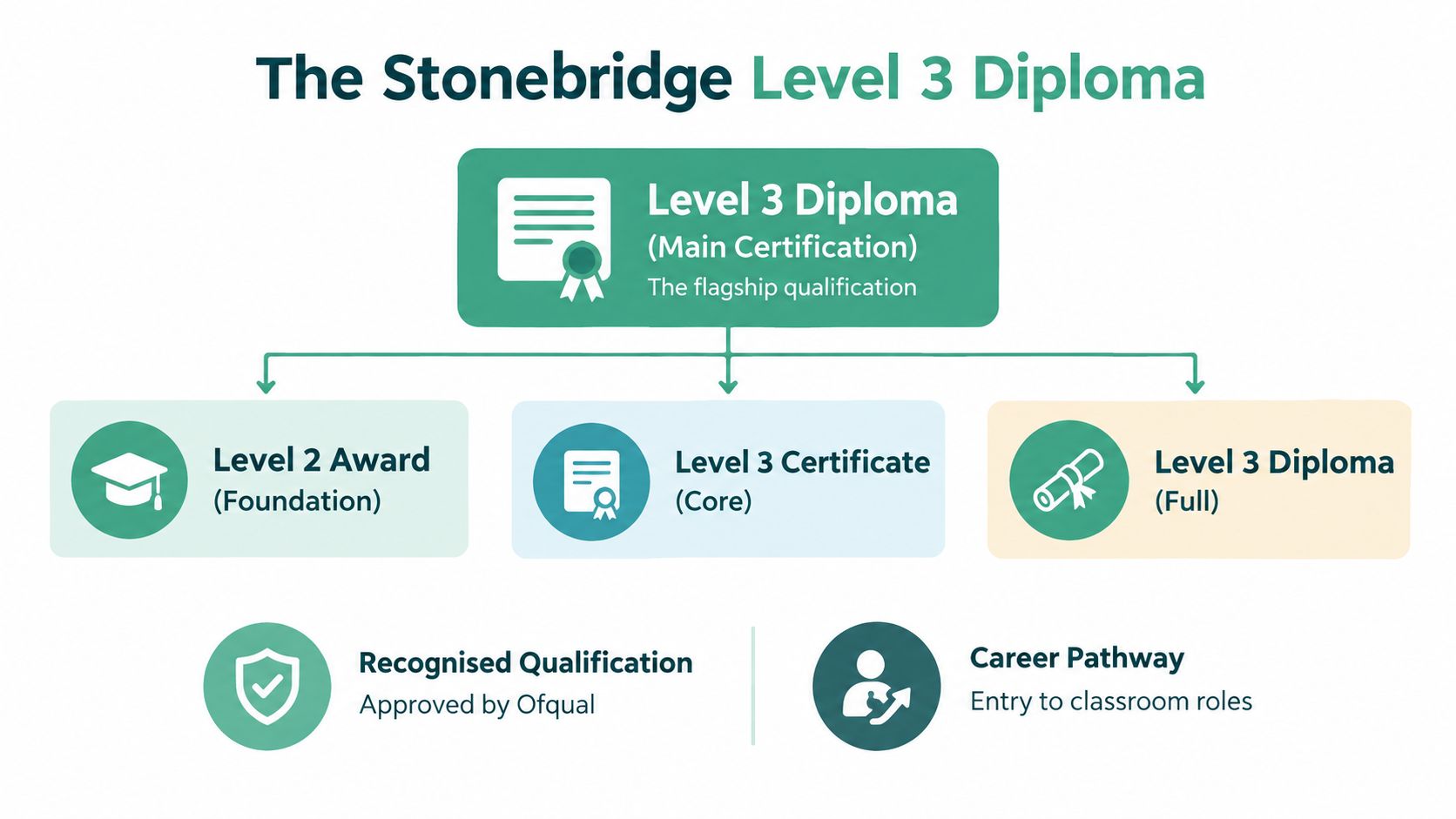
Stonebridge's Level 3 Diploma in Supporting Teaching and Learning (RQF) is the main route for learners who want a serious, work-focused teaching assistant course from home. As part of the course, learners also complete a placement, which helps connect online study to real classroom practice. The RQF label matters because it places the course within a recognised qualifications framework, which helps learners understand where the diploma sits in relation to other study options.
What you actually study
The course content is designed around the everyday work of a Teaching Assistant. That means learning about child development, communication, safeguarding, equality and inclusion, and supporting learning activities. Those aren't abstract topics. They're the kinds of decisions a Teaching Assistant makes when helping a pupil settle, explaining instructions, or supporting a small group during a lesson.
Stonebridge's subscription model keeps the cost predictable. You pay a single monthly fee, there's no long-term credit agreement, and you can pause or cancel if your circumstances change. For many adults, that's the difference between starting now and keeping the idea on hold for another year.
The other practical advantage is that online study removes travel and fixed classroom timetables. You can work through your units at home, while still getting access to qualified tutors. If you want one option that ties study to school support roles, this is the clearest place to begin.
The diploma also links naturally to next steps. Some learners move into classroom support roles straight after completion, while others use it as a base for more specialist support or further study later on.
Entry requirements and the digital access checklist
Most adults don't need a complicated admissions process before starting a teaching assistant course from home, but they do need a realistic starting point. Age, English and maths confidence, and digital access all play a part. Schools also tend to want clear evidence that a learner understands safeguarding and can work safely with children, which is where a DBS check becomes relevant once school-based work begins.
What to have ready before you enrol
Many learners begin at 18 or 19 plus, and schools often look for English and maths at GCSE or Functional Skills level. If you don't already have those, Stonebridge offers Functional Skills English and Maths Level 2 combined, so you can build the foundation first if needed. That keeps the route into teaching assistant training more practical.
A basic home-study setup helps a lot too. UK survey data show that most adults use the internet, but not everyone feels fully confident with digital tasks, so it's sensible to check your setup in advance (DSIT Public Engagement Survey 2025/2026). A simple checklist is enough:
-
Computer or tablet: a device you can rely on for reading, writing, and submitting work.
-
Internet connection: steady broadband for lessons, uploads, and tutor contact.
-
Quiet study space: somewhere you can concentrate without constant interruptions.
-
Document access: a way to store and send files neatly.
-
Confidence with video calls: useful for support, feedback, or online discussion.
If digital tasks make you hesitate, the learndirect Community Hub app can help you settle in before you even start formal study. It gives learners and alumni of the learndirect Digital Group a place to ask questions and connect with others who've been there too.
A realistic home study schedule you can keep
The best home study plans are boring in the right way. They're steady, repeatable, and easy to return to after a difficult week. A teaching assistant course from home works best when you stop trying to cram and start building a rhythm you can keep.
A simple weekly pattern
A sensible routine might be three to five short study blocks a week. One block can be for reading. Another can be for a short written task. A third can be used for reflection or portfolio notes. That's enough to keep moving without making every evening feel like an exam.
Useful habit: treat tutor feedback as part of study, not an extra.
A typical module can flow like this. First, you review the theory. Then you adapt a learning resource or think through a classroom situation. After that, you produce evidence such as a lesson-support plan or an inclusion reflection. Finally, you send it to your tutor, revise it if needed, and record what improved.
Keeping a small weekly slot for tutor communication makes a big difference. It stops small misunderstandings from turning into bigger problems later. It also means your portfolio grows piece by piece, so by the end of the course you've built a body of work you can talk about in an interview.
Home study succeeds when it feels sustainable. If your routine depends on motivation alone, it'll wobble. If it depends on a regular pattern, it usually holds.
Assessments, tutor support and the Community Hub app
Assessment on a Stonebridge teaching assistant course from home is designed to be practical rather than dramatic. You're working through portfolio-based tasks, short written responses, and reflective evaluations, with tutor feedback guiding each stage. That's a much better fit for school support training than one high-pressure test at the end.
How feedback helps you improve
Tutors mark work against clear criteria, which means you know what needs to change and why. If a piece needs resubmission, that's part of the process, not a punishment. For adult learners, that can be reassuring, because it turns assessment into a conversation about progress rather than a one-shot judgement.
The support doesn't stop at marking. Personalised feedback on written work and portfolio pieces helps you sharpen your understanding of the role and spot the gaps in your evidence before they become a problem.
There's also a social side to remote learning that's easy to overlook. The learndirect Community Hub app is available for learners and alumni of the learndirect Digital Group only, and it gives people a space to talk, ask questions, and share experiences in topic-specific communities. That can be a real help when you're studying from home and don't want to feel cut off from everyone else.
Home study is still study. It's just study with more control over where and when you do it.
Moving from course to classroom and beyond
A certificate is useful, but it isn't the whole story. Employers usually want to see that you can show up reliably, work under supervision, and bring school-based evidence into your applications. That's why the move from course to classroom needs a plan.

Turning study into experience
Some parts of a teaching assistant course can be completed remotely, especially the knowledge-based work. Other parts are stronger when they're backed by supervised experience in a school or similar setting. That might come through volunteering, a lunch-time supervisor role, a cover role, or support in a family member's school.
The point is to move from learning about the role to showing that you can do the role. Schools often ask about references, DBS status, and recent experience with children, so it helps to think beyond the certificate itself.
If you want progression later, the diploma can sit beside wider education goals too. Some learners move into SEND support, others aim for more senior classroom support, and some use the qualification as a step towards an Access to Higher Education Diploma (Education Professions) and further study. Stonebridge also offers that route, which can be useful if you want to keep your options open.
The honest answer is that online study gets you ready, but it doesn't replace classroom evidence. That's why the strongest applications combine both.
Your next step with Stonebridge
A teaching assistant course from home works best when it gives you structure without trapping you in it. Stonebridge's Level 3 Diploma in Supporting Teaching and Learning is built for that kind of learner, with 100% online study, a modular structure, personal tutor support, and the option to pause or cancel your subscription if life changes. It's a practical route for adults who want to build towards school work without stepping away from everything else.
Stonebridge Associated Colleges is accredited by the UK Register of Learning Providers and regulated by the Financial Conduct Authority, which gives monthly learners extra reassurance about the way the course is delivered and managed (Stonebridge Associated Colleges). If you're comparing routes, it's also worth looking at related qualifications such as the Access to Higher Education Diploma (Education Professions), especially if you think you may want to progress further later on.
If you're ready to study from home and build towards a real school support role, take a look at Stonebridge's teaching assistant course, see how the monthly subscription fits your life, and choose the path that feels sustainable. When you're ready, visit Stonebridge Associated Colleges and start planning your next step into education.