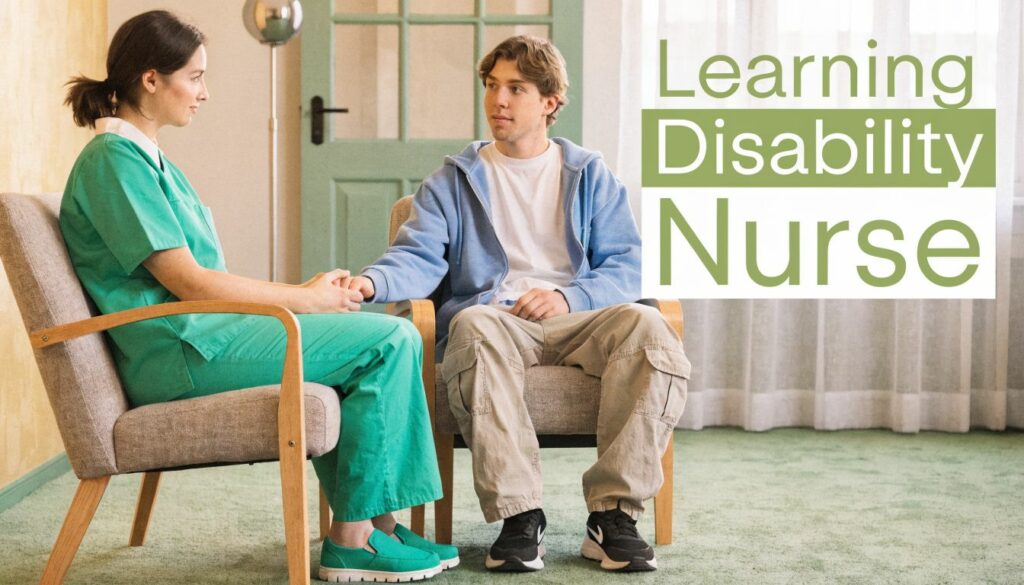
A mother brings their adult son to a clinic because they haven't been sleeping, is refusing food, and can’t explain what feels wrong. A learning disability nurse slows the whole moment down, notices the signs others might miss, and helps the family turn distress into understanding.
The Heart of the Role: More Than Just a Carer
If you’re asking what does a learning disability nurse do, the shortest answer is this. They help people with learning disabilities get fair, safe, person-centred healthcare.
That sounds simple. It isn’t.
A learning disability nurse is not only there to “look after” someone. They assess health needs, spot problems early, explain care in a way the person can understand, and make sure other professionals adapt their approach too. In practice, that means combining clinical nursing skills with advocacy, communication, teaching, and long-term relationship building.
One fact shows why this role matters greatly. The 2018 Learning Disability Mortality Review found that men with learning disabilities die on average 23 years younger and women 27 years younger than the general population, as outlined by the Learning Disability Mortality Review summary discussed here. That is why this role is not a niche extra, it is part of tackling preventable inequality.

What sits at the centre of the job
A learning disability nurse often becomes the person who asks, “Has anyone explained this clearly?” and “Has anyone checked whether this care plan works for this individual?”
Their role usually includes:
Health assessment: checking physical and mental health, noticing changes, and helping identify unmet needs.
Communication support: using easier language, pictures, symbols, signs, or easy-read materials.
Advocacy: speaking up when a person’s needs are being overlooked.
Education: helping people understand medication, hygiene, diet, activity, appointments, and condition management.
Care coordination: working with families, GPs, therapists, social care staff, and hospital teams.
Practical rule: A good learning disability nurse doesn’t ask only “What treatment is needed?” They also ask “How will this person understand it, tolerate it, and take part in it?”
How this differs from other caring roles
People often confuse nursing with support work. Both matter, but they aren’t the same.
A support worker may help with daily living. A learning disability nurse does that broader human work too, but through a clinical lens. They assess risk, monitor health, manage medicines, contribute to diagnosis and treatment planning, and make reasonable adjustments so healthcare is fully accessible.
Another difference is lifespan care. Learning disability nurses may support children, adults, and older people. They can be involved in community living, hospital admissions, behavioural support, long-term conditions, maternity, and end-of-life care.
That breadth is what draws many people in. It’s nursing that asks you to treat the whole person, not just the symptom.
A Day in the Life of a Learning Disability Nurse
No two days are identical. That’s one reason many nurses love this field.
A community-based learning disability nurse might start the morning with a home visit. The person they’re seeing has become withdrawn, and their family isn’t sure whether the cause is pain, anxiety, medication side effects, or a recent change in routine. The nurse observes carefully, asks simple questions, notices body language, checks health history, and helps the family record patterns that can be shared with the wider team.

Morning work that prevents bigger problems
A lot of the role is preventive. That means spotting concerns before they become crises.
One important task is the annual health check. By helping people attend and take part in these checks, learning disability nurses can support detection rates for unmet health needs up to 50% higher than standard GP consultations, and NHS data cited here notes that 82% of deaths of people with learning disabilities are linked to treatable conditions that nurse-led annual health checks can identify in this discussion of the role.
That can sound abstract, so let’s make it concrete. During a health check, a nurse may help identify constipation, pain, untreated epilepsy concerns, poor nutrition, medication issues, mental health changes, or symptoms the person hasn’t been able to describe clearly.
Midday means teamwork
By lunchtime, the nurse may be in a multidisciplinary meeting. This often includes a GP, psychologist, speech and language therapist, occupational therapist, support staff, and family members.
The nurse’s contribution is often practical and specific:
Explaining patterns: what happens before distress, during it, and after it.
Clarifying communication needs: what words, visuals, or routines help the person understand.
Updating the care plan: what’s working, what isn’t, and what needs changing.
Planning reasonable adjustments: longer appointments, quieter waiting areas, familiar carers, hospital passports, or easy-read instructions.
Sometimes the most important clinical skill is helping everyone else slow down enough to see the person clearly.
Later in the day, the nurse might support a child in school, help a young adult prepare for a hospital appointment, or speak with residential staff about safe medication routines and health monitoring.
The work is community-focused
Many prospective students assume nursing happens mainly on wards. Learning disability nursing often happens wherever life is being lived.
A nurse may spend one part of the day in someone’s home, another in a clinic, and another on the phone coordinating services. They might help create a hospital passport so emergency staff know how the person communicates, what triggers distress, and what support helps them feel safe.
That’s why the role feels dynamic. You’re not only responding to illness. You’re helping build the conditions for health, dignity, and independence.
The Specialist Toolkit, Skills, and Understanding Required
Learning disability nursing is highly skilled work. Compassion matters, but compassion on its own isn’t enough.
Nurses in this field need a specialist toolkit. They must understand physical health, mental health, behaviour, communication, law, consent, risk, family dynamics, and how systems work. They also need to know how to turn that knowledge into practical support that makes sense for one individual person.
Positive Behaviour Support in real life
One of the best-known specialist approaches is Positive Behaviour Support, often shortened to PBS. This is not about controlling people. It’s about understanding why behaviour happens and changing support around the person so life becomes safer and calmer.
According to this overview of learning disability nursing practice, learning disability nurses use evidence-based PBS interventions that can reduce challenging behaviours by up to 70% in community settings. The same source explains that this work involves a detailed functional assessment to understand triggers and build person-centred support plans.

A nurse using PBS might ask:
What happened just before the distress?
What is the person trying to communicate?
Is there pain, fear, overload, confusion, or frustration underneath it?
What skill, adjustment, or support could reduce the need for that behaviour?
Communication is a clinical skill
In this field, communication is never an afterthought. It is part of treatment.
Some people use speech. Others may rely on gestures, signs, symbols, objects of reference, pictures, or familiar routines. A learning disability nurse may use easy-read documents, visual prompts, or tools such as Makaton-based communication supports where appropriate. The goal is always the same. Help the person understand what is happening and express what matters to them.
Here’s where students sometimes get confused. They think “good communication” means being warm and friendly. It does include that, but it also means adapting your method with precision.
What matters most: If a person can’t access the information, then consent, choice, and safe care are all affected.
Legal and ethical understanding
A learning disability nurse also has to understand rights. They need to think about reasonable adjustments, capacity, consent, safeguarding, and dignity.
That means noticing when the standard way of doing something excludes the person. A rushed appointment, complex written instructions, a noisy waiting room, or staff who don’t know the person’s communication style can all become barriers to care.
So the specialist toolkit is both technical and human. You need assessment skills, structured approaches, and sound judgement. You also need curiosity, patience, and the discipline to individualise everything.
The Human Element: What Kind of Person Thrives as an LDN?
This career suits people who care profoundly, but it especially suits people who care profoundly and think clearly under pressure.
In the UK, learning disability nurses make up just 2.4% of the nursing workforce, which reflects how specialised the role is, as noted in this peer-reviewed discussion of the profession. It’s a field for people who are comfortable working closely with complexity.
Traits that matter in everyday practice
You don’t need to arrive as a finished professional. Training builds a lot. Still, some qualities make the path a natural fit.
Patience: progress can be slow, and communication may take time.
Observation: small changes in appetite, sleep, mood, movement, or behaviour can mean something important.
Creativity: sometimes a picture card, a quiet room, or a different phrase enables understanding.
Resilience: you may need to repeat the same advocacy point more than once before people listen.
Respect: people with learning disabilities are not problems to solve. They are individuals with preferences, rights, humour, relationships, and goals.
Short scenarios that show the difference
A person becomes distressed every time blood pressure is checked. A nurse who thrives in this role doesn’t just label the person “non-compliant”. They ask what part feels threatening, try visual preparation, break the task into steps, and build familiarity over time.
A hospital team talks over a patient and directs all questions to a relative. The learning disability nurse gently redirects the conversation back to the patient, adapts the language, and protects that person’s voice.
A support plan looks fine on paper but keeps failing in real life. The nurse notices that the language is too complex for staff and too abstract for the person. They simplify it and make it usable.
People who do well in this field usually have a strong sense of fairness. They notice exclusion quickly, and they don’t shrug it off.
You may be drawn to this path if
The role often appeals to prospective students who recognise themselves in one or more of these statements:
| You might fit this role if you… | Why that matters |
|---|---|
| Stay calm when communication is difficult | The person may need time, repetition, and adaptation |
| Notice the details others miss | Subtle changes can point to pain, anxiety, or unmet need |
| Value dignity as much as treatment | Good care is not only clinical. It is relational |
| Like problem-solving with others | The work depends on teamwork across services |
This is a vocation for empathetic problem-solvers. If that phrase feels familiar, it’s worth paying attention to it.
Navigating Challenges and Celebrating Wins
A learning disability nurse might spend weeks helping someone prepare for a hospital test that lasts ten minutes. On paper, that can look slow. In real life, it is often the difference between a failed appointment and care that finally happens safely, with dignity.
That is one of the hardest parts of the role to understand from the outside. The work is not demanding only because people have complex needs. It is demanding because the nurse is often working against barriers built into the system itself.
A waiting room may be noisy and overwhelming. A letter may be written in language the person cannot easily use. A rushed clinic may miss the signs that someone is frightened, in pain, or does not understand what is being asked. The learning disability nurse works through those obstacles one by one, rather like clearing a path so the person can reach the care everyone says is available.
Why the work can feel demanding
This role asks for emotional steadiness, patience, and good judgement.
You may support a family that is running on very little sleep. You may need to explain, again, why a reasonable adjustment is not a favour but part of safe care. You may worry about a person whose illness is being missed because their distress looks different from what other professionals expect.
Some days, progress is slow.
That is why support from colleagues matters so much. Reflective practice helps too. It gives nurses space to make sense of difficult situations, learn from them, and protect their own wellbeing so they can keep offering calm, thoughtful care.
New tools can help, but they do not replace trust
Digital tools are becoming part of this work, but their value is practical rather than flashy. Accessible reminders, shared digital care plans, communication apps, and remote check-ins can help people prepare for appointments, reduce repetition, and keep everyone working from the same information.
Used well, technology acts like a good handover. It carries clear information forward so the person does not have to start from the beginning every time.
The relationship still comes first. A screen cannot notice hesitation in the same way a skilled nurse can. It cannot build trust through tone of voice, timing, or knowing when to pause. The nurse uses technology as support, not as a substitute for human understanding.
The point of digital support is better continuity, clearer communication, and fewer missed warning signs.
The wins are often quiet, but they are deeply felt
Success in learning disability nursing is not always dramatic. Often, it looks small to everyone except the person living it.
Someone attends an appointment without panic because preparation was done properly. A health problem is identified after months of being misunderstood. A parent stops blaming themselves because they finally understand what their son or daughter has been trying to communicate. A patient is able to make an informed choice because somebody took the time to explain the options in a way that made sense to them.
These moments stay with nurses because they reveal the core purpose of the role. You are not only helping with treatment. You are helping restore voice, safety, and a sense of control.
That is why this career suits empathetic problem-solvers so well. The people who thrive in it can tolerate frustration, stay curious under pressure, and keep sight of the person behind the paperwork. The challenges are real. So is the satisfaction of knowing your persistence changed something that mattered.
Your First Step Towards a Career in Learning Disability Nursing
A lot of future nurses reach this point with a simple but weighty question. I care about this work, so how do I get there?
For many adult learners, the first step is not choosing a uniform or a job title. It is building the academic base that will carry you into nurse training with confidence. In the UK, learning disability nurses qualify through an approved nursing degree. If you do not already have the usual entry qualifications, an Access to Higher Education Diploma in Nursing can offer a practical route in.

What this kind of course helps you build
Good preparation does more than help you meet an entry requirement. It starts shaping the way you think like a nurse.
An access course often works like a training ground before the main event. You begin to build the subject knowledge, study discipline, and confidence that degree-level nursing expects. That usually includes areas such as:
Biology and health science: helping you understand the body, illness, and treatment in a clearer way.
Psychology and human development: useful for understanding behaviour, communication, and emotional needs.
Academic writing and research skills: preparing you to read evidence, write assignments, and support your decisions properly.
Health and social care awareness: giving you a better grasp of person-centred care and how different services work together.
Stonebridge Associated Colleges is one provider offering online access courses, including nursing pathways for adult learners preparing for higher education.
Why this step matters
Starting with a foundation course is not a lesser beginning. It is careful preparation for a role that asks a great deal of your mind and your character.
Prospective students often worry that starting later means they are behind. In reality, many strong nurses begin after time in work, parenting, caring, or other life experience. Those experiences can deepen your patience, judgement, and understanding of people.
That matters in learning disability nursing. The role suits people who want to solve problems with compassion, notice what others miss, and keep asking, "What does this person need from me to feel safe, heard, and understood?" Preparing well is part of answering that question honestly.
Build the foundation first. The rest of the journey becomes much easier to carry.
Flexible Learning with Stonebridge Associated Colleges
Adult learners often need more than a course title. They need a way of studying that fits around work, parenting, shifts, or other responsibilities.
Stonebridge offers subscription-based online study across a wide range of vocational and academic subjects, including Access to Higher Education Diplomas, health and social care, nursing and midwifery, business management, education, and veterinary science. Learners study 100% online, receive personalised support from qualified tutors, and can pause or cancel their subscription at any time without long-term credit agreements.
Why flexibility matters for future nurses
If you’re changing career or returning to study after a gap, flexibility isn’t a luxury. It’s what makes study possible.
A model like this can help if you need to:
Study around employment: fit learning into evenings, weekends, or changing shifts.
Balance family life: work through modules without commuting to a campus.
Manage financial risk carefully: avoid being locked into rigid long-term arrangements.
Build confidence gradually: return to academic study in a more controlled way.
What support looks like
At Stonebridge, our courses are crafted with a modular structure and offer an affordable monthly fee, simplifying planning for learners who require a flexible approach. We are accredited by the UK Register of Learning Providers and regulated by the Financial Conduct Authority, with a commitment to recognised online learning and financial transparency.
For someone aiming at a caring profession, that kind of structure can remove a major barrier. It gives you room to prepare seriously without putting the rest of your life on hold.
If learning disability nursing feels like the right path, the important thing is to choose a starting point that matches both your ambition and your circumstances.
If you're considering a flexible entry into higher education, Stonebridge Associated Colleges provides online study options, including the Access to Higher Education Diploma (Nursing). This diploma is designed to develop the essential knowledge and confidence required for a career in nursing.