
You're taking handover at the start of placement when a patient's condition changes, two care tasks are due and the team is unsure who should act first. You don't need a management title to help bring order to the situation. You do need to communicate clearly, recognise your role and ask for support when a decision is beyond your competence.
This guide is for Access to Nursing learners and anyone preparing for nursing study or practice. It explains leadership management and team working in nursing as practical, accountable skills linked to safe care, not personality traits. The examples focus on UK NMC expectations, while the communication principles can help readers working towards healthcare roles around the world.
What leadership looks like at the bedside
A newly registered nurse arrives on a busy ward, receives handover and realises that no one has clearly coordinated the team. A patient needs reviewing, planned care is due and colleagues are waiting for direction. Leadership begins with the choices that help the team respond safely: clarifying priorities, agreeing who can do each task and raising concerns promptly.
Leadership means influencing and supporting the team's decisions and actions. Management means organising care, people and responsibilities so the work can be done safely. Team working is how colleagues share information and coordinate their contributions towards a patient's care. In practice, these overlap. A Staff Nurse may coordinate a shift without being a Ward Manager or Charge Nurse.
The Nursing and Midwifery Council (NMC) makes leadership and teamwork a professional expectation from registration. These skills aren't reserved for senior nurses. They're part of everyday clinical practice, alongside knowing your limits, treating people with respect and keeping patients' needs in view.
| Skill | Everyday example | Why it matters for patients |
|---|---|---|
| Leadership | Raising a concern and helping the team agree what needs attention first | A developing risk is more likely to be recognised and acted on |
| Management | Organising tasks according to urgency and staff competence | Care is coordinated rather than left to chance |
| Team working | Sharing a clear handover and checking colleagues understand responsibilities | Important information is less likely to be missed |
You can develop these skills through learning, feedback and reflection. They're observable in what you do and say, which makes them skills to practise and assess, not qualities you either have or lack.
The standards that shape nursing leadership
The NMC Standards of Proficiency for Registered Nurses, agreed by the Council on 28 March 2018, identify “leading and managing nursing care and working in teams” as one of seven core platforms for newly registered nurses (NMC standards of proficiency). This places leadership within clinical practice, not outside it as an optional extra for people in senior posts.
In plain English, the standards expect registered nurses to manage care for a group of people, act as role models for good practice and take responsibility for how care is delegated and supervised. Nurses must also work autonomously, as equal partners with other professionals, and proactively within interdisciplinary teams.
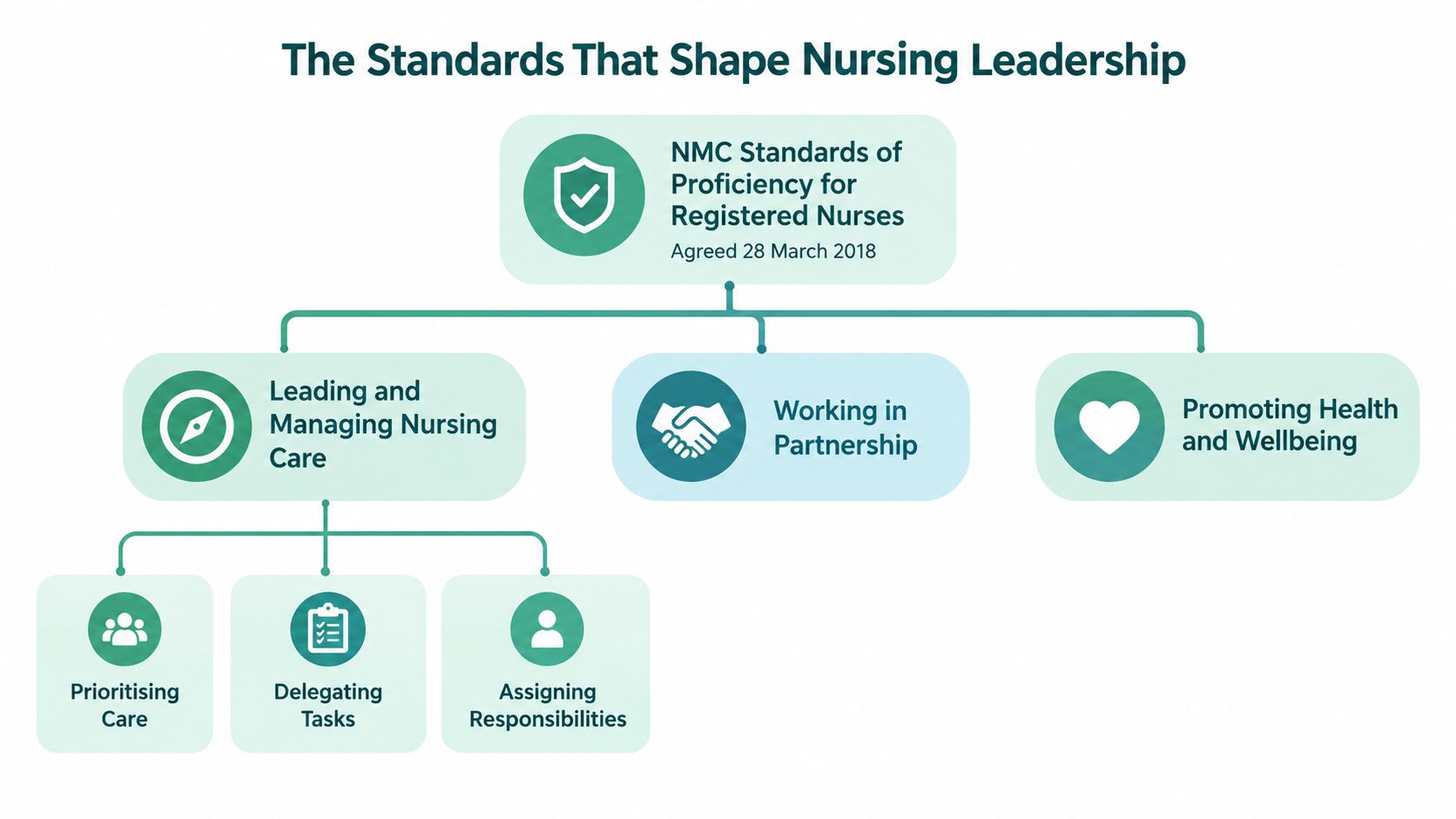
The framework becomes practical through actions you can observe: prioritising care, assigning responsibilities, supporting colleagues, communicating with the wider team and monitoring the quality of care others provide. Assessors and practice supervisors can use these behaviours to discuss how a learner or nurse makes decisions, not just whether they sound confident.
The NMC's Professionals Survey shows why good relationships between colleagues aren't enough on their own. Around 80% of respondents agreed they had positive relationships with immediate colleagues and 69% felt part of a supportive team. Yet 39% agreed that health and care leaders were readily available, while 36% felt supported by non-health-and-care management (NMC Professionals Survey). These findings point to a practical leadership need: teams benefit from accessible support as well as positive peer relationships.
Prioritising, delegating and assigning care
When the workload feels like one long list, separate three decisions. Prioritising means deciding what needs attention first, based on urgency and risk. Delegating means asking a suitable colleague to carry out a task while the registered nurse remains accountable for the decision to delegate. Assigning means giving named team members specific responsibilities.
Consider a community nursing team with seven visits planned, including two patients whose needs may be high acuity. The nurse coordinating the work should first clarify which visits involve time-critical care and what information might change the order. Then they can match each task to a colleague's competence, confidence and scope of practice, rather than spreading the work evenly without considering risk.
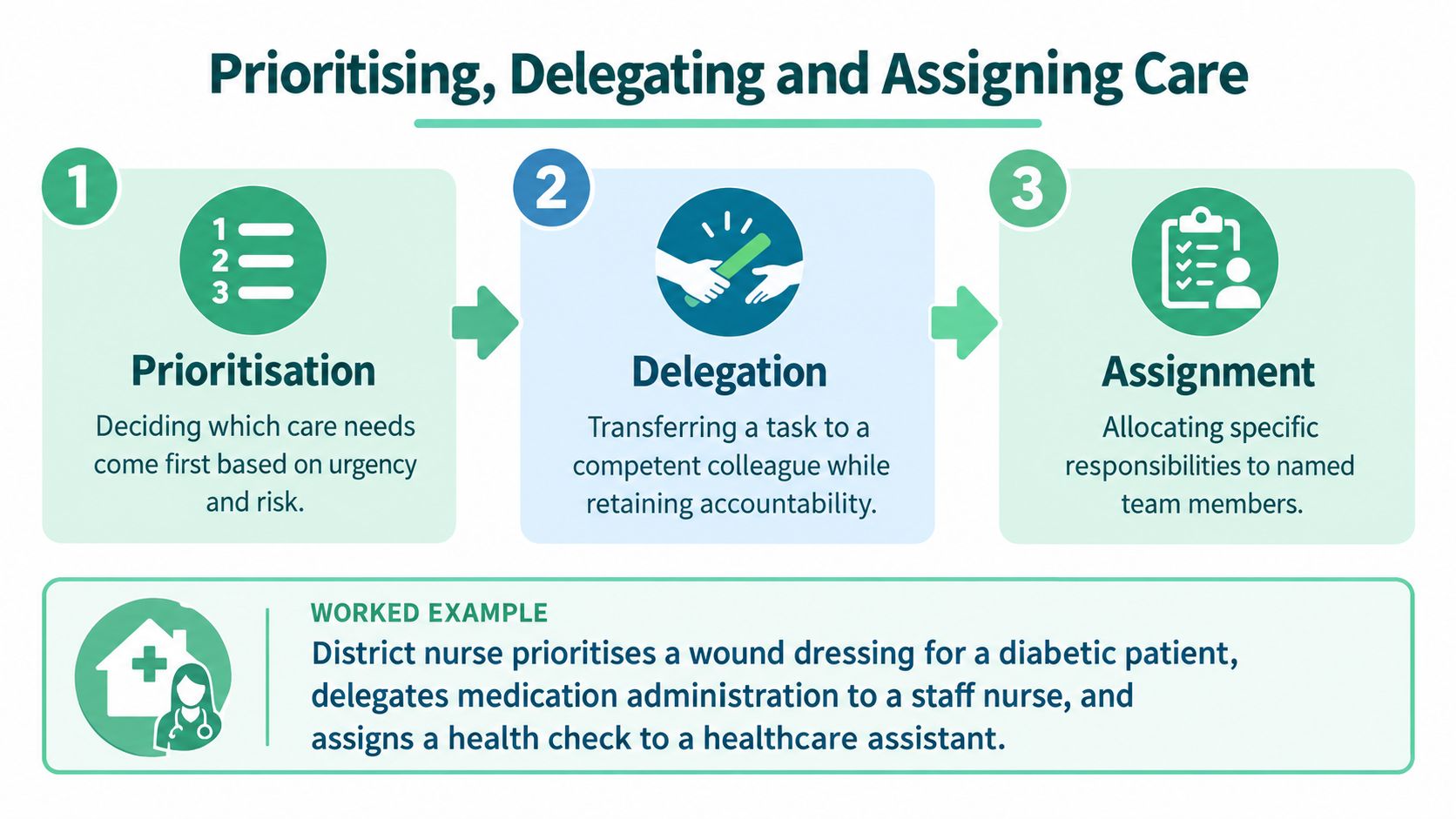
A nurse might delegate a suitable task to a Staff Nurse and assign another responsibility to a Healthcare Assistant, if it's within that person's role and competence. The nurse should explain the expected outcome, what to report and when to escalate. Asking the colleague to repeat the plan back can confirm that the instruction is clear. Delegation is not just passing work on and assuming it's been completed.
Before the shift gets busy, check: Which care needs are most urgent? Who is competent and authorised to carry out each task? What changes need immediate escalation? When will the plan be reviewed?
A short safety huddle or handover can make the allocation visible to the team. Reassessment matters too, since a patient's needs or the team's capacity may change. Stonebridge's Access to Higher Education Diploma (Nursing) offers learners a route to build the academic foundations for further study, including the reflective thinking needed to understand safe decision-making.
Communicating clearly across the multidisciplinary team
A patient becomes more unwell, and the nurse needs to share concerns with colleagues involved in their care. A rushed message such as “the patient's worse” doesn't tell the team what has changed or what response is needed. Clear communication turns a concern into useful information for shared decisions.
The NMC Code expects nurses to use language people can understand, take reasonable steps to meet communication needs, and check understanding to help reduce mistakes (NMC Code). In a handover, the nurse can describe the patient's situation, relevant background, current assessment and recommended action. SBAR, meaning Situation, Background, Assessment and Recommendation, offers a simple structure for organising that message.
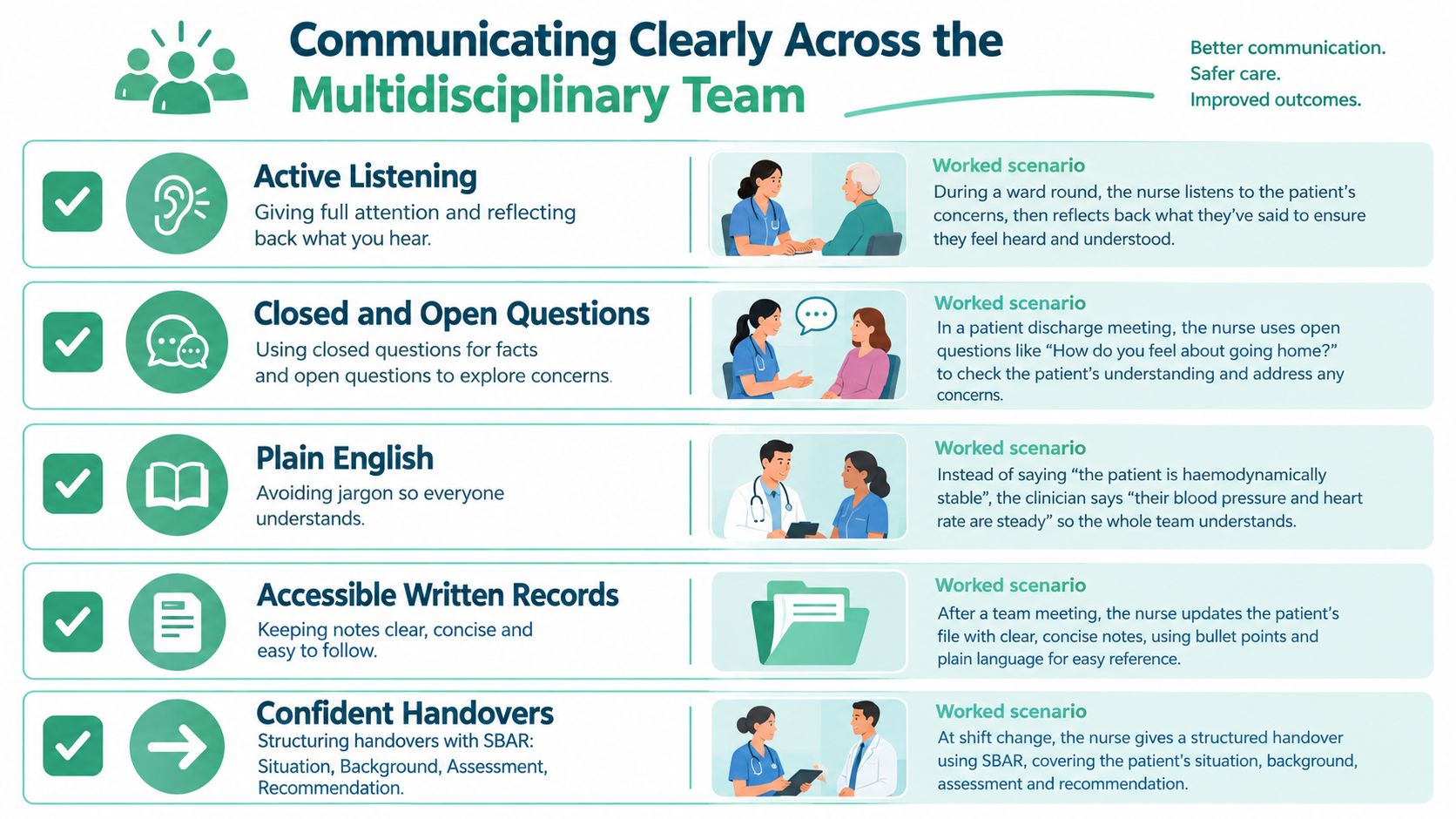
The nurse should listen to colleagues' questions, use plain English and make the recommendation specific. Open questions can help explore a patient's concerns; closed questions can confirm a fact or action. Clear, accurate records support continuity when team members aren't together, while verbal handover gives colleagues a chance to clarify what they've heard.
Communication is a leadership action because it helps people understand the risk, their role and what to do next. It also needs to adapt to the person receiving the information. A patient may need a different explanation from a clinician, and language or cultural needs may affect how information is understood.
Before your next placement task or written assignment, consider: Do you check what the other person has understood, or assume your message was clear?
Leading when staffing and pressure are stretched
Leadership can't make an unsafe staffing situation safe by asking people to be more resilient. The Royal College of Nursing's 2026 UK survey found that 64% of respondents considered staffing below or well below what was needed, and 76% felt emotionally exhausted on their last shift. The same report says 44% felt care had been compromised on that shift (RCN staffing survey).
The nurse in charge still has actions available, even when they can't personally fix staffing levels. They can bring the team together for an inclusive safety huddle, review patient needs and redistribute work fairly. They can document the risks, use the appropriate escalation routes and invite staff to speak up without blame. These actions don't remove the underlying shortage, but they help make risks visible and support decisions based on the situation as it is.
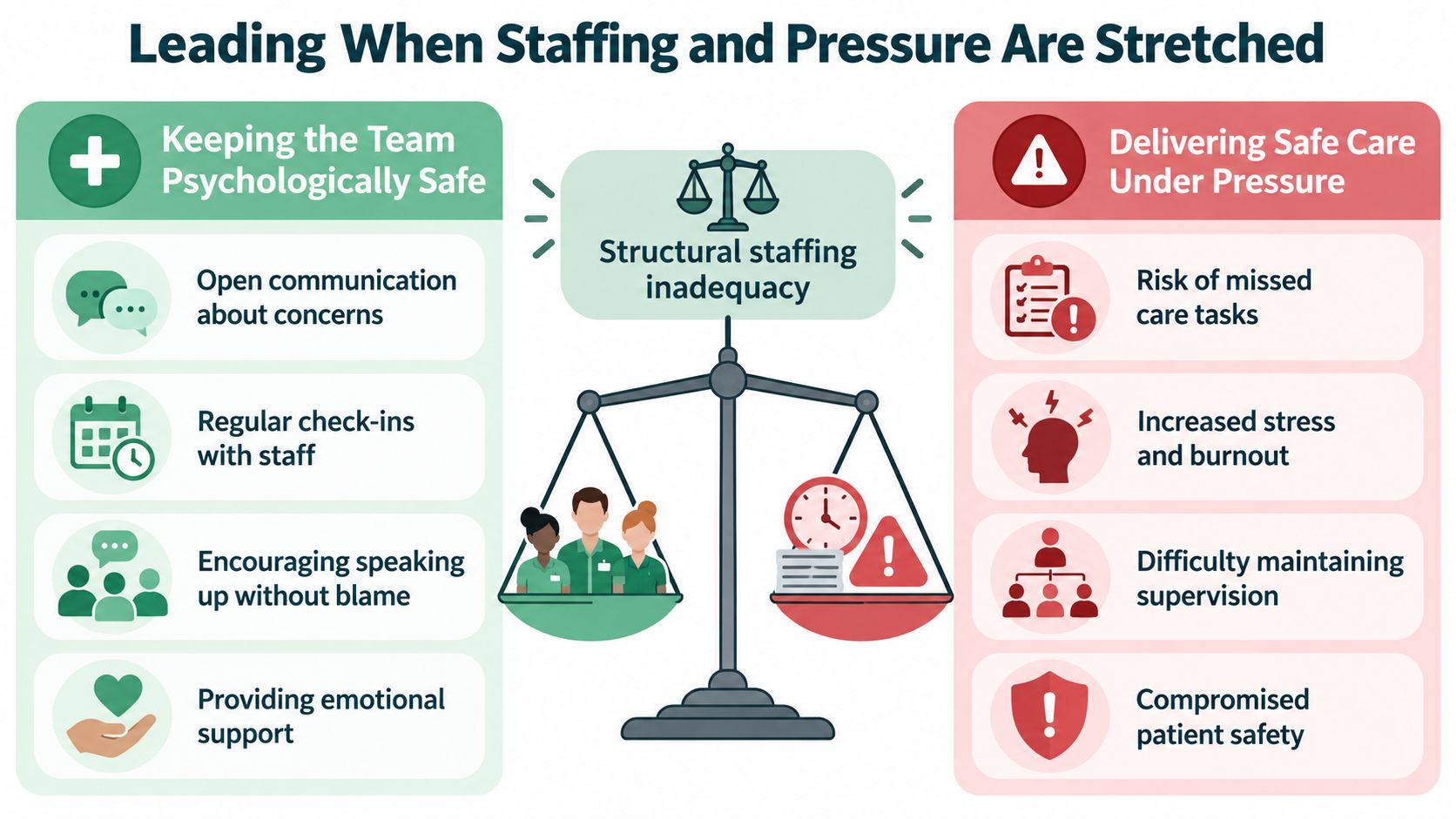
A UK study of community nursing teams found that around 60% reported missed care. Permanent-staff capacity, caseload size, registered-nurse numbers and overtime were identified as significant predictors; longer hours used to absorb backlogs were associated with compromised or suboptimal care (study of understaffing and missed community care). The lesson for leaders is to treat missed care, workload and staffing as connected risks, rather than assuming overtime can absorb pressure without consequences.
Accountable leadership isn't heroic coping. Staff should be able to raise concerns and receive a clear response, even when the wider problem needs escalation beyond the ward or service.
Learning to reflect on these dilemmas can help you examine what a nurse can control, what must be reported and how to protect team voice. The NMC also frames leadership as supporting people to speak up and creating inclusive workplaces, not keeping tasks moving.
Building a career through Stonebridge and the learndirect community
Leadership, management and team working are part of everyday nursing practice, and they develop through study, experience and reflection. Understanding how to communicate, take responsibility and work with others can help you prepare for the demands of further learning and, later, professional practice.
Stonebridge Associated Colleges offers an Access to Higher Education Diploma (Nursing) for learners preparing for higher education. Study is 100% online, with qualified tutor support and a subscription that can be paused or cancelled at any time, without a long-term credit agreement. The course page explains its qualification, requirements, syllabus, assessment and what's included, so you can check the details against your goals and circumstances.
Flexible online study can help you fit learning around work and life commitments. The Access Diploma is a preparation route, not a guarantee of a university place or a nursing role. Read the entry requirements for your chosen degree and check how the diploma meets them before deciding.
Learners and alumni of Stonebridge Associated Colleges who are part of the learndirect Digital Group can also access the learndirect: Community Hub app. It offers discussion groups, topic communities and interactive forums where members can ask questions, share ideas and connect with others on an online learning journey.
Take time to explore the course and consider whether this route fits your next step. You can also share a question about nursing study or team leadership with your learning community.
Stonebridge Associated Colleges offers flexible, online courses with tutor support and a subscription you can pause or cancel. Explore the Access to Higher Education Diploma (Nursing) and take your next step towards higher study with Stonebridge Associated Colleges.