Most schools in England don't legally require a Level 2 Teaching Assistant qualification, but many advertise for it or expect equivalent experience. You don't necessarily need to complete Level 2 before considering Level 3.
For adult learners changing careers, the key question isn't which certificate to take. It's how to build the knowledge and classroom experience schools want.
Do you need a Level 2 teaching assistant course?
England's state-funded schools recorded 288,800 full-time-equivalent Teaching Assistant posts in 2024/25, according to the School Workforce Census. Full-time equivalent measures staffing capacity, not individual people, because some assistants work part time.
Level 2 can make sense if you're new to schools, want a manageable introduction or have been asked to train by your employer. If you already have substantial classroom experience, a higher-level qualification or workplace development could suit you better.
Teaching assistant qualification levels compared
| Level | Typical focus | Best suited to | Usual next step |
|---|---|---|---|
| Level 1 | Simple supported tasks under close supervision | People new to schools with no prior experience | Level 2 course or a first support role |
| Level 2 | Supporting learning, small groups and recording progress | Those starting a first school support role | Level 3 course or further school experience |
| Level 3 | Wider responsibilities, planning support and SEND knowledge | Learners seeking greater independence or existing assistants wanting responsibility | Higher Level Teaching Assistant roles or further study |
These are typical pathways, not a compulsory ladder. Greater independence doesn't mean taking over a Teacher's responsibilities.
What a Level 2 course covers and how you are assessed
Hampshire County Council identifies the Level 2 Certificate in Supporting Teaching and Learning as an initial qualification for classroom support. It prepares you to assist under teacher guidance, not teach independently.
Typical learning includes:
Child development and learning: Help a pupil break down a maths task without supplying the answer.
Behaviour and inclusion: Follow agreed routines and adapt support for special educational needs and disabilities (SEND).
Safeguarding and communication: Recognise concerns, report them appropriately and protect confidential information.
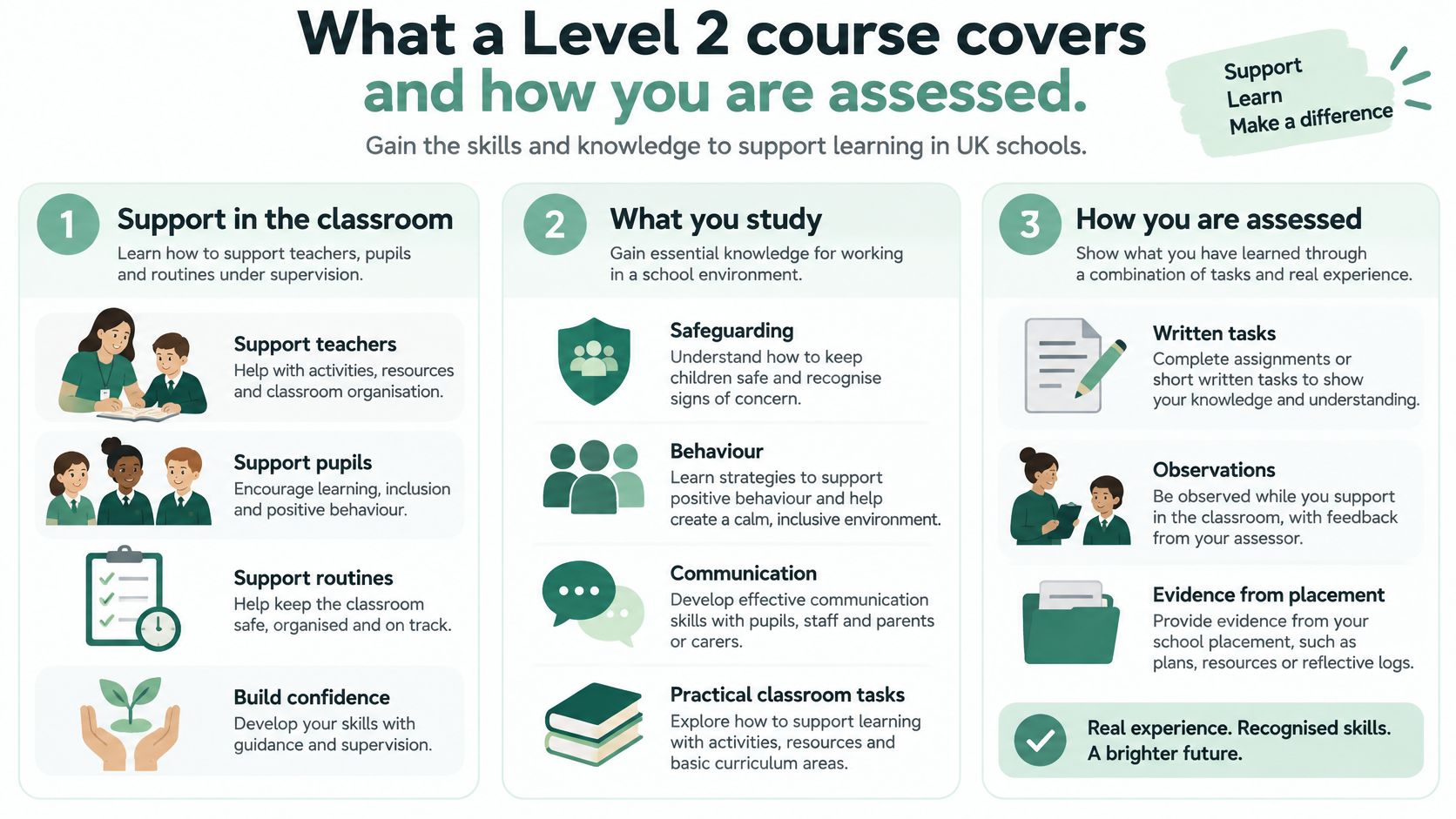
Assessment depends on the exact qualification. Knowledge-based awards and workplace-assessed certificates aren't interchangeable. Practical evidence might include a supervised support plan, progress record and safeguarding reflection.
A written answer can show what you understand. Classroom observation shows how you apply it.
Entry requirements, study modes and how long it takes
Separate course entry requirements from school recruitment expectations. Read our guidance on prior qualifications and experience, then confirm the rules for your chosen qualification.
Study modes and what to check before you enrol
| Study mode | Works well if | Check before enrolling |
|---|---|---|
| 100% online distance learning | You work, have caring duties or live far from college | Tutor contact, deadlines and placement arrangements |
| Evening classroom course | You prefer face-to-face groups and fixed routines | Travel and session times |
| Blended learning | You want online and in-person sessions | Local availability and travel costs |
| Full-time college course | You can study during the day without work commitments | Flexibility around work and family |

Online learning removes travel for theory study, but any placement needs separate diary space. Base your completion plan on published deadlines, assessment requirements and school access, rather than assuming every course takes the same time.
How to choose a course and pay for it
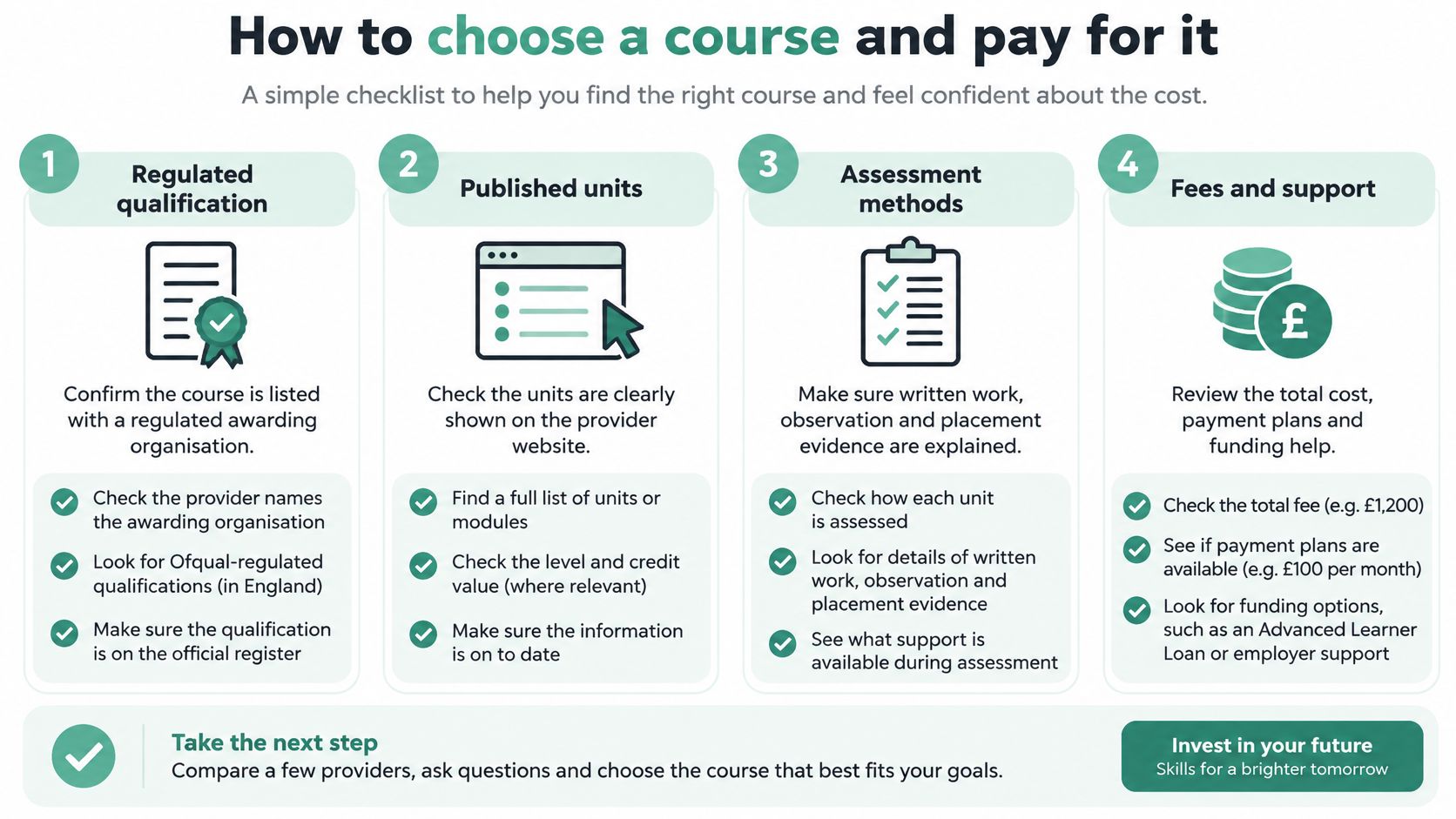
Use our guide to choosing a teaching course alongside these checks:
Qualification: Confirm the awarding organisation, regulated status and published units.
Practical evidence: Establish who arranges placement and assesses your work.
Support and progression: Check tutor availability and routes into further study.
Full cost: Include registration, certification and any additional assessment charges.
In the survey discussed by NCFE, 72% of surveyed Teaching Assistants had considered leaving. Ask about preparation for workload and SEND support, not just passing assignments.
Compare the total payable, not just an attractive monthly payment.
Check funding eligibility before paying. Online theory can develop judgement, but it can't replace supervised practice with pupils.
Common questions from adult learners
Can you study while working full time?
Yes, provided you can protect regular study time and accommodate any school-based assessment. Placement usually needs availability during the school day.
Do you need a degree?
A degree isn't normally necessary for classroom support work. Your course and prospective employer may have different entry expectations.
Will qualifying guarantee employment? No. Schools also assess suitability, references and relevant experience.
Is an online qualification recognised? Check the exact qualification and awarding organisation, rather than judging by delivery method.
What if you're nervous about returning to learning? Start with a realistic weekly routine and raise questions early instead of struggling alone.
Where Level 2 can take you and how to start online with Stonebridge
Level 2 can give you a foundation for classroom support. With experience and further training, you can explore Teaching Assistant career pathways and take on greater responsibilities. A qualification can show what you have studied, while schools may also look for practical experience and suitability for the role.
Stonebridge's Level 3 Diploma in Supporting Teaching and Learning is designed for people entering the profession at Level 3 and Teaching Assistants at Level 1 or 2 who want to progress. You study online with course materials, a study guide, tutor and admin support. Practical workplace assessment is also included.
The subscription option lets learners pause or cancel without a long-term credit agreement. Check the payment terms that apply before enrolling.
Which setting interests you most: early years, primary, secondary or specialist support? Visit Stonebridge Associated Colleges to explore your options and choose a starting point that fits your experience and commitments.