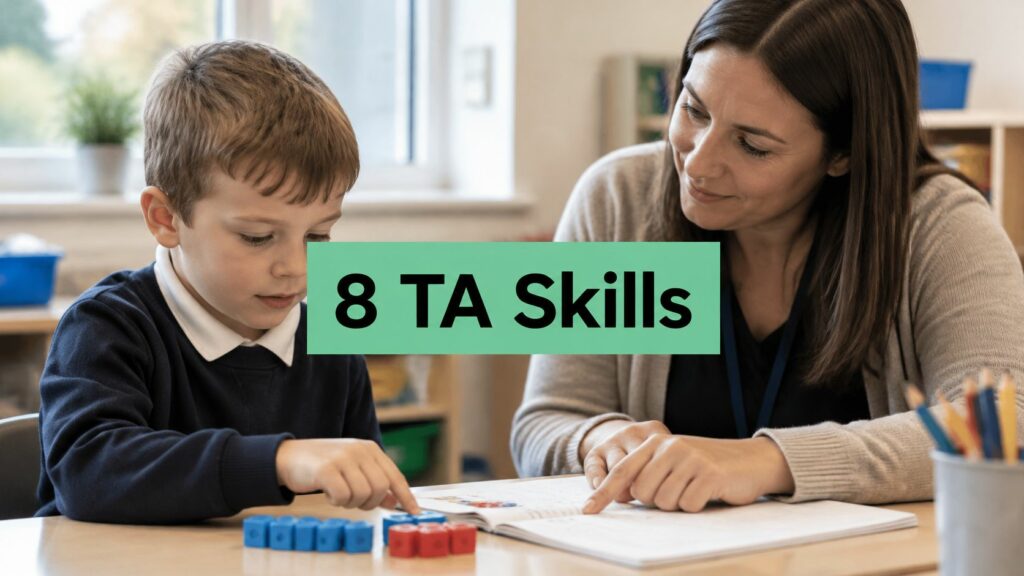
You're watching a Year 2 pupil stare at a maths sheet. The page is full, the rest of the class is working, and this one child doesn't know where to begin. The teacher is busy, so the Teaching Assistant pulls up a chair, asks what the first question is asking, and breaks it into one small step. A few minutes later, the pupil is working without help.
That moment looks simple. It isn't the product of patience alone. It depends on clear communication, good timing, careful observation and knowing when to step back. It also shows why the list of teaching assistant skills required in schools goes well beyond being kind and reliable, although those qualities still count.
The workforce is large, too. The 2024/25 School Workforce Census recorded approximately 288,800 teaching assistants, up from 221,500 in 2011/12. Around 69% worked in primary schools, 16% in secondary schools, and 15% in special schools or state-funded alternative provision. That spread means schools need people who can support early literacy and numeracy, adapt explanations, notice barriers to learning and work closely with teachers.
You don't need to arrive already polished. Each skill below can be practised, noticed in yourself and evidenced in a working day. Start with the habits, then build the knowledge around them.
1. Clear communication and active listening
A pupil looks lost during a maths task. Repeating the written question louder won't help. A skilled Teaching Assistant changes the route in, perhaps by using counters, a number line or a real object from the table to show what the question means. Then they check understanding with a small prompt, such as asking the pupil to explain the first step back in their own words.
Making instructions easier to follow
Break tasks into short steps and give one at a time. Long instructions are easy to forget, especially for younger pupils or children who are anxious. Point to the part of the page you're talking about, keep your language close to the language the teacher has used, and avoid introducing a different method unless you've checked first. Consistency stops pupils having to learn the task and a new explanation at the same time.
Listening needs the same care. Let a pupil, parent or colleague finish before you reply. A child who says a task is boring may mean it's too hard, too easy or hard to read. You won't know which until you ask and pause for the answer. With parents, pass concerns to the teacher rather than trying to solve sensitive issues at the classroom door.
Keep useful phrases handy: Note the prompts that work well with particular pupils, so you can use them again.
Check, don't assume: Ask the pupil to show you the first step before you move away.
Stay aligned: Use the teacher's key vocabulary and routines wherever possible.
Small adjustments like these help pupils ask questions without embarrassment and keep the whole team working from the same plan.
2. Behaviour management and building positive relationships
Good behaviour usually grows from relationships and consistent routines, not from the loudest voice in the room. Pupils settle better when they know what is expected, what happens next and that the adult supporting them will respond in the same calm way each time. As a Teaching Assistant, you'll often work with the pupil who finds settling hardest, so your tone and timing carry a lot of weight.
Say a pupil struggles to stay seated during writing. You and the class teacher agree a simple reward card, with praise for each short period of focused work. The target stays realistic, the praise is specific, and the child can see progress building. You're not ignoring the wobbling and wandering. You're making the desired behaviour easier to notice and repeat.
Warmth only works when it sits inside the school's behaviour policy. Agree the plan with the class teacher before you begin with a new pupil. Use the same warnings, choices and consequences as everyone else, and avoid private deals that other staff can't maintain. You can read more practical approaches in our guide to ways Teaching Assistants can help improve classroom behaviour.
Calm is a skill you can prepare for. Decide your words, your position in the room and your exit route before a lesson you expect to be tricky.
After a difficult session, take a few minutes to note what helped, what made things worse and what you'd try earlier next time. That short reflection often improves the next day more than a completely new strategy would.
3. Awareness of special educational needs and disabilities
Many Teaching Assistants work closely with pupils who have special educational needs and disabilities, often described as SEND. Empathy helps, but it isn't enough on its own. You need to recognise barriers to learning, adapt communication, follow the pupil's support plan and know when a concern needs to go to the Special Educational Needs Co-ordinator, usually called the SENCo.
The Education Endowment Foundation's updated Teaching Assistant guidance reports that many TAs support the growing cohort of pupils with SEND, including pupils with higher levels of need. It stresses that support should remain targeted, time-limited and designed to improve access to classroom teaching and independence. In plain terms, you should help the pupil join the lesson, not become a permanent one-to-one substitute teacher sitting apart from everyone else.
Supporting access without creating dependence
Say a pupil with dyslexia is finding a busy morning hard to follow. A visual timetable shows what is coming next, and a coloured overlay makes the text easier to track. You sit nearby at the start, prompt the first step, then step back so the pupil works alongside classmates. The supports reduce the barrier. They don't remove the learning.
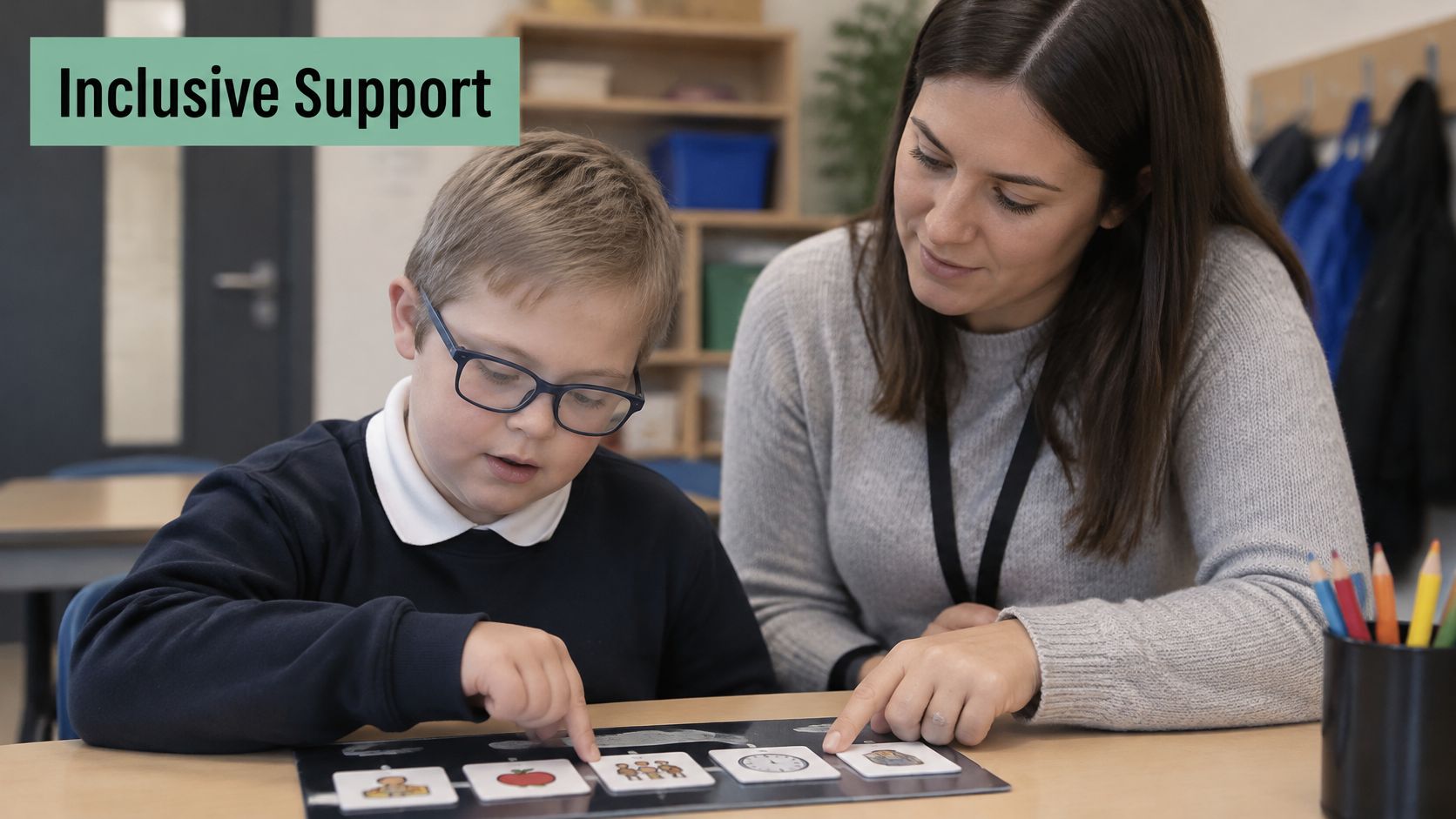
Ask the SENCo to explain any support plan you don't understand, and record small wins so the teacher can see what is changing. If a child's needs go beyond your training, say so and escalate. Improvising specialist provision can look caring, but it can also delay the right help. Our overview of courses for Teaching Assistants in special educational needs shows how structured training builds this side of the role.
4. Subject knowledge and curriculum awareness
You don't need to be a subject specialist to support a lesson well. You do need to know what the teacher is trying to teach, which ideas are new and where pupils commonly get stuck. Without that, it's easy to give an answer, use a different method from the teacher or miss the misunderstanding sitting underneath a wrong response.
Read the lesson plan before the session starts. Check the learning objective, the key vocabulary and the task pupils will complete. If the lesson uses a model, diagram or worked example, look at it first and try the task yourself if you have time. You'll spot the awkward step much sooner that way.
Turning lesson knowledge into useful support
Say Year 4 is learning science vocabulary for a unit on materials. You know words such as flexible, rigid, absorbent and waterproof are part of the lesson. While pupils sort objects, you connect each word to something they can touch, such as a sponge, a ruler or a coat. The pupil isn't just copying a definition. They're linking the new word to an everyday example they can remember.
Build a topic glossary: Write plain English meanings for key terms before the unit begins.
Listen for misconceptions: Note repeated errors and pass them to the teacher straight away.
Prepare one alternative explanation: Change the example or the resource, not the learning objective.
Curriculum awareness also helps you plan ahead. If next week's maths builds on this week's times tables, you can keep that in mind during support sessions. Small bits of joined up knowledge make your help feel calm and purposeful rather than reactive.
5. Supporting literacy and numeracy interventions
Running a small intervention group is different from sitting beside a pupil and helping them finish classwork. The session has a clear focus, a short teaching sequence and a way of checking whether it's working. That structure is one of the most important teaching assistant skills required in primary schools, where early reading and number skills need frequent, careful practice.
The Education Endowment Foundation's March 2025 guidance, based on a review of more than 52 studies, found that general classroom TA deployment has, on average, no additional impact on learning outcomes. Targeted, structured interventions can improve attainment when they're implemented effectively. That distinction should shape how you work. Being busy and helpful isn't the same as improving learning.
Keeping sessions short, structured and linked to class
Say you run a phonics intervention for three pupils each morning. You follow the agreed programme, give each child turns to read and blend sounds, and record decoding accuracy in a shared tracker. Because the session happens at the same time and in the same place where possible, pupils know the routine and you lose less time settling them.
Link the work back to the classroom. Use books, words and number methods pupils will meet in lessons, and tell the teacher when a pupil is ready to move on or needs a different approach. Celebrate small improvements with the pupil, but keep the record factual. For reading support in particular, our guide to Teaching Assistant guided reading strategies and resources gives useful starting points for group sessions.
6. Observation, feedback and assessment for learning
You're often closest to the moment a pupil understands something or loses track. The teacher may be working with another group, while you notice a repeated spelling error, a confident new strategy or a child copying a partner because the first step still isn't clear. Observation turns those moments into information the teacher can act on.
Keep notes short and specific. Write what the pupil said or did, the task they were working on and any support you gave. Avoid vague comments that don't help anyone plan the next step. A note saying a pupil mixed up two spellings in independent writing is useful. A note saying they tried hard may be kind, but it doesn't tell the teacher what to teach next.
A useful test for feedback: Can the pupil use your comment in the next two minutes to improve the work in front of them?
Feedback to pupils works best when it's close to the task. Point to the part that is working, name the next small step and give them time to try it. Resist doing the correction for them. If you always fix the mistake, you get a neater page and the pupil gets less chance to learn.
Ask the teacher what format helps them most. Some prefer a shared notebook, some use a simple template, and others want a brief spoken update at the end of the lesson. Agree it once, then stick to it.
Record the support given: Independent work and heavily prompted work tell different stories.
Pass on patterns: One mistake may be a slip, while the same mistake across several days needs teaching.
Keep it factual: Separate what you observed from what you think might explain it.
This is how everyday support shapes the next lesson rather than filling today's gaps.
7. Organisation and time management
A school day rarely stays in neat blocks. You may prepare resources before registration, support phonics, supervise break, run a maths group and attend a short meeting about a pupil, all before lunch. Organisation is what stops that mix turning into a constant rush from one table to another.
Start with ten minutes reviewing your plan for the day. Check which pupils you're supporting, which resources you'll need and where you need to be if the timetable changes. Put intervention materials together in one place, with pencils, timers, word banks or number lines ready. Pupils settle faster when the session begins cleanly instead of with a search through drawers.
Say you prepare small group resources the afternoon before. The morning intervention starts on time, you can greet pupils calmly, and the full session goes on learning rather than setup. That isn't just tidiness. It protects teaching time for pupils who often have the least of it to spare.
Shared systems help, too. Keep a shared calendar or list with the class teacher for assessments, meetings, trips and deadlines. Note when a resource runs low instead of waiting until it has gone. If two tasks clash, ask which one matters most rather than trying to do both badly.
Planning for the change you know is coming
Build a small buffer into your own routine. Keep spare worksheets in the right place, know where visual supports are stored, and have a quiet task ready for a pupil who finishes early. You can't control every interruption. You can reduce the number of avoidable ones.
Good time management also protects your own workload. Finish notes soon after a session while details are fresh, and avoid taking on extra jobs in the corridor without checking what you'll drop. A calm, organised Teaching Assistant makes the room feel safer for pupils because the day looks predictable, even when it changes.
8. Safeguarding, confidentiality and professional boundaries
This is the skill area where good intentions aren't enough. You need to know your school's safeguarding procedure, recognise possible concerns and report them to the Designated Safeguarding Lead straight away. If you're unsure whether something counts as a concern, pass it on and let the designated person decide. Waiting to see if it happens again can leave a child without help.
Say a pupil repeatedly arrives hungry and tired. You record the dates, what you observed and anything the pupil said, using factual language. You don't guess about home life, question the child in detail or promise to keep information secret. You report it the same day through the school's agreed system.
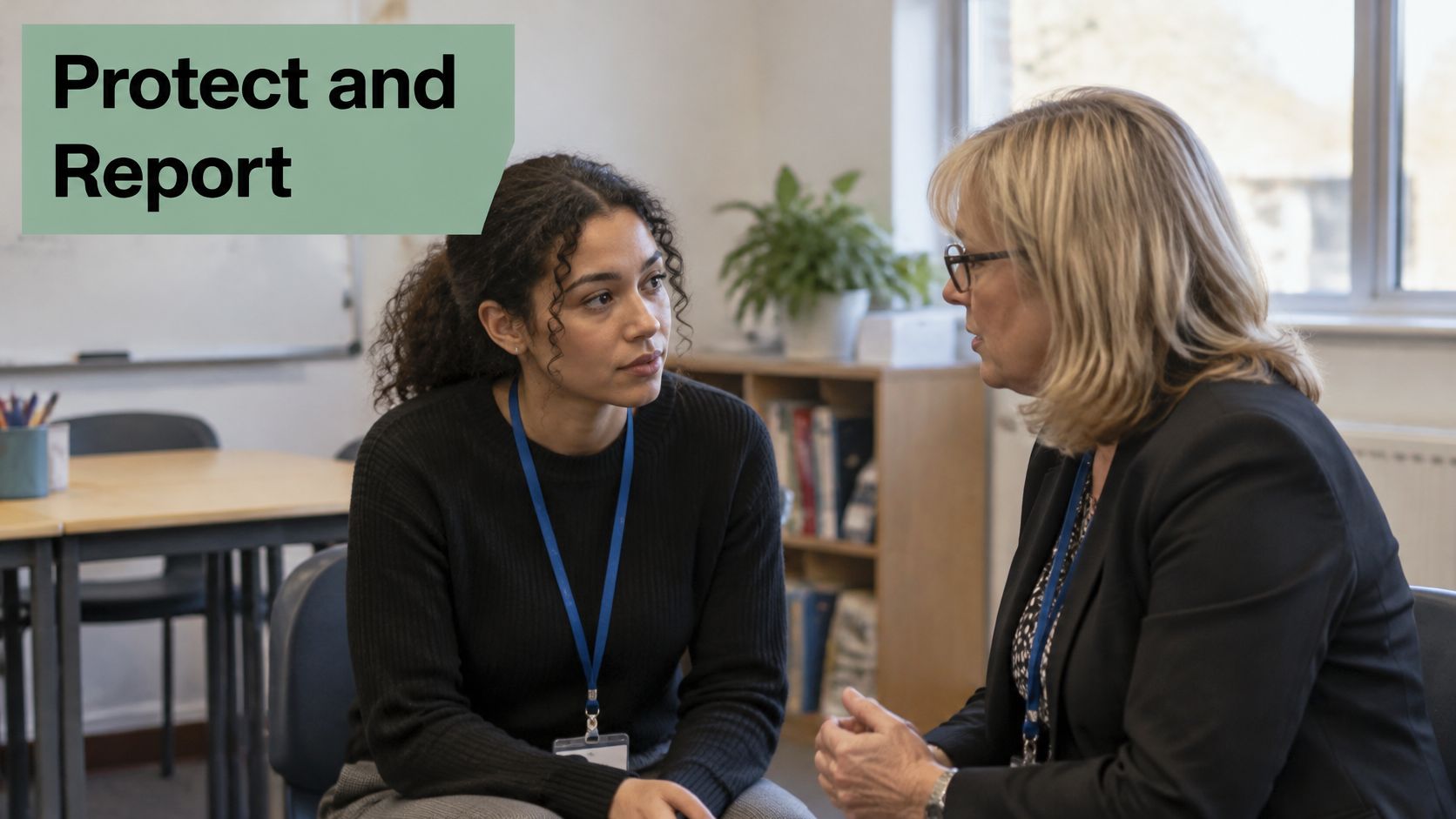
Confidentiality runs alongside safeguarding. Pupil information stays inside the professional team that needs it. Don't discuss a child in a public corridor, at the school gate or on social media. If a parent asks about another pupil, decline politely and direct them to the teacher.
Professional boundaries protect everyone. Be warm, consistent and fair, but don't become a pupil's friend, give personal contact details or keep private arrangements with families. Use school systems for communication and keep physical contact appropriate to the school's policy and the child's age and needs.
Complete safeguarding training when it's offered and refresh it regularly. Keep notes dated, factual and stored securely. In our Level 3 Diploma in Supporting Teaching and Learning (RQF), safeguarding is covered, alongside schools as organisations, positive behaviour, English and maths support and using ICT in learning. That structure helps learners connect policy to daily classroom decisions rather than treating safeguarding as a form to fill in after the event.
Teaching assistant skills at a glance
| Skill | Key feature | Main benefit | Main challenge |
|---|---|---|---|
| Clear communication and active listening | Uses plain language and checks understanding | Builds trust and reduces misunderstandings | Confidence can take time to build in difficult conversations |
| Behaviour management and building positive relationships | Sets calm, consistent expectations and praises positive behaviour | Helps pupils feel secure and reduces disruption | Can be emotionally demanding |
| Awareness of special educational needs and disabilities | Follows support plans and adapts resources | Supports pupil progress and inclusive lessons | Requires ongoing training |
| Subject knowledge and curriculum awareness | Understands lesson objectives and key subject vocabulary | Helps explain ideas and support learning across subjects | Unfamiliar topics can be challenging at short notice |
| Supporting literacy and numeracy interventions | Runs structured sessions and tracks progress | Helps close gaps in core skills | Progress can be slow |
| Observation, feedback and assessment for learning | Notices learning needs and shares actionable feedback | Guides teaching and clarifies pupils' next steps | Notes can be time-consuming without a clear format |
| Organisation and time management | Plans tasks, prepares resources and sets priorities | Reduces stress and improves reliability | Unexpected timetable changes can disrupt plans |
| Safeguarding, confidentiality and professional boundaries | Recognises concerns, reports them and handles information carefully | Keeps pupils safe and builds trust | The responsibility can feel heavy |
Build these skills and start your teaching assistant journey
None of these skills arrives finished on your first day. They grow through small, repeated habits: checking understanding instead of repeating instructions, noting what a pupil can do without prompts, preparing resources before the rush starts and reporting concerns without delay. Confidence follows evidence. When you can look back at what a pupil could not do in September and see what they manage now, you know the habit is working.
Training gives that practice shape. The Department for Education teaching assistant survey dataset distinguishes staff with and without TA qualifications, those holding HLTA qualifications, and those who had undertaken training during the year. Schools recognise those categories when they weigh up experience and readiness for responsibility. A qualification organises your judgement rather than replacing it.
Our Teaching Assistant course route is built around the Level 3 Diploma in Supporting Teaching and Learning (RQF). It is nationally recognised and designed for people entering the Teaching Assistant profession at Level 3, or progressing from a Level 1 or 2 role. You study 100% online, with full tutor support, study materials and a study guide included. Units cover the ground a working TA stands on: safeguarding children, supporting positive behaviour, supporting English and maths skills and using ICT in learning. After each lesson you submit a question paper to your personal tutor for marking, so progress is checked continually and your tutor can step in early if you need help.
The course is open if you are aged 16 or over, with no formal entry requirements, although English and Maths at Level 2 would be an advantage. You complete a placement with a suitably qualified mentor in that setting, such as the class teacher, who completes observations and witness statements. Direct observation forms part of the assessment, so the skills you build are tested in a real classroom, with real pupils.
Study works on a flexible subscription with an affordable monthly fee, and you can pause or cancel at any time without long-term credit agreements. That makes it easier to fit learning around work, family and placement hours.
If classroom support sounds like the right direction, pick one skill to focus on this month, then look at the course structure and placement requirements in detail. You can start building the habits before a job advert ever appears, and you will walk into school with clearer purpose and stronger evidence of what you can do.
Ready to build the classroom skills schools ask for, from safeguarding and SEND support to structured literacy and numeracy interventions? Study online with qualified tutor support through Stonebridge Associated Colleges, explore the Level 3 Teaching Assistant route, and take your next step towards working in a school this month.