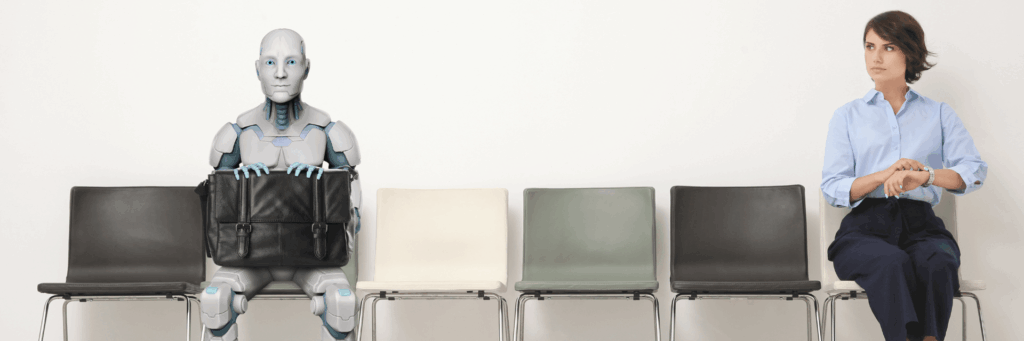
AI tools can now write emails and summarise reports in seconds. If you’re wondering whether your own job could be next, you’re not alone.
The good news is that some careers are much harder to automate than others, and they have one big thing in common. They’re built around people.
In this guide, we look at the jobs AI can’t replace, why human-centred roles are among the safest jobs from AI, and how you can train for one online with Stonebridge Associated Colleges, even if you don’t have A-Levels.
What jobs are safe from AI?
No job is completely untouched by technology. Nurses already use digital patient records and teachers use online learning platforms. But there’s a big difference between a job that uses AI and a job that AI can do on its own.
The Office for National Statistics (ONS) looked at this in its 2019 analysis of automation risk in England. It found that around 1.5 million jobs, or 7.4% of jobs in England, were at high risk of automation. Medical Practitioners and higher education teaching professionals were among the roles at the lowest risk.
More recent research points the same way. The Department for Education’s 2023 report on the impact of AI on UK jobs and training found that office-based roles in finance, consulting and professional services were the most exposed to AI. As FE Week reported, the registered nurse degree and police constable apprenticeships showed low exposure, as did hands-on trades like roofing and plastering. The report measured exposure rather than job losses, so it doesn’t predict which roles will disappear.
So, what jobs are safe from AI? Broadly, they’re the ones where you need to be in the room with people and make judgement calls you’re personally responsible for.
Why the safest jobs from AI are built around people
You’re needed in the room
A chatbot can explain how to dress a wound, but it can’t actually do it. Care, health and education roles involve hands-on work in settings that change minute by minute, whether you’re helping someone out of bed or calming a child who’s had a rough morning. That kind of unpredictable, physical work is very hard for technology to take over.
Trust and empathy can’t be coded
People going through illness or a family crisis want another person on their side. A Midwife reassuring a nervous parent or a Social Worker visiting a family in difficulty is doing work that relies on trust built face to face. Software can support that work, but it can’t replace the relationship.
Someone has to be accountable
Many human-centred careers are regulated professions. Nurses and Midwives register with the Nursing and Midwifery Council, Social Workers with Social Work England, and Radiographers with the Health and Care Professions Council. A registered professional is personally responsible for the decisions they make, and that responsibility can’t be handed over to an algorithm.
In these jobs, AI is far more likely to become a helpful assistant than a replacement. It might take some of the paperwork off your plate and give you more time with the people you’re there to support. If you’d like to understand how to use these tools well, our blog on why AI ethics is your key to business success is a good place to start.

Are AI-proof jobs in the UK actually in demand?
Being hard to automate is one thing. Being able to find work is another. Thankfully, many AI-proof jobs in the UK also have long-term demand behind them.
Adult social care is a good example. Skills for Care’s 2026 report on the size and structure of the adult social care sector and workforce in England found there were 1.59 million filled posts in 2025/26 and 96,000 vacant posts. It also estimates the sector is likely to need another 410,000 posts by 2040.
Work that’s hard to automate, paired with a need for more people, is what makes human-centred roles some of the most future-proof jobs you can train for.
Human-centred careers you can train for online
Whether you’re coming back to work after a break or changing direction completely, there’s a route into a people-focused career that fits around your life. Here’s where our online courses can take you.
Nursing, midwifery and radiography
Most healthcare professions need a degree, and that’s where our Access to Higher Education Diplomas come in. They’re designed for adults who want to go to university but don’t have the traditional qualifications to apply. You can choose the Access to Higher Education Diploma (Nursing), the Access to Higher Education Diploma (Midwifery) or the Access to Higher Education Diploma (Radiography), depending on the career you have in mind. Universities set their own entry requirements, so it’s worth checking with the ones you’d like to apply to.
Social work
Social Workers support children, families and adults through some of the hardest moments of their lives. It’s a role built on human judgement and relationships, which is why it’s so often named among the jobs AI can’t replace. The Access to Higher Education Diploma (Social Work) can help prepare you for a social work degree.
Adult care
If you’re working in adult care and want to progress, the Level 3 Diploma in Adult Care (RQF) builds the knowledge you need to take on more responsibility. Senior Care Workers and Team Leaders rely on skills no algorithm can copy, from spotting small changes in someone’s health to supporting families through difficult decisions. You can see all of our options in our health and social care courses.
Teaching and early years
Children learn best from people who know them well. Teaching Assistants and Early Years Educators spend their days supporting children’s development and wellbeing, and that takes patience and close relationships. You can study the Level 3 Diploma in Supporting Teaching and Learning (RQF) or the TQUK Level 3 Diploma for Working in the Early Years Sector (Early Years Educator). If you’re aiming for a teaching degree, the Access to Higher Education Diploma (Education Professions) is a great place to begin.
Working with animals
Animals can’t tell you what’s wrong, and they need hands-on care from someone who understands them. If you’d love to work in a veterinary practice, the Level 2 Diploma for Veterinary Nursing Assistants (RQF) is a good introduction to supporting vets and veterinary nurses.

How to move into future-proof jobs without A-Levels
Lots of adults rule themselves out of these careers because they left school without the right qualifications. That doesn’t have to hold you back. An Access to HE Diploma gives you a recognised route into university study, and you can work through it at home around your job or family.
Many degree courses also ask for English and maths at GCSE level or equivalent. If you need to brush up first, our Functional Skills English & Maths Level 2 Including Exams course is a good first step. Our guide on whether universities accept Functional Skills Level 2 explains what to check before you apply.
Still weighing up your options? Our guide to courses for career change compares the online pathways adults most often choose when they retrain.
Why study online with Stonebridge?
Changing career doesn’t mean giving up your income while you train. With Stonebridge, you study 100% online with personalised support from qualified tutors. You pay an affordable monthly subscription that you can pause or cancel at any time, with no long-term credit agreements. You’ll find fees and payment options on each course page.
You’ll also get access to the learndirect: Community Hub app, which is only for learners and alumni of the learndirect Digital Group. Inside the app, you can join topic-specific communities and take part in discussion forums where questions get answered and ideas are shared. You’ll never feel alone on your learning journey.
Frequently asked questions
What are the safest jobs from AI?
The safest jobs from AI tend to involve hands-on work with people and decisions you’re accountable for. Healthcare, social work, care, education and animal care roles all fit that description.
Will AI replace nurses and teachers?
It’s very unlikely. AI may help with tasks like record-keeping, but research from the ONS and the Department for Education suggests roles built around patient care and teaching are among the least at risk.
Can I retrain for AI-proof jobs without A-Levels?
Yes. Our Access to Higher Education Diplomas are designed for adults who want to go to university without A-Levels, and you can study them entirely online. Each university sets its own entry requirements, so check these before you enrol.
How long does it take to change career?
It depends on the course and how much time you can give it each week. Because our courses are self-paced, you can fit study around your current job. You’ll find more detail on each course page, or our advisers can talk you through it.
Ready to train for one of the jobs AI can’t replace?
Browse our Access to Higher Education Diplomas or explore the course that suits your goals above. If you’d like to talk it through, call our friendly course advisers on 0121 392 8288 or send us an enquiry. The jobs AI can’t replace are waiting for people like you, and your next step could start today.