Does a Level 3 teaching assistant course teach you to teach a class, or to support one? Many who arrive at this question assume the two are almost the same. They aren't, and the difference shapes what you study, where you study it, and what a school asks you to do on your first morning.
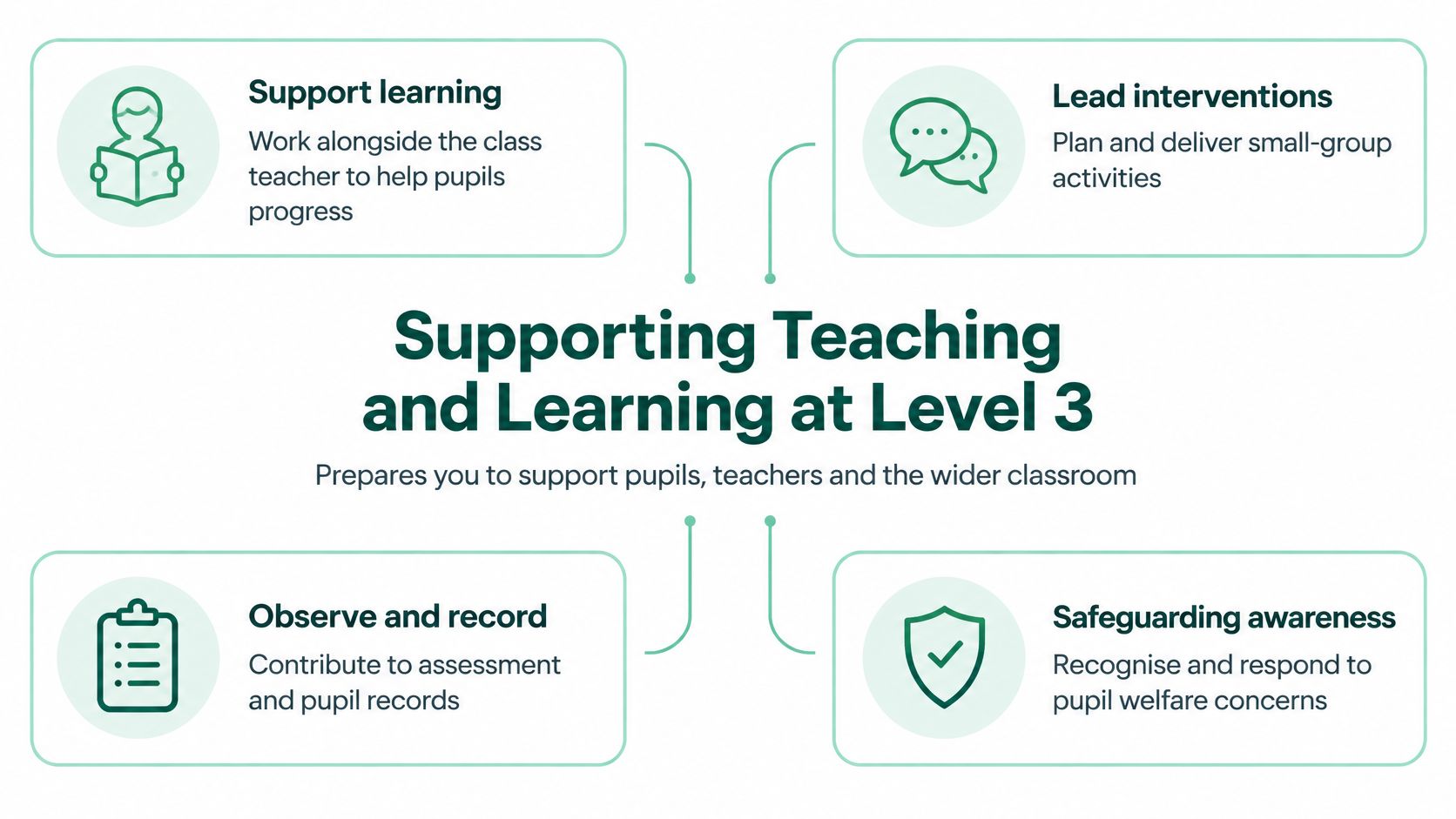
A Level 3 teaching assistant course prepares you to work alongside a Teacher rather than in place of one. You support children and young people in class, run activities the Teacher has planned, watch how pupils respond, and report back so the teaching can be adjusted. It doesn't give you qualified teacher status, and it isn't a degree.
This guide is for adult learners comparing options, whether you're starting out or already working as a Teaching Assistant at Level 1 or 2 and want more responsibility. It covers what the course helps you do, who it suits, the topics you'll meet, how you're assessed in a real setting, and how far a general Level 3 award reaches into specialist SEND work.
What a Level 3 teaching assistant course can help you do
Say you're in a Year 4 classroom on a Tuesday morning. The Teacher has set a reading task on a two-page spread about volcanoes. One pupil has read half a page and is losing focus. You sit beside them, cover the second paragraph with a sheet of paper, and ask one question at a time. Twenty minutes later they've finished and can tell you two facts about lava.
That's the work. Our Level 3 Diploma in Supporting Teaching and Learning (RQF) is built around it. You study the knowledge online with tutor support, then show the practical side in a real school or college. There's no single final exam at the end.
Where the role sits in England's schools
Teaching assistants aren't a marginal part of the school workforce. The government's School workforce in England 2025 statistics report 295,200 full-time-equivalent teaching assistants in 2025/26. That's 6,200 more than the previous year and 73,200 more than the 221,500 recorded in 2011/12, when support staff were first counted through the school workforce census. The overall rise is around 33%.
Where they work tells you how transferable the training needs to be. 63% work in nursery and primary schools, 18% in secondary schools, and 18% in special schools or pupil referral units. Those figures cover England rather than every UK nation, so read them as the shape of the job rather than a local headcount.
What Level 3 does not do: it doesn't make you a qualified Teacher, and it doesn't replace a school's own induction, safeguarding training or the direction of the class Teacher.
If you're already qualified at this level and want to cover classes and lead interventions, our guide on how to train for Level 4 higher level teaching assistant roles sets out what changes at the next stage.
Who a Level 3 course suits and what to check first
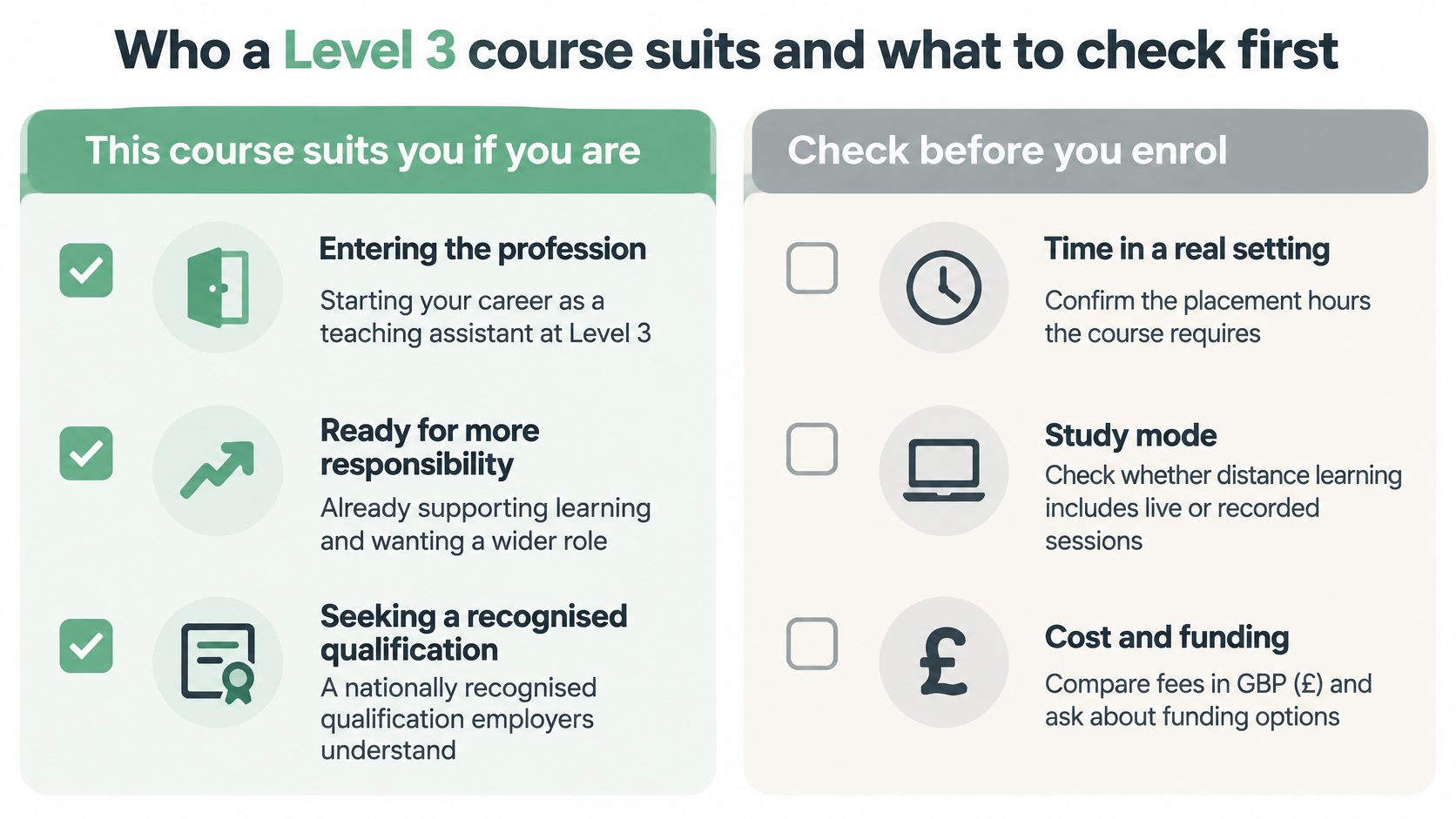
Two readers tend to land on this page. One is entering the Teaching Assistant profession and wants a qualification schools recognise. The other already supports learning at Level 1 or 2 and wants a wider role, more responsibility and a clearer route onward. Our diploma is designed for both.
Supporting Teaching and Learning isn't an informal short course with a certificate at the end. The UK Government's Register of Regulated Qualifications lists Level 3 qualifications in the subject, including the NCFE CACHE Level 3 Certificate and Diploma, and files the subject area as "Direct learning support."
That filing is the clue. These awards sit with practical work supporting pupils in a classroom, not with qualified teacher status. The register also records Level 3 qualifications in the same area previously offered by awarding organisations such as City & Guilds, Pearson Edexcel, OCR, IAO and TQUK.
Four checks before you enrol
Because the same title has moved between awarding bodies over the years, do a little checking first. It takes ten minutes.
The exact title and qualification number. Write both down. A course described loosely as a "Level 3 teaching assistant diploma" tells you very little until the qualification number matches a live entry.
The awarding organisation. Confirm who will issue your certificate, and confirm they are the body named on the register entry.
Approval status. The register separates approved qualifications from archived ones. An older Level 3 title shouldn't be assumed to still be current.
The placement requirement. Competence is shown in a school or college, so check how much time you need and who will observe you.
Then there's the practical fit. English and maths at Level 2 or above help, even where no formal academic bar is set, because the job itself includes supporting those skills in pupils. Our qualification is nationally recognised and supports learners starting or progressing in their career as a Teaching Assistant.
If you're still unsure whether a qualification is expected at all, our guide on whether you need qualifications to be a teaching assistant answers that one directly.
The duties and topics a Level 3 course covers
The Teaching Assistant Level 3 occupational standard calls the role an evidence-informed support function. That phrase is doing real work. You don't invent the learning. You apply teaching strategies inside activities the Teacher has planned, then feed evidence back so the Teacher can adjust what happens next.
The four terms that trip people up
Course pages throw these around without explaining them. They mean this in a classroom.
Formative assessment means checking understanding while the lesson is still running and passing that evidence to the Teacher. It isn't a test at the end of the topic. Scaffolding is temporary help that comes away as the pupil manages more alone, such as a writing frame or a prompt card. Safeguarding means acting to keep a child safe and passing concerns to the right person in school, usually the Designated Safeguarding Lead. Prevent is the part of safeguarding that covers radicalisation.
Open questioning belongs with them. An open question invites more than a yes or a no, which is how you find out what a pupil has understood rather than what they can guess.
The duties, and what stays with the Teacher
| Workplace duty | What you learn to do | What stays with the Teacher |
|---|---|---|
| Learning activities | Apply teaching strategies in planned activities or interventions | Planning the lesson and leading the teaching |
| Adapting learning | Adapt resources and communication, using scaffolding and open questions | Curriculum choices and learning targets |
| Behaviour | Apply the school's behaviour-management strategies | Behaviour policy and decisions on sanctions |
| Formative assessment | Observe, record evidence and report it through school procedures | Using that evidence to change teaching |
| Safeguarding and wellbeing | Follow safeguarding, Prevent, health and safety and wellbeing procedures | Decisions made by the Designated Safeguarding Lead |
| Technology | Use current technology safely to support learning | School systems, accounts and data rules |
A school day, duty by duty
In a reading activity you might simplify a worksheet, offer one prompt, note who coped with which part, and tell the Teacher before the next group arrives. In a practical science task you'd model a single step and then step back so the pupil tries it themselves. During group work you'd spot the pupil who has gone quiet and check in, without turning it into a public correction.
The cause and effect runs both ways. When you observe performance, record evidence and report it through school procedures, the Teacher can refine instruction and target support. When you adapt a resource or change how you speak, a pupil reaches the same curriculum with fewer barriers in the way.
The boundary to hold on to: you support planned learning. You don't replace the Teacher, and you don't rewrite the lesson plan on your own judgement.
The topics behind the duties
Knowledge study for this kind of qualification works through how schools and colleges are organised, safeguarding children, supporting positive behaviour, supporting English and maths skills, and using ICT in learning. It also covers supporting speech, language and communication, including for bilingual learners, and practical classroom help for special educational needs and disabilities.
Our Level 3 Diploma in Supporting Teaching and Learning (RQF) covers that ground and includes a placement of at least 50 hours, spread across your study.
In 2024, teaching assistants represented 239,000 workers in occupations identified as in demand in England, according to the Department for Education's occupations-in-demand statistics. The same core duties apply whether you're in a primary classroom, a secondary department or a special school. Safeguarding, inclusion, behaviour, assessment and professional boundaries don't change with the age of the pupil.
How you are assessed in a real setting
This qualification is shown in practice. Hold on to that if you're weighing up online study and wondering how a screen can judge classroom skill. It can't, so it doesn't try. The knowledge is studied online and the competence is evidenced where pupils are, in a real school or college.
The assessment route looks like this from start to finish.
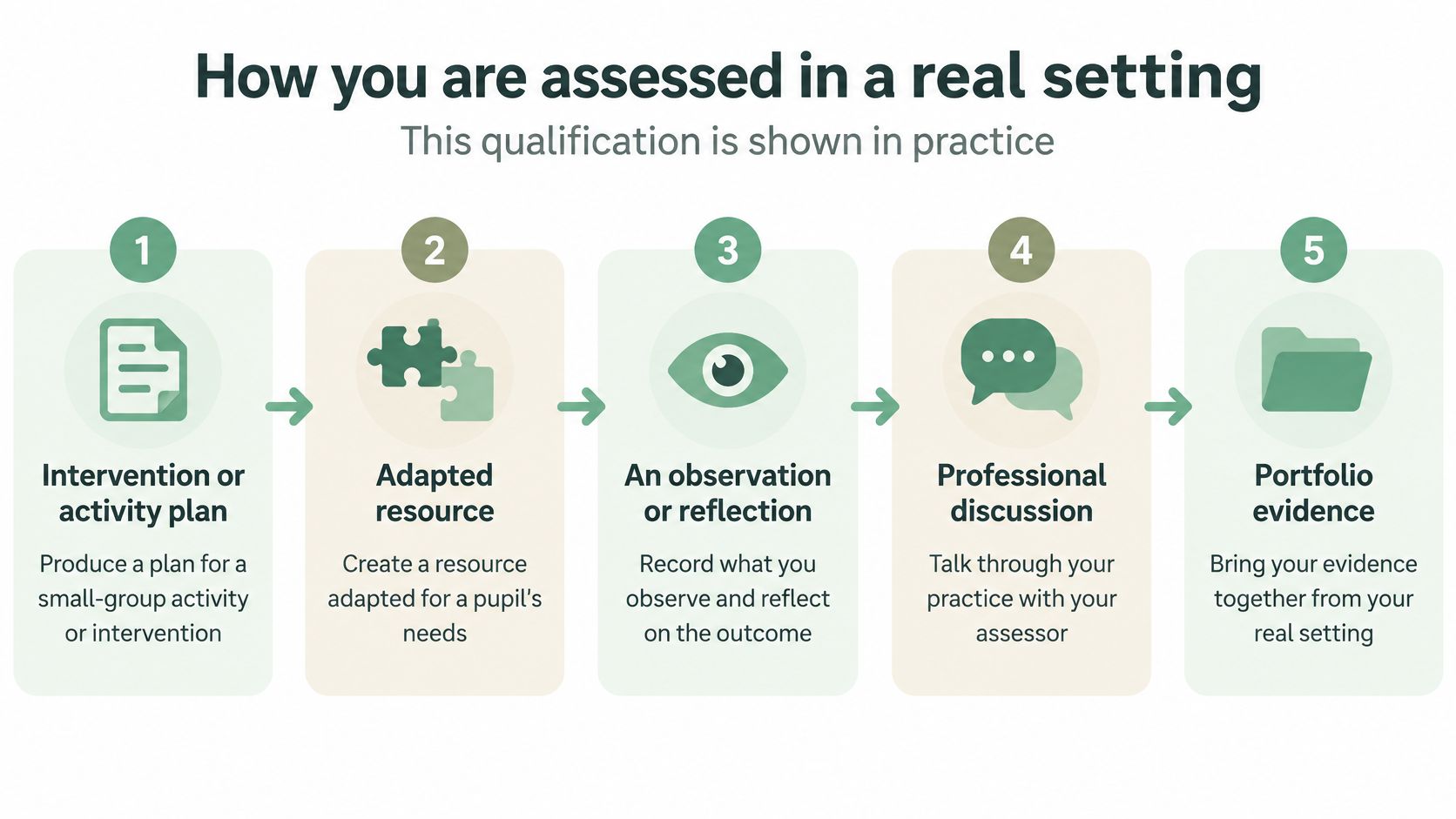
What each piece of evidence proves
| Evidence you produce | What it proves | Where it comes from |
|---|---|---|
| Intervention or activity plan | You can support a planned learning activity | Placement, agreed with the Teacher |
| Adapted resource | You can reduce a barrier for an individual learner | Prepared around a real activity |
| Observation record | You can report what you saw through school procedures | Noted during the activity |
| Formative assessment evidence | You can check understanding and pass it to the Teacher | Taken during the lesson |
| Reflective evaluation | You can link your actions to school policy | Written after the activity |
One placement sequence, step by step
Agree the activity with the Teacher. Know what the learning intention is before you sit down with a pupil.
Prepare the adapted resource. Cover a paragraph. Add a word bank. Reduce the number of instructions on the page.
Support the pupil. Prompt, pause, let them try, prompt again.
Record what happened. Write what you saw, not what you assume the pupil felt.
Submit the set to your tutor. Plan, resource, observation, formative notes and a short reflection.
Direct observation is part of how the qualification is judged. A suitably qualified person watches you work in your setting, and you'll need a mentor there, usually the class Teacher, who is willing to complete observations and witness statements.
This video walks through what studying with us looks like in practice.
The course combines online study with practical learning, giving you the skills to support children and young people in a classroom without going to university for this diploma. The same evidence set you build on placement is everyday support work. The next question is how far that everyday support reaches into specialist SEND territory.
Classroom support and the limits of SEND preparation
Does a general Level 3 course prepare you for special educational needs and disabilities, or mainly for classroom support? Course pages rarely answer this, so here's the split.
Picture a primary literacy group. One pupil needs longer to process an instruction. You simplify the wording, give one step at a time, and afterwards tell the Teacher which prompt worked and which one didn't. Now picture a secondary lesson where a pupil is using a laptop. You keep them on the task the Teacher set, and you note the exact point where the work stalled so the Teacher can see it.
That is what SEND support looks like at this level. You adapt one activity, use clearer language, keep a routine steady, and record what helped. You're not diagnosing anything or designing a curriculum.
Where a general diploma stops: it gives you a strong start in inclusive classroom support. It doesn't replace school induction, advice from the Teacher or the Special Educational Needs Coordinator (SENCO), or later specialist development.
The pressure is real. Support staff make up more than half of England's school workforce, and government research cited by Skills England's occupation record for teaching assistants found that 24% report they cannot manage their current workload. Autism, trauma, social, emotional and mental health needs, English as an additional language and education, health and care plans can all be complex.
That's why specialist routes now exist. A separate Level 3 technical occupational qualification focused on teaching assistants and SEND was approved for funding from 1 August 2025. If you want the broad classroom role first and specialist skill later, start with the general diploma and build the specialist knowledge in the school that employs you. Our guide to courses for teaching assistants in special educational needs compares those routes.
Study the Level 3 diploma online with Stonebridge
Our Level 3 Diploma in Supporting Teaching and Learning (RQF) is for people entering the profession at Level 3 and for Teaching Assistants at Level 1 or 2 who want more responsibility. You can start from age 16 with no formal entry requirements, though English and maths at Level 2 or higher would be an advantage.
Study is 100% online with personalised tutor support, and you still complete your placement in a real setting so the qualification stays practical.
Once you're enrolled, learners and alumni of Stonebridge Associated Colleges can use the learndirect Community Hub app. It gives you discussion groups and topic-specific forums, so questions get answered by people working through the same units rather than left sitting.
Open the course page and read each tab properly: description, qualification, requirements, syllabus, assessment and what's included. When the fit is right, enrol.
If you're ready to turn classroom support into a recognised qualification, Stonebridge Associated Colleges offers a Level 3 Diploma in Supporting Teaching and Learning (RQF) that you can study entirely online, with tutor support and a placement in a real school. It's built for new entrants and for Teaching Assistants at Level 1 or 2 who want more responsibility, and you can pay in full or through an annual subscription you can pause or cancel. Visit Stonebridge Associated Colleges to compare the course details and start when the timing suits you.